


Lebanon Not Bound by US Sanctions, No Action Against Officers Yet

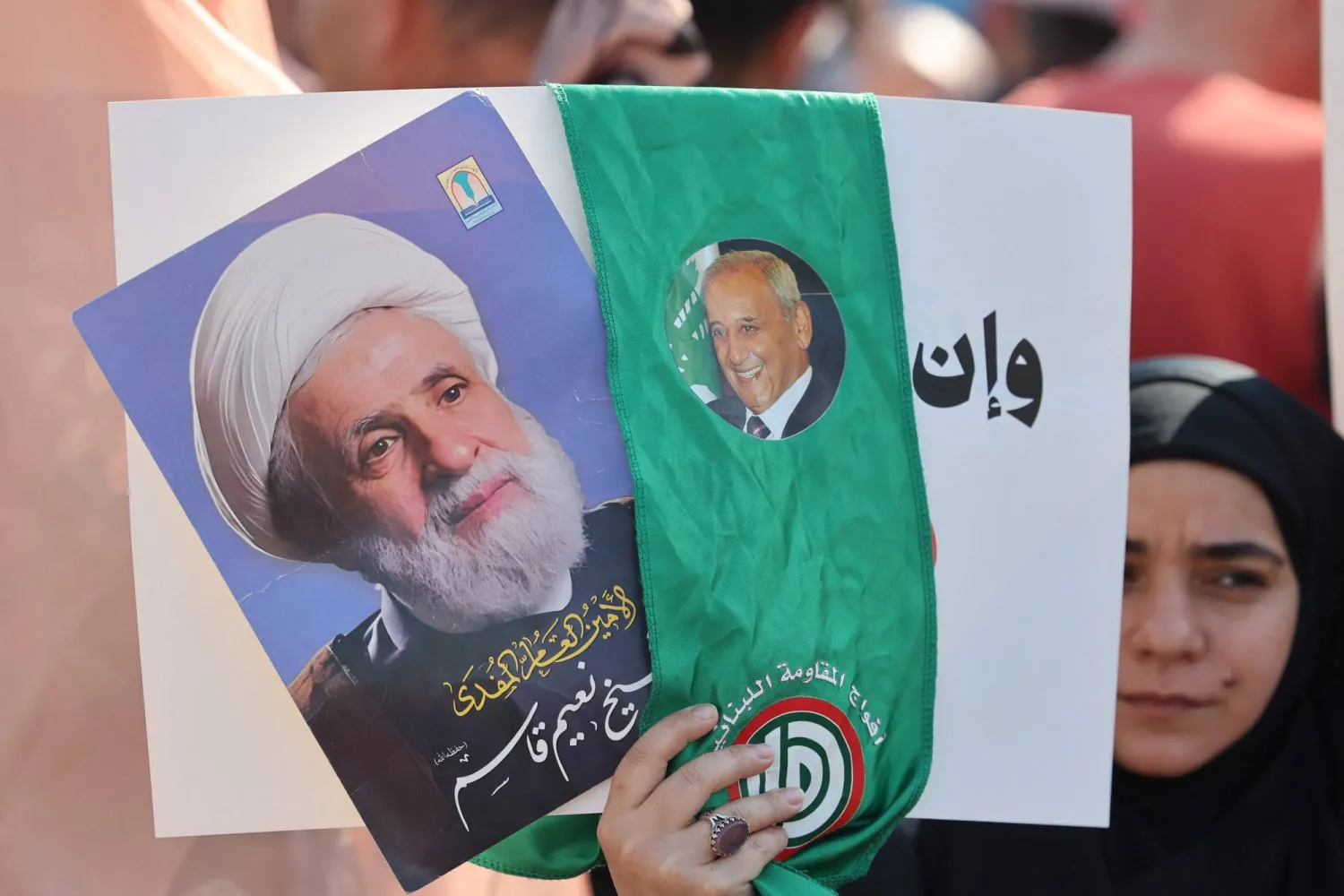
A woman holds pictures of Lebanese parliament Speaker Nabih Berri (R) and Hezbollah's leader Naim Qassem (L) while residents of the devastated southern Lebanese border villages protest against the destruction of their villages and being prevented from returning by order of the Israeli army, at Martyrs’ Square in central Beirut on April 30, 2026. (AFP)
TT

Lebanon Not Bound by US Sanctions, No Action Against Officers Yet

A woman holds pictures of Lebanese parliament Speaker Nabih Berri (R) and Hezbollah's leader Naim Qassem (L) while residents of the devastated southern Lebanese border villages protest against the destruction of their villages and being prevented from returning by order of the Israeli army, at Martyrs’ Square in central Beirut on April 30, 2026. (AFP)

Attention in Lebanon is turning to how the state will respond to unprecedented US sanctions that targeted two officers from the army and General Security, along with figures, including MPs, from Hezbollah and its ally the Amal Movement that is headed by parliament Speaker Nabih Berri.

Although Lebanon is not legally bound to comply with the decision, and no direct measures have so far been taken against the two targeted officers, Interior Minister Ahmad al-Hajjar said he had asked General Security Director General Maj. Gen. Hassan Choucair to investigate any violations, if any exist, and take the necessary measures.

No measures yet

Security sources said what was surprising was that the army and General Security had not been notified of the sanctions through official and legal channels, as both commands learned of the measures through statements and the media.

The sources asked: “As long as Col. Samir Hamadeh is the head of the Beirut southern suburbs branch at the Lebanese army’s Intelligence Directorate, who is he supposed to coordinate with on the ground in the southern suburbs?”

They explained that intelligence coordinates with other parties in other areas, while also dismissing as “misguided” claims that significant intelligence was being shared with Hezbollah.

“So far, no measures have been taken against them, and they are still carrying out their duties,” they added.

The US Treasury accuses the two officers of sharing significant intelligence with Hezbollah during the ongoing conflict over the past year.

'Political message’

Legal and constitutional expert Said Malek said the sanctions against officers were “a political message from the US Treasury Department that dealing with Hezbollah, which is internationally banned and whose military wing in Lebanon has effectively been disbanded, has become prohibited and carries consequences.”

He told Asharq Al-Awsat that “the Lebanese state, through the relevant ministries and administrations, is not obliged to comply with the decision, even if it could obstruct the payment of salaries to those targeted, their transactions, or their cooperation with local and foreign agencies.”

“The government may understand the adoption of such decisions, but they are not binding on the state. In other words, nothing requires that these individuals be held accountable or punished, as they are subject to Lebanese laws, not decisions taken by a Western administration,” Malek explained.

Who was targeted?

Among the nine figures targeted by the sanctions were four Hezbollah lawmakers:

  • MP Mohammad Fneish, whom the US Treasury said heads Hezbollah’s Executive Council and is responsible for reorganizing the party’s administrative and institutional structure to preserve its armed presence in Lebanon.
  • MP Hassan Fadlallah, whom the Treasury said helped establish Al-Nour Radio, which is designated by the United States, and served as a senior director at Al-Manar television, also designated by Washington.
  • MP Ibrahim al-Moussawi, a longtime Hezbollah official who currently heads the party’s media committee.
  • MP Hussein al-Hajj Hassan, whom the Treasury described as one of the most prominent figures opposing Hezbollah's disarmament.

In a clear message to the Amal Movement, the sanctions also included Ahmad Asaad Baalbaki and Ali Ahmad Safawi. The Treasury statement said they were security officials in Amal.

“Baalbaki serves as Amal’s security director and coordinates shows of force with Hezbollah’s leadership to intimidate political opponents in Lebanon,” said the Treasury.

“Safawi is the commander of the Amal militia in southern Lebanon. Acting as Baalbaki’s subordinate, Safawi coordinated with and took direction from Hizballah on attacks against Israel as well as leading Amal militia forces in joint Hizballah-Amal military operations against Israel.”

Notably, the sanctions also targeted Mohammad Reza Sheibani, Iran’s ambassador-designate to Lebanon, whom Lebanon’s Foreign Ministry declared persona non grata after withdrawing its approval of his accreditation and asking him to leave Beirut. Sheibani has defied the order and remained in Lebanon.

The US statement noted “Iran’s violation of diplomatic norms, as well as the practices routinely used by the ambassador in communication between the two states, was cited as the reason for Sheibani’s expulsion.”



Lebanon Urges Greece to Help Implement Truce with Israel

Greek President Konstantinos Tasoulas (R) talks next to Lebanese President Joseph Aoun (L) during their meeting at the Presidential Palace in Athens, Greece, 31 August 2026. (EPA)
TT

Lebanon Urges Greece to Help Implement Truce with Israel

Greek President Konstantinos Tasoulas (R) talks next to Lebanese President Joseph Aoun (L) during their meeting at the Presidential Palace in Athens, Greece, 31 August 2026. (EPA)

Lebanese President Joseph Aoun asked Greece on Monday for support to help implement a ceasefire agreement with Israel and end Israeli attacks on his country, hours after Greece and Israel announced a multibillion arms deal.

The June 26 accord, brokered by the United States, says both sides must cease hostilities and allow the Lebanese army to restore control over the entire country.

Beirut wants Israel to withdraw from all territory it has occupied in southern Lebanon. Israel first wants Lebanese group Hezbollah evacuated from the sector.

"Lebanon and the Lebanese people are tired of wars, and from the start of the negotiations with Israel the aim was to put an end to the state of hostility," Aoun told a press conference in Athens alongside Greek President Konstantinos Tassoulas.

"The framework agreement ... cannot be implemented unilaterally. It needs to be implemented on both sides," he insisted.

"We request Greece's assistance as much as possible to help Lebanon."

Lebanon was dragged into the US-Israeli war against Iran in March, when Israel launched a massive bombardment of its neighbor and invaded, while Hezbollah fired missiles at Israeli territory.

Since then, Aoun said, Israeli strikes have killed 4,300 Lebanese, wounded 12,000 and destroyed 60-70 villages.

"Solving the problem by military force will not succeed," he said, insisting on the total withdrawal of Israeli forces from his country.

After a later meeting, Greek Prime Minister Kyriakos Mitsotakis said Greece supported "the sovereignty, independence and unity of Lebanon" and would support "all efforts aimed at de-escalation and mutual comprehension".

On Monday, Greece and Israel announced Athens was buying a $3.5-billion aerial defense system from Israel.


Iraq Sentences Kidnapper of US Journalist to 15 Years in Prison

American freelancer Shelly Kittleson. (Facebook)
TT

Iraq Sentences Kidnapper of US Journalist to 15 Years in Prison

American freelancer Shelly Kittleson. (Facebook)

Iraq's judiciary has sentenced a man to 15 years in prison for the kidnapping of an American journalist who was abducted earlier this year by a powerful Iran-backed group, a judicial source said Monday.

At the height of the Middle East war, on March 31, Kataeb Hezbollah kidnapped journalist Shelly Kittleson in Baghdad, holding her for several days before setting her free just hours before the United States and Iran agreed to a ceasefire.

Iraqi authorities arrested one member of the group at the time.

According to a document shared by local media, a criminal court on Sunday sentenced Amir Rahim Jabbar to 15 years in prison under an "anti-terrorism law... for the crime of kidnapping" Kittleson.

A judicial source verified to AFP the document's authenticity, and a Kataeb Hezbollah source confirmed the ruling against one of its members.

Kittleson, who shared a copy of the ruling on X, said she was "grateful to the Iraqi judiciary".

Kataeb Hezbollah is among several pro-Iran armed groups that intervened in support of Tehran during the Middle East war, claiming attacks on US facilities in Iraq and across the region.

Under mounting US pressure to curb Tehran's influence, the new Iraqi government of Prime Minister Ali al-Zaidi says it is committed to ensuring that pro-Iran armed groups, which Washington designates as terrorist organisations, hand over their weapons to the state.

The issue has fuelled tensions in Iraq, with several groups, including Kataeb Hezbollah, refusing to disarm.

Earlier this month, Kataeb Hezbollah accused Zaidi of engaging in "provocative and irresponsible actions".

Baghdad was once notorious for kidnappings and attempted abductions, but they have decreased as the security situation in Iraq improved in recent years.


Israeli Fire Kills Two People in Gaza, Medics Say

Smoke rises following an Israeli strike at the al-Bureij refugee camp in central Gaza Strip on August 24, 2026. (AFP)
TT

Israeli Fire Kills Two People in Gaza, Medics Say

Smoke rises following an Israeli strike at the al-Bureij refugee camp in central Gaza Strip on August 24, 2026. (AFP)

An Israeli strike killed at least two Palestinians in the Gaza Strip on Monday, health officials said.

Medics said two people were killed and several others wounded when an Israeli airstrike hit a crowd of people near the municipal public ‌park in ‌Gaza City, an ‌area ⁠densely populated with displaced ⁠families.

The Israeli military did not immediately comment on the incident.

An October 2025 US-backed ceasefire halted major fighting in the shattered territory, but it ⁠failed to end strikes ‌by ‌the Israeli military, which says such actions ‌are aimed at thwarting attacks ‌by Hamas and other Gaza fighters.

Hamas accuses Israel of violating the ceasefire and undermining efforts to ‌implement a broader plan by US President Donald Trump ⁠to ⁠end the Gaza conflict, which also includes Israeli withdrawals and Hamas disarmament.

More than 1,300 Palestinians have been killed in Gaza since the ceasefire took effect last October, according to Gazan health officials, while the Israeli military says four Israeli soldiers have been killed.