

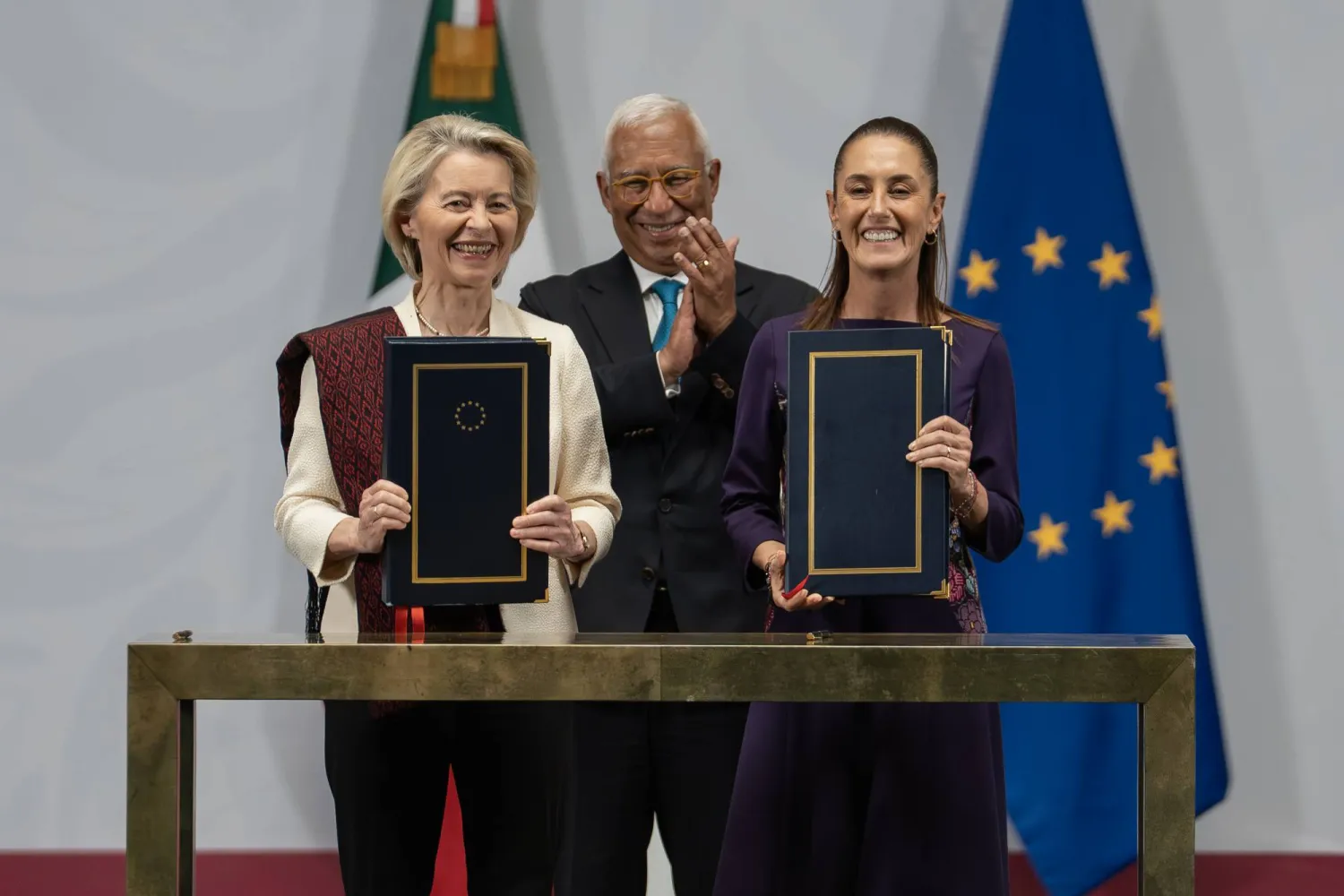

Mexico, EU Sign Stalled Trade Deal as they Aim to Diversify from US

22 May 2026, Mexico, Mexico City: EU Council President Antonio Costa, Mexico's President Claudia Sheinbaum and EU Comission President Ursula von der Leyen are pictured holding the trade agreement at the presidential palace. Photo: Felix Marquez/dpa
TT

Mexico, EU Sign Stalled Trade Deal as they Aim to Diversify from US

22 May 2026, Mexico, Mexico City: EU Council President Antonio Costa, Mexico's President Claudia Sheinbaum and EU Comission President Ursula von der Leyen are pictured holding the trade agreement at the presidential palace. Photo: Felix Marquez/dpa

Mexico and the European Union signed a long-stalled free trade agreement on Friday as they seek to decrease dependence on the US and partially insulate themselves from US President Donald Trump's tariffs.

The accord, which they reached broad agreement on in 2025 but have delayed signing, expands a Mexico-EU trade accord from 2000, which covered only industrial goods. The new pact adds services, government procurement, digital trade, investment and farm produce.

Mexico's President Claudia Sheinbaum, European Commission President Ursula von der Leyen and European Council President Antonio Costa signed the deal in Mexico City in their first summit in ⁠over a decade.

"This ⁠agreement is a true geopolitical statement," Costa said on Friday, shortly after signing the agreement. "With the modernized global agreement, we are better prepared to face the challenges of our time."

"This agreement opens up enormous opportunities for both regions, allowing for expanded trade," Sheinbaum said, highlighting the pharmaceutical industry, agriculture, technological development and electric mobility.

Both sides want to diversify their exports away from the US.

The EU was hit with sweeping new duties in Trump’s “Liberation Day” tariffs in April 2025 and ⁠prepared countermeasures, though these were paused as both sides sought talks. While tensions eased somewhat with a tariff truce and a July deal, US tariffs on EU exports remain elevated.

Mexico has also been hit with stiff US tariffs on automotive, steel and aluminum exports, and trade relations between the two countries have been volatile throughout Trump's second term.

According to Reuters, Mexico's economy ministry estimates the new agreement could increase Mexican exports to the EU from around $24 billion a year to $36 billion by 2030. The EU exports around $65 billion in goods annually to Mexico.

Trade between Mexico and the EU has increased 75% in a decade, dominated by transport equipment, machinery, chemicals, fuels and mining products.

The new deal provides duty-free access for almost all goods including farm products such ⁠as Mexican chicken and ⁠asparagus and European milk powder, cheese and pork, albeit with some quotas.

While the updated trade deal has been ready, it has taken over a year to sign.

The EU prioritized a free-trade agreement with the South American bloc Mercosur and it concluded free-trade negotiations with Indonesia, India and Australia in the past eight months.

Mexico, meanwhile, has been cautious about taking steps that could anger the Trump administration during sensitive negotiations to extend the US-Mexico-Canada trade pact. More than 80% of Mexico's exports currently go to the US.

In the EU, the trade deal will be voted on by the European Parliament, which is likely to approve it within a few months.

"The goal here is very simple: we want to create more jobs and more value on both sides of the Atlantic," von der Leyen said. "This agreement gives us great wings to fly very high."



US Economy Expanded at Solid 2.1% Pace in January-March, Government Says

President Donald Trump stands on stage after speaking at the opening of the Great American State Fair on the National Mall, Wednesday, June 24, 2026, in Washington. (AP Photo/Julia Demaree Nikhinson)
TT

US Economy Expanded at Solid 2.1% Pace in January-March, Government Says

President Donald Trump stands on stage after speaking at the opening of the Great American State Fair on the National Mall, Wednesday, June 24, 2026, in Washington. (AP Photo/Julia Demaree Nikhinson)

The US economy expanded at a solid and unexpected 2.1% annual pace from January through March, the Commerce Department reported Thursday in its final estimate of first-quarter growth.

The growth in gross domestic product — the nation’s output of goods and services — marked a rebound from a sluggish 0.5% in the last three months of 2025 when a 43-day federal government shutdown weighed on the economy. Thursday’s numbers were an upgrade from of Commerce’s previous first-quarter estimate of 1.6% growth, The Associated Press reported.

Business investment surged, probably reflecting an investment boom in artificial intelligence. But consumer spending, which accounts for around 70% of US economic activity, fell sharply from fourth-quarter 2025 and from Commerce’s previous estimate in a sign that consumers may be cutting back in the face of higher gasoline prices caused by the war with Iran.

“It was unsettling to see consumer spending revised even lower,” Heather Long, chief economist at Navy Federal Credit Union, said in a commentary.

"Spending is likely to tick up in (the second quarter), but it’s worth watching carefully... It’s been a tough few months for American consumers, but most have been able to make it through. The question is how much relief is coming” as the US and Iran continue talks toward a resolution of the conflict.

Excluding housing, private investment jumped 10.6%, up from 2.4% in fourth-quarter 2025. In a sign of the AI boom, investment in information-processing equipment jumped at a 39.9% pace as companies scrambled to outfit their data centers. But Michael Reid, head of US economics at RBC Capital Markets, said before Thursday’s report came out that “unfortunately, it’s not a sustainable path.’’ He expects data center investment to lose momentum going forward.

Residential investment, weighed down by high interest rates, dropped 7.8% from January through March, biggest fall since late 2022 and the fifth straight quarterly decline.

The federal government's spending and investment rose at a 9.4% clip in the first quarter after dropping 16.6% in October-December 2025 largely because of the government shutdown.

Imports, which are subtracted from GDP, grew at a slower pace than last estimated from January through March. They still subtracted 1.49 percentage points from first-quarter growth, but that was down from a 2.59 percentage-point hit in the previous estimate and was a major factor in Thursday's upgrade.

The US economy — the world’s biggest — has continued to chug along despite the Iran energy shock. The American job market has proven especially resilient. Employers added an average 188,000 jobs a month from March through May after adding fewer than 10,000 a month in 2025 amid uncertainty over President Donald Trump’s trade and immigration policies.

Thursday’s report was the Commerce Department’s third and final estimate of first-quarter GDP growth. The first look at second-quarter economic growth is due July 30.


Baghdad Urges OPEC to Raise Iraq's Production Quota

A handout picture released by Iraq's Prime Minister's Press Office on January 2, 2025, shows a partial view of the oil refinery of Baiji north of Baghdad, during the inauguration ceremony of the fourth and fifth units. (Iraq's Prime Minister's Press Office / AFP)
TT

Baghdad Urges OPEC to Raise Iraq's Production Quota

A handout picture released by Iraq's Prime Minister's Press Office on January 2, 2025, shows a partial view of the oil refinery of Baiji north of Baghdad, during the inauguration ceremony of the fourth and fifth units. (Iraq's Prime Minister's Press Office / AFP)

Baghdad has urged OPEC to increase Iraq's oil production quota, taking into account the damage done to its industry by its history of conflicts and the recent regional war, its oil ministry said Thursday.

Like other oil producers, Iraq, a founding member of OPEC, was greatly affected by the Middle East war, as it is hugely dependent on oil exports, which make up about 90 percent of its budget revenues.

Iraq's oil ministry said that reassessing production baselines was important "to ensure they are aligned with the sustainable production capacities of member countries", and with respect to "Iraq's unique security and economic circumstances".

OPEC has "responded by launching a process to reassess" its member states' capacities, the ministry said.

Following reports of a possible Iraqi exit from OPEC, oil ministry spokesperson Salim al-Rikabi told AFP that Iraq "has no intention of withdrawing from the organization and remains committed to its mechanisms".

But he added that the cartel "has to raise Iraq's production quota. Otherwise, a decision will have to be made about whether to stay or leave the organization".

Iraq has started increasing its production "in line with its capacities and needs", he said.

The ministry said that "reports suggesting that Iraq is considering ending its membership in OPEC do not reflect" the government's position.

Iraq's ministry said that any change would be decided within OPEC's existing framework, but noted there was a "high level of understanding" among members regarding Iraq's situation after decades of wars, sanctions, and recent attacks on the sector during the Middle East War.

All of these challenges will be considered to "ensure that Iraqi oil production reaches a fair level".

The Middle East war and Iran's blockade of the Strait of Hormuz choked off shipments and prompted production cuts in key oil-producing countries including Iraq, shaking world energy markets.

During the conflict, several Iraqi oil fields were struck by drones mostly launched by pro-Iran armed groups.

Before the war, Iraq produced around four million barrels per day (bpd), and exported an average of 3.5 million bpd, mostly via Hormuz.

After the recent deal between Washington and Tehran to end the fighting, Iraq now hopes to return within two months to its previous production levels.

A former oil ministry official, who requested anonymity, warned against Iraq's exit from OPEC.

A "withdrawal would not serve the interests of Iraq", which is exclusively dependent on the oil sector, he said.

"I don't think that Iraq has really the incentives to leave OPEC," said Jorge Leon, an analyst at Rystad Energy.

Instead, he added, Iraq might be trying to apply pressure to "the capacity review exercise that the group is currently doing", which will serve as the basis for the 2027 quota.


Egypt Overhauls Nitrogen Fertilizer Export Levy, Exempts High-grade Ammonium Nitrate

General view of part of Cairo (Reuters)
TT

Egypt Overhauls Nitrogen Fertilizer Export Levy, Exempts High-grade Ammonium Nitrate

General view of part of Cairo (Reuters)

Egypt has revamped its export tax regime for nitrogen fertilizers, replacing a fixed export tax with a 10% ad valorem duty on all nitrogenous fertilizer exports, while exempting high-purity ammonium nitrate, according to a decision published in the Official Gazette on Thursday.

The duty, calculated on the FOB invoice value, does not apply to pure ammonium nitrate with a nitrogen concentration exceeding 34.2%, or to shipments destined for productive enterprises in Egypt's free zones, Reuters reported.

The World Bank warned in its April Commodity Markets Outlook that global fertilizer prices could rise by more than 30% in 2026 due to conflict-related disruptions in the Middle East and logistical risks around the Strait of Hormuz.

The new decree replaces a flat $90-per-metric-ton tax introduced in May, tying the levy more directly to prevailing export prices, which have fallen since peaking in mid-April.
Egypt is the world's seventh-largest exporter of nitrogen fertilizers, according to LSEG data.