

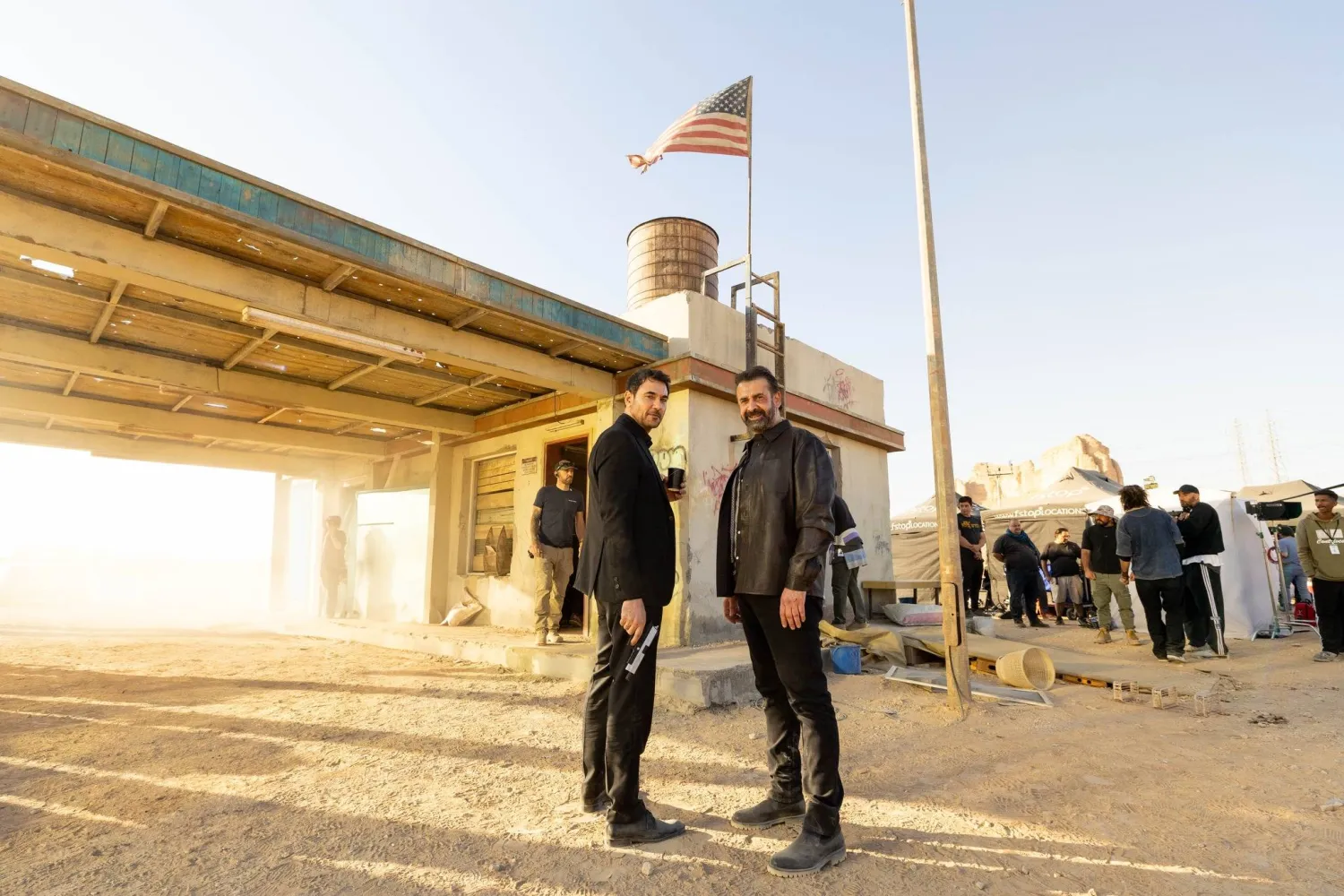

Inside ‘7 Dogs,’ the Biggest Arab Film Production

Karim Abdel Aziz and Ahmed Ezz behind the scenes during filming (production company)
TT

Inside ‘7 Dogs,’ the Biggest Arab Film Production

Karim Abdel Aziz and Ahmed Ezz behind the scenes during filming (production company)

The makers of “7 Dogs” set out to do more than produce an action film to international standards. Their aim was to deliver a visual spectacle shaped by Saudi Arabia’s General Entertainment Authority, built on a strategic vision for a transcontinental thriller with Hollywood-level technical standards, while preserving a Middle Eastern identity and cultural voice.

The film, which opened in Cairo on Friday evening in the presence of its makers, was written by Egyptian screenwriter Mohamed el-Dabbah, who was tasked with turning the Entertainment Authority’s ambitious vision into a fully developed screenplay.

El-Dabbah did not write a conventional chase story. He built a fast-paced, dramatic structure driven by escalating events and centered on the infiltration of an international criminal network, requiring a coherent narrative that could sustain the film’s heavy visual and action momentum.

The decisive moment that moved the project from concept to production came during the 2024 global tour for “Bad Boys: Ride or Die.”

During that period, Belgian-Moroccan directors Adil El Arbi and Bilall Fallah visited Riyadh and held a lengthy meeting with adviser Turki Alalshikh, chairman of Saudi Arabia’s General Entertainment Authority. Their talks focused on the major advances in Saudi Arabia’s film infrastructure.

The meeting reviewed Riyadh’s growing logistical capabilities and its ability to attract major global productions. Alalshikh then presented the idea for the film, drawing an immediate and enthusiastic response from the directing duo, who saw it as a chance to apply their experience in American cinema to a new production environment.

Riding the momentum of their film’s record commercial success at the Saudi and global box office, the directors became convinced that regional audiences were eager for action films made with a global sensibility.

A large-scale production partnership was formed to provide the financial and technical resources needed to carry out the project without restrictions or creative compromise.

To give the film its international scope, producer Ivan Atkinson was brought in as the project’s logistical maestro. His first task was to build a creative front by recruiting department heads with extensive experience in big-budget filmmaking, ensuring that every technical detail met contemporary Hollywood standards.

Among them was renowned production designer Paul Kirby, known for creating complex architectural spaces and adapting them to serve the drama.

Atkinson also brought in the global stunt and fight design team 87eleven, the celebrated group behind the combat identity of the “John Wick” franchise, giving the film a decisive edge in its action sequences.

The directors approached the script through rhythm. They wanted a visual experience with the pace and dynamism of modern video games. That choice pushed the editing and cinematography teams toward extremely fast movement, with a highly flexible camera designed to keep viewers alert as they follow the layers of the international conspiracy.

According to the film’s crew, preparatory workshops began in Riyadh months before filming.

The screenplay went through detailed technical reviews by el-Dabbah, the directors and the fight team to balance the characters’ human drama with the film’s action. The aim was to ensure the chases and explosions served the dramatic line rather than felt forced into the story.

Adil and Bilall’s artistic vision centered on breaking the stereotype of Middle Eastern action films that rely on easy visual solutions. They insisted on shooting the dangerous scenes with rough realism, which required the cast to undergo long, demanding physical training so they could perform complex fight movements themselves under the supervision of Hollywood stunt experts.

Sela Studios helped clear the logistical hurdles by providing advanced filming, lighting and lens equipment, including tools that had not previously been used in the region.

That production support allowed cinematographer Robrecht Heyvaert to create a visual identity that blends the warm colors of the East with the cooler, contemporary palette of modern global action cinema, according to sources from the production company.

The chemistry between El Arbi and Fallah important. The two worked in close coordination, with one focusing on the actors and dramatic performance while the other concentrated on visual design, camera movement and special effects.

The arrangement helped maintain a fast and efficient production flow on crowded, detail-heavy sets.

Early preparations required complex schedules to manage the movement of international stars and coordinate their filming dates in Riyadh. The logistics team created a flexible system that accommodated the project's evolving demands, allowing principal photography to begin on schedule amid enthusiasm and strict professional discipline from all parties involved.

The General Entertainment Authority placed government and security facilities at the filmmakers’ disposal, allowing them to close key areas and film complex car chases on open streets. That regulatory flexibility demonstrated that Riyadh can offer not only closed studios but also entire urban spaces ready to serve as stages for large-scale action scenes.

In the film, 7 Dogs is not presented as a conventional gang. It is written as a complex cross-border intelligence and criminal entity, an octopus-like network of businessmen and influential figures running globalized organized crime from distant locations. That makes it an invisible threat that cannot easily be tracked by traditional security methods.

The main dramatic trigger is the organization’s creation of a highly dangerous synthetic drug called Pink Lady. The lethal compound is not just a product for sale. It drives the plot, turning the conflict from a local criminal case into a major security threat that mobilizes international security agencies and INTERPOL.

To confront the network, Egyptian INTERPOL officer Khaled Al Azazi, played by Ahmed Ezz, launches a wide-ranging intelligence operation to infiltrate the organization from within.

His investigation leads him to a fragile lead, a professional transcontinental criminal named Ghali Abu Dawood, played by Karim Abdel Aziz. Ghali has close ties to The Seven Dogs’ pillars, making him the only one who can bring down the destructive network.

The disciplined officer and the elusive criminal are forced into an uneasy alliance. The stark contrast between a man who represents the law and another who embodies pragmatism and life outside it creates a tense dynamic marked by suspicion, shifting loyalties and deep psychological conflict throughout the journey.

Alongside Karim Abdel Aziz and Ahmed Ezz, the cast includes international names such as Monica Bellucci, Giancarlo Esposito, Bollywood star Salman Khan, Sanjay Dutt, Max Huang, Tara Emad, Nasser Algassabi, and Sayed Ragab. The geographic and cultural diversity of the cast reflects the organization’s reach across continents.

Bellucci plays Julia, the luxurious and dark European face of the organization. The character combines extreme elegance with absolute cruelty, creating a striking visual contrast with the Eastern characters.

The participation of Salman Khan as Johar and Sanjay Dutt as Ranjit adds strong visual and action energy to the film’s Asian track. Their screen presence is used in large-scale action scenes marked by violent combat, turning the Mumbai segment into an action climax tied to the broader dramatic arc.

Saudi actor Nasser Algassabi brings a local flavor and Gulf depth to the film’s web of international relationships.

His character serves as the logistical link in the region. Egyptian actress Tara Emad plays a young intelligence operative working in the shadows to support Khaled, alongside Jessica, played by Lebanese actress Sandy Bella, a member of the INTERPOL team.



Sydney Reopens Beach Under Heavy Patrols After Shark Attack

A beach closed sign is displayed at Coogee Beach in Sydney on June 13, 2026. (AFP)
TT

Sydney Reopens Beach Under Heavy Patrols After Shark Attack

A beach closed sign is displayed at Coogee Beach in Sydney on June 13, 2026. (AFP)

Sydney's Coogee Beach reopened on Monday under the watchful eyes of lifeguards and jet ski patrols, after a shark attack over the weekend left a woman critically injured and prompted a safety review at Australia's popular shorelines.

The 35-year-old victim was swimming about 30 meters (100 feet) from the shore on Saturday morning when she was bitten by a three-to-four-meter-long shark, sustaining serious injuries to her arms and lower left leg. She remains in hospital in stable condition.

Local authorities urged swimmers to be cautious.

"Our Lifeguards will continue JetSki patrols throughout the day, and Surf Life Saving NSW is operating a shark-spotting drone at Coogee Beach," Randwick City Council said in a statement.

Coogee, south of iconic Bondi ‌Beach, is symbolic ‌of Sydney's coastal lifestyle. The beaches, which lie east of the city, are famous ‌for ⁠their golden sands ⁠and dramatic coastal cliffs and draw millions of tourists from around the world every year, making water safety a high-stakes priority for the authorities.

"I wouldn't even dip my toe in at the minute," said local resident Ryan Brady. "I used to do a few lengths across the beach but I'd always have in the back of my mind is there sharks around but after, after the weekend, no. It's kind of a nail in the coffin for me."

Saturday's attack was the latest in a series of shark encounters off Australian beaches.

The week before, a man died after ⁠being attacked by a shark while fishing off the coast of Western Australia. Last ‌month, a 39-year-old man died after being attacked while fishing on ‌Queensland's Great Barrier Reef. Ten days before that, a 38-year-old was fatally mauled off an island near Perth in Western Australia.

Dozens ‌of beaches along Australia's east coast were closed in January after four shark attacks in two days.

While ‌shark encounters remain statistically rare, a Reuters analysis of data from the Australian Shark Incident Database shows a gradual rise in encounters, with the country averaging nearly 29 incidents per year over the last decade, up from an average of roughly 16 per year in the 2000s.

"We have seen more shark bites recently but that's probably more to do with population ‌increase," said Leonardo Guida, shark scientist at the Australian Marine Conservation Society.

Climate change was also a factor, he added, with warmer waters prompting people to go ⁠to the beach more ⁠often, and also changing sharks' movements.

"Climate is changing how our ocean works and sharks are just one aspect of it," Guida added.

SHARK CULL DEBATE

The attack has forced a regulatory review of aerial surveillance.

While emergency drones were deployed on Monday, Coogee normally faces strict flight restrictions because it sits directly beneath the flight path for Sydney's airport.

New South Wales Agriculture Minister Tara Moriarty said on Monday that nothing was off the table as the state considered safety measures.

Some experts said Saturday's attack was by a white shark, a protected species under environmental laws. However, the attack has again led some to suggest a cull, a highly contentious issue.

“It’s so wrong that we don’t cull sharks after attacks,” former conservative Prime Minister Tony Abbott said in a video posted on his Facebook page.

Australia already culls sharks as part of its shark meshing program and additional culling was unlikely to produce a measurable difference, said Emeritus Professor Rob Harcourt, from the Sydney Institute for Marine Science at Macquarie University.

"Other safety measures, including drones (and) smart drum lines, and their help with understanding and then predicting when foraging sharks are likely to be present, have already shown to be of high efficacy," he said.


Burnt-Out Indonesians Beat the Blues with Children’s Games

Members of the "Playing Community" group react as they play an Indonesian children's game at the Gelora Bung Karno Stadium compounds in Jakarta on May 22, 2026. (AFP)
TT

Burnt-Out Indonesians Beat the Blues with Children’s Games

Members of the "Playing Community" group react as they play an Indonesian children's game at the Gelora Bung Karno Stadium compounds in Jakarta on May 22, 2026. (AFP)

Flushed and sweating, 31-year-old Annisa Enggracia Fidel runs back and forth to defend her fort from invaders -- hundreds of fellow adults all beating the blues by playing a nostalgic Indonesian children's game.

The tech professional is a member of Jakarta's "Playing Community", a group that gathers after work every Friday to let off steam in ways not usually associated with grown-ups.

Similar get-togethers have sprung up elsewhere in the Southeast Asian nation as larger numbers of burnt-out workers seek novel solutions for handling stress and maintaining mental health.

"The more energy we exert, the more we sweat, the more our stress is released," Annisa told AFP at the capital's main stadium, where about 500 people had come together.

"Of course, our happy chemicals are released too -- endorphins -- and that's what makes us feel more energized and motivated," she said after her game, which was enthusiastically cheered on from the sidelines.

Rapid urbanization has transformed Jakarta's metropolitan area -- now recognized as the world's biggest, with more than 42 million residents.

The expansion has brought faster-paced lifestyles, grinding traffic jams, regular flooding, severe air pollution and a dire shortage of public green spaces to unwind.

The Playing Community dates from 2024, when founder Akihiko Akira was battling work pressure and personal problems.

"It started because, like most Gen Z folks, I was stressed out by work, burnt out with life," he said.

The 24-year-old office worker found solace in "lompat karet" -- a game from infancy that involves jumping over a long rope made from braided elastic bands.

Videos he posted were met with a surge of interest from others wishing to join.

"The games make us reminisce about our childhood... not only can we be healthier, but we can also enjoy that nostalgic feeling with our inner child," Akira said.

That "can help release the stress inside of us, inside of our soul", he told AFP.

- Inner child revived -

The concept has since spread beyond Jakarta to other parts of Java island, such as Bandung and Yogyakarta, as well as to the tourist island of Bali.

Participants -- sometimes up to 1,000 per session -- are not charged a fee. They only need to bring their own water bottles and comfortable clothing.

Many activities are high-energy, including Annisa's beloved fort-guarding game -- known as "bentengan" -- and a variant of tag called "petak jongkok".

But some opt for less physically demanding escapism in the form of "congklak" -- a counting game using seeds or stones -- or "bola bekel", similar to jacks.

IT developer Imam Hidayat said he joined the Jakarta group after jogging past a Playing Community session last year.

"I was very stressed out because of deadlines, especially since I work in a corporate bank," said the 27-year-old.

"It makes me so happy. I played two games tonight, including 'bentengan' with many other people."

Initiatives like Playing Community are invaluable as a drug-free anti-depressant, said Jakarta-based psychologist Ratih Ibrahim.

"There's a sense of togetherness; you meet new people, and in that moment, you become human again," she told AFP.

Intan Permata, a 36-year-old homemaker and mother of three from neighboring Banten province, agreed.

"In our daily lives, we get so caught up in school issues, the kids, the house... It really feels like such a refreshing break," she told AFP.

"My inner child suddenly returned, all the sore muscles disappeared, and I feel happy. Very happy," said Intan.


Greek Fishermen Struggle to Keep Up with Pufferfish Invaders

This photograph shows a yellow-spotted pufferfish (Torquigener flavimaculosus), which are considered to be even more toxic than the larger silver-cheeked pufferfish (Lagocephalus sceleratus), swimming in a tank at Cretaquarium Thalassokosmos in Heraklion, on the island of Crete, on June 2, 2026. (AFP)
TT

Greek Fishermen Struggle to Keep Up with Pufferfish Invaders

This photograph shows a yellow-spotted pufferfish (Torquigener flavimaculosus), which are considered to be even more toxic than the larger silver-cheeked pufferfish (Lagocephalus sceleratus), swimming in a tank at Cretaquarium Thalassokosmos in Heraklion, on the island of Crete, on June 2, 2026. (AFP)

On his fishing boat moored in the Greek port of Ierapetra in southwestern Crete, Alexis Charlambakis pries open the mouth of a freshly-caught pufferfish to reveal two massive teeth on each jaw.

"If one of these bites you, it will take your finger clean off," the 43-year-old said. "They are the destruction of the sea. They leave nothing behind."

Proof of the damage is visible on a neighboring boat deck: a ray, a common seabream and another fish netted that day lie half shredded.

Pufferfish, a warm-water invasive species, were first spotted in Greek waters some 20 years ago and are wreaking havoc with the country's fishing industry, a pillar of the nation's agricultural exports.

Off the coast of Crete, Greece's largest island, fishermen are seeing their catch dwindle because of the silver-cheeked Lagocephalus sceleratus menace, which typically measures between 40 and 60 cm.

"It's an omnivorous fish that eats everything it encounters," said 65-year-old fisherman Giannis Giankakis.

"Nothing seems to bother it, because it has no natural predators among other fish," he added.

- Southern invaders -

The pufferfish explosion in Greek waters is the latest example of how warming oceans are changing ecosystems and upturning their reliant economies.

Of the nearly 200 species of pufferfish living in the world's warm waters, three are currently found in the eastern Mediterranean Sea.

Scientists recorded them for the first time in Greece in June 2005, said Nota Peristeraki of the Hellenic Center for Marine Research (HCMR).

Present in the Red Sea and in the Indian and Pacific oceans, the silver-cheeked pufferfish entered the Mediterranean via the Suez Canal, according to Université Côte d'Azur, which records non-native Mediterranean species.

Originally located near Crete and the Dodecanese islands, it has since spread to other areas, Peristeraki said.

- 'We cannot survive' -

In addition to their powerful toxin that makes them deadly to eat, these members of the Tetraodontidae family have a beak-like mouth strong enough to bite through wood and metal.

They not only ravage the fishermen's daily catch, but leave their nets in tatters too.

"If this wasn't my boat, I'd quit this profession for good," Charlambakis said.

"The situation is dire...we cannot survive," he told AFP.

After five days at sea, Charlambakis said his nets become useless and difficult to repair.

"It took me two days to fix these nets. I took them out this morning, another 20 holes," he said.

Feasting on other fish, crustaceans and squid, pufferfish cause around 8,500 euros' ($9,800) worth of damage and lost income per year to fishing boats, said Peristeraki, the HCMR marine biologist.

The predator also contains tetrodotoxin, "an extremely dangerous toxin if ingested," warns HCMR marine biologist Thekla Anastasiou.

"It causes heart failure and stops the lungs from functioning," Anastasiou said.

- 'Worse every year' -

"It is imperative to reduce their population," Peristeraki said.

That's easier said than done, fishermen say.

"The job gets worse every year," said 53-year-old fisherman Kostis Zevelekakis.

"The state isn't doing enough to help us deal with these fish (...) We can control their numbers if we're given the right framework to hunt them," he added.

WWF in April released a responsible seafood guide with over a hundred species found on the Greek market.

Among them are 13 invasive species which were not on the previous guide in 2015.

The newcomers include the Atlantic shrimp (Penaeus aztecus) and blue crab (Callinectes sapidus) in the northern Aegean Sea, and the lionfish (Pterois miles) in waters further south.

The fishermen want the state to subsidize them to hunt pufferfish, a program already running in neighboring Cyprus.

"They should give us an incentive to round them up," said 25-year-old Babis Doriakis.

"I have taken on my father's fishing boat, but I won't be able to continue without assistance," he said.

Then deputy agriculture minister Christos Kellas in February told parliament that authorities were examining a support program for fishermen.

- Waste not -

Scientists in the meantime are trying to find ways to neutralize the fish's deadly toxin -- which can cause paralysis, respiratory failure, and death -- in order to make it marketable.

"At present, pufferfish are considered class 1 waste," the equivalent of potentially threatening industrial waste, said Elkethe chemist Manolis Mandalakis.

Under EU rules, the appropriate way to treat this waste is incineration, he said.

"We are trying to find alternative ways...that are less energy-consuming," said Mandalakis.

Potential uses could include fertilizer or fish feed, he said.