

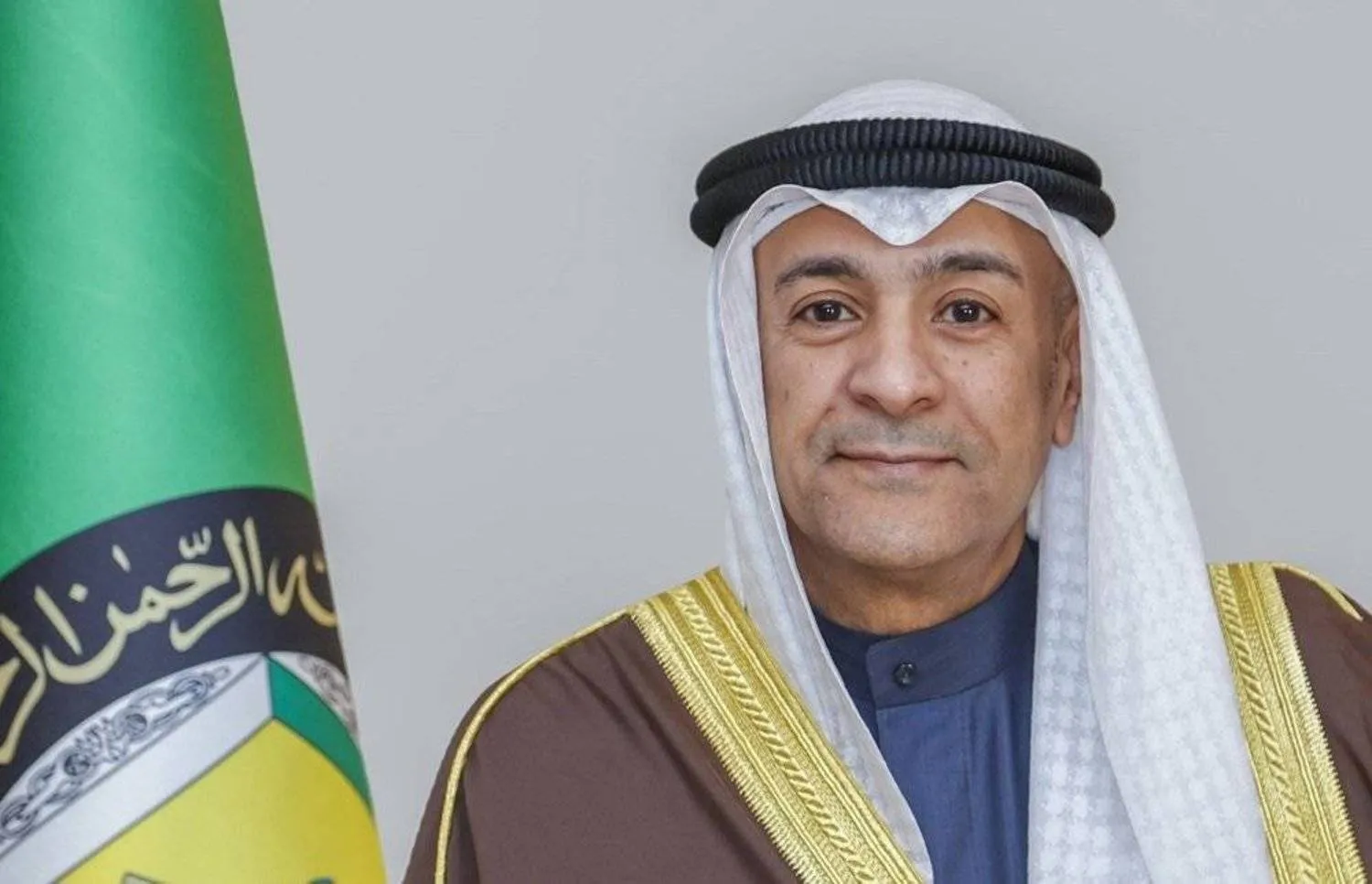

Albudaiwi: GCC States Consistently Seek to Enhance Global Security and Stability

Secretary-General of the Gulf Cooperation Council (GCC) Jasem Albudaiwi. SPA
TT

Albudaiwi: GCC States Consistently Seek to Enhance Global Security and Stability

Secretary-General of the Gulf Cooperation Council (GCC) Jasem Albudaiwi. SPA

Secretary-General of the Gulf Cooperation Council (GCC) Jasem Albudaiwi said that the GCC member states consistently seek to enhance security, stability, development, and prosperity to serve the mutual interests of the region's peoples and the entire world.

This comes in light of the rapid geopolitical shifts as well as growing security and economic challenges facing the globe, according to SPA.

During his participation in a panel session on GCC-European strategic links, held today in the Czech capital, Prague, on the sidelines of the GLOBSEC Global Security Forum 2026, the GCC secretary-general said: "The GCC General Secretariat’s participation in the GLOBSEC Global Security Forum 2026 embodies its keenness to maintain an active presence in regional and international forums. This engagement aims to bolster communication and exchange perspectives with international partners, decision-makers, and experts, thereby supporting efforts to maintain regional and international security while keeping pace with rapid global changes."

He also pointed out that the region has recently witnessed several events that have heavily impacted security and stability, adding that the GCC states have sustained their continuous diplomatic efforts to de-escalate and defuse tensions in the region, promoting paths of dialogue and diplomacy to protect regional security, stability, and the safety of its peoples.

The GCC secretary-general underscored the paramount importance of protecting the security of air and maritime corridors, ensuring freedom of navigation, the safety of supply chains, and the stability of global energy market.

"The stability of the Gulf region remains a fundamental pillar for the stability of the global economy and international maritime security," he reiterated.

Albudaiwi explained that recent developments have proven that the security of Europe and the Middle East has become unprecedentedly interconnected, asserting that any disruption in the Gulf region and its surrounding maritime passages directly affects the European economy, global energy security, supply chains, and international stability as a whole. He stressed that Gulf stability is no longer merely a regional matter, but has become a shared international interest.

Discussing the future of Gulf-European relations, Albudaiwi mentioned that both sides aspire to elevate their ties to broader horizons.

He added that the upcoming GCC-EU Summit will contribute to cementing cooperation across numerous fields and achieving the mutual interests of both parties, emphasizing the significance of reaching tangible results that serve both sides and elevate their ongoing cooperation.



Saudi Arabia, Arab and Muslim Countries Condemn Israeli E1 Settlement Plan

Israeli settlers move into the former Israeli settlement of Kadim near the West Bank city of Jenin, 20 August 2026. (EPA)
TT

Saudi Arabia, Arab and Muslim Countries Condemn Israeli E1 Settlement Plan

Israeli settlers move into the former Israeli settlement of Kadim near the West Bank city of Jenin, 20 August 2026. (EPA)

The foreign ministers of Saudi Arabia, Jordan, the United Arab Emirates, Indonesia, Pakistan, Türkiye, Qatar, and Egypt condemned on Friday “Israel’s continued illegal settlement policies in the Occupied Palestinian Territory, categorically rejecting the E1 settlement plan and related settlement activities east of occupied East Jerusalem.”

In a statement, they further reiterated their condemnation “of the violations and acts of violence perpetrated by settlers, with the support of the Israeli occupying authorities, against the Palestinian people and their property.”

They stressed that such acts “in no way diminish the inalienable rights of the Palestinian people and constitute violations of international law and relevant United Nations resolutions, while posing a serious threat to regional and international peace and security.”

The ministers warned that the E1 settlement plan “constitutes a dangerous escalation that further advances settlement expansion and annexation and undermines the geographical contiguity of the Occupied Palestinian Territory, particularly between the West Bank and East Jerusalem, thereby threatening the viability and realization of an independent, contiguous Palestinian State based on the 1967 lines with East Jerusalem as its capital.”

Such actions “are a direct challenge to international efforts aimed at achieving peace,” foremost among them US President Donald Trump’s Comprehensive Plan, “including its unequivocal rejection of annexation and forced displacement, and the mechanisms envisaged for its implementation through the Board of Peace.”

It is also a violation Trump’s “firm commitment to not allow annexation of the West Bank, with a view to achieving stability and bringing the conflict to an end.”

The ministers reaffirmed that the two-state solution, in accordance with international law and relevant United Nations resolutions, “remains the only viable path towards a just, comprehensive and lasting peace.”

They warned that “actions aimed at undermining this solution risk further escalating tensions, threatening regional and international peace and security, and jeopardizing prospects for lasting peace and stability in the region.”

The ministers expressed their support for “all efforts aimed at ensuring accountability, including through appropriate international measures and sanctions against entities and individuals responsible for illegal settlement activities, including the E1 settlement plan, as well as those supporting, facilitating or implementing policies of settlement expansion and annexation.”

They called for an end to “any support or financing that contributes to the establishment, expansion or entrenchment of illegal settlements.”

They stressed that “the lack of accountability contributes to the continuation of violations and further undermines prospects for a just and comprehensive peace.”

The ministers called for “immediate action” to halt the E1 settlement plan, rescind all measures taken in connection with it, and cease all settlement activities and other measures “aimed at altering the geographic and demographic character of the Occupied Palestinian Territory.”

They called on the UN Security Council, all states and relevant international actors “to uphold their responsibilities under international law and take urgent and effective measures to halt illegal settlement expansion, and to ensure the protection of the Palestinian people, safeguard their inalienable rights, including their right to self-determination, and realize their independent state, in accordance with international law and relevant UN resolutions."


Saudi Crown Prince Heads to France on Official Visit

Prince Mohammed bin Salman, Saudi Crown Prince and Prime Minister. (SPA)
TT

Saudi Crown Prince Heads to France on Official Visit

Prince Mohammed bin Salman, Saudi Crown Prince and Prime Minister. (SPA)

Prince Mohammed bin Salman, Saudi Crown Prince and Prime Minister, traveled to France on Friday on an official visit.

In a statement, the Royal Court said the visit is taking place upon the directives of Custodian of the Two Holy Mosques King Salman bin Abdulaziz Al Saud, and in response to an invitation extended by French President Emmanuel Macron.


Saudi Arabia Condemns Bombing Near Educational Center in Kabul

The Saudi flag. Asharq Al-Awsat
TT

Saudi Arabia Condemns Bombing Near Educational Center in Kabul

The Saudi flag. Asharq Al-Awsat

The Saudi Ministry of Foreign Affairs expressed the Kingdom’s condemnation and denunciation of the bombing near an educational center in the Afghan capital, Kabul, which left dozens injured, SPA reported on Friday.

In a statement, the ministry reiterated the Kingdom's absolute rejection of all forms of violence, extremism, and terrorism, expressing solidarity with the Afghan government and people.

The ministry extended Saudi Arabia's wishes for a swift recovery to the injured and for lasting security, peace, and stability across Afghanistan.