


Report: Netanyahu Relegated from Partner to Passenger in Trump's War on Iran

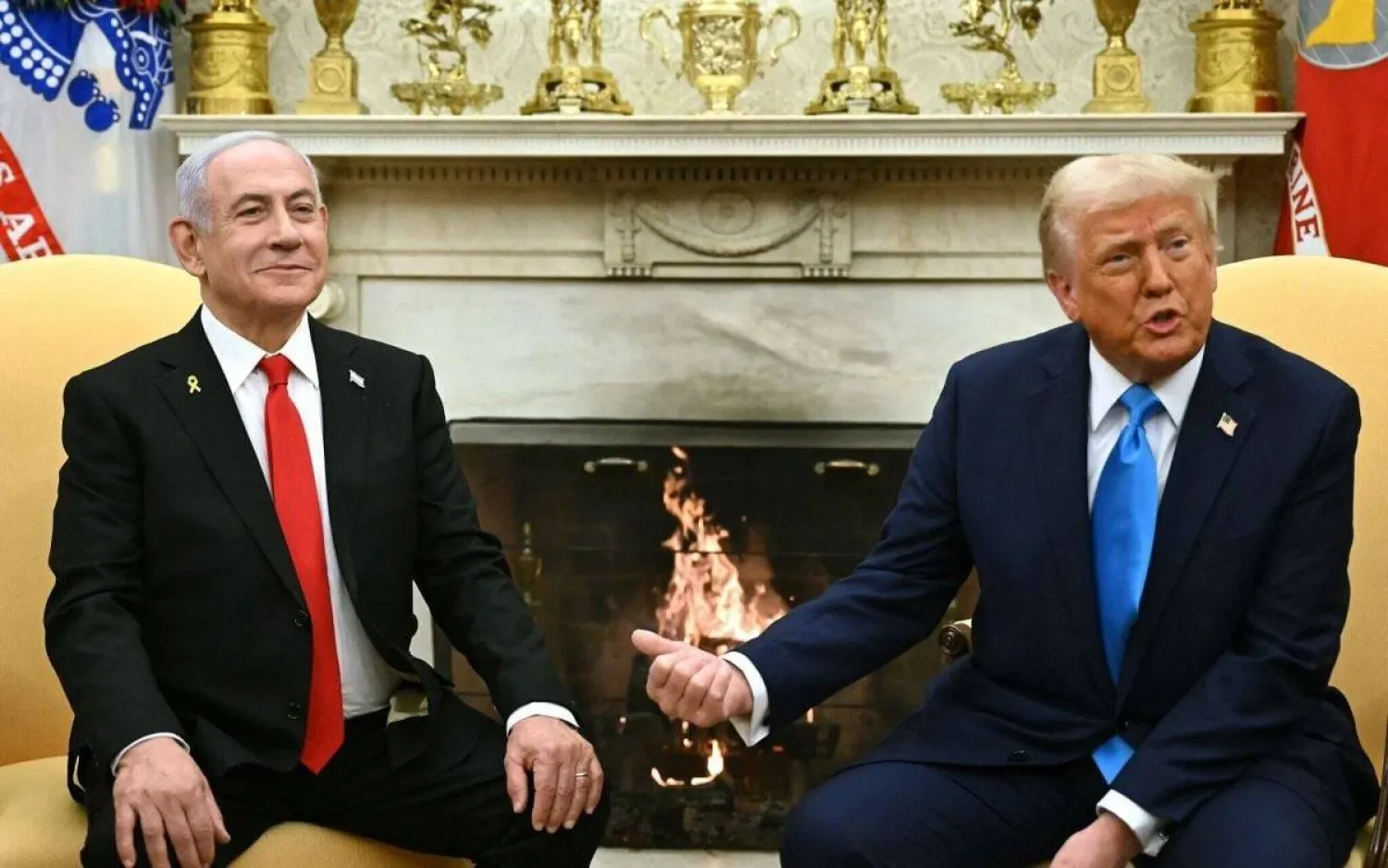
 US President Donald Trump, right, meets with Prime Minister Benjamin Netanyahu in the Oval Office of the White House, in Washington, Feb. 4, 2025. (AFP)
US President Donald Trump, right, meets with Prime Minister Benjamin Netanyahu in the Oval Office of the White House, in Washington, Feb. 4, 2025. (AFP)
TT

Report: Netanyahu Relegated from Partner to Passenger in Trump's War on Iran

 US President Donald Trump, right, meets with Prime Minister Benjamin Netanyahu in the Oval Office of the White House, in Washington, Feb. 4, 2025. (AFP)
US President Donald Trump, right, meets with Prime Minister Benjamin Netanyahu in the Oval Office of the White House, in Washington, Feb. 4, 2025. (AFP)

In the run-up to the February 28 attack on Iran, Prime Minister Benjamin Netanyahu of Israel was not only in the Situation Room with President Trump, he was leading the discussion, predicting that a joint US-Israeli strike could very well lead to the demise of the regime in Iran.

“Just a few weeks later, after those sanguine assurances proved inaccurate, the picture was starkly different. Israel was so thoroughly sidelined by the Trump administration, two Israeli defense officials said, that its leaders were cut almost entirely out of the loop on truce talks between the United States and Iran,” said a New York Times report on Saturday.

“Starved of information from their closest ally, the Israelis have been forced to pick up what they can about the back-and-forth between Washington and Tehran through their connections with leaders and diplomats in the region as well as their own surveillance from inside the Iranian regime,” said the two officials, who spoke on the condition of anonymity to discuss sensitive matters.

“The banishment from the cockpit to economy class has potentially significant consequences for Israel, and especially for the prime minister, who faces an uphill re-election battle this year.”

“Netanyahu has long sold himself to Israeli voters as a kind of Trump whisperer,” uniquely capable of enlisting and retaining the president’s support. In a televised speech early in the war, he portrayed himself as the president’s peer, assuring Israelis that he talked to Trump “almost every day,” exchanging ideas and advice, “and deciding together.”

“He had led Israel to war in February with grand visions of achieving a goal he has pursued for decades: stopping Iran’s push for nuclear weapons once and for all. As the war began with a stunning decapitation of much of the government in Tehran, it seemed as though an even more grandiose dream might come true: the toppling of the regime.”

“But many in Trump’s inner circle had always viewed the idea of regime change as absurd. And it wasn’t long before American and Israeli priorities began to diverge more, especially after Iran closed the Strait of Hormuz, sending oil prices soaring and pressuring Trump into agreeing to a ceasefire.”

Far from vanquished, Tehran has behaved as though it won the war, merely by surviving it. Israel, by contrast, has seen its biggest objectives for the war elude its grasp.

Netanyahu set three goals at the start of the war: toppling the regime, destroying Iran’s nuclear program and eliminating its missile program. None have been realized.

Instead of burying Iran’s nuclear ambitions, a recent American proposal called for a 20-year suspension of, or moratorium on, Iranian nuclear activity and that time frame may have gotten smaller in subsequent proposals. That raises the prospect that an eventual deal could resemble the Obama administration’s 2015 nuclear accord, which Netanyahu fought against at the time and Trump exited from three years later.

With the Trump administration excluding Israel from the negotiations, Iran’s arsenal of ballistic missiles may have been left off the table, as far as Israeli officials know. In that respect, any deal would fail to improve on the 2015 agreement, which Netanyahu assailed in part because it did not address Iran’s missiles.

It would also be a dismaying setback for the Israeli public, for whom life largely ground to a halt as the nation was bombarded by Iranian missiles in March and April.

There are other concerns for Israel about the possible contours of a US-Iran agreement, including a lifting of economic sanctions against Tehran. Doing so could amount to an economic lifeline, flooding Iran with billions of dollars that it could then use to rearm and to help its proxy forces, like Hezbollah, replenish their own arsenals with weapons to use against Israel.

While little is certain yet about the shape of an eventual deal — and any agreement could still be postponed by a renewal of fighting — what seems clear is that Israel’s partnership with the United States has come at a steep price. A country that for generations prided itself on “defending ourselves by ourselves,” and whose leaders exasperated a succession of American presidents with their hardheaded recalcitrance, is now making little secret of its need, and willingness, to submit to Trump’s demands.

As Defense Minister Israel Katz said on April 23, as Trump threatened to resume the war and bomb Iran back to the “Stone Age”: “We are only waiting for the green light from the US.”

“That admission was a humbling climbdown from the heady first days of the war, when the two countries achieved air supremacy and were so confident of success that they urged the Iranian people to topple the regime and secure their future,” said the NYT.

Within two weeks, it became clear that the war would not produce instant victory, as Trump had hoped. The White House, and some Israeli leaders, put aside their hopes for regime change, and Trump turned his attention toward ending the fighting.

“He had viewed Netanyahu as a war ally, but not as a close partner when it came to negotiating with the Iranians,” American officials familiar with his thinking said; in fact, he considered Netanyahu someone “who needed to be restrained when it comes to resolving conflicts.”

Israel soon found itself demoted from “equal partner” to something more akin to a “subcontractor” to the US military.

Israel would often clear plans with the United States, only to have the Trump administration throw it under the bus after those plans were executed, such as when Israel struck the South Pars natural gas field and oil facilities along the Gulf in southern Iran.

Trump even pressured Israel to bring a premature halt to its campaign against Hezbollah in Lebanon within days after the ceasefire on April 8, forcing Israel to accept restraints on its fighting with a hostile adversary right on its border.

“The sidelining is particularly hard to take for some Israeli officials, who, speaking on condition of anonymity, noted that the country willingly shouldered some of the war’s more controversial assignments.”

For Netanyahu, it has meant repeatedly recalibrating his rhetoric, and even adjusting his description of Israel’s war objectives, in response to Trump’s frequent vacillations.

After initially telling his citizens that Israel’s goals were to “remove” the existential threats of an Iranian nuclear weapon and of its ballistic missile arsenal, by March 12 Netanyahu was articulating a new idea. This one downplayed the fact that those threats had not been removed, and instead exalted Israel’s close partnership with the United States.

“Threats come and threats go, but when we become a regional power, and in certain fields a global power, we have the strength to push dangers away from us and secure our future,” he said. What gave Israel such newfound strength in the eyes of its adversaries, Netanyahu asserted, was his alliance with Trump — “an alliance like no other.”


*David M. Halbfinger and Ronen Bergman for The New York Times


One Year On, Trump's Gaza Plan Has Not Stopped Israeli Fire or Disarmed Hamas

TOPSHOT - A Palestinian man cleans the roof of a building at the Jabalia refugee camp in the northern Gaza Strip on October 5, 2026.  (Photo by Bashar Taleb / AFP)
TOPSHOT - A Palestinian man cleans the roof of a building at the Jabalia refugee camp in the northern Gaza Strip on October 5, 2026. (Photo by Bashar Taleb / AFP)
TT

One Year On, Trump's Gaza Plan Has Not Stopped Israeli Fire or Disarmed Hamas

TOPSHOT - A Palestinian man cleans the roof of a building at the Jabalia refugee camp in the northern Gaza Strip on October 5, 2026.  (Photo by Bashar Taleb / AFP)
TOPSHOT - A Palestinian man cleans the roof of a building at the Jabalia refugee camp in the northern Gaza Strip on October 5, 2026. (Photo by Bashar Taleb / AFP)

US President Donald Trump’s year-old plan to end the Gaza war has stalled, with Israel mounting near daily ‌attacks and occupying around two-thirds of the shattered enclave where Palestinians face dire conditions.

The initial phase resulted in a ceasefire on October 10, 2025 and secured the release of the last remaining hostages seized in Hamas’ 2023 attacks on Israel, along with freedom for hundreds of Palestinian prisoners and detainees held by Israel, Reuters said.

But other goals, including disarming Hamas, securing Israeli withdrawal and rebuilding Gaza, appear far from reach.

WHAT WAS IN THE PLAN?

The first phase of Trump’s 20-point plan included a suspension of all military operations, Israeli withdrawal from part of the enclave, hostage and prisoner releases and a surge in aid.

Later phases foresaw Hamas disarming and new governance by a Palestinian body overseen by the Trump-led Board of Peace. Israel would gradually withdraw, handing territory to a temporary International Stabilization Force (ISF).

“Gaza will be redeveloped for the benefit of the people of Gaza, who have suffered more than enough,” the plan said.

HAS THE CEASEFIRE HELD?

There has been no return to full-scale military operations, but Israeli strikes have continued. Gaza's health ministry says at least 1,400 Palestinians have been killed since the October ceasefire, many of them women and children, although it does not disclose militant casualties.

Israel says its strikes have targeted Hamas, accusing the group of trying to carry out attacks and rearm. Hamas denies this.

Five Israeli soldiers have been killed by Palestinian militants or in combat since ‌the ceasefire, according to ‌the Israeli military.

HOW MUCH OF GAZA DOES ISRAEL OCCUPY TODAY?

Most of it.

The initial phase of Trump’s plan foresaw ‌Israel ⁠withdrawing to a so-called “yellow ⁠line” that left Israeli troops in control of 53% of Gaza. Since then, the Israeli military has expanded its effective control to around two-thirds of the territory.

The advancing yellow line has uprooted more Palestinians, squeezing the population of 2 million into a shrinking coastal strip where they shelter in tents and damaged buildings.

Israel-backed Palestinian militias opposing Hamas use the Israeli-held zone to launch attacks into Hamas-controlled areas.

HAVE AID FLOWS IMPROVED?

Yes, but aid groups say it isn't enough.

Global hunger watchdog IPC says more than 1.2 million people still face acute hunger in Gaza despite a major scale-up of aid operations after the ceasefire.

In an August report, it cited data showing that an average of 227 trucks a day carried humanitarian and commercial supplies into Gaza from the ceasefire to the end of May - less than half the minimum 600 trucks stipulated in the Gaza plan.

COGAT, ⁠the Israeli military agency that controls access to Gaza, did not immediately respond to a request for comment on the ‌figure cited in the IPC report.

Israel says around 600 trucks carrying humanitarian aid and commercial goods are ‌entering each day, that Gaza is getting enough goods to meet needs, and that it is meeting its obligations.

Aid agencies say Israel is blocking essential items, including metal tent poles, ‌engine oil and spare parts, from entering Gaza, on the grounds that Hamas could use them for military purposes.

IS HAMAS READY TO DISARM?

It has indicated ‌so, but a plan unveiled in July to achieve this has also stalled.

Trump said Hamas and other Gaza militants had accepted a 15-point roadmap drawn up by the Board of Peace to give up their arms. Israeli forces would withdraw as Hamas disarmed. The ISF, working with a new Palestinian security force, would secure Gaza. Trump called it historic.

Hamas said it had agreed to hand over its weapons to be stored under the control of the US-backed Palestinian technocratic government. Though Hamas rejected the word ‘disarmament’, this marked a once-unimaginable position for ‌the Iran-backed group.

But Israel, skeptical that Hamas will give up its arms, called the plan unacceptable and said it would not carry out any withdrawal until Hamas is fully disarmed.

HAS THE ISF BEEN FORMED?

Plans have taken shape ⁠but it has yet to be assembled. ⁠There is a commander - US Major General Jasper Jeffers - and Indonesia, Morocco, Kazakhstan, Albania, Kosovo, and Uganda have committed personnel.

Jeffers has said the long-term plan is for the ISF to use 20,000 troops and train 12,000 Palestinian police.

The technocratic Palestinian governing body, the National Committee for the Administration of Gaza, was appointed in January led by Ali Shaath, who formerly served as a deputy minister in the Ramallah-based Palestinian Authority. It has yet to enter Gaza.

WHAT ABOUT RECONSTRUCTION?

A year on, Palestinians are still scavenging in the rubble of wrecked buildings for materials to prop up tents and other shelters.

The Board of Peace unveiled a $2.45 billion plan in September to begin rebuilding Gaza.

That is a fraction of what is needed. The Board of Peace cited an EU and UN assessment released in April that estimated recovery and reconstruction needs at $71.4 billion over the next decade.

WHAT ARE ISRAELI POLITICIANS SAYING ABOUT GAZA’S FUTURE?

While the Trump plan promises to encourage people to stay in Gaza, Israeli right-wing politicians have stepped up calls for the mass removal of Palestinians through “voluntary emigration”.

Israeli Defense Minister Israel Katz said last month there was "no real solution for Gaza in the end without this migration".

Israel's defense ministry in 2025 established an office tasked with overseeing “voluntary emigration” from Gaza, after comments by Trump suggesting Gazans could be permanently displaced.

Trump later backed away from the idea, which faced strong resistance from Arab states and was widely rejected internationally. Israeli officials have said there are no plans to move Gaza's population out by force.

Israel will hold a general election on October 27, the country's first since the October 7, 2023, Hamas attack. Some leading opposition figures have spoken in support of Trump's plan. Polls show pro- and anti-Netanyahu parties in a tight race.


What Will the Next Leader of the UN Need to Get the Job Done in an Increasingly Complex World?

UN Secretary General Antonio Guterres receives a standing ovation after speaking during the 81st United Nations General Assembly at the United Nations Headquarters in New York, on September 22, 2026. (Photo by ANGELA WEISS / AFP)
TT

What Will the Next Leader of the UN Need to Get the Job Done in an Increasingly Complex World?

UN Secretary General Antonio Guterres receives a standing ovation after speaking during the 81st United Nations General Assembly at the United Nations Headquarters in New York, on September 22, 2026. (Photo by ANGELA WEISS / AFP)

On Jan. 1, the next United Nations secretary-general will take over an aging organization still controlled by World War II powers. What will the world need from that person?

Once a major player in solving conflicts and crises around the world, the 81-year-old institution has been sidelined from the top table in trying to end the wars in Iran, Ukraine and Gaza. And its precarious financial situation — caused mainly by the billions of dollars the United States owes — has forced major cuts to its humanitarian and development programs where it has remained a key player.

The annual global gathering of world leaders at the United Nations that ended last week shed some light on what the next UN chief needs to focus on and pursue.

In his farewell address to the General Assembly, outgoing Secretary-General Antonio Guterres told global leaders, “The world does not need a weaker United Nations.”

“It needs a UN strong enough to face the world as it is," he said, “and determined enough to build the world as it should.”

But is that even possible?

Much talk of a shared future with the UN at the center

After 10 years at the helm of the United Nations, Guterres said he is strongly convinced that its greatest power is to build a tomorrow that works for everyone. As he put it, “Our shared future will be forged by whether humanity can govern power wisely.”

Guterres then issued challenges to the United Nations that will be led by his successor, the 193 countries in the General Assembly “and humanity itself."

Will you “uphold the law before impunity becomes normalized?” Will you “end wars before they consume generations?” Will you tackle inequality “before societies fracture?” Will you accelerate climate action “before tipping points are crossed?” Will you govern artificial intelligence “before it governs us?" Guterres asked.

For the next secretary-general — the selection process is ongoing — the top priority will be reconfiguring the United Nations to reflect the 21st century rather than the post-World War II era when it was established.

The new UN chief “will have the most monumental task that the UN has faced in decades because you have a UN that’s going through this critical reform process that it has not gone through for a long time,” said Kizito Byenkya, the Open Society Institute’s advocacy director.

The UN's financial crisis has led to budget cuts and efforts to consolidate programs and agencies, and eliminate hundreds of mandates ordering the UN Secretariat to take a wide variety of actions and deliver reports, many that never get read. That's just to name a few.

At the same time, Byenkya told The Associated Press, “You have huge pressure on all sides for the new secretary-general to act like a general and really play a central role in mediation for world conflicts.” He cited the late secretary-general Kofi Annan, who became directly involved in some conflicts and was a skilled mediator and negotiator.

“If you look at the conflicts we've been facing in the last few years, let's say from Gaza to Sudan to Ukraine and more, you often have to ask yourself: Where has the role of the United Nations been with all of these?,” he said. “In the time of Kofi Annan, he was center to all.”

Reform sounds good but is a lot harder than one might think

During high-level week, leader after leader spoke of the need for reform. But when it comes to taking action, serious and sometimes impossible differences emerge, especially when it comes to reforming the Security Council, the UN’s most powerful body and still controlled by the World War II victors.

All UN member nations want to see the council reflect the 21st century world, but there are huge national differences on how it should be expanded. That has stymied progress for decades.

The five permanent members — the US, Russia, China, Britain and France — hold veto power, which gives them ultimate control. Africa, home to 1.5 billion people, has no permanent seat. Neither does Latin America. Neither do the collection of island nations whose existence is threatened by climate change.

“Security Council reform is not a favor to Africa,” Ghana’s President John Mahama told world leaders last week. “It is an imperative for the legitimacy, credibility, and survival of the United Nations.”

Mahama also raised perhaps the most difficult problem that will confront the next UN chief: the world’s “intense fragmentation, deepening inequality and eroded trust in our multilateral system.”

“We must address the alarming breakdown of global order today,” he said, pointing to “the dangerous drift toward unilateralism."

Mahama lauded the UN Charter, whose opening words say the organization was founded to prevent a repetition of the 20th century’s two world wars. That, he said, “must reign supreme over the cynical doctrine that `might makes right.’”


Thousands of Young Sailors Adjust to Iran War Aboard USS George Washington

Night Aircraft Handling Officer Breana Royston and AE1 Andrew Schmucker coordinate aircraft positioning aboard the USS George Washington in the Arabian Sea, September 13, 2026 (Reuters)
TT

Thousands of Young Sailors Adjust to Iran War Aboard USS George Washington

Night Aircraft Handling Officer Breana Royston and AE1 Andrew Schmucker coordinate aircraft positioning aboard the USS George Washington in the Arabian Sea, September 13, 2026 (Reuters)

An emergency alert blares from a loudspeaker, and Damon Dennard and other sailors on the deck of the aircraft carrier USS George Washington are scrambling. Dennard, 23, is readying bombs for loading onto aircraft as his crewmates race to their positions.

“It has been eventful,” said Dennard, an aviation ordnanceman airman apprentice. Once the alert ends, he takes a breath, sits on one of the bombs and jokes that he probably expected an easier deployment.

“It’s crazy, but at the end of the day, it’s work. That’s all.”

Dennard was one of dozens of sailors Reuters spoke with in September on a rare visit to a US warship that is central to the Iran war.

The visit began at a particularly tense moment, just three days after the US military blew up five Iranian oil tankers in retaliation for Iran targeting a US Navy warship.

The George Washington’s mission near the Strait of Hormuz which has no defined end-date came as a surprise to the crew, who were deployed from Japan at the end of August to relieve another carrier.

The aircraft carrier is effectively a floating city of around 5,000 personnel, each with their own mission, from Majesta Ochoa, who operates a cash register, to Lieutenant Commander Brody Samaha, a “shooter” who helps oversee the launch of aircraft from the carrier’s catapults.
But there is a sense of synchronization as the sailors go about their jobs, crew say.

The aircraft carrier is effectively a floating city of around 5,000 personnel, each with their own mission, from Majesta Ochoa, who operates a cash register, to Brody Samaha, a “shooter” who helps oversee the launch of aircraft from the carrier’s catapults.

“It’s a dance, with lots of people checking each other,” Samaha said, before adding that the flight deck is also a “very dangerous place to be. It’s very unforgiving.”

Ouija Board

Breana Royston, the night aircraft handling officer, or ‘NACHO,’ has a unique perspective over the dangerous maneuvering on the flight deck.

Her job is to supervise aircraft movement, including bringing fighter jets up to the flight deck and back down to the hangar bay via massive elevators.

To do that, she uses what’s known in Navy parlance as a “ouija board” — a real-time model of the deck, with miniature aircraft all lined up in their current positions. It looks a little like a strategy board game.

“We’ve been on our toes the last week, maneuvering and everything — with everything that's going on,” Royston said, adding it’s been “kind of crazy, really busy.”

“It’s nerve-wracking, but it’s fun,” she said.

The Iranian government has repeatedly condemned US military actions in the Strait of Hormuz. On September 25, the Iranian foreign minister said the insecurity prevailing in the strait was the “direct result of the aggressive actions of the United States and the Israeli regime.”

The war began in February with joint strikes on Iranian targets by the US and Israel. US President Donald Trump has said many times the conflict would soon be over, but it persisted for longer than initially expected.

In August, in response to reports of deteriorating conditions, low morale and suicide attempts on the Lincoln, US Secretary of Defense Pete Hegseth said the accounts “misrepresented” the reality, praising sailors who endure austere conditions.

Extended Deployments Pose Strain on Crew

Still, extended deployments can pose enormous strain on crews’ mental health, particularly in wartime, and are a challenge for any navy. Sailors must maintain a state of alert and readiness, heightened in the case of the George Washington due to the threat of drone and missile attack from Iran.

“Morale is really important to us,” said Rear Admiral Jeffrey Heames, the commander of Carrier Strike Group 5.

Heames talked about ensuring the ability of the crew to contact home and receive mail.

“Some of those things affect how sailors hold up out in this kind of environment,” Heames said. “They are huge focus areas for me.”

Reuters spoke with Seaman Deandre Cook as he checked in with his wife back home on a video call. She was holding one of their young daughters on her hip.

It was hard being away from his family, Cook said, but added: “The distance makes the relationship stronger.”

Growing Up

As jets thundered off the carrier’s deck above them, hundreds of members of the George Washington’s crew gathered for a ceremony to mark the 25th anniversary of the September 11, 2001 attacks — an event many of them were too young to remember.

Al Qaeda’s attacks on New York and Washington propelled the US into two decades of war that sent troops to Afghanistan, Iraq, Syria and elsewhere. Many supporters of Trump had hoped Middle East wars were a thing of the past.

After a sailor sang the national anthem, the chaplain on board, Ben Garrett, delivered a prayer as the assembled crew bowed their heads.

“Help us honor those who have gone before us,” Garrett said.

Garrett later told Reuters that many of the crew members are still learning the basics of growing up, including skills like patience, managing relationships and career expectations.

“A huge percentage of this ship are between the ages of 19 and 24 years old,” said Garrett, a Roman Catholic priest. “So they’re trying to figure out being an adult while they’re out here.”
Sometimes sailors enlist to get away from a small town or a situation back home, Garrett added.

Lieutenant Commander Brian Lasley said there were more people on the George Washington than back in his hometown of Fredericktown, Missouri, whose population was 4,429 in the 2020 census.

Camren Pollard, 24, an interior communications electrician third class, said he joined the Navy on a spur-of-the-moment decision after seeing older coworkers unhappy in his previous job. “I wanted to change things in my life,” he said.

“My mom freaked out more than anything. My little brother thought it was kind of cool.” For Pollard, however, “I don’t think about it a whole lot. It’s work for me.”
