


Russia Kills 4 in Massive Ukraine Attack Using Nuclear-Capable Missile

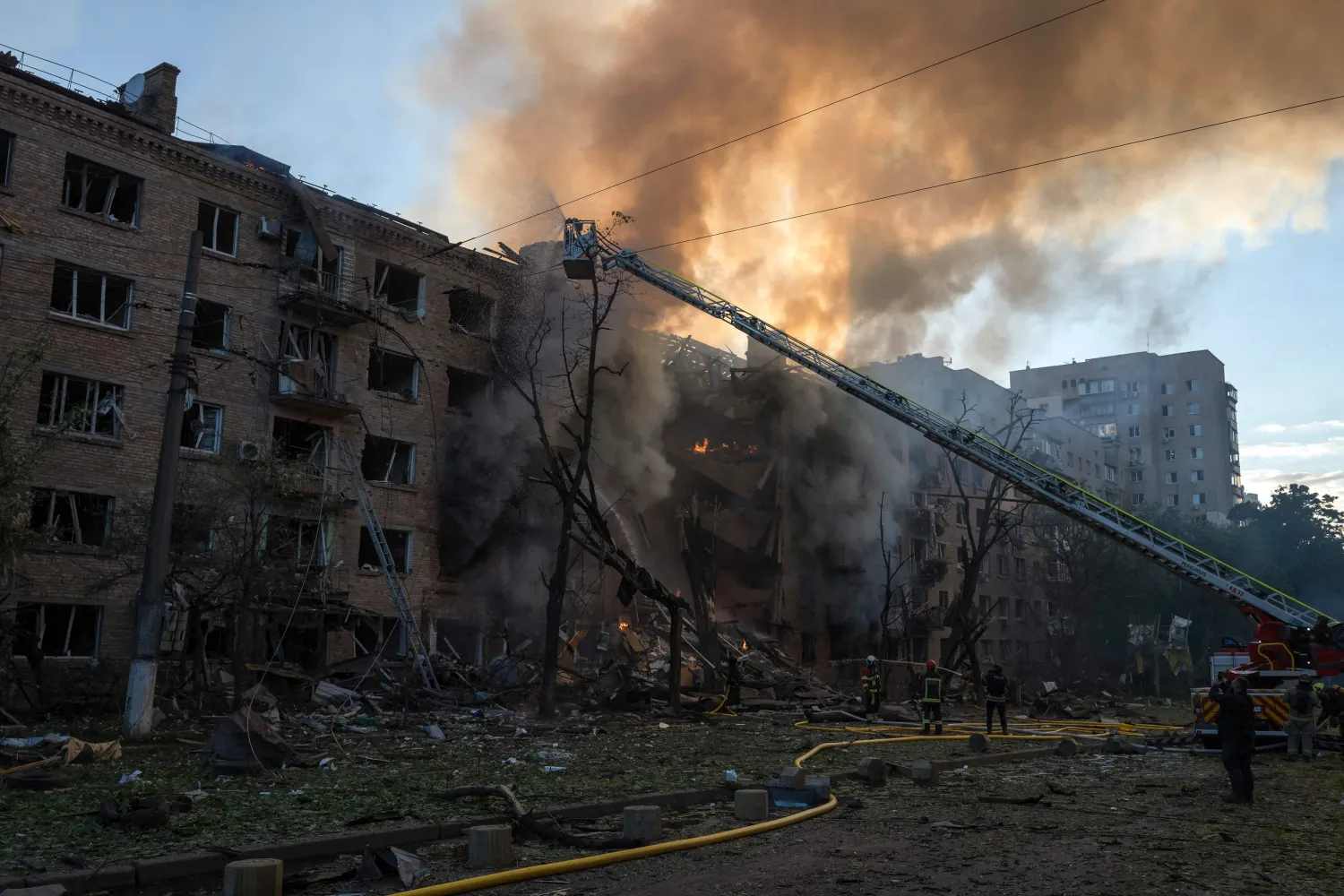
Firefighters work to extinguish a fire at the site of a heavily damaged building following Russian strikes to the Ukrainian capital in Kyiv on May 24, 2026, amid the Russian invasion of Ukraine. (AFP)
TT

Russia Kills 4 in Massive Ukraine Attack Using Nuclear-Capable Missile

Firefighters work to extinguish a fire at the site of a heavily damaged building following Russian strikes to the Ukrainian capital in Kyiv on May 24, 2026, amid the Russian invasion of Ukraine. (AFP)

Russia pounded Kyiv with a massive bombardment that killed four people, authorities said Sunday, with Moscow unleashing its nuclear-capable hypersonic Oreshnik missile in one of the largest barrages in the more-than-four-year war. 

Multiple rounds of loud explosions were heard in the Ukrainian capital throughout the early hours of the morning, AFP journalists reported, as residents took shelter in underground stations. 

Daylight revealed rescue workers extinguishing fires and sifting through debris of heavily damaged buildings -- houses, shopping centers, museums, theaters, schools and universities. 

Russian President Vladimir Putin had earlier threatened retaliation for Ukrainian strikes in Russian-occupied eastern Ukraine that killed 21 people in a vocational school. 

In Kyiv, Sofia Melnychenko, 21, thought she was safe in the subway, "but then there were three loud explosions, and after the fourth one the ceiling in the metro started crumbling," she told AFP. 

"There was complete chaos. Children started screaming, people were panicking," she added. 

"It was a very frightening night." 

The Ukrainian air force said the raid involved 600 drones and 90 missiles, of which 549 drones and 55 missiles were intercepted. 

- 'Genuinely deranged' - 

Kyiv has been grappling with an acute air defense missile deficit since the US-Israeli air campaign against Iran drove up demand for US-made Patriot rounds. 

European leaders reacted by saying the salvo showed Russia's desperation. 

"Terror against civilians is not strength. It's despair," EU chief Ursula von der Leyen said on X. 

French President Emmanuel Macron said the strikes signaled "the dead end of Russia's war of aggression", while German Chancellor Friedrich Merz called the use of Oreshnik a "reckless escalation". 

Ukrainian President Volodymyr Zelensky urged more action from allies. "I am grateful to everyone now expressing words of support. But concrete steps to bolster air defense are also needed -- missile deliveries must not stop for a single day," he said on social media. 

He earlier said the Russians hit dozens of residential buildings, schools, a water supply facility and a market in a "genuinely deranged" attack. 

Russia's army confirmed it had launched the Oreshnik at Ukraine for the third time in the war, saying it was "in response to Ukraine's terrorist attacks on civilian infrastructure on Russian territory". The missile was used without a nuclear warhead. 

Moscow denied targeting civilians, saying it had struck command posts of the Ukrainian army and intelligence. 

Four people were killed and more than 100 were wounded in Kyiv and the surrounding region, local officials said. Kyiv mayor Vitali Klitschko said damage had been recorded in every district of the capital. 

The residence of the Albanian ambassador was also hit and the Balkan country summoned the Russian envoy in protest. 

Buildings housing a studio of German broadcaster ARD and an office for German outlet DW were damaged as well, the companies said in statements. Both premises were empty of people at the time. 

Projectiles also hit other Ukrainian regions, with dozens of wounded reported in the Kharkiv, Cherkasy and Dnipropetrovsk regions. 

Attacks continued during the day, with a shelling killing two and wounding 17 in the frontline city of Kherson. 

- Retaliation - 

Ukraine had been expecting a major strike after its own forces launched a drone barrage on Starobilsk, in the Russian-occupied east of the country, which Moscow said hit a college dormitory and killed 21 people, most of them young female students. 

Launched overnight on Thursday to Friday, the drone salvo -- one of Ukraine's deadliest such strikes in months -- also wounded dozens in the city, located in the occupied Lugansk region. 

Ukraine denied targeting civilians, saying it had hit a Russian drone unit stationed in the area. 

Ukraine regularly targets Russian-controlled areas of the country with drones, arguing that the strikes are retaliation for Russian attacks. 

Kyiv has recently expanded its drone capabilities and stepped up strikes on internationally recognized Russian territory, including residential areas and oil export infrastructure. 

Moscow has hit Ukraine almost daily with barrages of missiles and drones since launching its full-scale invasion of the country in 2022, also hitting infrastructure and causing civilian deaths. It denies targeting civilians. 

US-led efforts to negotiate an end to more than four years of war have slowed in recent months, with Washington's attention diverted towards its conflict in the Middle East. 


5 Killed in Russian Strikes on Ukraine as Putin Warns Europe Against Sending Troops

Ukrainian rescuers work amid the rubble at the site of a Russian strike on a multi-story residential building in Odesa, southern Ukraine, 12 September 2026, amid the ongoing Russian invasion. EPA/IGOR MASLOV
TT

5 Killed in Russian Strikes on Ukraine as Putin Warns Europe Against Sending Troops

Ukrainian rescuers work amid the rubble at the site of a Russian strike on a multi-story residential building in Odesa, southern Ukraine, 12 September 2026, amid the ongoing Russian invasion. EPA/IGOR MASLOV

Russian strikes killed five civilians and wounded dozens in Ukraine, local officials said Saturday, after Russian President Vladimir Putin warned that sending European troops into Ukraine would amount to direct conflict with Russia.

Ukraine is under mounting pressure from Russia’s intensifying air campaign that uses ballistic missiles and jet-powered drones to pierce defenses. Moscow’s attacks have targeted Ukraine’s power grid ahead of winter in what officials say is meant to demoralize civilians.

Two people were killed and one wounded when Russian drones struck a residential area overnight in the Ukrainian city of Zaporizhzhia, regional head Ivan Fedorov said Saturday.

One person died and three others were wounded in strikes on Kryvyi Rih, according to local officials.

In the Black Sea port of Odesa and the surrounding area, 35 people were wounded overnight in what regional head Oleh Kiper called a “massive attack.” Among the buildings hit was a residential high-rise, whose upper floors were completely destroyed.

Later on Saturday, two people were killed in a Russian attack on a grocery store in Ukraine's Zhytomyr region, local officials said.

Meanwhile, Ukrainian President Volodymyr Zelenskyy said Ukrainian forces struck two chemical industry facilities in Russia, one in Samara and one in Perm. The governors of the regions did not immediately comment, but Russian independent online news outlet Astra reported drone attacks on chemical plants in both regions.

Putin, speaking to reporters at a summit of the BRICS group of emerging economies in India on Friday, said that if European governments send troops into Ukraine, it will mean “a war with Russia.”

“Now they’re talking about how they’re considering sending troops into Ukraine. That means a war with Russia,” The Associated Press quoted him as saying.

Some European leaders have pledged their commitment to a potential peacekeeping force, a prospect that Moscow has repeatedly described as unacceptable.

Putin also denied Russia posed any threat to Europe, saying “there is no such threat and never has been.”

“We do not threaten, nor do we intend to threaten, European countries,” he said.

Polish Prime Minister Donald Tusk said Thursday that two incidents along Ukraine’s borders with Poland and Moldova this week were a preview of potential intensified Russian provocations at Ukraine’s border crossing points with Europe.

Two people died when Russian drones hit the Starokozache border crossing between Ukraine and Moldova on Tuesday night, while a “direct threat” to a Polish-Ukrainian crossing point on Wednesday night was only avoided thanks to cooperation between Warsaw and Kyiv, he said.

Meanwhile, Zelenskyy told Deutsche Welle, in an interview published Saturday, that he would meet Putin if both leaders were invited to the Group of 20 summit of rich and developing nations in December in Miami.

Putin’s foreign policy adviser, Yuri Ushakov, said Saturday that the possibility of Putin attending the summit had not yet been discussed.

The Kremlin in the past has said that Zelenskyy can come to Moscow if he wants a meeting with Putin, a proposal Kyiv has rejected.

“If he really wants to meet with Putin, Putin has already said that he could fly to Moscow,” Kremlin spokesman Dmitry Peskov said Saturday.

Russian Foreign Minister Sergey Lavrov affirmed Saturday that Russia is “ready for negotiations,” but that the so-called “special military operation,” as Moscow refers to its war in Ukraine, “will not be suspended during this period of negotiations.”


BRICS Nations Call for 'Maximum Restraint' in Middle East War

A handout photo made available by India’s Ministry of External Foreign Affairs shows BRICS leaders planting trees during the 18th BRICS Leaders' Summit in New Delhi, India, 12 September 2026. EPA/INDIAN MINISTRY OF EXTERNAL FOREIGN AFFAIRS/HANDOUT
TT

BRICS Nations Call for 'Maximum Restraint' in Middle East War

A handout photo made available by India’s Ministry of External Foreign Affairs shows BRICS leaders planting trees during the 18th BRICS Leaders' Summit in New Delhi, India, 12 September 2026. EPA/INDIAN MINISTRY OF EXTERNAL FOREIGN AFFAIRS/HANDOUT

Members of the 11-nation BRICS group including China, Russia, Iran and India called for calm in the Middle East at a summit in New Delhi on Saturday.

Chinese President Xi Jinping, who joined Russian, Iranian, Indian and other leaders in India's capital, told the summit that the Middle East war "does not serve the common interests of the international community.”

Leaders issued a statement on Saturday after intense diplomatic efforts by host India, as the bloc seeks to bolster its global influence and address conflict, trade turbulence and energy security.

"We express deep concern over the continued escalation of tensions in Middle East/West Asia," the joint statement said, according to AFP, adding the countries "call for exercising maximum restraint, as well as avoiding actions that could further aggravate the situation.”

BRICS was created in 2009 as a forum for major emerging economies seeking greater influence in institutions dominated by Western powers.

"We have to transform this pyramid of privilege into a platform of partnership," Indian Prime Minister Narendra Modi told Xi, Russian President Vladimir Putin, Iranian President Masoud Pezeshkian and other leaders as he opened the two-day summit.

Modi said BRICS nations "represent 50 percent of the world's population, 40 percent of global GDP and more than 25 percent of global trade.”

But finding balance in the bloc is a tough diplomatic task.

India maintains cordial relations with both Iran and US ally Israel, but is also careful to strike a delicate balance in its ties with Washington.

Iran's Pezeshkian attended the summit shortly after warning that the Middle East does not need the United States to be a "regional policeman,” with the two countries at war and tensions threatening the vital Strait of Hormuz.

India has navigated the energy crisis caused by the US-Iran war in part by turning to Russia, despite Moscow's war in Ukraine and pressure from Washington and other Western capitals.

Modi embraced Putin before talks on Friday. The Russian president, who last visited India in December 2025, is one of New Delhi's most important strategic partners.

Xi's participation is also being closely watched because it is his first visit to neighboring India since 2019, and the biggest step yet in a cautious thaw between the nuclear-armed rivals.

Xi was given a red-carpet welcome, with an honor guard of soldiers and traditional dancers in colorful dresses.

"Although our two countries are different in many respects, they are fully capable of complementing each other's strengths, supporting one another, achieving mutual success and advancing together," Xi said as he met Modi, in a video released from New Delhi.

His visit comes six years after a deadly military clash along the disputed Tibetan border between China and India, with ties gradually improving through restored flights, visas and high-level contacts.

The underlying territorial dispute remains unresolved, and both sides retain heavy military deployments along their roughly 3,500-kilometer high-altitude border.

India's foreign ministry said in a statement after the meeting that "the two leaders expressed commitment to a fair, reasonable, and mutually acceptable resolution of the boundary question.”

Modi "underlined the need for both sides to observe existing agreements and understandings on border related issues," the foreign ministry added.

Deep mistrust remains, with their contested Himalayan frontier, a widening trade deficit and strategic rivalry continuing to complicate ties.

"Both sides should... work hand-in-hand to promote high-quality major financial cooperation, advocate an equal and sustainable global order, and foster an economic globalization that is open and inclusive," Xi said.


Pezeshkian Says Middle East Has No Need for US 'Policeman'

Indian Prime Minister Narendra Modi, right, greets Iranian President Masoud Pezeshkian upon his arrival for the BRICS summit in New Delhi, India, Saturday, Sept. 12, 2026. (Indian Foreign Ministry via AP)
TT

Pezeshkian Says Middle East Has No Need for US 'Policeman'

Indian Prime Minister Narendra Modi, right, greets Iranian President Masoud Pezeshkian upon his arrival for the BRICS summit in New Delhi, India, Saturday, Sept. 12, 2026. (Indian Foreign Ministry via AP)

Iran's President Masoud Pezeshkian said on Saturday that the Middle East does not need the United States to be a "regional policeman,” with the two countries at war and vying for control of the Strait of Hormuz.

"We do not need a regional policeman," he said on the sidelines of a BRICS summit in India during a meeting with Malaysian Prime Minister Anwar Ibrahim.

"The territorial integrity and security of the region can only be guaranteed by its main players and the countries that comprise it," he added, according to the Iranian presidency.

Iran has been at war since February 28, when US-Israeli strikes killed its supreme leader.

Tehran retaliated with attacks across the region and blockaded the Strait of Hormuz, through which one-fifth of the world's oil previously flowed.

Iran and the US have since been vying for control of the strategic waterway.

The strait was free to transit before the war, but Iran now requires vessels to obtain permission and is considering a mechanism to impose service fees.

Ships that do not comply are regularly targeted by Iranian strikes, while the US periodically bombs the Iranian coastline to challenge the country's control of the strait.

More than six months into the Middle East war, the blockade continues to drive up oil prices, which soared past $100 a barrel this week.

"Despite all the injustices suffered by our people, we neither desire war nor its continuation. Peace remains our priority," Pezeshkian added.
