


'Extremely Dangerous': Cycle-mad Amsterdam Slams Brakes on 'Fatbikes'

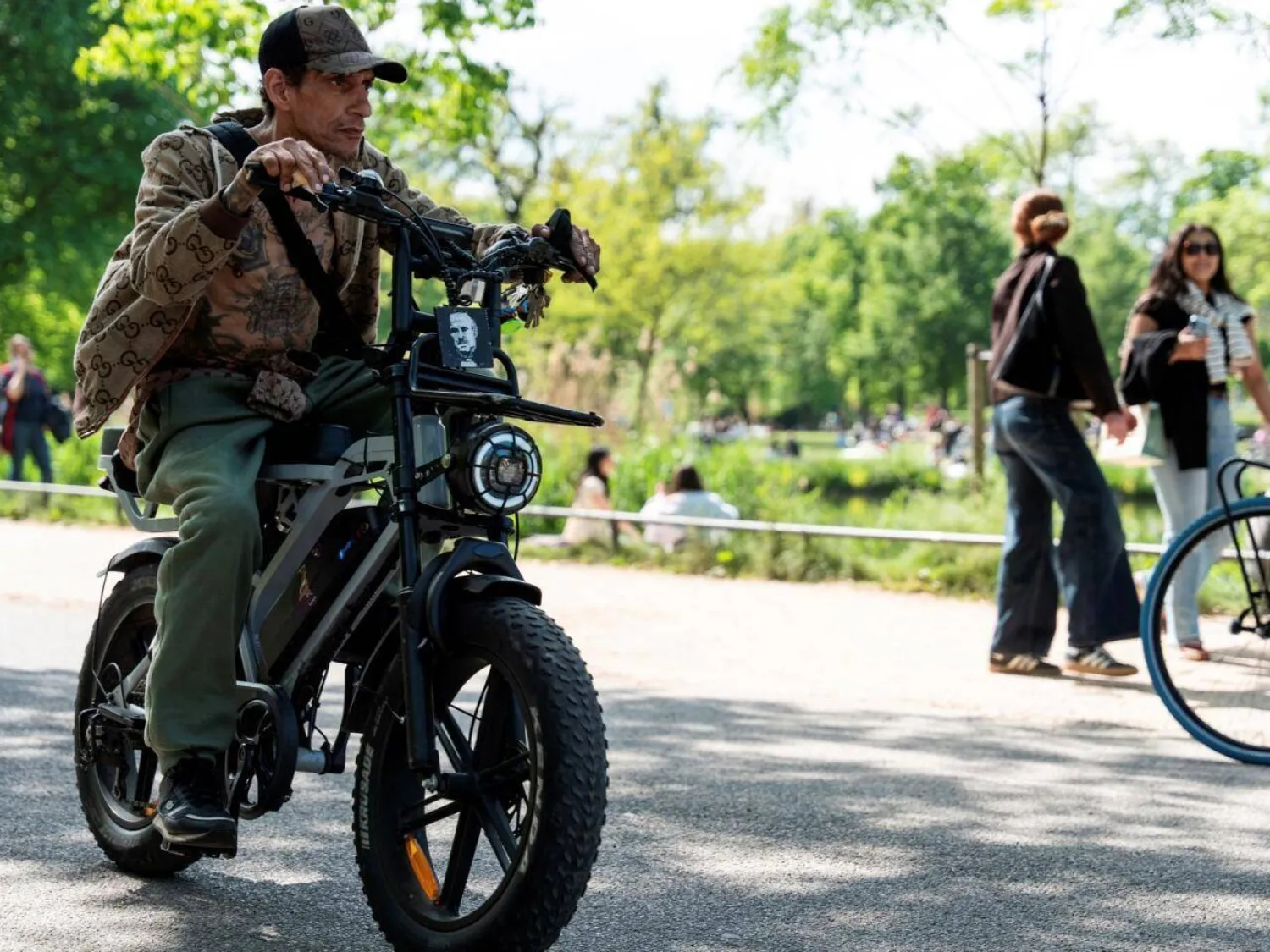
Fatbikes are seen by many as the scourge of the cycle path. Lina Selg / AFP
TT

'Extremely Dangerous': Cycle-mad Amsterdam Slams Brakes on 'Fatbikes'

Fatbikes are seen by many as the scourge of the cycle path. Lina Selg / AFP

Fast, fashionable mode of transport for some, scourge of the cycle path for others: in bike-mad Amsterdam, complaints about "fatbikes" have driven authorities to impose an unprecedented ban in one of the city's top parks.

Hugely popular with children, fatbikes -- so called for their ultra-thick tires -- are electric bikes that look like squat motorcycles and can reach speeds of up to 60 kilometers (37 miles) per hour, said AFP.

Competing for space on busy cycle paths in the famously flat Netherlands, many classic cyclists see fatbikes as a menace due to their superior speed and size.

Complaints of "fatbike gangs" of youths tearing around Dutch cities and causing havoc are also commonplace.

A petition against "aggressive fatbikers" in Amsterdam has garnered 2,400 signatures, complaining: "Pavements are racetracks. Public space no longer feels safe."

So city authorities have decided to ban them in the Vondelpark, a busy park that attracts locals and hordes of tourists on hire bikes or roller skates.

"We get a huge amount of complaints," said Melanie van der Horst, the Amsterdam city official who introduced the ban.

"A few years ago, we only got around 20 complaints about fatbikes. Now we have more than 2,000," she told AFP in an interview in the park.

Aside from the nuisance value, there is a safety aspect, given the fatbikes' popularity among children, added the official.

Fatbikes are supposed to have a maximum speed of around 25 kph, but they are often illegally souped up to reach anywhere between 50 and 60 kph.

"Imagine an 11-year-old child driving around town at 50 kph on a big, souped-up fatbike. It's extremely dangerous," said van der Horst.

Children have been rushed to hospital with serious injuries after fatbike accidents, she said, including brain injuries and torn knee ligaments.

"Doctors say it is the same level of impact as a motorcycle accident."

- 'Goes very fast' -

Visitors to the Vondelpark generally welcomed the ban, with a healthy dollop of the liberal skepticism for which Amsterdam is world-famous.

"I don't think you should ban anything but I do believe that they should have started maybe by banning kids under a certain age... because I think that's the biggest issue," said Aleksandar Rankovic.

"For the park and the people who just want to have peace, I think it's a good thing," the 47-year-old football coach told AFP.

Tanja Meuris, who has recently moved into the area, also welcomed the ban, but admitted she didn't see the difference between a fatbike and a classic electric bike.

"I have an electric bike myself and I think that this thing goes very fast and it can be dangerous if not handled well," said Meuris, 27, a psychologist.

Officially introduced on May 11, the ban applies to all fatbikes with an electric motor and whose tires are more than seven centimeters (about three inches) wide.

From next week, anyone caught riding a fatbike in the Vondelpark will be hit in the wallet.

People over 16 will have to pay a fine of 115 euros ($133). Children between 12 and 15 pay half that.

Children under 12 get away without having to pay the fine, but their parents are informed.

Amsterdam authorities are keeping a close eye on the effects of the ban, which could potentially be extended to other parts of the capital.

Officials in Enschede, in the east of The Netherlands, have also taken action against fatbikes, banning them in the city center.

"We've never seen anything like this before. That's why, to protect our children, I would like to see a national law passed," said van der Horst.

"I would actually just like to get to a situation where children, especially the youngest ones, are simply not allowed to ride these bikes," she said.



Belgium’s Francis Halzen Wins Nobel Prize in Physics

Eva Olsson, Ellen Moons, and Mark Pearce sit in front of a screen displaying Francis Halzen as the recipient of the 2026 Nobel Prize in Physics during a press conference at the Royal Swedish Academy of Sciences in Stockholm, Sweden, on October 6, 2026. (Photo by Christine OLSSON / TT NEWS AGENCY / AFP)
TT

Belgium’s Francis Halzen Wins Nobel Prize in Physics

Eva Olsson, Ellen Moons, and Mark Pearce sit in front of a screen displaying Francis Halzen as the recipient of the 2026 Nobel Prize in Physics during a press conference at the Royal Swedish Academy of Sciences in Stockholm, Sweden, on October 6, 2026. (Photo by Christine OLSSON / TT NEWS AGENCY / AFP)

Belgian Francis Halzen won the Nobel Prize in physics on Tuesday for his contributions to the IceCube Neutrino Observatory and his discovery of high-energy neutrinos of astrophysical origin.

The Royal Swedish Academy of Sciences announced the award in Stockholm.

The prize money this year is 12 million Swedish kronor (about $1.2 million), whether for an individual, a small group of laureates or an organization.

Last year, three scientists won the Nobel Prize in physics for research on the strange behavior of subatomic particles called quantum tunneling that enabled the ultra-sensitive

measurements achieved by MRI machines and laid the groundwork for better cellphones and faster computers.

The announcements of this year's prizes began Monday with the Nobel Prize in medicine being awarded to three scientists whose work led to a tool that uses light to help unravel how the brain works.

This week's awards continue Wednesday with the chemistry prize and literature on Thursday. After Friday’s peace prize is awarded, the Nobel Memorial Prize in Economic Sciences will be announced on Monday.

The prize money this year is 12 million Swedish kronor (about $1.2 million), whether for an individual, a small group of laureates or an organization.


Indonesia Says Will Halt Forest Destruction for Rice Paddies

A man attempts to extinguish flames with a bucket amid thick smoke and fires burning through peatland in Palangkaraya, Central Kalimantan, on October 3, 2026. (Photo by REINA / AFP)
TT

Indonesia Says Will Halt Forest Destruction for Rice Paddies

A man attempts to extinguish flames with a bucket amid thick smoke and fires burning through peatland in Palangkaraya, Central Kalimantan, on October 3, 2026. (Photo by REINA / AFP)

Indonesia said on Tuesday it will halt a project to raze several million hectares of forest to clear land for rice production, saying it had reached self-sufficiency levels of the staple grain.

The government launched a program in 2024 to stop relying on rice imports within five years by clearing three million hectares of land for paddies.

Indonesia is one of the world's most forested countries, and as such a major absorber of planet-warming carbon emissions from mankind's burning of fossil fuel.

It aims to become a net carbon sink by 2030, with forests and other land use absorbing more carbon than they emit.

However, observers have said continuing forest destruction for agriculture and logging, as well as rampant wildfires, could put Indonesia's plans at risk.

President Prabowo Subianto hailed an "important victory" this year after data showed countrywide rice demand had been met with domestic production in one of the world's top consumers of the commodity.

Climate envoy Hashim Djojohadikusumo said on Tuesday the government's strategic reserve rice stock had reached about 5.3 million tonnes.

"The government sees no further need for expanding rice cultivation areas in the so-called forest areas," said Hashim, who is Prabowo's brother.

He added that the government will focus instead on "intensification measures" using superior seeds, for example, to increase rice yields.

It was not known how much forest had already been replaced by rice paddies before the project was halted.

According to the National Food Agency, a government body that seeks to advance food security, Indonesia produced 34.71 million tons of rice in 2025 -- exceeding annual demand of 31.19 million tons.

Haze from wildfires consuming forests and peatlands in Indonesia has blanketed neighboring Malaysia and Singapore for weeks.

Hot, dry conditions associated with the El Nino weather phenomenon have fueled the fires, which are also linked to land clearing.

The Mighty Earth advocacy group welcomed Hashim's announcement, AFP reported.

"This decision renews Indonesia's leadership in showing how to expand agriculture while protecting nature," the NGO's founder, Glenn Hurowitz, said in a statement.

"This decision creates an opportunity for large-scale investments in achieving President Prabowo's goal of restoring 12 million hectares of forest, peat, and other ecosystems," he added.


Vietnam Busts Cat-stealing Ring that Took 2,700 Pets for Food

Stray cats. AFP
Stray cats. AFP
TT

Vietnam Busts Cat-stealing Ring that Took 2,700 Pets for Food

Stray cats. AFP
Stray cats. AFP

Vietnamese police have arrested 12 men accused of stealing nearly 2,700 cats during night raids into residential neighborhoods, taking the pets to be slaughtered for food, police and state media said on Monday.

Fur removal machines, cat traps and measuring scales were among items confiscated during investigations into the alleged cat-stealing ring in Ho Chi Minh City.

Consumption of dogs and cats is legal in Vietnam, where many restaurants openly advertise the meat, but vendors are required to obtain certificates showing the origin of the animals.

Media reports have said that stolen cats can be sold at restaurants for at least 70,000 dong ($2.70) per kilogram.

The 12 men were arrested on allegations of property theft and admitted "to stealing and trafficking approximately 2,700 cats of various types", police said in a statement.

Criminal proceedings began on Sunday, but it was not clear when the men were detained.

The suspects pounced between 11:00 pm and 04:00 am, roaming residential areas on motorbikes in small groups to steal local cats, state media said.

The network was first discovered in July, with police seizing 50 live cats alongside 55 cat traps, two scales and two fur removal machines.

Each team was estimated to have stolen between four and 10 cats per night.

Police in Ho Chi Minh City arrested 18 people earlier this year accused of being part of two separate cat-stealing rings.