


Rubio Says Announcement Possible Later Sunday on Iran War

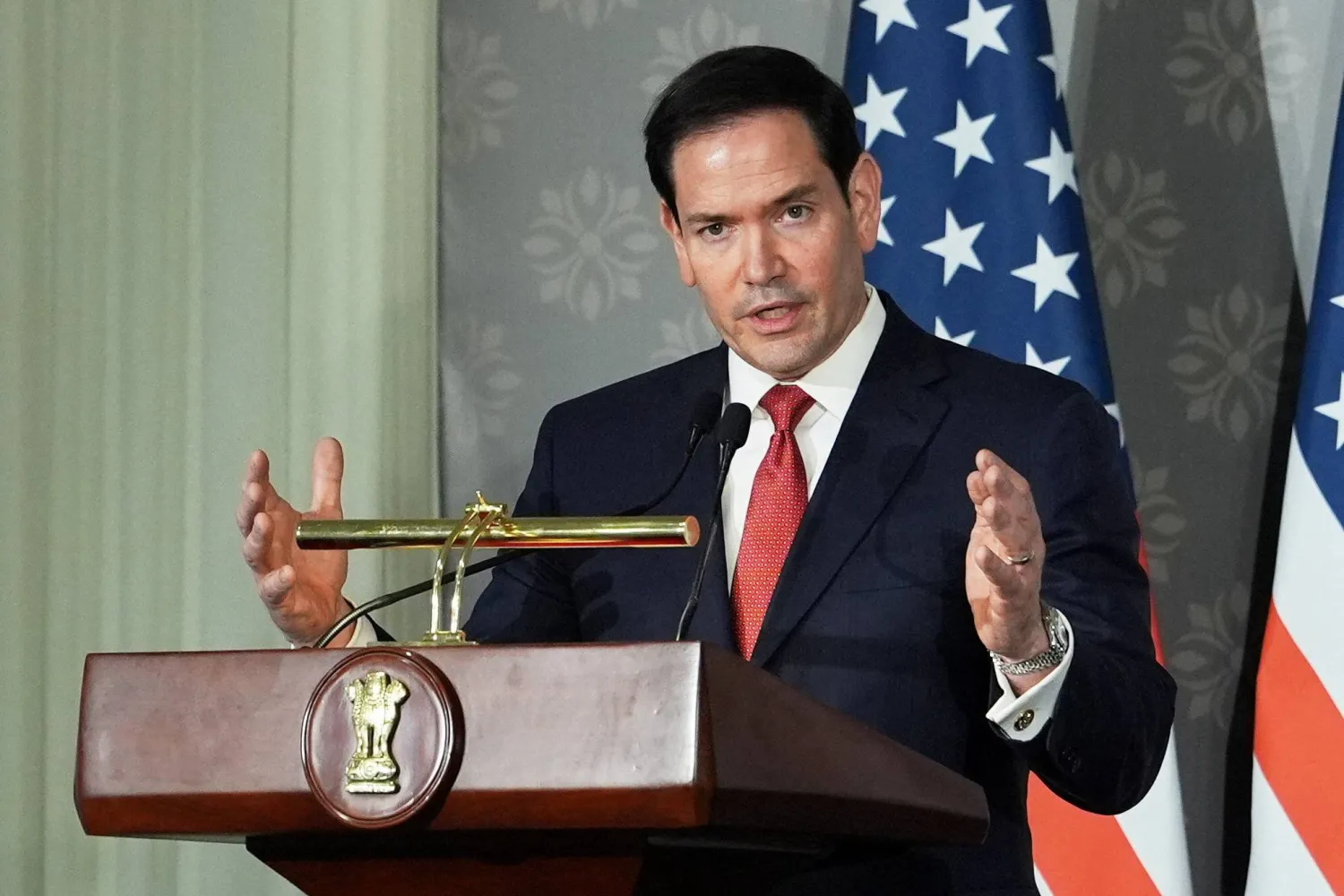
 US Secretary of State Marco Rubio speaks at a joint presser with India’s Minister of External Affairs S. Jaishankar (not pictured) following their talks in New Delhi, India, May 24, 2026. (Julia Demaree Nikhinson/Pool via Reuters)
US Secretary of State Marco Rubio speaks at a joint presser with India’s Minister of External Affairs S. Jaishankar (not pictured) following their talks in New Delhi, India, May 24, 2026. (Julia Demaree Nikhinson/Pool via Reuters)
TT

Rubio Says Announcement Possible Later Sunday on Iran War

 US Secretary of State Marco Rubio speaks at a joint presser with India’s Minister of External Affairs S. Jaishankar (not pictured) following their talks in New Delhi, India, May 24, 2026. (Julia Demaree Nikhinson/Pool via Reuters)
US Secretary of State Marco Rubio speaks at a joint presser with India’s Minister of External Affairs S. Jaishankar (not pictured) following their talks in New Delhi, India, May 24, 2026. (Julia Demaree Nikhinson/Pool via Reuters)

US Secretary of State Marco Rubio said an announcement was possible later Sunday on a deal with Iran that could formally end the Middle East war, insisting goals had been met.

"I do think perhaps there is the possibility that in the next few hours the world will get some good news," Rubio told reporters in New Delhi.

Rubio, who is on his first visit to India, said the emerging deal would address US President Donald Trump's concerns on the Strait of Hormuz, which Iran has largely blocked in response to the US-Israeli attack.

The agreement would also start a "process that can ultimately leave us where the president wants us to be, and that is a world that no longer has to fear or worry about an Iranian nuclear weapon", he added.

His remarks came after Trump said a proposal that included opening the Strait of Hormuz had been "largely negotiated".

"An Agreement has been largely negotiated, subject to finalization between the United States of America, Iran, and the various other Countries," Trump wrote on his Truth Social platform on Saturday.

The emerging agreement has quickly met criticism from usual supporters of Trump including Senator Ted Cruz and Mike Pompeo, Trump's secretary of state in his first term.

Both are staunch supporters of Israel and voiced opposition to Iran soon receiving benefits such as the unimpeded ability to sell its oil.

Cruz said the outcome could be a "disastrous mistake".

Asked about the criticism, Rubio said "no one has been stronger" among US presidents against Iran by launching the war, codenamed Epic Fury.

"When this conflict began with Iran, the goals were outlined, they were very simple, they were very clear -- we were going to destroy their navy, which was done," he said.

Rubio said the United States also aimed to "significantly reduce" Iran's ability to fire ballistic missiles and to "do damage to the defense-industrial base" of the country.

"Those were the objectives of Epic Fury. Those objectives were achieved," Rubio said.


Iran Condemns US Plans to Announce New Sanctions

Iranian people walk past an anti-US mural in Tehran, Iran, 17 August 2026. (EPA)
TT

Iran Condemns US Plans to Announce New Sanctions

Iranian people walk past an anti-US mural in Tehran, Iran, 17 August 2026. (EPA)

Iran on Saturday denounced US plans to announce new sanctions that could put further strain on the country’s economy and have an impact on its most important trading partners including China.

After nearly six months of war since the US and Israel launched airstrikes against Iran on February 28, the sides are not firing at each other but also showing no sign of pursuing peace talks.

Oil shipments are at a virtual standstill in the Strait of Hormuz, with Tehran threatening to strike any unauthorized oil tankers that try to transit the vital waterway, and Iran's economy is already under immense pressure from sanctions.

US Treasury Secretary Scott Bessent is due to hold a press conference at 2 p.m. EDT (1800 GMT) on Monday after threatening "the toughest sanctions in history" on Iran.

Bessent has also urged cooperation with Washington by China, which buys more than 80% of Iran's shipped oil, according to 2025 data from ‌analytics firm Kpler. ‌Beijing has urged diplomacy.

Iran's Foreign Ministry spokesperson, Esmaeil Baghaei, said on Saturday the imminent US announcement of ‌new ⁠economic sanctions was an "assertion ⁠of extraterritorial sovereignty over every independent member state of the United Nations."

"Such secondary sanctions find no foundation in international law," he said in a post on X.

The chief of staff of Iran's armed forces, Major General Ali Abdollahi, promised on Friday that Iran would respond to enemy threats militarily with "crushing, punishing and devastating responses.”

US President Donald Trump, who has warned of economic consequences against any country that provides "any type of lifeline to Iran," said on Friday that Washington was observing "what happens" in the conflict.

"They would love to make a deal, but they're not ready to make the right deal, in my opinion," Trump said of Iran.

HORMUZ TRAFFIC HALTED

While the US has effectively blockaded Iranian vessels in their ports, the Strait of ⁠Hormuz remained bottled up with thousands of seafarers stranded on hundreds of vessels.

Only four commodity ships ‌sailed along the strait on Thursday, none of them large crude carriers or liquefied ‌natural gas tankers, ship-tracking data showed.

However, Iran has granted permission for a number of Iraqi oil tankers to pass through the Strait following repeated requests from ‌Baghdad, Iran’s state news agency IRNA reported on Saturday.

IRNA said obtaining special permission for Iraqi tankers was one of Baghdad’s main requests ‌during a visit to Iraq by Parliament Speaker Mohammad Baqer Qalibaf.

US Energy Secretary Chris Wright said the US military helped move a seven-day average of 8 million barrels a day of oil through the strait. That's down from more than 20 million per day before the war or about one of every five barrels consumed worldwide.

US attacks have severely diminished Iran's economy and devastated its navy and air force, but Tehran maintains enough missile and drone capability ‌to impede oil tanker traffic and attack regional rivals.

Abdollahi, the armed forces chief of staff, sought to underline Iran's missile capabilities during a visit to an underground plant manufacturing ballistic missiles that was reported ⁠by state television on Saturday.

"This ⁠plant has been able, much better than in the past, to produce equipment superior both in capacities and quality and in quantity," he said.

Trump, meanwhile, has yet to achieve objectives he set at the start of the war such as dismantling Iran's nuclear program - the state of which remains uncertain given that UN inspectors have been shut out since 2025 - and creating conditions for Iranians to overthrow their clerical rulers.

Thousands have been killed, mainly in Iran, where 168 Iranian school children were killed on the first day of the war. The US has reported more than 750 military personnel wounded and 18 killed.

While Iran remains defiant, President Masoud Pezeshkian has also called for a diplomatic solution.

"It would be better to end the war today, when we are powerful and have dignity, and the whole world acknowledges our victory and emphasizes that America, contrary to all regulations, attacked our schools, hospitals, and infrastructure and is hated in the world," the ISNA news agency quoted him as saying on Friday.


North Korea Says Record-High Japan Defense Budget Would Risk ‘Turmoil’

North Korean leader Kim Jong Un, accompanied by his daughter Kim Ju Ae and his wife Ri Sol Ju, visits the Revolutionary Martyrs Cemetery on National Liberation Day, in Pyongyang, North Korea, August 14, 2026, in this photo released by North Korea's official Korean Central News Agency (KCNA) on August 15, 2026. (KCNA via Reuters)
TT

North Korea Says Record-High Japan Defense Budget Would Risk ‘Turmoil’

North Korean leader Kim Jong Un, accompanied by his daughter Kim Ju Ae and his wife Ri Sol Ju, visits the Revolutionary Martyrs Cemetery on National Liberation Day, in Pyongyang, North Korea, August 14, 2026, in this photo released by North Korea's official Korean Central News Agency (KCNA) on August 15, 2026. (KCNA via Reuters)

North Korea slammed Japan's reported plans to increase its defense budget, accusing Tokyo on Saturday of preparing for a "war of aggression" as its US ally pursues talks with Pyongyang.

Japan has been gradually moving away from its post-World War II pacifist stance, increasing military spending, ramping up defense pacts and deploying missile launchers to its outer islands.

The Japanese defense ministry is now seeking a "record-high" budget for the upcoming fiscal year, broadcaster NHK and other media outlets reported this week, putting the sum at 8.9 trillion yen ($56 billion).

The budget request "will once again break all-time records", a commentary carried by Pyongyang's official Korean Central News Agency (KCNA) said.

While not yet finalized, the move "clearly signifies a dangerous expansion of the war budget that will bring new turmoil to the region and the world", KCNA said.

"This massive increase in military spending will lead to a buildup of military power to complete preparations for a war of aggression".

The United States, an old Japanese and South Korean ally, meanwhile seeks its own engagement with Pyongyang, with President Donald Trump scaling back annual military drills with Seoul aimed at countering potential threats from the nuclear-armed North.

Trump's order has alarmed allies concerned about US commitments to security in East Asia. Japan this week underlined the "critical" importance of security cooperation with the United States and South Korea.

Trump also said he would meet with North Korean leader Kim Jong Un this year.

Japan occupied all of Korea before its 1945 surrender in World War II, after which the peninsula was divided into separate states along the 38th parallel.

The legacy of the violent colonial period continues to weigh on the foreign policies of both North and South Korea.

China, a key ally of North Korea, has recently expressed alarm at what it sees as "new militarism" by Japan.

Prime Minister Sanae Takaichi's administration is undertaking a major update of the national defense strategy this year in the face of China's expanding military ambitions.

Tokyo has already lifted Japan's self-imposed ban on weapons exports and expanded defense spending, while pushing to amend the pacifist constitution.

Still, Defense Minister Shinjiro Koizumi last week reaffirmed the government's "determination to continue fulfilling our responsibility to uphold Japan's postwar path as a peaceful nation", he said during a visit to a shrine honoring the country's war dead.


US Judge Strikes Down Policy Suspending Immigrant Visa Processing for 75 Nations

Trump pursued a strict immigration policy, which he says aimed to improve national security. (Reuters)
TT

US Judge Strikes Down Policy Suspending Immigrant Visa Processing for 75 Nations

Trump pursued a strict immigration policy, which he says aimed to improve national security. (Reuters)

A US judge on Friday struck down a Trump administration policy suspending the issuance of immigrant visas to applicants from 75 countries, saying that the policy exceeded Secretary of State Marco Rubio's statutory authority.

US District Judge Jeannette Vargas in Manhattan said the policy that the State Department announced in January was "patently unlawful" and ran afoul of federal immigration law, which explicitly stripped the secretary of state of authority over ‌consular officers' ‌processing of immigrant visas.

"The Policy, which ‌categorically ⁠prohibits the issuance ⁠of immigrant visas based upon the nationality of the applicant, represents a direct abrogation of this statutory scheme," she wrote.

The State Department's suspension that also took effect in January impacted applicants from Latin American countries including Brazil, Colombia, and Uruguay; Balkan nations such as Bosnia ⁠and Albania; South Asian countries Pakistan and Bangladesh; ‌and those from ‌many nations in Africa, the Middle East, and the Caribbean.

The State ‌Department said applicants from those countries were "at a ‌high risk for becoming a public charge and recourse to local, state and federal government resources in the United States." The department did not immediately respond to a request for ‌comment on the ruling.

Vargas, an appointee of Democratic former President Joe Biden, issued ⁠the ruling ⁠in a lawsuit filed by immigrant rights groups Catholic Legal Immigration Network and African Communities Together along with applicants for immigrant visas and US citizens who are sponsoring family members from the designated countries for immigrant visas.

President Donald Trump has pursued an aggressive immigration crackdown that he says is aimed at improving domestic security. Rights groups say the crackdown has violated free speech and due process rights and has created an unsafe environment, particularly for ethnic minorities, who have raised concerns about racial profiling
