

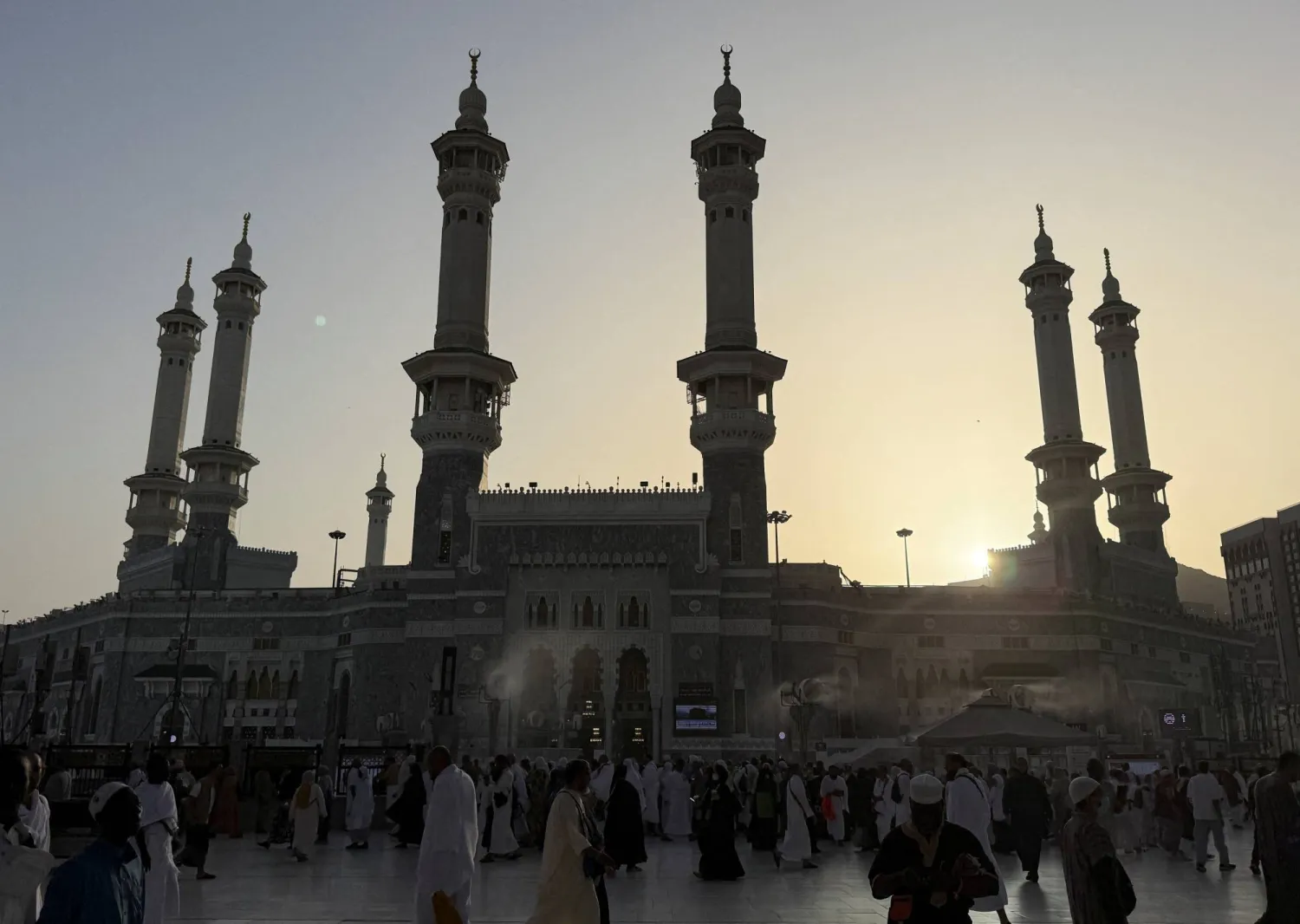

Technology Powers Hajj Season as Advanced Digital Network Supports Millions of Pilgrims

Muslim pilgrims at the Grand Mosque complex, ahead of the annual hajj pilgrimage, in the holy city of Makkah, Saudi Arabia, May 22, 2026. REUTERS/Ibraheem Abu Mustafa
TT

Technology Powers Hajj Season as Advanced Digital Network Supports Millions of Pilgrims

Muslim pilgrims at the Grand Mosque complex, ahead of the annual hajj pilgrimage, in the holy city of Makkah, Saudi Arabia, May 22, 2026. REUTERS/Ibraheem Abu Mustafa

As millions of pilgrims move between the holy sites in scenes of profound devotion and spirituality, a vast and sophisticated digital network operates quietly behind the scenes to ensure uninterrupted communications, stable digital services, efficient app performance, and the continuous real-time flow of data.

At the center of this system is the Communication, Space and Technology Commission (CST), which, in partnership with telecom service providers, drives one of the world’s most complex technology operations during the Hajj season, the Saudi Press Agency reported on Monday.

What was once primarily the management of massive crowds has evolved into a global model for operating a temporary smart city functioning at extraordinary intensity, with digital infrastructure forming a core pillar of the Hajj season’s logistical, health, security, and service operations.

Each year, the CST works to elevate the readiness of digital infrastructure across Makkah and the holy sites in coordination with technology service providers to maintain network stability and communication quality in some of the world’s most densely crowded locations.

Its efforts include boosting internet speeds, ensuring the quality of local and international calls, and facilitating access to government services. The commission oversees telecommunications towers, fiber-optic networks, 5G and 4G systems, Wi-Fi access points, data centers, and indoor coverage systems.

The CST also deploys smart solutions, including real-time analytics, crowd management systems, AI, the Internet of Things, and drones, to enhance the pilgrim experience.

The efforts reflect Saudi Arabia’s digital transformation in managing Hajj, where technology has become an essential element in delivering a more efficient, flexible, and secure experience.

Behind every message sent, every app used, and every stable connection maintained among millions of users lies a vast digital ecosystem managed with precision, underscoring how technology has evolved into a fundamental part of the modern Hajj journey.



The Sunhat is Everywhere in Athens as Crowds Grow Larger at Ancient Sites

Tourists wearing hats take photographs on the rocky Areios Pagos Hill next to the Acropolis in Athens, Greece, Friday, Aug. 14, 2026. (AP Photo/Thanassis Stavrakis)
TT

The Sunhat is Everywhere in Athens as Crowds Grow Larger at Ancient Sites

Tourists wearing hats take photographs on the rocky Areios Pagos Hill next to the Acropolis in Athens, Greece, Friday, Aug. 14, 2026. (AP Photo/Thanassis Stavrakis)

Outside the Acropolis, a sea of hats bobs up and down the hill to the ancient site: straw boaters, Panama hats, baseball caps and bucket hats in the relentless heat.

Hat racks are hard to miss in central Athens this summer. Kiosks and stores keep outdoor stands piled high as more tourists seek relief from the midday heat.

The Acropolis drew about 4.6 million visitors in 2025, a record year for Greek tourism. Many spend hours in mid-30s Celsius (mid-90s Fahrenheit) temperatures with little shade. Even a carriage horse at the foot of the ancient monument has joined in, sporting a brown bucket hat with holes cut for its ears.

“You need a hat. I’m already red as it is,” said Jack Yosif, an Australian tourist wearing a black baseball cap. “It’s a bit more of a common thing nowadays, and people are a bit more aware.”

Scorching temperatures didn't deter a record 38 million visitors last year, the most recent for which there is data. The combination of extreme heat and high demand for sites — which means not everyone can visit in the morning — is adding urgency to sun protection.

Greek health campaigners have welcomed a growing awareness of the dangers of ultraviolet exposure and risk of heat stroke. Red Cross volunteers at the Acropolis hand out kits with sunscreen, water, information leaflets and red caps, The Associated Press reported.

Hats are displayed alongside materials using in their production on hangers and shelves at a shop in Athens, Greece, Tuesday, Aug. 11, 2026. (AP Photo/Thanassis Stavrakis)

On nearby Syntagma Square, kiosk owner Konstantinos Mallios says hat sales have risen in recent years. His stylish and souvenir models run up to 20 euros ($24) while the cheapest costs 6 euros. Available elsewhere is semi-disposable headgear: mass-produced hats made using compressed paper pulp.

And there are more ostentatious options. At her basement workshop, hatmaker Lisa Sarigiannidou turns straw braids into boaters using century-old presses and molds in a matter of minutes. Her hats start at around 50 euros, with elaborate designs costing more than 100 euros.

“People’s attitudes toward hats have changed,” said Sarigiannidou, who was trained by her hatmaker father. “In the past, when a young woman tried on a hat and looked at herself in the mirror, she usually laughed. Now they try them on seriously ... and they wear them straight out the door.”


King Salman bin Abdulaziz Royal Reserve Highlights Two Distinctive Native Shrubs

The King Salman Bin Abdulaziz Royal Natural Reserve (SPA).
TT

King Salman bin Abdulaziz Royal Reserve Highlights Two Distinctive Native Shrubs

The King Salman Bin Abdulaziz Royal Natural Reserve (SPA).

King Salman bin Abdulaziz Royal Reserve is distinguished by its unique natural plant diversity and its captivating natural features, highlighted by distinctive plants that add exceptional beauty to its various environments. Among the most prominent plant features found across most areas of the reserve are Al-Rmath (Haloxylon salicornicum) and Al-Qaisum (white wormwood).

Al-Rmath is a perennial shrub in the family Amaranthaceae and is widespread throughout most of the reserve.

According to SPA, it can reach a height of 120 centimeters and is characterized by bluish-green stems that turn gray with age, as well as scale-like leaves and tiny yellow flowers.

Al-Qaisum is also a perennial aromatic shrub belonging to the Asteraceae family. It grows in clay flats, valleys, ravines, and most areas of the reserve.

It can reach a height of 60 centimeters and is distinguished by its white stems, oval to oblong leaves with serrated edges, and small yellow flowers.


Lebanon Arrests ‘Doctor Food’ over Drug-laced Treats

Georges Dib, known on TikTok as "Doctor Food." Photo: Social media
TT

Lebanon Arrests ‘Doctor Food’ over Drug-laced Treats

Georges Dib, known on TikTok as "Doctor Food." Photo: Social media

Lebanon on Sunday arrested an online influencer known for his videos about food who had been handed a life sentence in absentia for drug trafficking, a judicial source told AFP.

Georges Dib, known on TikTok as "Doctor Food" and followed by more than eight million accounts, was apprehended at his home in the far north governorate of Akkar, the source said, speaking on condition of anonymity.

Dib, who also owns a confectionery business, would be taken to a detention center in Mount Lebanon, where he would face a new trial on further drug trafficking charges, the source added.

Two years ago, the Lebanese judiciary issued a warrant for Dib, accusing him of "manufacturing narcotics, trafficking and smuggling them abroad,” according to Lebanon's state-run National News Agency (NNA).

The NNA said at the time that authorities had seized confectionery and other food products at Beirut's international airport that contained narcotics and were manufactured in factories owned by Dib.

The products were to be shipped to a Gulf country, the news agency reported.

Despite an arrest warrant and conviction against him, Dib continued to post videos on TikTok.

Last month, after news of his conviction was made public, he denied the accusations in one of his videos, urging followers not to listen to what was being said about him.

Dib rose to prominence on social media posting content about cooking and daily life with his ex-wife, known as Shorouk, a Canadian of Palestinian origin who has more than 15 million followers.

They separated after she accused him of abuse. On Saturday night, she held a "divorce party" at a seaside resort in Lebanon attended by thousands of her followers.