


‘He’s Tiny! It’s Blue!’: Scientists Find New Deep-Sea Octopus

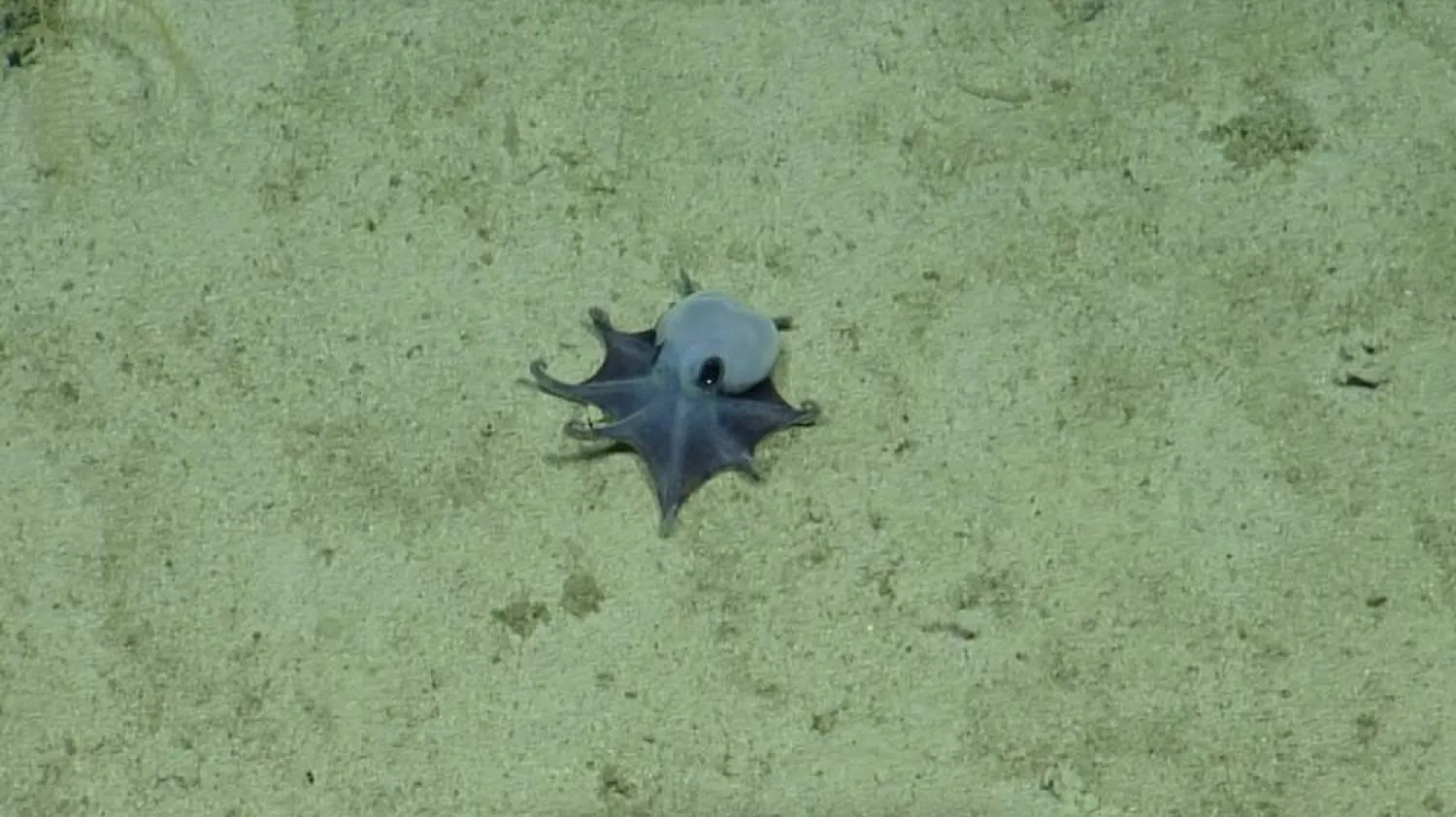
An undated handout picture released on May 22, 2026 by the Charles Darwin Foundation shows a newly discovered blue pygmy octopus off the Galapagos Islands. (Charles Darwin Foundation / AFP)
TT

‘He’s Tiny! It’s Blue!’: Scientists Find New Deep-Sea Octopus

An undated handout picture released on May 22, 2026 by the Charles Darwin Foundation shows a newly discovered blue pygmy octopus off the Galapagos Islands. (Charles Darwin Foundation / AFP)

On the ocean floor near the Galapagos Islands, a submersible controlled by scientists came across a mysterious octopus as blue as the ocean and no bigger than a golf ball.

"He's tiny! It's blue!" one excited scientist was recorded as saying when she first caught sight of the cerulean cephalopod on footage transmitted from the sub.

The team from the Charles Darwin Foundation had just discovered a new species of octopus nearly 1,800 meters (5,900 feet) below the water's surface, according to research published on Monday.

"Right away, I knew it was something really special," said octopus expert Janet Voight, who was asked to identify the strange species.

At first the curator at the Field Museum of Natural History in Chicago had to make do with photos of the animal.

Then she received its preserved body in the mail.

"When it arrived, I was like 'Oh! My goodness! It's beautiful'," Voight told AFP.

She was immediately interested because the closest known octopus of that shape lives off the coast of Uruguay -- in a different ocean on the other side of South America.

Normally to describe a new octopus species, a specimen needs to be cut open so that its mouth, beak, teeth and other parts can be examined.

"We only had the one specimen, so I didn't want to take it apart," Voight said.

Instead, the team at the Field Museum used CT scans to take thousands of X-ray images, then compiled them to make a 3D model of the octopus, revealing its insides.

"There's nothing like spending the day looking at something no other human has ever seen," the Field Museum's X-ray lab head Stephanie Smith said in a statement.

- 'Deep purple' -

The new species, named Microeledone galapagensis, stands out for reasons other than its blue hue, which is believed to be the rarest color in nature.

The octopus appears to be the runt of the Megaleledonidae family, whose members are normally much larger and live in the Southern Ocean surrounding Antarctica.

"Its stubby little arms with only one row of suckers set it apart from most octopus we are familiar with," Voight said.

Even among "other species with short little arms and a single sucker row, its coloration and smooth skin on the back surface separate it", she added.

While the octopus is light blue on its back, underneath it is a "very deep purple", Voight said.

"We think this color pattern helps keep it safe. If the octopus grabs a prey item that emits light, that light may attract predators that might then eat the octopus," she explained.

"So the octopus puts its dark-colored web over the prey item, keeping itself safe."

Surprisingly, it is not uncommon to find new species of octopus in the deep sea -- particularly in areas that have not been well explored, which is a massive amount of the ocean floor.

"If you took all the land on Earth and pieced it together, you would not cover the Pacific Ocean," Voight pointed out.

She added that she had last seen a new octopus in 2023, off the coast of Costa Rica.

The first sighting of the new blue octopus was made in 2015 near Darwin Island, named after the English scientist whose visit to the Galapagos helped him form the theory of evolution.

Voight's research on the species was published in the journal Zootaxa.


The Sunhat is Everywhere in Athens as Crowds Grow Larger at Ancient Sites

Tourists wearing hats take photographs on the rocky Areios Pagos Hill next to the Acropolis in Athens, Greece, Friday, Aug. 14, 2026. (AP Photo/Thanassis Stavrakis)
TT

The Sunhat is Everywhere in Athens as Crowds Grow Larger at Ancient Sites

Tourists wearing hats take photographs on the rocky Areios Pagos Hill next to the Acropolis in Athens, Greece, Friday, Aug. 14, 2026. (AP Photo/Thanassis Stavrakis)

Outside the Acropolis, a sea of hats bobs up and down the hill to the ancient site: straw boaters, Panama hats, baseball caps and bucket hats in the relentless heat.

Hat racks are hard to miss in central Athens this summer. Kiosks and stores keep outdoor stands piled high as more tourists seek relief from the midday heat.

The Acropolis drew about 4.6 million visitors in 2025, a record year for Greek tourism. Many spend hours in mid-30s Celsius (mid-90s Fahrenheit) temperatures with little shade. Even a carriage horse at the foot of the ancient monument has joined in, sporting a brown bucket hat with holes cut for its ears.

“You need a hat. I’m already red as it is,” said Jack Yosif, an Australian tourist wearing a black baseball cap. “It’s a bit more of a common thing nowadays, and people are a bit more aware.”

Scorching temperatures didn't deter a record 38 million visitors last year, the most recent for which there is data. The combination of extreme heat and high demand for sites — which means not everyone can visit in the morning — is adding urgency to sun protection.

Greek health campaigners have welcomed a growing awareness of the dangers of ultraviolet exposure and risk of heat stroke. Red Cross volunteers at the Acropolis hand out kits with sunscreen, water, information leaflets and red caps, The Associated Press reported.

Hats are displayed alongside materials using in their production on hangers and shelves at a shop in Athens, Greece, Tuesday, Aug. 11, 2026. (AP Photo/Thanassis Stavrakis)

On nearby Syntagma Square, kiosk owner Konstantinos Mallios says hat sales have risen in recent years. His stylish and souvenir models run up to 20 euros ($24) while the cheapest costs 6 euros. Available elsewhere is semi-disposable headgear: mass-produced hats made using compressed paper pulp.

And there are more ostentatious options. At her basement workshop, hatmaker Lisa Sarigiannidou turns straw braids into boaters using century-old presses and molds in a matter of minutes. Her hats start at around 50 euros, with elaborate designs costing more than 100 euros.

“People’s attitudes toward hats have changed,” said Sarigiannidou, who was trained by her hatmaker father. “In the past, when a young woman tried on a hat and looked at herself in the mirror, she usually laughed. Now they try them on seriously ... and they wear them straight out the door.”


King Salman bin Abdulaziz Royal Reserve Highlights Two Distinctive Native Shrubs

The King Salman Bin Abdulaziz Royal Natural Reserve (SPA).
TT

King Salman bin Abdulaziz Royal Reserve Highlights Two Distinctive Native Shrubs

The King Salman Bin Abdulaziz Royal Natural Reserve (SPA).

King Salman bin Abdulaziz Royal Reserve is distinguished by its unique natural plant diversity and its captivating natural features, highlighted by distinctive plants that add exceptional beauty to its various environments. Among the most prominent plant features found across most areas of the reserve are Al-Rmath (Haloxylon salicornicum) and Al-Qaisum (white wormwood).

Al-Rmath is a perennial shrub in the family Amaranthaceae and is widespread throughout most of the reserve.

According to SPA, it can reach a height of 120 centimeters and is characterized by bluish-green stems that turn gray with age, as well as scale-like leaves and tiny yellow flowers.

Al-Qaisum is also a perennial aromatic shrub belonging to the Asteraceae family. It grows in clay flats, valleys, ravines, and most areas of the reserve.

It can reach a height of 60 centimeters and is distinguished by its white stems, oval to oblong leaves with serrated edges, and small yellow flowers.


Lebanon Arrests ‘Doctor Food’ over Drug-laced Treats

Georges Dib, known on TikTok as "Doctor Food." Photo: Social media
TT

Lebanon Arrests ‘Doctor Food’ over Drug-laced Treats

Georges Dib, known on TikTok as "Doctor Food." Photo: Social media

Lebanon on Sunday arrested an online influencer known for his videos about food who had been handed a life sentence in absentia for drug trafficking, a judicial source told AFP.

Georges Dib, known on TikTok as "Doctor Food" and followed by more than eight million accounts, was apprehended at his home in the far north governorate of Akkar, the source said, speaking on condition of anonymity.

Dib, who also owns a confectionery business, would be taken to a detention center in Mount Lebanon, where he would face a new trial on further drug trafficking charges, the source added.

Two years ago, the Lebanese judiciary issued a warrant for Dib, accusing him of "manufacturing narcotics, trafficking and smuggling them abroad,” according to Lebanon's state-run National News Agency (NNA).

The NNA said at the time that authorities had seized confectionery and other food products at Beirut's international airport that contained narcotics and were manufactured in factories owned by Dib.

The products were to be shipped to a Gulf country, the news agency reported.

Despite an arrest warrant and conviction against him, Dib continued to post videos on TikTok.

Last month, after news of his conviction was made public, he denied the accusations in one of his videos, urging followers not to listen to what was being said about him.

Dib rose to prominence on social media posting content about cooking and daily life with his ex-wife, known as Shorouk, a Canadian of Palestinian origin who has more than 15 million followers.

They separated after she accused him of abuse. On Saturday night, she held a "divorce party" at a seaside resort in Lebanon attended by thousands of her followers.
