


How Collecting DNA Samples in the Wild Could Transform Conservation

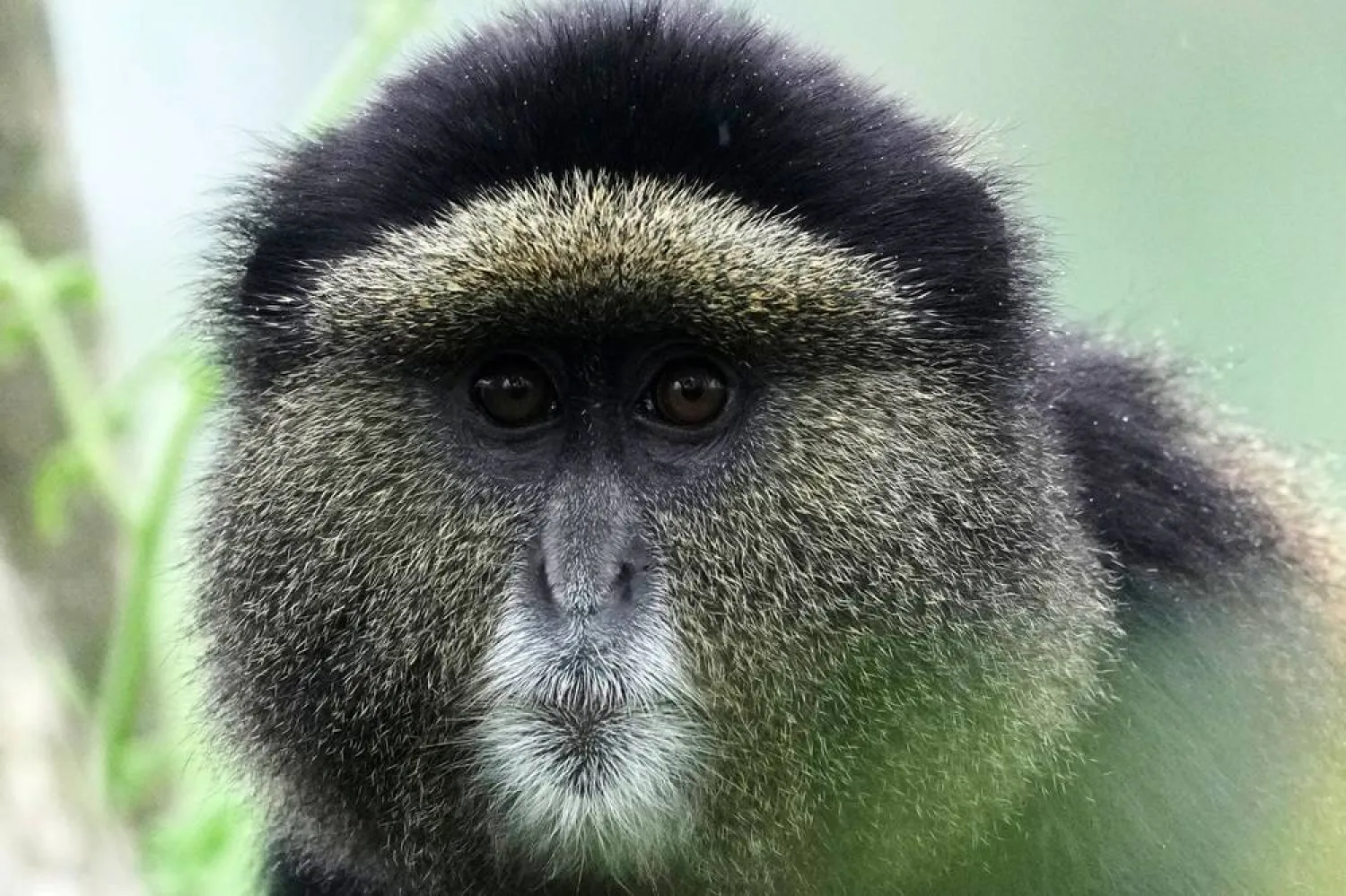
A golden monkey is seen in Volcanoes National Park in Kinigi, Rwanda, Thursday, March 19, 2026. (AP)
TT

How Collecting DNA Samples in the Wild Could Transform Conservation

A golden monkey is seen in Volcanoes National Park in Kinigi, Rwanda, Thursday, March 19, 2026. (AP)

A guide called out to endangered golden monkeys with grunts and clicks to signal he posed no threat, a familiar sound in the mist-covered forests of Rwanda ’s Volcanoes National Park.

Here in one of Africa's most well-known parks, steep ridges and dense vegetation often obscure even the largest mountain gorillas — also endangered — and scientists are turning to new technology to detect and protect them.

Known as environmental DNA, or eDNA, the technology allows researchers to identify species using genetic material like fur or feces left in soil and water. This reduces the impact of human interaction during wildlife surveys that can leave researchers groping through the mist.

The technology, more often used in marine conservation work, was introduced by the African Wildlife Foundation in partnership with the Rwandan government. It aims to develop a list of all species in the country. That will help protect biodiversity that is threatened by climate change and population growth.

“We selected eDNA as a new technology to bring solutions and to complement existing methods used in ecological monitoring,” said the foundation’s country manager for Rwanda, Patrick Nsabimana.

Biodiversity monitoring for decades has relied on camera traps, which operate when animals trigger their sensors, and ranger observations.

But that is a challenge in rugged terrain such as the Virunga mountains that are central to Volcanoes National Park, which covers part of Rwanda, Uganda and Congo. Insecurity in the border area also can limit ranger movement.

Nsabimana said eDNA is a cost-effective monitoring approach in large ecosystems such as Virunga. Samples are taken from locations like downstream ponds that are likely to have traces of animals on higher ground. Then they are tested.

“With one sample, you can detect multiple species, mammals, birds, amphibians and many others,” said Deogratias Tuyisingize, a Rwanda-based biodiversity researcher with the Dian Fossey Gorilla Fund that is also involved in the project.

He said a combination of traditional methods and new technology is needed to ensure all species are monitored. Because of steep ravines and mountainsides, “we are sure we were missing some species."

Meanwhile, having a better sense of where endangered species are could help in patrolling against poachers, people with the project said.

The ability to generate a broad snapshot of biodiversity is critical for conservation, especially as Rwanda expands some of its national parks by rehabilitating previously agricultural land.

“We can see how species are colonizing these sites over time,” Tuyisingize said.

That allows conservationists to measure success by the return of rare or threatened species, and offers early warnings of invasive species.

But the eDNA technology is not without limitations. It cannot reliably estimate how many animals are present in an ecosystem. DNA can linger long after a species has left.

Being able to process samples in Rwanda is also a challenge, as the project's initial ones had to be sent to Europe for analysis.

Joshua Newton, who conducted research on eDNA for Curtin University’s Trace and Environmental DNA Laboratory, said challenges also include having cold storage to preserve DNA samples and ensuring samples are not contaminated.

Data gaps are another issue. Africa has relatively limited genetic reference libraries, despite decades of conservation work on the continent, making it harder to match DNA samples to known species.

Most genetic reference libraries come from Europe and America, said James Munyawera, a lab specialist with the Dian Fossey Gorilla Fund.

Researchers are now building region-specific databases.

The project in Volcanoes National Park has also begun training residents of local communities, along with rangers, to participate in monitoring efforts by collecting samples.



Brooch Given to First Passenger to Board Doomed Steamship Found at Roadshow

The brooch contains a dedication with the date April 21 1894 (AP)
TT

Brooch Given to First Passenger to Board Doomed Steamship Found at Roadshow

The brooch contains a dedication with the date April 21 1894 (AP)

A brooch given to the first passenger to board a Dundee-built steamship 37 years before she sank has surfaced at an antiques roadshow.

The decorative item was presented to Elizabeth Anderson on April 21 1894, the date of the maiden voyage of the SS Citrine, according to the British website ‘itv News.’

Built by Dundee shipbuilders W B Thompson & Co, the Citrine was one of a number of vessels in the Glasgow-based “Gem line,” all of which were named after gemstones or minerals.

The shipping firm was owned by William Robertson, who started out with a single barge in 1852 before growing it into one of the largest coastal bulk shipping fleets in Britain.

The brooch was presented to Anderson by Robertson and is inscribed with the words “SS Citrine, April 21 1894, Elizabeth McIntyre Anderson, from William Robertson.”

The sides of the gold-colored item are shaped as a ship’s rope and its center has been designed as a life ring mounted with a citrine stone, echoing the name of the vessel.

The Citrine sank on March 17 1931 after striking rocks at Bradda Head, Port Erin, on the Isle of Man.

Accounts at the time described the ship’s final moments in darkness, heavy weather and confusion, and the disaster claimed the lives of nine of her 11 crew members.

William Robertson had been dead for 12 years by the time of the sinking but the business remained in family hands under his sons, William Francis Robertson and James Robertson.
The brooch was discovered at a WeBuyVintage roadshow in Fleetwood, Lancashire.


NASA Robot Mission Aiming to Rescue Space Telescope

This handout photo released by NASA on July 31, 2004, shows the Swift spacecraft being unwrapped in Hangar AE at Cape Canaveral Air Force Station at Kennedy Space Center, Florida. (Photo by Handout / NASA / AFP)
TT

NASA Robot Mission Aiming to Rescue Space Telescope

This handout photo released by NASA on July 31, 2004, shows the Swift spacecraft being unwrapped in Hangar AE at Cape Canaveral Air Force Station at Kennedy Space Center, Florida. (Photo by Handout / NASA / AFP)

NASA on Tuesday is set to launch a daring robotic rescue mission, a long shot bid to prevent one of its aging telescopes from vanishing into dust.

If successful, the effort could pave the way for giving other satellites a second life.

The operation is set to last several months, kicking off with the launch of a robot designed to rescue the Swift space telescope that's currently falling towards Earth.

Without intervention, Swift is expected to soon burn up in the atmosphere.

The rescue spacecraft developed by the US startup Katalyst is slated to lift off Tuesday at 1023 GMT from a Pacific Ocean atoll aboard a small rocket named Pegasus.

The rocket-propelled launch vehicle will not take off from a launch pad. Instead, it will be released from a jet.

"Everything about this mission is so crazy," said NASA astrophysicist Regina Caputo with a laugh during an interview with AFP.

After it reaches an orbit near that of the telescope, the robot must locate Swift across the vastness of space.

The aim is then for the robot to maneuver around the telescope and latch on with three movable arms.

It will then vie to tow Swift into a stable orbit over the course of at least a month, rescuing it from destruction by moving it about 300 kilometers higher.

"This is a lot of firsts stacked on top of each other," said Shawn Domagal-Goldman, the director of NASA's astrophysics division, during a recent call with reporters.

"I'm just deeply thankful that we're even giving this a go."

The idea of such a rescue might seem odd at first glance.

The Neil Gehrels Swift Observatory telescope was launched in 2004, and was originally designed for a two-year mission.

The device was intended to study gamma-ray bursts, what Caputo called "the most energetic things that happen in the universe."

She likened it to a supercharged version of a supernova, which is a dramatic, explosive death of a star.

Gamma-ray bursts are extremely brief, she explained, so the telescope was placed at an altitude of approximately 600 kilometers in low Earth orbit, so it could remain in constant communication with researchers.

But with that pro came a con -- at such an altitude, the device without its own propulsion would eventually drift closer to Earth and burn up in the atmosphere.

Caputo said that phenomenon was expected and normal, because when the Sun is in its more active cyclical stages, it emits more particles and causes an expansion of Earth's atmosphere.

That creates drag, meaning satellites in low Earth orbit lose altitude.

Yet when forecasts in early 2025 indicated the telescope was nearing the end of its life, NASA began considering a possible rescue.

"We decided, yeah, we want to go save this one this time, because of how special it is," said Domagal-Goldman.

Despite its age, the Swift telescope remains in high demand within the scientific community, not least for its rapid response capabilities.

Should it burn up, it could not be immediately replaced.

The mission attempting unprecedented maneuvers has a projected cost of $30 million to save the device, which originally cost $250 million.

The rescue robot named LINK will have to overcome numerous challenges and unknowns.

For example, engineers do not have a clear picture of what the back of the telescope actually looks like -- even though that's where the robot must latch on.

With a laugh, Caputo projected the chances of success at "maybe 50-50."

Still, both NASA and the company Katalyst believe the mission -- which could run into the fall -- might pave the way for new possibilities in spacecraft management, and is worth a shot.

Robert Lamontagne, a vice president at Katalyst, said during a call with journalists that it could represent the "start of a new model" to "refuel, reposition, repurpose, repair, and even upgrade satellites, even if they were never prepared for it."


Rare Dinosaur Fossil from Antarctica is Found Tucked Away in a Drawer

This image provided by the Natural History Museum shows a fossil found in Antarctica that belongs to a group of dinosaurs called titanosaurs. (Natural History Museum via AP)
TT

Rare Dinosaur Fossil from Antarctica is Found Tucked Away in a Drawer

This image provided by the Natural History Museum shows a fossil found in Antarctica that belongs to a group of dinosaurs called titanosaurs. (Natural History Museum via AP)

Scientists have stumbled on a rare dinosaur fossil from Antarctica, tucked away for decades in a drawer.

The bone comes from the tail of a long-necked, plant-eating dinosaur called a titanosaur. Scientists haven't yet identified the species it belongs to, The Associated Press reported.

It was discovered in 1985 during an expedition to Antarctica's James Ross Island and collected by geologist Mike Thomson. Working with the British Antarctic Survey, Thomson was mapping the area's rock layers and collected marine reptile fossils to help with future dating efforts. He recorded the find as a large reptile.

Decades later, paleontologist Mark Evans spotted the bone in the British Antarctic Survey's collections and wondered whether it might be a dinosaur.

He and other researchers analyzed the shape of the bone and compared it to other more complete dinosaur remains, confirming their discovery. The findings were published on Monday in the journal Acta Palaeontologica Polonica.

Dinosaur fossils are rare to find in Antarctica because of the unforgiving ice caps. But millions of years ago, when this dinosaur lived, the region was populated by lush forests — a “rather different and much more hospitable place than we think of today,” said study co-author Paul Barrett with the Natural History Museum in London.

At about 23 feet (7 meters) long, the dinosaur was small for its group and may have been young when it died. Scientists don't know how the creature met its end, but they think its body floated away from the coast and sank to the sea floor, becoming fossilized in marine rock.

Technology has come a long way since the dinosaur tail bone was first found, allowing researchers to peer inside bones and gain even more detailed information about ancient creatures. Thomson died in 2020 before the fossil was identified as belonging to a dinosaur.

“If he were still with us, he would be delighted to know what this was,” Evans, a study co-author, said.