



More Climate Records Under Threat as Spring Heatwave Bakes Western Europe

A woman shields herself from the sun with a newspaper as she crosses London Bridge during a heatwave in London, Britain, May 26, 2026. REUTERS/Jack Taylor
TT

More Climate Records Under Threat as Spring Heatwave Bakes Western Europe

A woman shields herself from the sun with a newspaper as she crosses London Bridge during a heatwave in London, Britain, May 26, 2026. REUTERS/Jack Taylor

Western Europe faced another day of record-breaking temperatures Tuesday as a heatwave pushed the mercury well above normal levels for May.

A so-called "heat dome" of warm air from northern Africa trapped under a high-pressure system over western Europe is behind the sort of heat not usually seen until high summer.

France's weather agency reported that Monday was its hottest day in the month of May on record -- with Tuesday forecast to be even hotter -- while the United Kingdom also posted unprecedented highs and Italy imposed restrictions on outdoor work.

French authorities on Tuesday also reported at least seven deaths linked to the heatwave -- five of which were drownings, as many people sought relief on beaches and other bodies of water, AFP reported.

Scientists say human-driven climate change is amplifying such extremes, with weather events like heatwaves, droughts and floods becoming more intense and frequent.

The United Kingdom's Met Office weather agency said Monday was the hottest May day on record, with temperatures hitting 34.8C at Kew Gardens, southwest London -- a full two degrees above the previous high.

The Met Office forecast a drop later in the week.
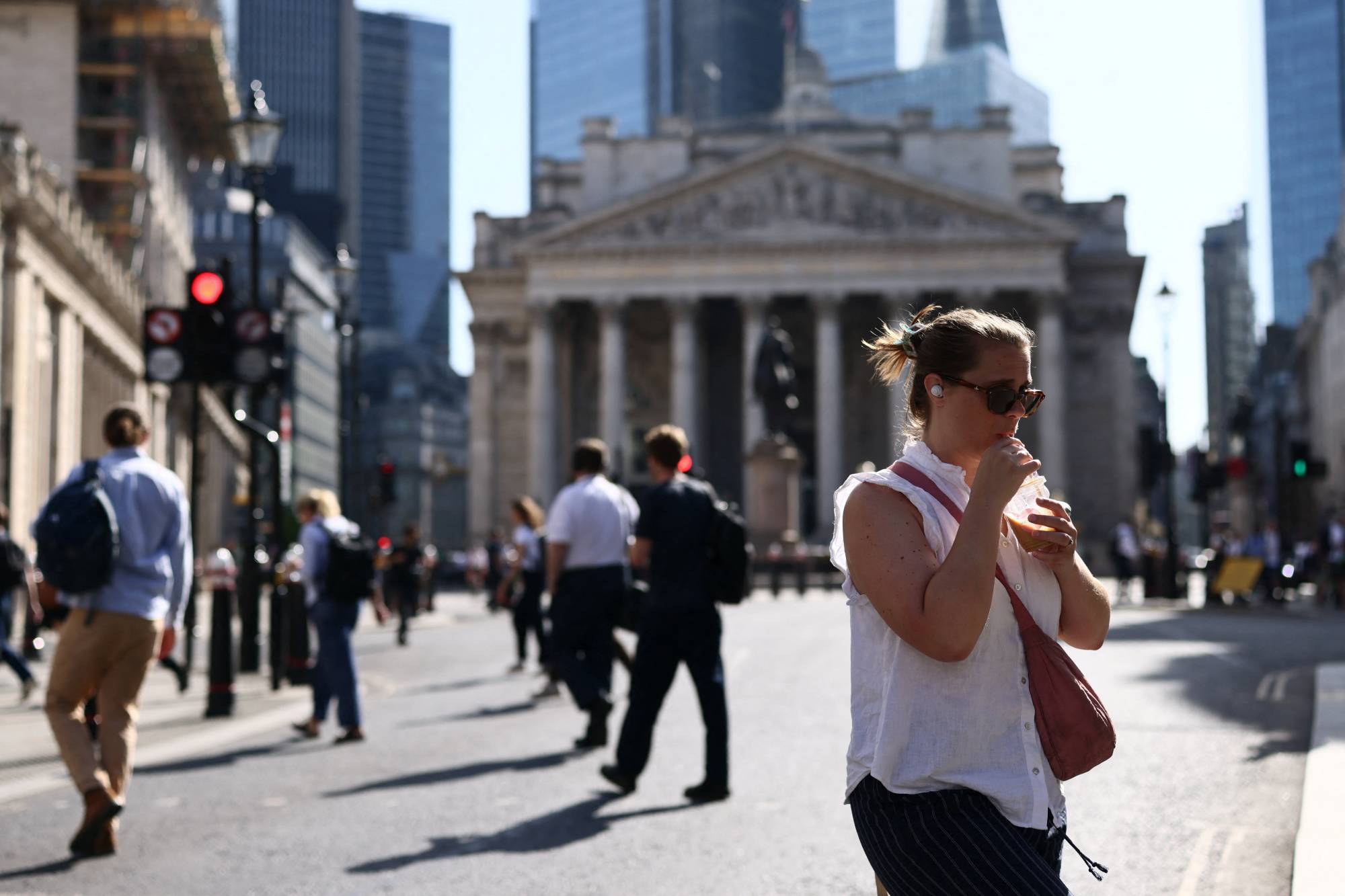
A woman drinks an iced coffee during a heatwave in London, Britain, May 26, 2026. REUTERS/Jack Taylor

Met Office meteorologist Greg Dewhurst told AFP the increase in extreme temperatures was "a good indication of climate change in action" and more likely to become "the new norm."

A record May temperature of 28.8C was recorded at two of Ireland's weather stations amid the current blast of heat, Met Eireann data showed.

A grass fire broke out near Arthur's Seat hill near Edinburgh, sending smoke over the Scottish city that saw temperatures climb to 25C, according to firefighters and the BBC.

Across the English Channel, France's weather agency said "Monday was the hottest day recorded for the month of May since measurements began,” with tennis fans in the capital Paris baking in temperatures of 33C at Roland Garros.

Highs of 36C were expected in some regions on Tuesday, Meteo-France said, adding that the spell was likely to last at least until the end of the week.

Government authorities also noted the heat had taken a deadly turn.

"What I can say today is that there have been seven deaths directly or indirectly related to the heat," government spokesperson Maud Bregeon told television broadcaster TF1 on Tuesday.

The heat drove many people to the country's beaches to cool off in the water, even though lifeguard supervision is not due to start in many areas until July.

"We were just wondering this morning whether the beach was supervised," Thomas Dupuy told AFP while visiting a beach in the southwestern city of Anglet with his two young children.

"I'm extremely careful for myself, for my children who can't swim yet," he added. "We know the currents can pull you out, the Atlantic beaches are dangerous."

On Monday, the western town of Bergerac recorded a high of 34.7C, with the cities of Nantes and Angers not far behind.

Spain's State Meteorological Agency (Aemet) warned the "extraordinarily high temperatures for this time of year" will continue across the country all week, except in the Canary Islands, in the Atlantic Ocean.

"Widespread tropical nights" are also forecast in southwestern Spain from Wednesday, with temperatures peaking from Wednesday to Friday at between 36C and 38C, it wrote on X.

Farther east, Italy's Lazio region, which includes Rome, on Monday approved rules limiting work in conditions "with prolonged exposure in the sun" between 12:30 pm and 4:00 pm.

An April report by the European Copernicus Climate Change Service and the World Meteorological Organization stated that since the 1980s, "Europe has warmed twice as fast as the global average" and "heatwaves are becoming increasingly frequent and severe" across at least 95 percent of the continent's territory.



UK on Course to Record Warmest Summer for Second Year in a Row

A man runs across the parched park lands of Hyde Park in central London, Britain, 11 August 2026. (EPA)
TT

UK on Course to Record Warmest Summer for Second Year in a Row

A man runs across the parched park lands of Hyde Park in central London, Britain, 11 August 2026. (EPA)

Britain is "on course" to chalk up its warmest summer on record for the second-year running, the UK's Met Office weather agency said Tuesday as the country braced for its fifth heatwave of the season.

"The UK is on course to record its warmest summer on record for mean temperature, with only average conditions needed for the remainder of August to surpass the record set only last year," the Met Office said in a statement.

Britain last year sweltered through its hottest summer on record with a mean temperature of 16.10C, surpassing the previous record of 15.76C set in 2018.

The current average temperature for the summer, from June 1 to August 10, was already at 16.48C, the Met said.

"Another record-breaking summer now looks increasingly likely for the UK, following the second-warmest June, and second-warmest July on record and yet another heatwave imminent," said Met senior scientist Mike Kendon said.

"These statistics are a clear reminder -- if one were needed -- of the stark changes that we are seeing in the UK's climate."

High temperatures and low rainfall in swathes of the country, which is built for more temperate weather, have also plunged almost three-quarters of England and all of Wales into drought.

England and Wales also experienced their driest July on record this year.

Scientists say climate change is making extreme weather events like heatwaves and droughts more intense, and resulting in records tumbling more frequently.

Heatwaves and record temperatures in May and June disrupted schools, transport and hospitals, leading to an estimated 2,877 excess deaths in England -- almost double the total of the whole of summer 2025.


Extreme Heat Becoming More Frequent and Intense, UN Agency Says

 Castel Sant'Angelo, at background right, towers over the Tiber River, which has reached a low water level after several months without rain, in Rome, Tuesday, Aug. 11, 2026. (AP)
Castel Sant'Angelo, at background right, towers over the Tiber River, which has reached a low water level after several months without rain, in Rome, Tuesday, Aug. 11, 2026. (AP)
TT

Extreme Heat Becoming More Frequent and Intense, UN Agency Says

 Castel Sant'Angelo, at background right, towers over the Tiber River, which has reached a low water level after several months without rain, in Rome, Tuesday, Aug. 11, 2026. (AP)
Castel Sant'Angelo, at background right, towers over the Tiber River, which has reached a low water level after several months without rain, in Rome, Tuesday, Aug. 11, 2026. (AP)

Periods of extreme heat are becoming more frequent, intense and longer-lasting as climate change warms the planet, the UN weather agency said on Tuesday, noting changes since the famously hot European summer of 1976. Parts of Europe are enduring their fifth heatwave of a summer marked by drought, wildfires and record-breaking temperatures.

"Extreme heat is becoming more frequent, more intense, ‌it's lasting longer, and ‌covering much wider areas than in ‌the ⁠cooler climates of the ⁠past," John Kennedy, the World Meteorological Organization's head of climate information, told a press briefing in Geneva.

Kennedy said the current pattern of heat across Europe, the world's fastest-warming continent, reflected the interaction between a persistent pattern of high-pressure systems across the Northern Hemisphere and a warmer climate.

The high-pressure systems trap warm air, reduce cloud cover and ⁠block cooler air from moving in, allowing heat ‌to build over large regions for ‌days or weeks. El Niño, the naturally occurring climate pattern that typically boosts ‌global temperatures, was not contributing to Europe's heat this year ‌because conditions in the tropical Pacific are currently neutral, he added.

CHANGES OVER THE PAST FIVE DECADES

Kennedy noted that June 1976 featured a broadly similar pattern of high and low pressure systems to those seen this year, ‌but said the outcomes were very different because of decades of global warming.

"The picture for 1976 ⁠is one ⁠of a few isolated areas above average temperatures in a much cooler world," he said, whereas today "the picture is reversed" with much of the globe experiencing above-average temperatures and only a few isolated cooler regions.

Exceptionally warm seas and parched soils were amplifying temperatures across Europe, Kennedy said.

Marine heatwaves in the Mediterranean Sea and waters west of Europe are fueling hotter conditions on land by providing additional background warmth for persistent high-pressure systems, he added.

Dry ground was also intensifying the heat because soils warm more quickly once moisture is depleted.

"Lots of these factors are coming together to give us the record heat that we're seeing this year," Kennedy stated.


Invasive Species Thrive as Global Warming Transforms the Mediterranean

 A lionfish lies after being caught in a trap in the coastal city of Limassol, Cyprus, July 17, 2026. (Reuters)
A lionfish lies after being caught in a trap in the coastal city of Limassol, Cyprus, July 17, 2026. (Reuters)
TT

Invasive Species Thrive as Global Warming Transforms the Mediterranean

 A lionfish lies after being caught in a trap in the coastal city of Limassol, Cyprus, July 17, 2026. (Reuters)
A lionfish lies after being caught in a trap in the coastal city of Limassol, Cyprus, July 17, 2026. (Reuters)

Pepis, the bearded skipper of a small fishing boat, deftly picks up two lionfish caught in experimental traps off the coast of Cyprus, cuts off their venomous spines, guts them and tosses them into a bucket.

Around him, the Mediterranean looks like a pane of glass, its calm surface giving little hint of the dramatic transformation unfolding underwater.

Pepis' practiced routine is part of a wider effort by scientists to track and control the spread of invasive species, such as lionfish, in these waters. Here life is changing, caused by a combination of warming sea temperatures and the Suez Canal, which has eased access for fish from more tropical climes.

A new species is estimated to enter the Mediterranean every two weeks, according to a recent survey collated by the Cyprus Academy of Sciences, Letters and Arts, based on research by scientists based in 11 countries.

In all, there are more than 1,000 non-indigenous species in the Mediterranean, the report said, up ‌from fewer than ‌800 counted in another study by the European Environment Agency in the 2012 to ‌2017 period.

The ⁠tropical newcomers ⁠from the Red Sea and beyond are displacing native species, reshaping food chains and threatening fisheries, experts said.

That is just another sign of the impact of climate change which has wreaked such havoc on land this summer in Europe, causing record heatwaves, wildfires and drought. And it's a big worry for environmentalists: Despite accounting for just 0.8% of the global ocean area, the Mediterranean supports a share of the world's marine species that some estimates place as high as 18%.

“Changes have been drastic, especially since 2000,” said Periklis Kleitou, a marine scientist at the Cyprus-based Marine and Environmental Research (MER) lab which is looking at ways to reduce the impact of invasive species.

“We ⁠see more and more non-indigenous species proliferating and dominating the marine environment and, unfortunately, fewer native ‌species.”

A yellowspotted pufferfish swims inside an aquarium in Heraklion, on the island of Crete, Greece, August 9, 2026. (Reuters)

NEW ARRIVALS TAKE OVER

The lionfish looks like an underwater punk, sporting ‌a spiky mohican above a permanent scowl. It has no known predator in the Mediterranean and has a voracious appetite for native fish ‌and crustaceans, scientists say.

Around Cyprus, MER is testing selective traps designed to attract lionfish and blue crabs while allowing other species ‌to escape.

In Greece, increasingly common alien species are disrupting marine ecosystems.

More than 230 have entered Greek waters in recent decades, said Paraskevi Karachle, research director at the Hellenic Centre for Marine Research.

Newcomers disrupt the ecosystem in differing ways. Rabbitfish graze heavily on algae, creating barren areas underwater and competing with the Mediterranean's native herbivorous fish, said Karachle.

The Lagocephalus pufferfish, also known as silver-cheeked toadfish, a carnivore whose toxins can be fatal ‌to humans, attacks other fish and is associated with reports of reduced octopus catches. Silver and speckled with black dots, it looks like a bruiser with bulging eyes and buck ⁠teeth.

Greek and Cypriot authorities ⁠have offered fishermen bounties on pufferfish hauls.

"Invasive species are taking over our seas, and that affects the local biodiversity as well as the economy," said Christina Kakoulli, a marine biologist at MER.

A lionfish with risotto is served on a plate in a restaurant in the coastal city of Limassol, Cyprus July 17, 2026. (Reuters)

LOOKING AT WAYS TO ADAPT

Scientists are looking for ways to adapt. One option is to get consumers used to eating new types of fish. Lionfish is safe to consume once the spines are removed. Pepis the skipper advises dusting it with flour before frying.

"In the beginning people were afraid, but now they understand it's a high quality, delicious fish," said Petros Yiangou, a chef who works with MER on Life Prometheus, a European Union-funded project that looks at ways to reduce accidental capture of sharks and rays, while encouraging ways to harvest invasive species.

Markets are emerging in Lebanon and Türkiye, while Atlantic blue crabs have found customers in Tunisia.

Greek marine researchers have tested ways of removing toxins to turn pufferfish into fishmeal for farmed sea bass, Karachle said. Other research has explored possible uses for alien species in cosmetics, food supplements, leather products and pain relief.

Finding uses for the newcomers might be easier than finding one single trigger point for their spread and impact. Scientists say the situation needs sustained, long-term monitoring.

"The sea is very complicated," Kleitou said. "It has so many confounding variables interacting at the same time."