


LEGO Foundation Donates $97 Million to Bring Play-based Learning to More Children in Conflict Zones

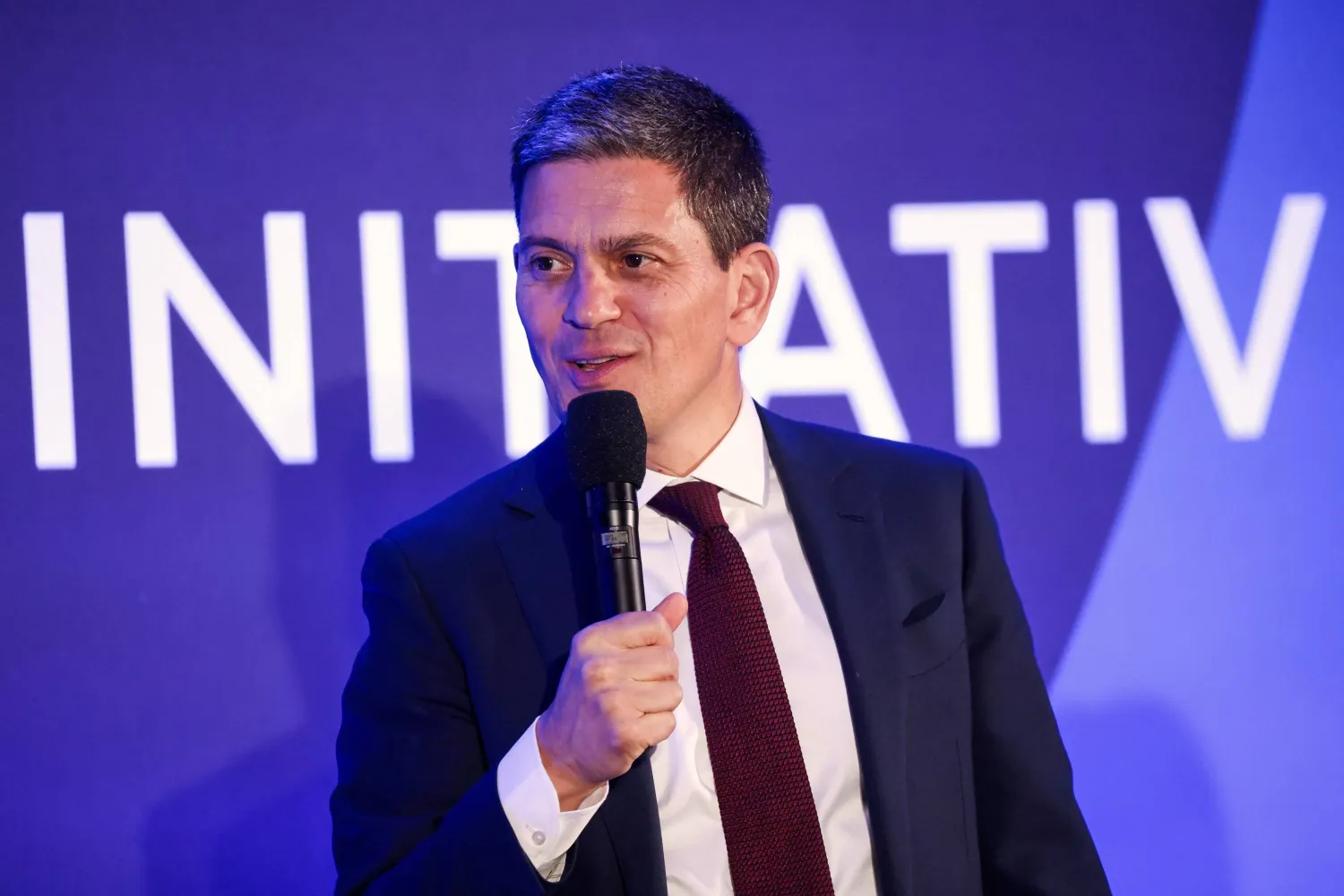
FILE - David Miliband, president and chief executive officer of the International Rescue Committee, speaks during the Clinton Global Initiative, Sept. 19, 2023, in New York. (AP Photo/Julia Nikhinson, File)
TT

LEGO Foundation Donates $97 Million to Bring Play-based Learning to More Children in Conflict Zones

FILE - David Miliband, president and chief executive officer of the International Rescue Committee, speaks during the Clinton Global Initiative, Sept. 19, 2023, in New York. (AP Photo/Julia Nikhinson, File)

Global conflicts from South Sudan's political crisis to the United States' recent war with Iran are putting more children at risk of suffering.

One humanitarian duo wants to ensure conflict-stricken children get funding for an often-overlooked need: education. Under an agreement announced Wednesday, the LEGO Foundation committed $97 million to expand International Rescue Committee programs that use play to help millions of children learn and recover.

“Children who are born in conflict have their childhood stolen from them," IRC President David Miliband told The Associated Press. “But what’s remarkable about children is that if you give them a bit of their childhood back, they make the most of it. And this is about giving the best of childhood back.”

The five-year partnership aims to reach 5 million children across East Africa and the Middle East. Who, exactly, they serve will change as conflicts evolve. LEGO Foundation CEO Sidsel Marie Kristensen pledged to focus on those “in the most dire contexts." Currently under consideration are Ethiopia, Lebanon, the Palestinian territories, Somalia, South Sudan, Sudan, Syria and Uganda.

Kristensen said the “truly agile” framework is designed to bring play-based learning wherever it’s needed most, rather than funding individual place-based grants that might become outdated as conflicts evolve in real time.

“In the world we are living in right now, nobody knows honestly what is happening tomorrow or in two months,” Kristensen said. “That (flexibility) is what we need right now.”

The investment will introduce more classrooms to an IRC-led program called PlayMatters that offers training for teachers of 3-to 12-year-olds to integrate what they call “playful learning" into lessons. The goal is not to tell educators what they should teach but help tailor their instruction to the needs that arise in schools serving children traumatized by crises. Program leaders also act as a policy advocates for education funding at the national level, working with government officials to embed their materials into their curriculum.

Teacher says ‘playful learning’ reduces absenteeism At a primary school serving refugees in western Uganda’s Nakivale settlement, one teacher credits PlayMatters with reducing absenteeism. Sister Kasingye Secunda said attendance used to be an issue. Teachers try their best to make students "feel at home,” she said. But many students don’t understand both the local language and English, the language of instruction.

Children learn colors through one game where they select mangoes, bananas and other fruits to share with their classmates. They build confidence through class presentations, she said, and develop leadership as they take turns guiding small groups through activities.

“Learners enjoy the lessons,” Secunda said. “They are eager to come to school.”

From Ethiopia to Tanzania, a radio show helps children name their emotions through episodes offered in multiple languages featuring culturally familiar characters. PlayMatters Project Director Martin Omukuba said they are expanding such digitally delivered multimedia lessons. The radio show, for example, helps them remotely reach schools in South Sudan that are made inaccessible by flooding for half the year.

The LEGO Foundation provides flexible funding so that IRC can respond to the fluid nature of conflicts. A refugee class size can quickly jump from 25 to 150 students, Omukuba noted, creating new demands for sanitation, nutrition or other classroom needs not traditionally classified under education. Omukuba credited the LEGO Foundation for trusting them to move grant money around in emergencies.

“We need first to make sure that children are alive,” he said. “We can introduce the education when they are stabilized.”

The partners first collaborated in 2019 when the LEGO Foundation committed $100 million to “Ahlan Simsim,” the show by IRC and the nonprofit Sesame Workshop that helps kids affected by the Syrian and Rohingya refugee crises.

Kristensen, who leads the Denmark-based corporate foundation that funds early childhood development, said they've been scaling up their donations in these settings. The LEGO Foundation recently announced a separate $30 million partnership with global funding collaborative Co-Impact to support locally led solutions to issues of learning and wellbeing among children impacted by conflict and crisis.

She wants Wednesday's announcement to inspire greater collaboration among governments, civil society and the private sector. “That is so needed in a world right now where the development aid is decreasing,” she said, referring to international assistance cuts by the United States and many European nations.

Those cuts have stretched the humanitarian system's capacity over the past year. Already, Miliband said, the ongoing Ebola outbreak in Congo provides “a graphic demonstration of the short-sightedness of aid cuts for activities that are considered marginal." He pointed to sanitation and handwashing programs in the Congo's Ituri province, where the global health emergency is centered, that lost US funding last year as part of the Trump administration's dismantling of international development.

“We warned at the time what the risk was,” he said. “And sure as night follows day, we end up with an under-detected Ebola outbreak.”

International Rescue Committee officials similarly see early childhood development not as a luxury, but a necessary intervention to toxic stress that alters brain development and delays learning.

Education was an underfunded part of humanitarian responses even before wealthy countries slashed their aid budgets, according to Patty McIlreavy, the president and CEO of the Center for Disaster Philanthropy. “Life saving” assistance was too narrowly limited to “what do you actually need to keep the body alive,” she said," a definition that excluded “life sustaining” efforts such as children's education.

She pointed to Wednesday's announcement as an example for donors, who often ask her how they can actually help in complex conflicts without clear ends in sight.

“It's not our role as philanthropy to fix what's broken in a country," she said. "That's politics. That's bigger than us. But there's so much we can do — even by offering six months or a year of education.”




US Strike on Alleged Drug Boat in Pacific Kills One, Strands Two

A US strike targeted a boat suspected of being used for drug trafficking in the eastern Pacific (Reuters ffile photo)
TT

US Strike on Alleged Drug Boat in Pacific Kills One, Strands Two

A US strike targeted a boat suspected of being used for drug trafficking in the eastern Pacific (Reuters ffile photo)

The US military attacked what it called a drug trafficking boat Tuesday in the eastern Pacific, killing one person and leaving two others stranded at sea, officials said.

"One male narco-terrorist was killed during this action and there were two survivors," US Southern Command (SOUTHCOM) wrote in a post to X.

It added that it "immediately notified the US Coast Guard to activate the search and rescue system for the survivors."

In its post, the military alleged the targeted vessel was "operated by Designated Terrorist Organizations" and "transiting along known narco-trafficking routes in the Eastern Pacific" for drug trafficking.

Grainy black-and-white video accompanying the post showed part of the boat obscured by a box before the strike, then a large explosion, and then smoking wreckage in the water.

No survivors can be seen in the footage.

The US military launched the operation, dubbed "Southern Spear," in early September, with President Donald Trump insisting the US is effectively at war with drug cartels operating out of Latin America.

But his administration has not provided definitive evidence that the vessels it has been striking are involved in drug trafficking.


US Navy Assisting Ships Cross Strait of Hormuz

US naval units enforce a blockade in the Strait of Hormuz (Getty)
TT

US Navy Assisting Ships Cross Strait of Hormuz

US naval units enforce a blockade in the Strait of Hormuz (Getty)

The US Navy is quietly assisting commercial ships transiting the Strait of Hormuz as the US-Iran negotiations remain uncertain, The Wall Street Journal reported Tuesday.

Citing US military officials, the newspaper said a Greek supertanker carrying 2 million barrels of crude oil was guided by the US Navy as it crossed the strategic waterway off the Omani coast.

The ship was stuck in the Gulf since early March and is now headed to India to deliver its cargo.

A spokesman for the US Central Command confirmed that Washington was not resuming Project Freedom and that US forces are not currently escorting commercial vessels through.

The US Navy plans to assist about a dozen vessels, including supertankers and container ships, in transiting the waterway over the coming days, according to the report.

On Tuesday, Iran said the United States had violated a ceasefire by striking targets near the contested Strait of Hormuz, potentially complicating efforts to bring the war to a close. The US said its attacks were defensive in nature, targeting missile sites and boats attempting to lay mines.

Despite a ceasefire officially coming into effect since early April, the US military’s Central Command announced that it had launched “self-defense” strikes against Iran, with targets including missile launch sites and boats placing mines.

The New York Times quoted two American officials as saying that the US military strikes against targets in southern Iran on Monday came after intelligence analysts detected a series of potentially threatening Iranian military actions in the 24 hours leading up to the strikes.

American warplanes sank two of Iran’s Revolutionary Guards Corps (IRGC) speedboats that were trying to place mines in the Strait of Hormuz, a vital waterway that Iran has effectively blocked and that carried roughly a fifth of the world’s daily oil and gas supply before the war, the newspaper said.

The officials, who spoke on the condition of anonymity to discuss operational matters, also said that Iran launched one-way attack drones near some of the nearly two dozen US Navy warships in or around the Gulf of Oman and the Arabian Sea. The ships are enforcing a blockade against vessels trying to enter or leave Iranian ports.

American military analysts also detected activity at some of Iran’s surface-to-air missile sites near the Strait of Hormuz that threatened land- and carrier-based attack planes operating in the region as part of the naval blockade.

US officials and independent analysts also said on Tuesday that the Revolutionary Guards may have been testing to determine whether their forces have some new, additional operating room as the two sides try to solidify the potential agreement that US President Donald Trump has said could end the war and reopen the Strait of Hormuz.

CENTCOM said Tuesday that, as part of the American blockade on Iranian ports, it has redirected 108 commercial vessels since mid-April.

Meanwhile, the IRGC said Tuesday it reserves the right “to respond to any ceasefire violation by the aggressor US army.”

It added that it shot down a US MQ-9 drone and claimed that an RQ-4 drone and an F-35 fighter jet also entered Iranian airspace before retreating.

Other Pentagon officials dismissed Iranian media reports of the downing of a US MQ-9 drone.


Chief of Communications Intel Agency: Russia is Relentlessly Targeting the UK

FILE PHOTO: Silhouettes of laptop users are seen next to a screen projection of binary code are seen in this picture illustration created on March 28, 2018.  REUTERS/Dado Ruvic/Illustration/File Photo
FILE PHOTO: Silhouettes of laptop users are seen next to a screen projection of binary code are seen in this picture illustration created on March 28, 2018. REUTERS/Dado Ruvic/Illustration/File Photo
TT

Chief of Communications Intel Agency: Russia is Relentlessly Targeting the UK

FILE PHOTO: Silhouettes of laptop users are seen next to a screen projection of binary code are seen in this picture illustration created on March 28, 2018.  REUTERS/Dado Ruvic/Illustration/File Photo
FILE PHOTO: Silhouettes of laptop users are seen next to a screen projection of binary code are seen in this picture illustration created on March 28, 2018. REUTERS/Dado Ruvic/Illustration/File Photo

Britain and its allies risk losing a conflict in cyberspace against adversaries such as Russia unless citizens, corporations and governments treat cybersecurity with much greater urgency, a UK spy chief is warning.

Anne Keast-Butler, director of the communications intelligence agency GCHQ, will warn Wednesday that Moscow is “relentlessly targeting critical infrastructure, democratic processes, supply chains and public trust” in Britain and Europe.

In a speech at a World War II code breaking center near London, she will accuse Russia of stealing technology and plotting sabotage and assassination attempts, The Associated Press reported.

Keast-Butler plans to say that rapid advances in artificial intelligence mean that “the ground beneath our feet is shifting” and there is a “narrowing window for the UK and allies to stay ahead” of countries such as China, a science and technology “superpower.”

She plans to argue there must be an effort “from boardrooms to living rooms” to make cybersecurity “10 times more urgent,” according to extracts released in advance by GCHQ, short for Government Communications Headquarters.

It is the latest in a string of warnings from Western spies and intelligence experts that Russia is stepping up hostile activity in a “gray zone” that falls just below the threshold of war.

In recent months, authorities in countries including Sweden, Poland, Denmark and Norway have alleged that hackers linked to Russia targeted their critical infrastructure, including power plants and dams.

The head of the UK’s National Cyber Security Centre, Richard Horne, warned last month that hostile states including Russia, China and Iran are behind the most serious cyberattacks the country faces. He said such attacks could increase dramatically if Britain becomes involved in an international conflict.

Keast-Butler plans to stress the importance of international partnerships as US President Donald Trump’s “America First” foreign policy and disregard for longtime allies strains the relationship between London and Washington.

Pointedly, she is delivering the annual GCHQ director’s lecture speech at Bletchley Park, a manor house 45 miles (72 kilometers) northwest of London where hundreds of mathematicians, cryptographers, crossword puzzlers, chess masters and other experts worked to crack Nazi Germany’s supposedly unbreakable secret codes.

Their work both shortened the war and hastened the birth of modern computing.