


CEO: Nvidia to Spend $150 Billion a Year in Taiwan, 'Epicenter' of AI Revolution

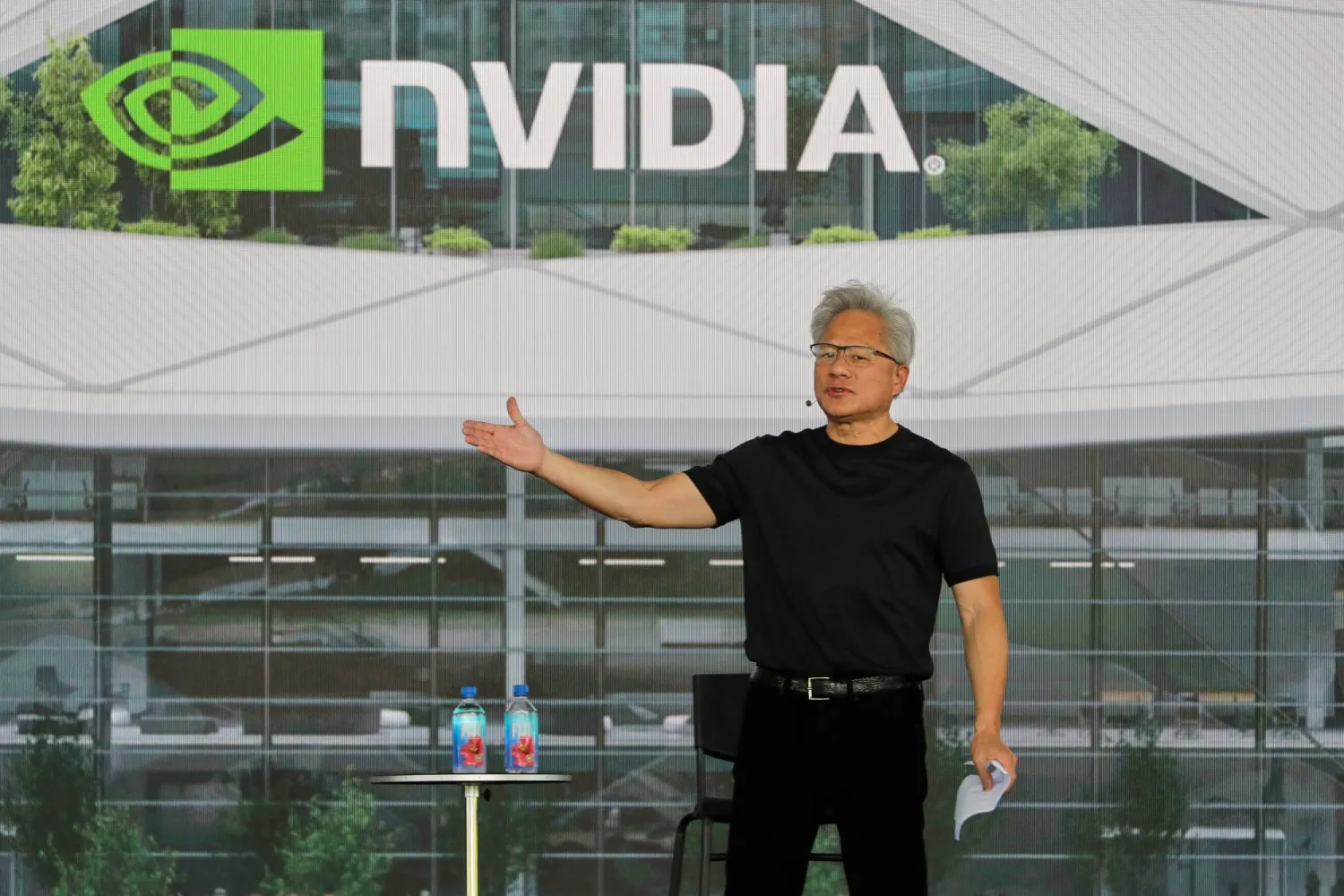
Nvidia CEO Jensen Huang delivers a speech during an all employee celebration at the construction site of their Taiwan headquarters "Constellation" in Taipei, Taiwan, Wednesday, May 27, 2026. (AP Photo/Chiang Ying-ying)
TT

CEO: Nvidia to Spend $150 Billion a Year in Taiwan, 'Epicenter' of AI Revolution

Nvidia CEO Jensen Huang delivers a speech during an all employee celebration at the construction site of their Taiwan headquarters "Constellation" in Taipei, Taiwan, Wednesday, May 27, 2026. (AP Photo/Chiang Ying-ying)

Nvidia's chief executive said on Wednesday the chip company plans to invest around $150 billion a year in Taiwan, terming it the "epicenter" of the AI revolution and predicting it will be the world's tech manufacturing hub for a long time.

"Four years ago, five years ago, Nvidia was spending about 10, 15 billion dollars a year in Taiwan. Now we're spending 100, going to 150 billion dollars in Taiwan each year," Reuters quoted CEO Jensen Huang as saying at a launch celebration in Taipei for the $5 trillion chipmaker's planned Taiwan headquarters.

The project will break ground this year and aims to be operational in 2030, Huang said. He did not provide a timeframe for the number of years the company plans to invest $150 billion. The Taiwan ⁠headquarters will bring ⁠Nvidia closer to TSMC , the world's largest contract chipmaker, which makes many of the advanced semiconductors powering the trend towards AI and is a major supplier to the US tech giant.

It will also help the world's most valuable company boost its alliances with other manufacturing partners including Foxconn, Wistron and Quanta Computer , which all play key roles in the build-out of AI servers and infrastructure. "Taiwan is booming," Huang said on stage to a crowd including his family, around 1,000 employees ⁠and Taipei Mayor Chiang Wan-an. He said Nvidia planned to employ 4,000 people at the new site.

"Taiwan is the epicenter of the AI revolution. This is where the chips come, packaging comes, this is where the systems are made, this is where AI supercomputers were created. The number of partners we work with here in Taiwan, incredible."

Huang was born in the southern city of Tainan, Taiwan's historic capital, and Wednesday's launch was attended by his parents, and his wife, daughter and son. He emigrated to the United States at the age of 9, and has somewhat of a rockstar status in Taiwan, where his every move is followed closely.

Earlier this month Huang was part of the delegation that accompanied US President Donald Trump on a trip ⁠to Beijing for a ⁠summit with Chinese President Xi Jinping.

Taiwan plays a pivotal role in the global AI supply chain for companies including Nvidia and Apple, and its position is anchored by TSMC.

Underscoring the significance of Taiwan, Advanced Micro Devices said last week it would invest more than $10 billion in Taiwan's AI sector to deepen strategic partnerships and expand its capacity to build and assemble advanced AI chips.

Nvidia made history late last year when it became the first company to reach $5 trillion in market value, cementing its place at the center of the global AI boom, and Huang said on Wednesday it will be worth even more in three to five years.

Last week, Nvidia aimed to assure investors that it can keep up its blockbuster growth with the help of a broad base of customers and that new products will help it beat the $1 trillion in sales it has forecast for its flagship AI chips.



Nvidia to Invest $1.5 billion in SB Energy under OpenAI Data Center Deal

FILE PHOTO: Nvidia logo is seen in this illustration taken June 11, 2026. REUTERS/Dado Ruvic/Illustration/File Photo
TT

Nvidia to Invest $1.5 billion in SB Energy under OpenAI Data Center Deal

FILE PHOTO: Nvidia logo is seen in this illustration taken June 11, 2026. REUTERS/Dado Ruvic/Illustration/File Photo

Nvidia will invest $1.5 billion in SoftBank-backed SB Energy and secure up to 8 gigawatts of AI computing capacity at an Ohio campus being built by the data center developer for OpenAI.

The deal is the latest where Nvidia is financing the ecosystem consuming its chips, a strategy that has helped fuel demand but also drawn scrutiny over the circular flows of funds from the chipmaker to its biggest customers, Reuters reported.

Leading tech firms are increasingly tying together chips, power and data center development as they race to secure the infrastructure needed for increasingly power-hungry AI models.

Chip giant Nvidia has secured land and power at Ohio's PORTS-Pike Technology Campus for an AI data center that will use its graphics processors and networking gear, with an initial capacity of 4.25 GW.

SB Energy and SoftBank plan to build at least 10 GW of new power generation and invest $4.2 billion in Ohio grid infrastructure to support AI data centers.

Also backed by OpenAI, SB Energy develops large-scale power and data center infrastructure projects. Founded in 2019, the company is building several data center campuses to support rising demand tied to AI workloads.


German Regulator: Apple to Change App Data Consent Rules

FILE PHOTO: People walk past a booth showcasing Apple's suppliers during the China International Supply Chain Expo (CISCE) in Beijing, China June 22, 2026. REUTERS/Florence Lo/File Photo
TT

German Regulator: Apple to Change App Data Consent Rules

FILE PHOTO: People walk past a booth showcasing Apple's suppliers during the China International Supply Chain Expo (CISCE) in Beijing, China June 22, 2026. REUTERS/Florence Lo/File Photo

Apple will change rules governing how app developers can use personal data for targeted advertising on iPhones and iPads, Germany's competition authority said on Monday, closing a years-long investigation.

The Federal Cartel Office found that Apple's App Tracking Transparency framework gave its own apps more favorable consent prompts than those of third-party developers, potentially breaching competition rules.

Apple has four ⁠months to implement ⁠the changes after the decision is served. Commitments run for seven years and will be monitored by a trustee.

Under the commitments, consent pop-ups for third-party apps must be redesigned ⁠to remove discouraging language and symbols, and made visually and linguistically neutral.

Third-party app publishers will also gain more flexibility to combine Apple's required consent request with separate data-protection consent prompts.

According to Reuters, Apple said the changes would apply in almost all European Union countries and that it had adapted the text and design of the ⁠consent ⁠prompt at the authority's request.

Developers of third-party apps, including Facebook parent Meta Platforms, aim for accurate user data so that targeted adverts can be displayed on devices. These generate more revenue than broader campaigns.

France and Italy have already fined Apple €150 million and €98.6 million, respectively, over the ATT framework.


AI Market Correction is Coming, ECB Blog Predicts

FILE PHOTO: European Union flags flutter outside the European Central Bank (ECB) headquarters in Frankfurt, Germany, March 19, 2026. REUTERS/Jana Rodenbusch/File Photo
TT

AI Market Correction is Coming, ECB Blog Predicts

FILE PHOTO: European Union flags flutter outside the European Central Bank (ECB) headquarters in Frankfurt, Germany, March 19, 2026. REUTERS/Jana Rodenbusch/File Photo

A market correction to tech stock exuberance in the US is likely and could have far-reaching consequences due to limits in fiscal and monetary policy buffers to blunt the potential economic hit, a European Central Bank blog post said on Monday.

Investors have been piling into technology stocks on bets that AI will fundamentally alter the global economy, and valuations for top tech companies are now far above historic averages.

"Economic research on past technological revolutions points to a worrisome conclusion: a correction of current stock market valuations is likely," said ⁠the blog post, ⁠which does not necessarily reflect the ECB's opinion.

Even if the technology succeeds and profits rise, stocks may still fall because it is hard to fulfil markets' excessively optimistic profit growth bets, the post added.

Psychological trends also point to a correction, ⁠the blog argued. Overly optimistic investors tend to bid up prices beyond fundamentals. Then when optimism fades, prices tend to fall even more sharply than in the rational scenario, the post said.

For Europe, a US market correction would be a question of financial stability since households have a €440 billion exposure to so-called Magnificent Seven stocks - Alphabet, Amazon, Apple, Meta Platforms, Microsoft, Nvidia and Tesla -while pension and insurance firms' exposure is about the same.

"The more severe ⁠scenario is ⁠not the equity correction on its own but a correction that coincides with broader market instability that policymakers cannot easily calm: unlike in the dot-com episode, today's starting point leaves markedly less room to cut interest rates or use fiscal policy to cushion the fallout," Reuters quoted the blog as saying.

While European stock valuations appear more rational, market moves closely correlate with the US, so local equities will also take a hit, the blog said, adding that the exact timing of the correction "is unknowable in advance".

"These boom-bust patterns are only identifiable with hindsight," it said.