ECB Tells Banks to Invest More to Get a Grip on AI Security Risk

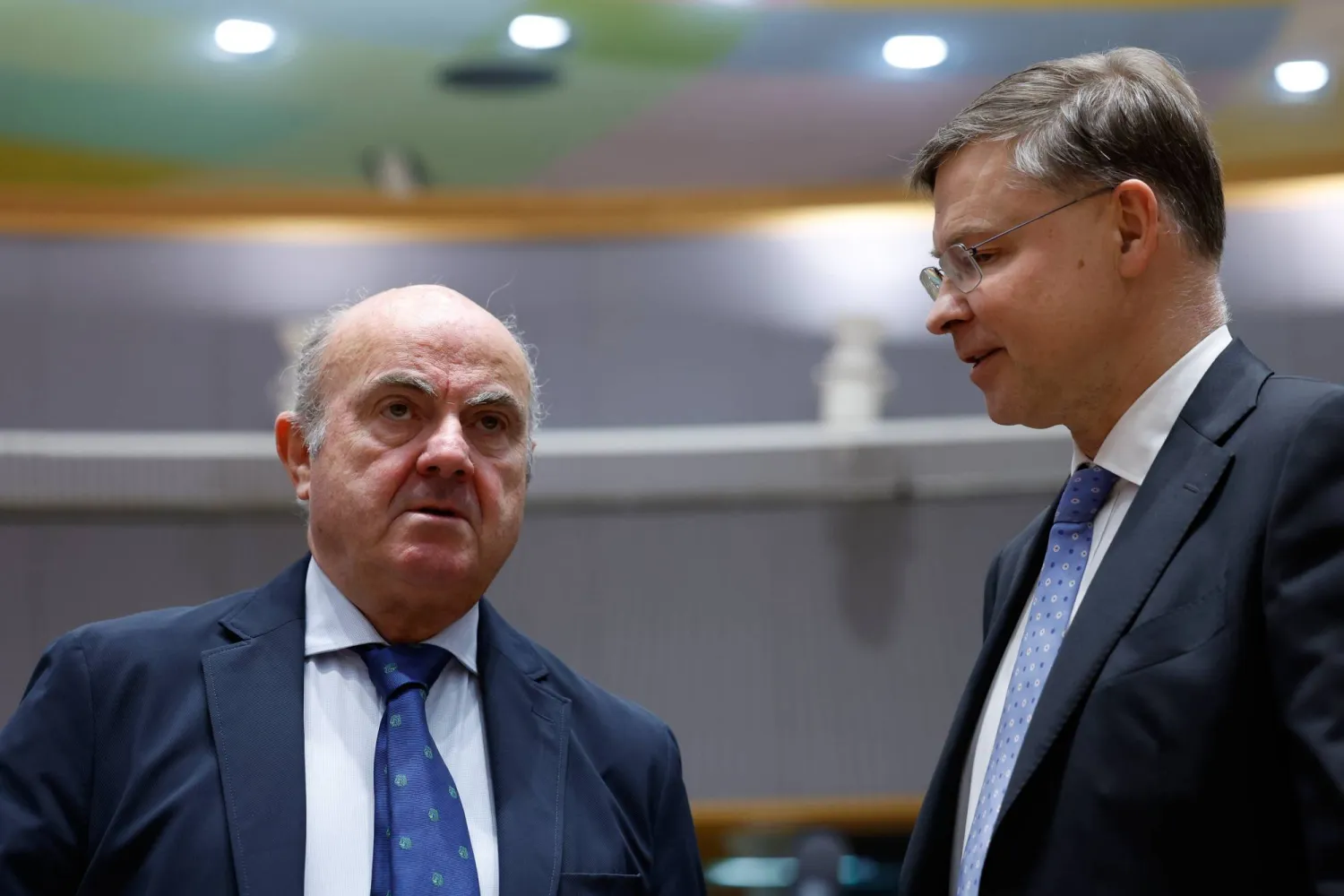
European Central Bank Vice-President Luis de Guindos, left, speaks with European Commissioner for Economy and Productivity, Implementation and Simplification Valdis Dombrovskis during a meeting of EU finance ministers at the European Council building in Brussels, Tuesday, May 5, 2026. (AP Photo/Geert Vanden Wijngaert)
TT

ECB Tells Banks to Invest More to Get a Grip on AI Security Risk

European Central Bank Vice-President Luis de Guindos, left, speaks with European Commissioner for Economy and Productivity, Implementation and Simplification Valdis Dombrovskis during a meeting of EU finance ministers at the European Council building in Brussels, Tuesday, May 5, 2026. (AP Photo/Geert Vanden Wijngaert)

Euro zone banks need to invest more in cybersecurity if they are to get a grip on new AI models that can find flaws in software, the European Central Bank's outgoing Vice President Luis de Guindos said on Wednesday.

New large language models such as Anthropic's Mythos are viewed by cybersecurity experts as posing significant challenges to the banking industry and its legacy technology systems, prompting a series of warnings from regulators and policymakers around ⁠the world.

The ECB has ⁠been quizzing euro zone banks about their preparedness for weeks, including at a meeting this week, and de Guindos said the sector needed to reach deeper into its pockets to strengthen its defenses against cyberattacks powered by AI.

"We have to understand ⁠much better the potential implications of these new models and to try to put in place the systems and cybersecurity patches that can address that situation," de Guindos, whose term runs out at the end of the month, told reporters.

"And (we have) to try to start to enhance the awareness of the financial institutions, of the banks, about the need of additional cybersecurity investment, because it's going to be something that ⁠is ⁠going to be quite structural in the near future."

He said the meeting with euro zone lenders on Tuesday featured a presentation by a US bank which, unlike its counterparts on this side of the Atlantic, has had access to Mythos.

"The main message to everyone is cyber is becoming more and more important," de Guindos said. "We have to invest more. And investment has to be pervasive. It's not only for the large banks. It's as well for the small banks."


Alvarez & Marsal Returns to Lebanon’s Central Bank to Trace Missing $20 Billion

People walk outside Lebanon's Central Bank building in Beirut, Lebanon April 4, 2025. REUTERS/Mohamed Azakir
TT

Alvarez & Marsal Returns to Lebanon’s Central Bank to Trace Missing $20 Billion

People walk outside Lebanon's Central Bank building in Beirut, Lebanon April 4, 2025. REUTERS/Mohamed Azakir

Lebanon’s central bank (BDL) has formally reappointed consulting firm Alvarez & Marsal to conduct a comprehensive forensic audit on the period from October 2019 through the end of 2023, in a move aimed at uncovering possible misuse, embezzlement, and waste involving more than $20 billion in depleted foreign reserves.

The announcement, made in coordination with the finance and justice ministries, reflects renewed commitments by BDL to disclose how public funds and central bank reserves were managed during Lebanon’s financial collapse.

A senior official described the decision as a significant step toward applying international accounting standards to investigate allegations of financial misconduct tied to the rapid depletion of central bank reserves following the onset of Lebanon’s economic crises nearly seven years ago.

According to BDL, the audit is part of a joint institutional effort to review a period marked by large-scale financial interventions carried out by the bank on behalf of both public and private sector entities.

The selection of Alvarez & Marsal is particularly significant because the firm previously conducted a forensic audit of the central bank’s accounts covering 2015 to 2020. Officials believe the new review could build on earlier findings submitted to the Finance Ministry and provide a clearer accounting of how funds were spent.

A senior official told Asharq Al-Awsat that the audit and its expected findings could reshape Lebanon’s financial recovery strategy by establishing a credible basis for restructuring financial data, supporting legal accountability efforts, recovering misappropriated funds, and advancing reforms long demanded by international donors and financial institutions, particularly the International Monetary Fund and the World Bank.

Scrutiny of Subsidy Programs

The audit will focus heavily on subsidy programs approved by successive Lebanese governments between 2019 and 2023, involving billions of dollars in transfers and payments, as well as funds provided by the central bank to public institutions and government agencies.

It will also examine international transfers made by BDL to commercial banks’ overseas accounts.

According to the central bank, the primary objective is to determine whether all transfers and payments - particularly those tied to subsidy programs - were legally authorized, reached their intended beneficiaries, and were used for their stated purposes without misuse or exploitation of public funds.

The central bank said the audit would assist the finance and justice ministries in identifying and prosecuting individuals or entities that may have improperly benefited from subsidy funds or diverted them from their intended purposes. Once completed, the report will be formally submitted to both ministries.

Preliminary estimates indicate the renewed audit will examine at least $11 billion spent on consumer subsidy programs during the period, much of it allocated to fuel subsidies. Large quantities of subsidized fuel were allegedly smuggled into Syria through illicit trade networks while Lebanese motorists queued at gas stations.

Consumer subsidy programs were also marred by major loopholes, including support for luxury goods that offered little benefit to ordinary citizens. At the same time, subsidized Lebanese products reportedly appeared at discounted prices in markets abroad, including Syria, Kuwait, Cyprus, and other Arab and European countries.

There were similar concerns son medicine and medical supply subsidies, amid allegations of hoarding and artificial shortages despite extensive public support. Lists of subsidy recipients and traders had previously been referred by the central bank to public prosecutors, but investigations have so far produced few meaningful results.


TotalEnergies Extends Fuel Price Cap in France Through June

This photograph shows the TotalEnergies refinery in Antwerp on May 18, 2026. (Photo by JONAS ROOSENS / Belga / AFP)
TT

TotalEnergies Extends Fuel Price Cap in France Through June

This photograph shows the TotalEnergies refinery in Antwerp on May 18, 2026. (Photo by JONAS ROOSENS / Belga / AFP)

Oil major Total Energies said on Wednesday it would extend its policy of capping fuel prices at its French service stations through the month of June as the Middle East crisis continues.

The company said it would ⁠keep the price ⁠caps, first announced in March, at €1.99 ($2.32) per liter for gasoline and €2.25 per liter for diesel.

French Finance Minister Roland Lescure welcomed the ⁠decision but told BFM TV he also would not rule out imposing a new tax on profits energy companies have made during the surge in energy prices provoked by the Iran war.

Several French opposition politicians have advocated for additional so-called windfall taxes ⁠on ⁠oil companies including TotalEnergies since the war began in late February.

TotalEnergies' Chief Executive Patrick Pouyanne said earlier this month the company would end its cap on prices were such a tax approved.


Samsung Workers Approve Bonus Deal after Big AI Profits

FILE PHOTO: Samsung Electronics’ labor union members chant slogans during a protest against the company’s compensation levels ahead of a planned lengthy strike in front of Samsung Electronics semiconductor plant in Pyeongtaek, South Korea, April 23, 2026.  REUTERS/Kim Hong-Ji/File Photo
FILE PHOTO: Samsung Electronics’ labor union members chant slogans during a protest against the company’s compensation levels ahead of a planned lengthy strike in front of Samsung Electronics semiconductor plant in Pyeongtaek, South Korea, April 23, 2026. REUTERS/Kim Hong-Ji/File Photo
TT

Samsung Workers Approve Bonus Deal after Big AI Profits

FILE PHOTO: Samsung Electronics’ labor union members chant slogans during a protest against the company’s compensation levels ahead of a planned lengthy strike in front of Samsung Electronics semiconductor plant in Pyeongtaek, South Korea, April 23, 2026.  REUTERS/Kim Hong-Ji/File Photo
FILE PHOTO: Samsung Electronics’ labor union members chant slogans during a protest against the company’s compensation levels ahead of a planned lengthy strike in front of Samsung Electronics semiconductor plant in Pyeongtaek, South Korea, April 23, 2026. REUTERS/Kim Hong-Ji/File Photo

Samsung Electronics union members on Wednesday approved a deal with management securing massive annual bonuses after threatening a major strike, as the global artificial intelligence boom causes the South Korean chip giant's profits to soar.

It means that around 78,000 employees from the company's 125,000-strong domestic workforce are eligible to receive a bonus of roughly $370,000 this year, based on a market estimate of annual operating profit.

Samsung's largest workers' union said in a statement that more than 73 percent of its members had backed the agreement in an electronic vote held over six days.

The deal was struck at the last minute last week to avert an 18-day strike that had raised fears over the impact on South Korea's economy.

Frenzied demand for the memory chips that power AI data centres has turbocharged Samsung's earnings.

The firm in April said first-quarter operating profit soared roughly 750 percent year-on-year, while its market value topped $1 trillion for the first time this month.

Under the union's 10-year deal -- which is tied to ambitious performance targets -- annual bonuses for employees in the semiconductor division would amount to 10.5 percent of their segment's operating profit.

The bonuses will be paid in shares, alongside an additional 1.5 percent in cash, AFP reported.

The new bonus scheme has fueled tensions among workers in other divisions, who will receive different rewards under the deal, as well as subsidiaries and shareholders.

The prospect of a strike had sparked wider concerns in South Korea, where Samsung Electronics alone accounts for around 12.5 percent of gross domestic product and memory chips make up about 35 percent of exports.

It has also fanned a debate over how AI profits should be distributed.

A senior presidential official has floated the idea of a "national dividend" -- arguing that excess AI-related tax revenue could be used to support social welfare programs.

Analysts say large bonuses could help prevent engineering talent from moving abroad, as US firms such as Tesla ramp up investment in AI chips.

According to Samsung's union, workers at rival chipmaker SK hynix -- which also hit a $1 trillion market capitalization on Wednesday -- received bonuses more than three times larger than those paid by Samsung last year.

The promised windfall at both firms has sharply elevated the social status of chip engineers in South Korea.

A simple jacket bearing the SK hynix logo went viral on social media this month as a symbol of wealth and success, with parody posts depicting it as a "golden ticket" to luxury boutiques or better dating prospects.

Yonhap news agency said jobs at Samsung and SK hynix now guarantee "a boost in marriage market value", citing a rise in their "desirability indices" compiled by matchmaking agency Sunoo -- catching up with professions such as doctors and lawyers.

There have been reports of worker discontent over similar issues at Taiwan's chip production giant TSMC, which has also logged record net profits due to AI demand.

The Samsung agreement is fueling labor demands across South Korea, with workers in sectors ranging from biotech and autos to shipbuilding asking for a larger share of corporate profits through bonuses.

Within Samsung Electronics, the deal has deepened divisions between employees in the highly profitable semiconductor business and other divisions such as mobile, display and consumer electronics, where profits have stagnated or declined.

The tensions have already led to legal action, with a smaller union representing workers outside the semiconductor division filing an injunction on Tuesday, seeking to block the agreement they say disproportionately favors chip employees.

Discontent is also spreading among employees at Samsung affiliates including Samsung Display, Samsung SDI and Samsung Electro-Mechanics, which are separately listed and offer significantly smaller bonuses.

Some shareholders have also voiced opposition, arguing the agreement lacked their approval. A group of retail investors said they were prepared to pursue legal action.