


Gaza Marks Third Eid Asking: What Joy Remains?

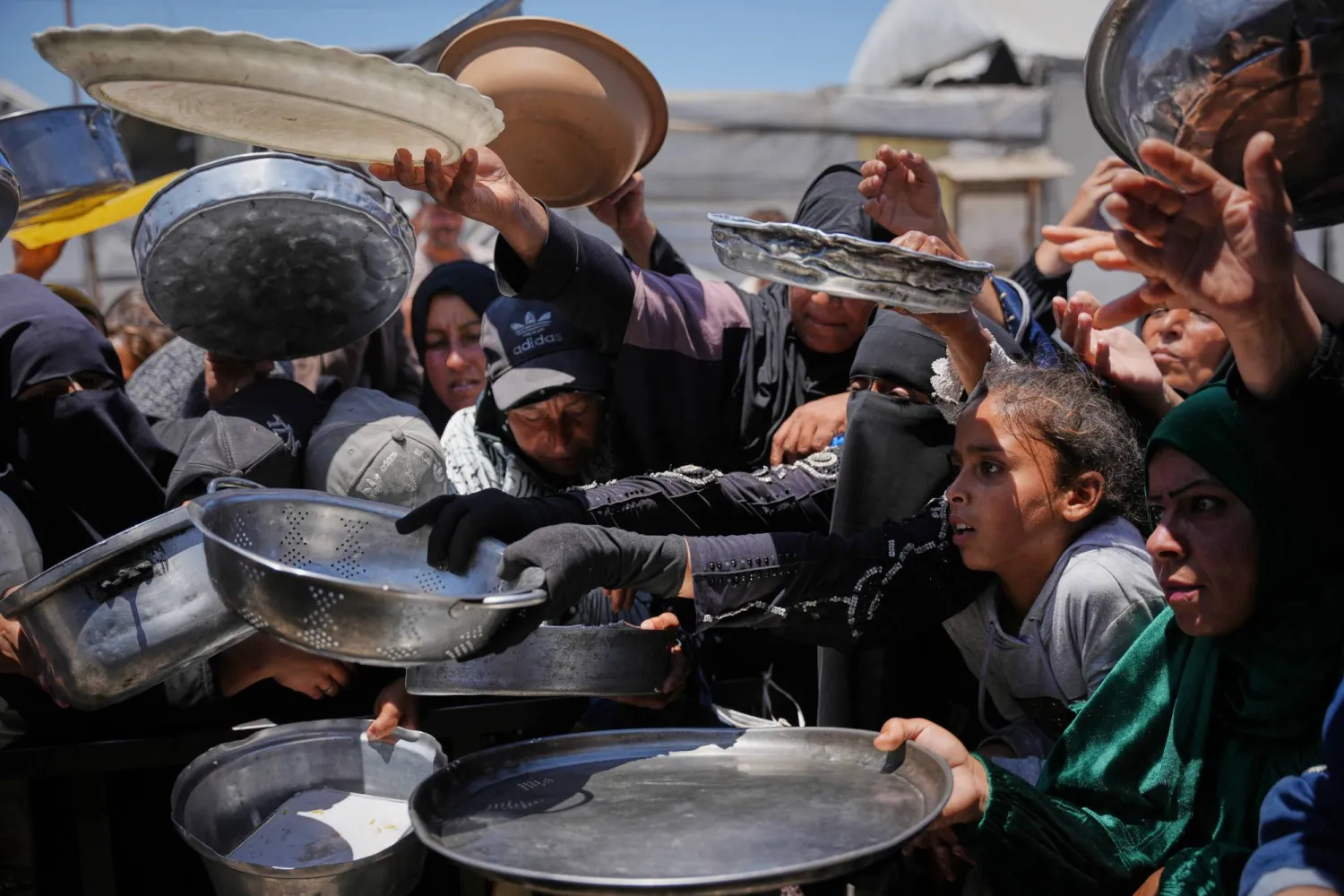
Palestinians wait to receive donated food at a distribution center in Khan Younis, Gaza Strip, Wednesday, May 27, 2026. (AP Photo/Abdel Kareem Hana)
TT

Gaza Marks Third Eid Asking: What Joy Remains?

Palestinians wait to receive donated food at a distribution center in Khan Younis, Gaza Strip, Wednesday, May 27, 2026. (AP Photo/Abdel Kareem Hana)

For the third year in a row, Gaza residents marked Eid al-Adha with the same bitter question, “In what state have you returned, Eid?”

Joy was again absent from the Gaza Strip, replaced by fear over the security situation, assassinations, and Israeli escalation, as fighter jets flew heavily overhead and carried out strikes.

That mood shaped the first day of Eid al-Adha on Wednesday. Residents moved cautiously, and family visits were limited by fears of renewed Israeli bombardment, which had intensified on Tuesday, the Day of Arafat, killing more than 15 Palestinians.

The latest developments overshadowed the third consecutive Eid to pass under harsh conditions in Gaza, amid war and continued escalation following the ceasefire that took effect on Oct. 10, 2025.

Remote greetings

Nabil Tareq, 41, a Gaza resident from the Jabalia refugee camp in the north, who is displaced west of Gaza City, settled for calling his sister and cousins to greet them on Eid al-Adha.

He had decided not to travel to the central Gaza Strip because of the security situation and the sudden Israeli strikes Gaza has seen in recent days.
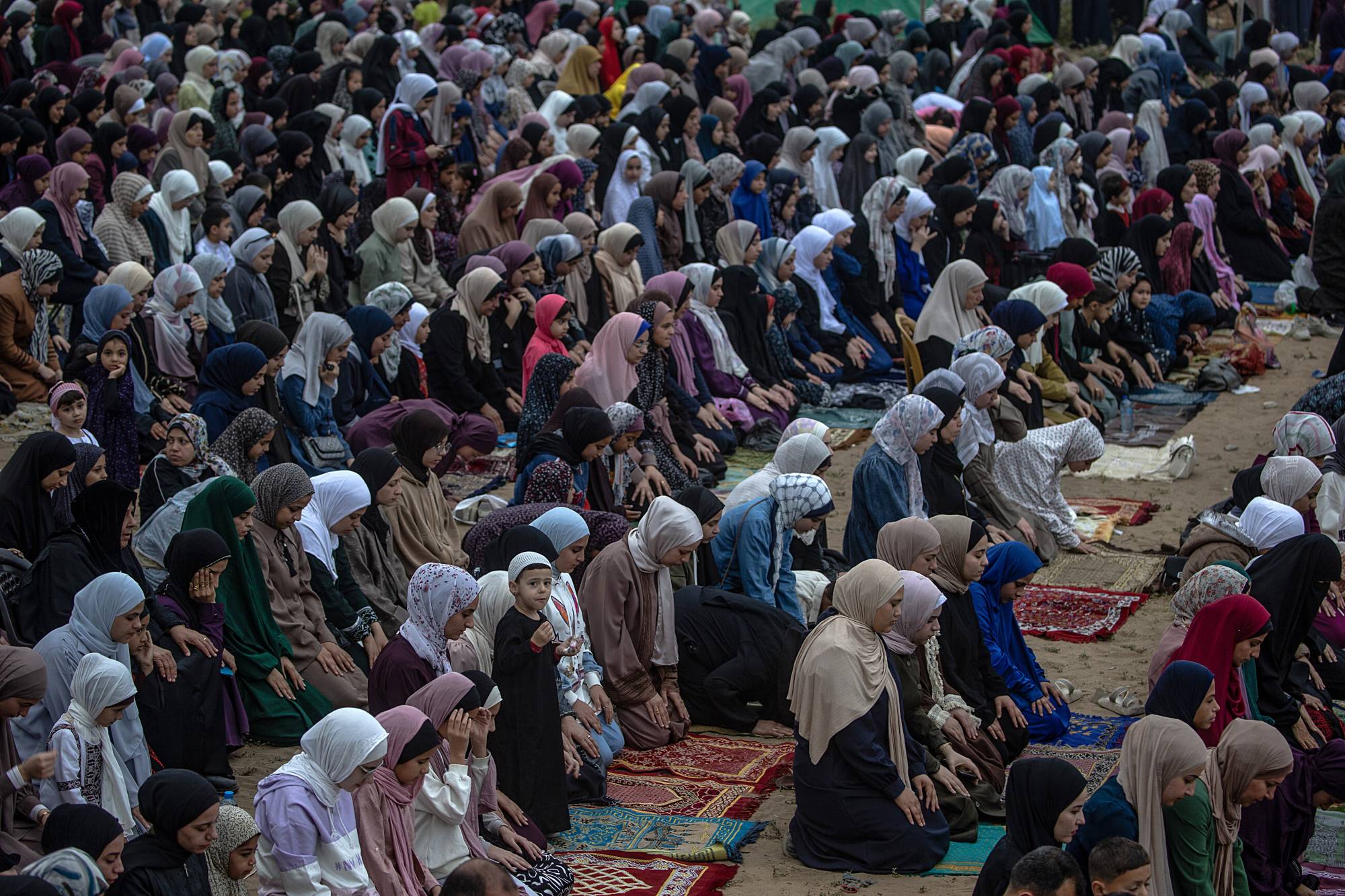
Internally displaced Palestinian women attend Eid al-Adha prayer in Gaza City, 27 May 2026. EPA/MOHAMMED SABER

Tareq told Asharq Al-Awsat that he only visited his brothers and relatives in western Gaza. The visit was brief, he said, so he could return to the tent where he is displaced and remain with his family, fearing for his life and theirs.

He said the security situation and the transport crisis kept him from visiting relatives in more distant areas.

Trying to adapt

Sama Hamdan, 23, from Gaza City and displaced to Nuseirat camp in the central Gaza Strip, traveled to her hometown in a rundown vehicle to see her uncles and greet them for Eid.

She was accompanied by her young brothers, who had been longing to play with their cousins.
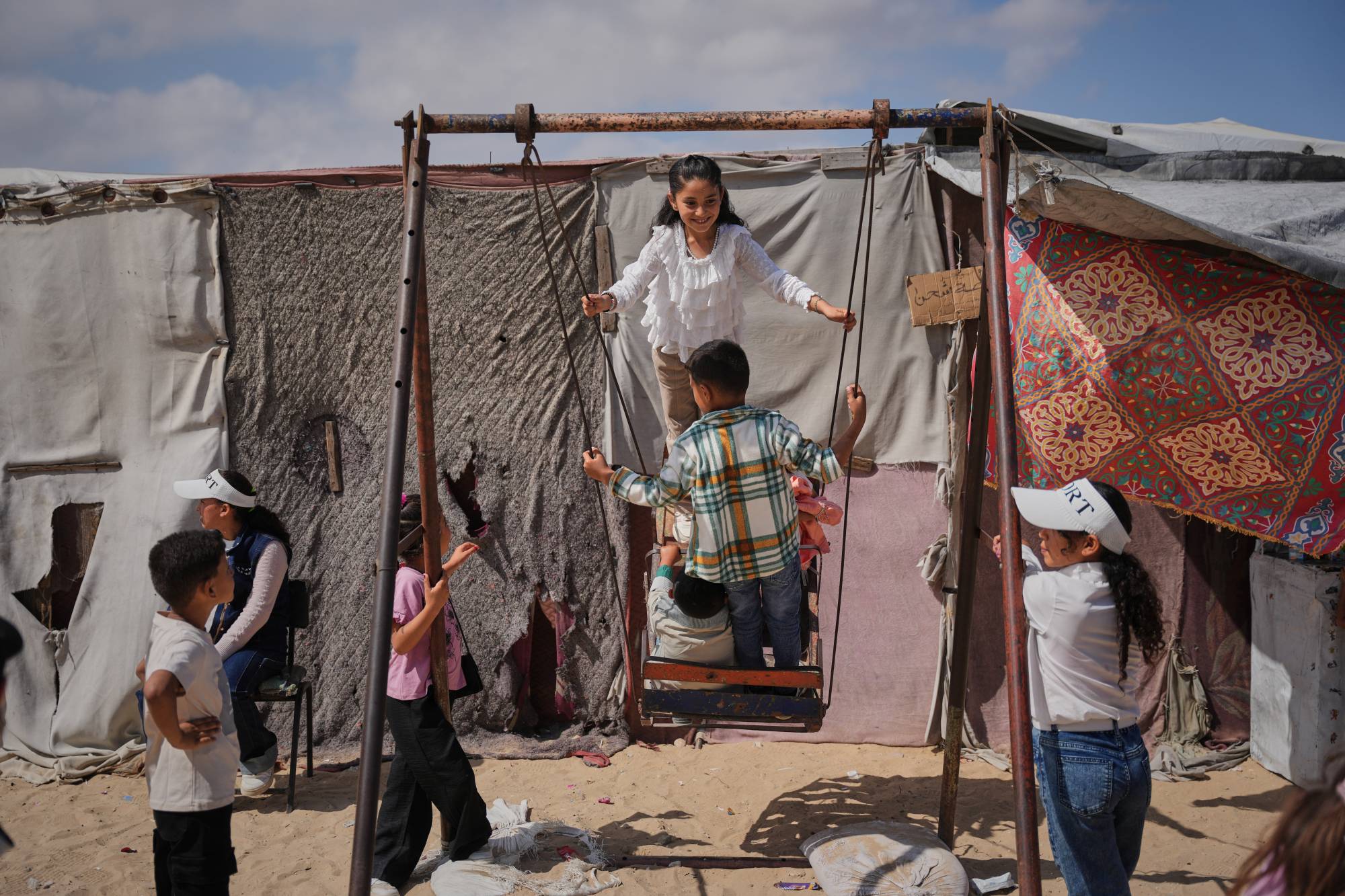
Displaced Palestinian children play on a swing at a tent camp during the Muslim holiday of Eid al-Adha in Khan Younis, southern Gaza Strip, Wednesday, May 27, 2026. (AP Photo/Abdel Kareem Hana)

Hamdan said she made the trip to ease the burden on her uncles, especially the elderly, amid Gaza’s harsh conditions, particularly the shortage of transport and high fares.

“Our lives have changed since the war, and no longer have meaning. All the conditions are discouraging and impose a state of despair on us, but we are trying to adapt to the new reality as much as possible despite the ongoing war by the occupation, which has not stopped bombing and destroying despite claims that there is a truce in Gaza,” Hamdan said.

An ongoing war

In a vehicle carrying several Gazans from the Rimal neighborhood to Sheikh Radwan in northern Gaza City, residents spoke of Israeli bombardment, the targeting of homes and the return of assassinations.

Saed Abu Safiya, 23, who started the conversation in the vehicle where Asharq Al-Awsat’s correspondent was present, said Israel would not halt its raids until Palestinian factions surrendered their weapons.

Salman Abu Khuwayter, a Gaza resident from Jabalia who is displaced in Sheikh Radwan, disagreed. He said the war would not stop even if Hamas and the factions handed over their weapons.

He said Israeli Prime Minister Benjamin Netanyahu and Israel aimed to displace Gaza’s population, pressure the factions and strip them not only of their weapons, but also eliminate all their members or move them out of the enclave.

Funerals on Eid

As family visits remained limited across Gaza, Palestinian families buried relatives killed in a series of strikes on Tuesday.
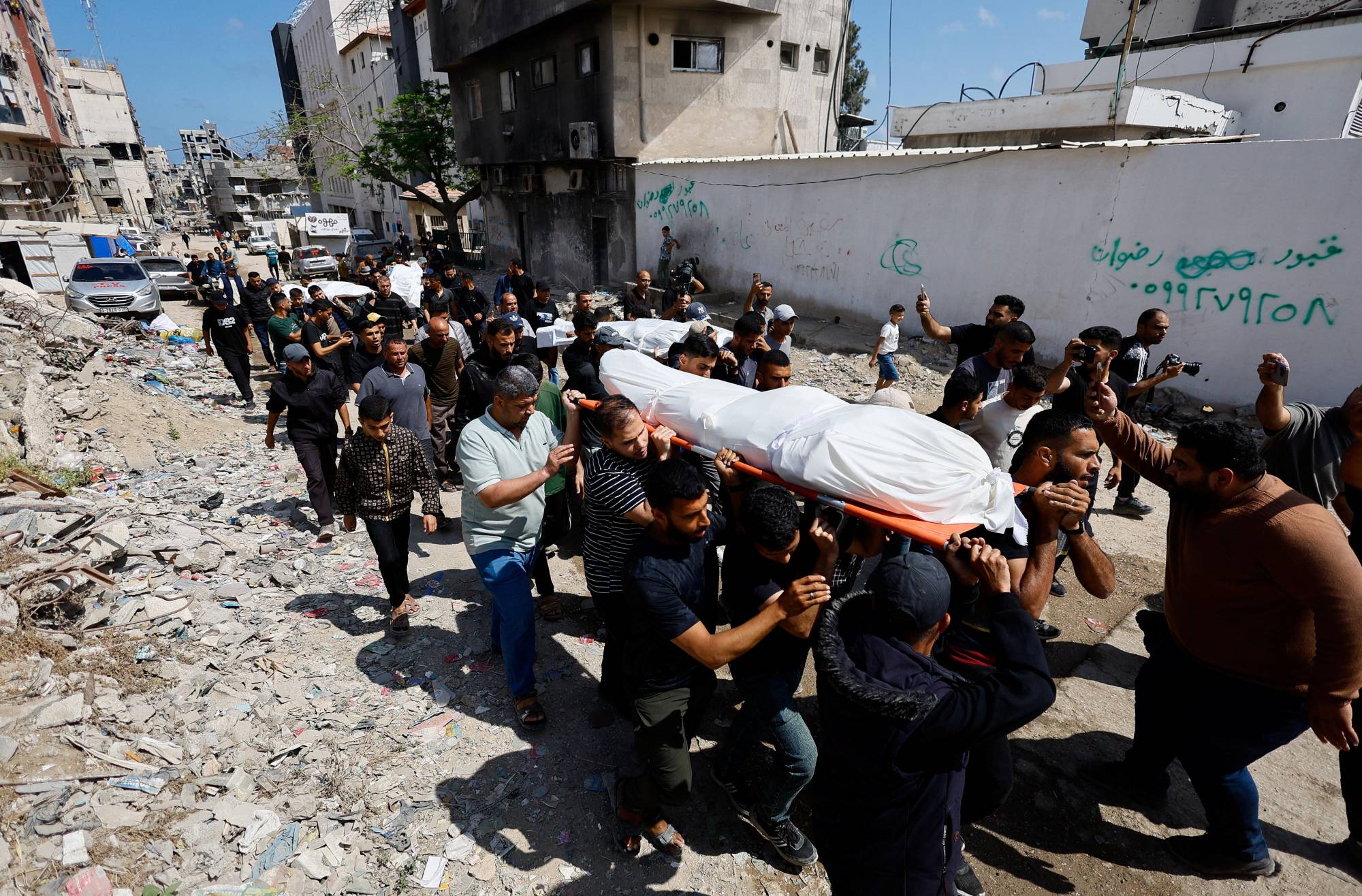
People carry bodies identified by mourners as Hamas' military wing commander Mohammad Odeh, who was killed in an Israeli strike on Tuesday, and his wife and children, during a funeral, in Gaza City, May 27, 2026. REUTERS/Mahmoud Issa

About 15 people were killed, including Mohammad Odeh, a commander in the Qassam Brigades, the armed wing of Hamas, his wife and three members of his family.

Grief marked the funerals held across southern, central and northern Gaza. Crowds joined processions that set out from different hospitals across the enclave.

At Odeh’s funeral, mourners chanted angry slogans demanding revenge for him and for all those killed in the escalating Israeli attacks on Gaza.

The number of Palestinian victims since the ceasefire has risen to more than 910.

The first day of Eid al-Adha was not quiet. Drones, warplanes, and helicopters kept flying over different parts of the enclave.

Explosions were heard in Khan Younis in southern Gaza and were later found to have been caused by mock raids off the city’s coast.

Shortly before Wednesday afternoon, a drone struck three Palestinians, wounding them. One injury was described as serious.


Iraq’s Ruling Coalition Discusses Arrests of Armed Faction Members

Iran’s Supreme National Security Council Secretary Mohsen Rezaei receives Iraq’s top judge Faiq Zidan in Tehran on Tuesday (Mehr)
TT

Iraq’s Ruling Coalition Discusses Arrests of Armed Faction Members

Iran’s Supreme National Security Council Secretary Mohsen Rezaei receives Iraq’s top judge Faiq Zidan in Tehran on Tuesday (Mehr)

Mohsen Rezaei, secretary of Iran’s Supreme National Security Council, said on Tuesday that regional countries would shape their own future and that the United States would have no place in the region.

Rezaei made the remarks in Tehran during talks with Faiq Zidan, head of Iraq’s Supreme Judicial Council.

He said Iran wanted a strong and independent Iraq and called for a resolution to the status of Iranian opposition groups based along the two countries’ border, an apparent reference to Iranian Kurdish parties in Iraq’s Kurdistan region.

His comments came days after Iranian parliament Speaker Mohammad Baqer Ghalibaf visited Baghdad, as Iraqi Prime Minister Ali Faleh al-Zaidi’s government faces growing pressure to press ahead with its plan to bring all weapons under state control.

During Ghalibaf’s visit, Iraqi National Security Adviser Qasim al-Aboudi said the government was moving forward with the plan.

He said the constitution did not allow armed groups to threaten the security of other countries and reaffirmed Baghdad’s commitment to its security agreement with Tehran.

The circumstances surrounding the visit suggested that armed factions were a central focus of the talks, even if the issue did not formally appear on every publicly announced agenda.

Iraqi reports said Ghalibaf conveyed Tehran’s position on government measures targeting the factions’ weapons as Baghdad’s deadline for completing the process approached.

Separately, leaders of the Coordination Framework discussed the arrests of Popular Mobilization Forces (PMF) members and commanders at a meeting in Baghdad attended by Mohsen Qomi, a representative of Iran’s supreme leader.

Local media said the leaders objected to how the arrests were carried out. They argued that those wanted by the authorities could have been summoned through formal judicial procedures instead of military force.

Underscoring the sensitivity of the issue, PMF later said what it called a “misunderstanding” over the arrests of several members had been resolved. It said they had been handed over to PMF security services to pursue their cases in court.

The developments come as al-Zaidi’s government seeks to enforce a state monopoly on weapons, bringing it into direct confrontation with armed factions that wield extensive political and security influence.

The weapons issue poses a sensitive test for al-Zaidi, who is also under US pressure to dismantle armed groups operating outside state control.

Baghdad ‘appreciates Tehran’s support’

In Tehran, Rezaei and Zidan focused their talks on security and judicial ties.

Zidan said Iraq appreciated Iran’s support and stressed the need for regional cooperation and security along the shared border.

He arrived in Tehran on Tuesday at the head of a senior judicial delegation following an official invitation. The delegation included the heads of the Judicial Supervision Commission and the Public Prosecution Service, as well as the director-general of the Judicial Protection Department.

Zidan was received by the Iranian judiciary’s deputy chief for international affairs and Nasser Seraj, secretary of the judiciary’s Human Rights Council.

During the visit, Zidan also met Iranian judiciary chief Gholam-Hossein Mohseni-Ejei to discuss closer judicial and legal cooperation.

Ejei said more than 131 Iranian convicts had been transferred from Iraqi prisons over the past year. He called for better prisoner-transfer and exchange mechanisms and measures to ease the difficulties facing their families.

He also said Iranian and Iraqi security were interconnected and urged closer coordination against activities threatening their shared border.

Zidan praised relations between the two countries and said the Iraqi government and people stood with Iran against what he described as “US and Israeli aggression.” He also recalled Iran’s support for Iraq during its war against ISIS.

Zidan also discussed several issues of common interest with Ghalibaf, according to Iraq’s state news agency.


Israel Restricts Movement in Three Christian Towns in Southern Lebanon

Civilians from Christian villages in southern Lebanon travel south along the coastal road in a convoy, as an Israeli flag is seen at the entrance to Naqoura in July 2026. (File photo/AFP)
TT

Israel Restricts Movement in Three Christian Towns in Southern Lebanon

Civilians from Christian villages in southern Lebanon travel south along the coastal road in a convoy, as an Israeli flag is seen at the entrance to Naqoura in July 2026. (File photo/AFP)

The Israeli military has restricted movement in and out of three beseigned Christian towns in southern Lebanon, forcing residents to travel in prearranged convoys along a single route through Naqoura.

Residents must register their vehicles and submit travelers’ details before entering or leaving Rmeish, Debel and Ain Ebel in the Bint Jbeil district.

People remain in the three towns despite being encircled by Israeli forces occupying every neighboring community. Relief and medical supplies arrive from elsewhere in Lebanon in convoys escorted by the United Nations Interim Force in Lebanon (UNIFIL).

Local sources in Rmeish told Asharq Al-Awsat that no vehicle may travel alone. At least one convoy of several cars or buses leaves one of the three towns each day.

The Lebanese army and UNIFIL organize the convoys, which must take the coastal road south of Tyre to Naqoura before heading to the Christian towns in Bint Jbeil.

The army escorts them as far as Qlayleh, about 15 km from the Israeli border. UNIFIL vehicles then accompany them to their villages.

Travelers must register their vehicles and provide UNIFIL with their personal details in advance. Their identities are checked and their vehicles searched as part of coordination with Israeli forces to allow them to pass, the sources said.

The restrictions have prompted the Vatican, through its ambassador to Lebanon, to ask the United States to intervene to prevent Israel from limiting the movement of residents of the Christian villages, Asharq Al-Awsat learned.

Marjayoun villages spared restrictions

The measures apply only to Christian villages in Bint Jbeil district and do not extend to those in Marjayoun district.

Residents and visitors can travel freely between Qlayaa, Jdeidet Marjayoun, Burj al-Mulouk and Deir Mimas and out of the towns, local sources in Qlayaa told Asharq Al-Awsat.

They use a route through the Western Bekaa in eastern Lebanon toward Hasbaya and then take the Ibl al-Saqi-Dibbin-Marjayoun road.

Residents continue to visit the towns as usual, but the communities are barred from hosting people displaced from nearby villages and towns. Journalists visiting the area are also prohibited from photographing the nearby town of Khiam, the sources said.

Israeli forces stationed in Kfar Kila and Tall al-Nahhas erected an earth mound on Tuesday near the Deir Mimas-Burj al-Mulouk-Kfar Kila junction, toward Tall al-Nahhas. It lies about 150 meters from inhabited homes in Burj al-Mulouk.

The forces built another earth mound near the Deir Mimas-Burj al-Mulouk-Houra junction.

More than 5,000 properties destroyed in Mais al-Jabal

Meanwhile, the Israeli military has continued bulldozing towns inside the “yellow line” and systematically destroying the homes still standing there.

In recent days, trucks carrying crates filled with explosives have traveled alongside Israeli patrols, a senior security source told Asharq Al-Awsat.

The crates are unloaded, and the explosives are placed around homes in occupied towns after they are looted, ahead of their demolition, the source said.

The same method was used in the border town of Mais al-Jabal, the largest town in Marjayoun district, where Israeli forces have continued destroying homes.

“Only dozens of housing units remain in Mais al-Jabal after more than 5,000 homes and commercial properties were destroyed,” the source said.

The latest demolition targeted a school complex consisting of prefabricated buildings that the Iraqi government had helped provide. The complex stood on the town’s outskirts, near Doubiyeh Castle and the road linking the area to Shaqra. Nearby homes were also destroyed.

The Israeli military also brought in specialized equipment to pulverize concrete into material resembling soil, making it easier for groups brought in for that purpose to remove reinforcing steel from destroyed buildings and transport it into Israel, the source said.

Before dawn on Tuesday, an Israeli force advanced toward Tallat al-Sawwan in Mayfadoun, an area inside the yellow line, and took up positions in a house.

Israeli military vehicles also moved from Hadatha into Haris in Bint Jbeil district and fired machine guns toward the town’s outskirts.

Lebanon’s state-run National News Agency said Israeli forces had stepped up attacks on villages in the western sector of Tyre district.

Aircraft carried out two strikes on Mansouri and another on Wadi Hassan in Tayr Harfa, as large-scale demolitions took place in Mansouri and Majdal Zoun, the agency said.

Israeli artillery also shelled Ainata and Beit Lif in Bint Jbeil district. Warplanes struck Mansouri and Wadi Hassan on the outskirts of Tayr Harfa, southeast of Tyre.


Gaza Parents Urged to Stop Kids Flying Kites After Israel Warning to Hamas

Palestinians make a kite at a tent camp sheltering displaced people in Gaza City, August 25, 2026. (Reuters)
TT

Gaza Parents Urged to Stop Kids Flying Kites After Israel Warning to Hamas

Palestinians make a kite at a tent camp sheltering displaced people in Gaza City, August 25, 2026. (Reuters)

Gaza parents have been warned to stop their children flying kites in the war-ravaged enclave, after Israel threatened a forceful response if the Hamas group revives a tactic of launching incendiary kites over the border.

The popular committees, comprising representatives of local non-government organizations and charities that run Gaza displacement camps and shelters, issued the warning in a statement late on Monday.

The announcement was coordinated with Hamas authorities, a source in the movement ‌said.

"We are ‌working tirelessly on the ground and doing everything possible ‌to ⁠stop this practice, ⁠not to restrict the childhood of our children, who have already been deprived of the most basic rights to play and live in safety, but to protect their innocent lives," the statement said.

In 2018, Gazans sent incendiary balloons and kites over the border, causing fires across hundreds of acres of open fields and farmlands, in what they said was in protest at the ⁠Israeli blockade of the Hamas-controlled enclave.

KITES SCARE ISRAELI VILLAGERS

In ‌the past month, several kites that ‌were not reported to be carrying incendiary materials were spotted drifting from Gaza into Israel, ‌alarming Israelis who live in the nearby villages which came under ‌attack by Hamas in the October 7, 2023 assault that sparked the Gaza war.

On Sunday, Israeli Prime Minister Benjamin Netanyahu warned Hamas that unless that stopped immediately, "those responsible" for launching kites, balloons or drones toward Israel would be targets of assassination and ‌that areas from which they are sent will be ordered to evacuate.

Umm Mohammed, a mother from Gaza ⁠City who spoke ⁠with Reuters over a chat app, said she was worried her son could be hurt.

"Every summer, my kid, Ahmed, 10, and the kids in the street fly those kites to entertain themselves, but I will not allow him to, not anymore," she said.

A senior Israeli defense official said that Hamas was trying to provoke Israel by encouraging Gazans to fly kites across the border.

A Hamas official told Reuters the group has complained to ceasefire mediators that "Israel was making fake pretexts to continue the war on Gaza."

Israel complained to US President Donald Trump's Board of Peace, which oversees the implementation of the 2025 Gaza ceasefire deal, about the kites, according to a second Israeli official.
