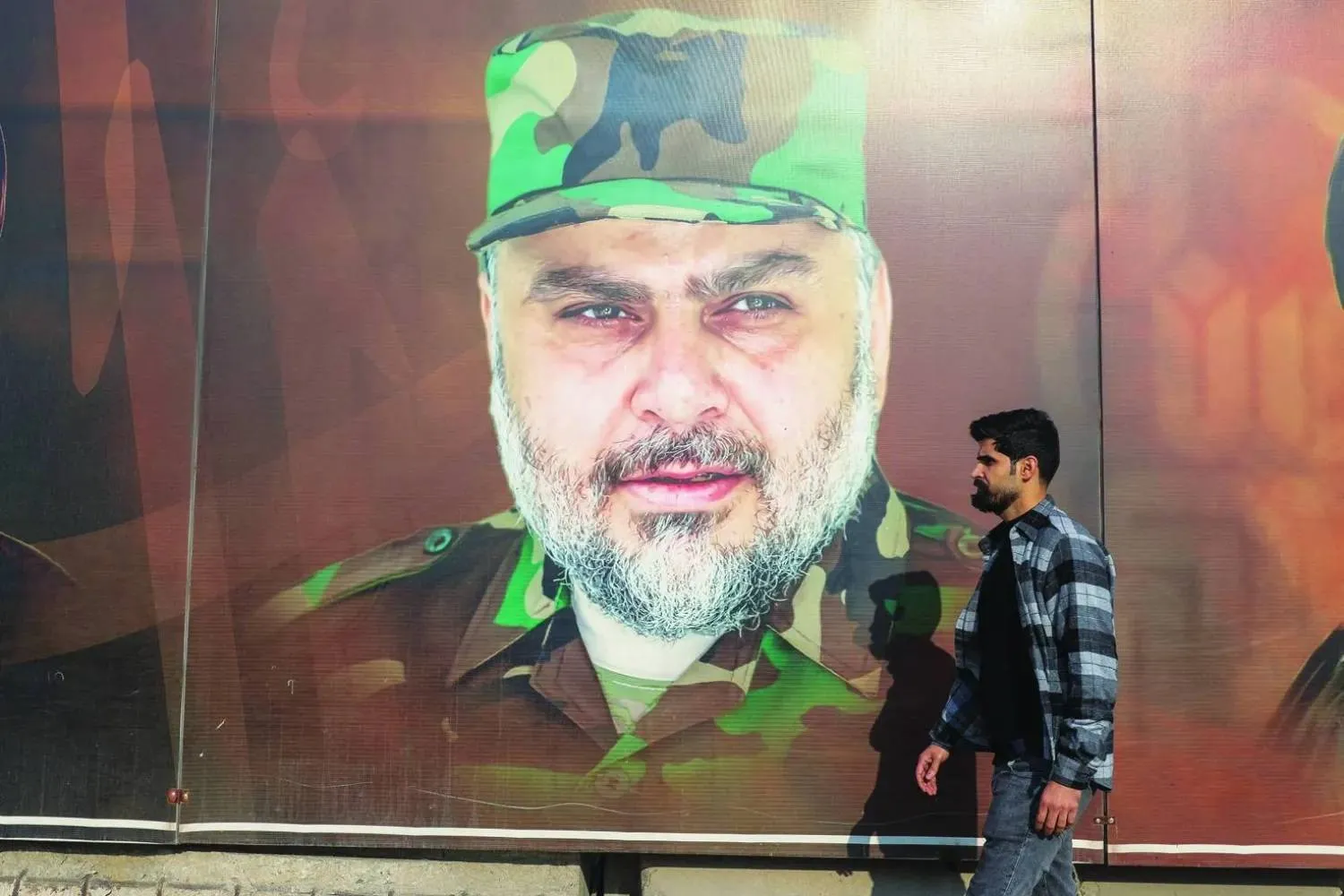

Shiite cleric Moqtada al-Sadr, leader of the Sadrist movement, said on Wednesday he had decided to sever his movement’s ties with its armed wing, Saraya al-Salam, and place its members under the authority of the state, in a move that comes amid political and government efforts to restrict weapons to the state and regulate the work of armed factions in Iraq.
Sadr had previously announced that he was dissolving his armed wing, but his latest position coincides with the arrival of a government working under regional and international pressure to disarm armed factions.
Observers said Sadr’s latest decision carries weight because it hands his Saraya al-Salam fighters over to the authority of the new prime minister, Ali al-Zaidi.
“It has become necessary for us to announce the complete separation of Saraya al-Salam from the movement and their full integration into the state and the general authority responsible for military formations, provided that the civilian bodies attached to Saraya al-Salam are transformed into Al-Bunyan al-Marsous, with no offices, weapons, uniforms, titles or anything else,” Sadr said in a statement.
“In the end, I can only thank the military formations of Saraya al-Salam for all their jihad, and may God forgive them,” he added.
Saraya al-Salam is part of the Popular Mobilization Forces through brigades 313, 314, and 315. It carries out security duties across several areas, most notably in Samarra.
Sadr called on “the remaining factions in the Popular Mobilization Forces to separate themselves from partisan and sectarian orders” and urged them to hand over their weapons to the state, saying he had offered such advice years earlier.
Government welcomes move
In a swift response, Iraqi Prime Minister Ali al-Zaidi welcomed the move, describing it as “an important path toward strengthening internal stability and consolidating the principle of restricting weapons to the state.”
Zaidi said in a statement that the current phase “requires unifying efforts and placing the higher national interest first.” He called on all armed factions to work under the umbrella of the state and its official institutions, stressing that the state “is the only authority authorized to carry weapons and enforce the law.”
Sadr’s announcement comes as the Iraqi government seeks to implement a program to restrict weapons to the state, a pledge included in the current government’s ministerial program, alongside discussions within the Coordination Framework over mechanisms to regulate and hand over weapons.
Sources said some factions had shown relative “flexibility” on the issue compared with their previous, more hardline positions, while others still reject including what they call “resistance weapons” in any disarmament measures.
It is widely rumored that five armed factions have agreed to place their weapons under government institutions, without clear details on how the possible process would be carried out, while Harakat al-Nujaba and Kataib Hezbollah have refused to comply with disarmament requests.
Nazim al-Saidi, head of the executive council of Harakat al-Nujaba, said earlier this month that measures to restrict weapons target “uncontrolled” arms that cause “chaos,” not “resistance weapons.”
Former lawmaker Sajjad Salem questioned whether the decision could be implemented, saying Sadr had previously announced the separation of Saraya al-Salam from the movement, “but the decision was not carried out.”
Salem said armed factions rely on weapons to secure their political and financial influence, adding that the Sadrist movement “has an exceptional ability to organize and mobilize with almost no resources,” a reference to the difficulty other factions may face in giving up their weapons.
Former Prime Minister Mustafa al-Kadhimi also commented on the move, saying the decision “stems from a high level of concern for the supreme national interest, and from a deep awareness of the need to push toward strengthening the path of the state and its institutions.” He described it as “a position worthy of praise and welcome.”
The leader of Asaib Ahl al-Haq also paved the way for the handover of his weapons. On Wednesday, he stressed that his political project supports “the state, sovereignty and stability, not a project of chaos,” as he put it.
Qais al-Khazali said in press remarks that “the current phase requires moving toward consolidating state institutions and strengthening their role in confronting internal and external challenges.”
Disarmament plan
Asharq Al-Awsat reported on May 9, 2026, that an Iraqi committee, including Prime Minister-designate Ali al-Zaidi, outgoing Prime Minister Mohammed Shia al-Sudani, and Hadi al-Amiri was working to complete an “executive project” to disarm armed factions before presenting it to Washington, amid mounting US pressure to keep militias away from the new government and state institutions.
The committee had presented militia leaders with “ideas on how to disarm,” but some meetings “did not pass calmly,” according to people familiar with the matter.
The plan includes removing heavy and medium weapons and restructuring the Popular Mobilization Forces, in parallel with expected changes in sensitive security agencies, which could include the intelligence service.
But political sources questioned the government’s ability to implement the project, saying it may be intended to “buy time.” In contrast, prominent factions, including Kataib Hezbollah and Harakat al-Nujaba, have said they reject handing over their weapons “whatever the cost.”