


US Treasury Sanctions Iran Authorities Overseeing Strait of Hormuz

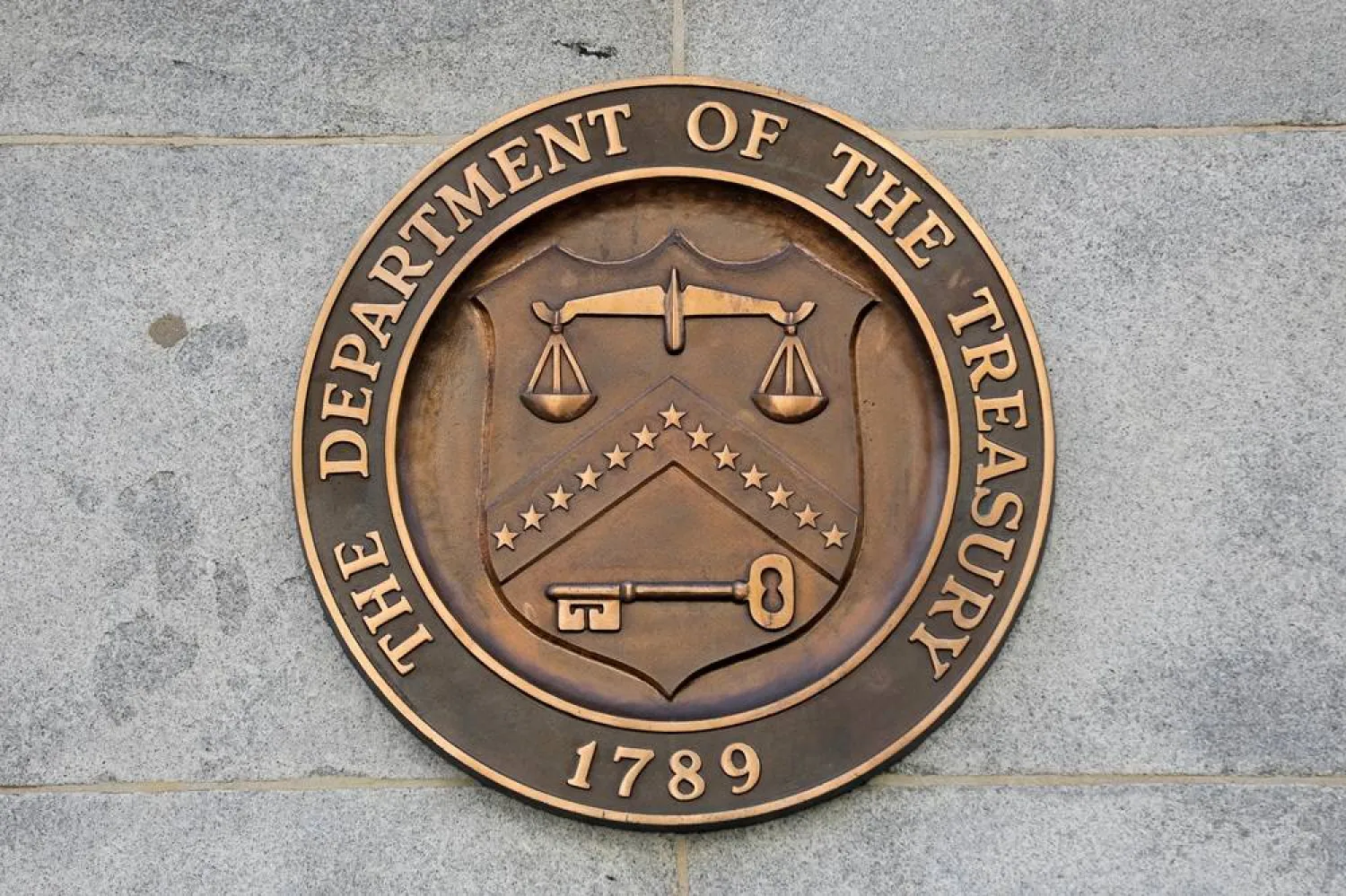
Signage is seen at the United States Department of the Treasury headquarters in Washington, DC, US, August 29, 2020. (Reuters)
TT

US Treasury Sanctions Iran Authorities Overseeing Strait of Hormuz

Signage is seen at the United States Department of the Treasury headquarters in Washington, DC, US, August 29, 2020. (Reuters)

The United States Treasury announced sanctions Wednesday against Iran's Gulf Strait Authority, Tehran's new agency that collects fees for traveling through the strategic Strait of Hormuz.

"The Iranian military's latest attempt to extort global maritime trade is proof that Economic Fury has left the regime desperate for cash," said Treasury Secretary Scott Bessent in a statement.

The statement extended the threat of sanctions to anyone paying the fees, because they "may be providing support to and receiving services from" Iran's Revolutionary Guards, and therefore may "be exposed to sanctions risk."

"Treasury has deprived the Iranian regime of revenue for their weapons programs, terrorist proxies, and nuclear ambitions," Bessent said.

The statement said the US has succeeded in disrupting "tens of billions of dollars' worth of revenue from being accessible" to Tehran.

In a post to X on May 20, the Gulf Strait Authority issued a map to define its "regulatory jurisdiction," demarcating red lines on both sides of the Strait of Hormuz that require Iran's authorization for passage.

US and Iranian forces have observed a ceasefire since April 8 while diplomats push for a negotiated settlement, but Iran's controls have tightened on Gulf shipping through the Strait of Hormuz and the US has launched strikes on Iranian targets in recent days.

Iran's foreign ministry spokesman Esmaeil Baqaei said Monday that Tehran will continue to manage traffic through the strategic Strait fo Hormuz -- through which 20 percent of the world's oil and natural gas transits -- and insisted Iran is collecting fees for "navigational services," rather than imposing tolls.

The war began after the United States and Israel attacked Iran on February 28, and saw Tehran respond with missile and drone attacks across the region.



Trump Believes Iran’s Supreme Leader Is Still Alive

Iranians shop at a bazaar in northern Tehran, Iran, 25 August 2026. (EPA)
TT

Trump Believes Iran’s Supreme Leader Is Still Alive

Iranians shop at a bazaar in northern Tehran, Iran, 25 August 2026. (EPA)

US President Donald Trump on Wednesday said he believes Iran's supreme leader, who has not been seen in public since taking over after his father's killing in February, remains alive. 

"I don't think he's dead. He was very seriously wounded. The left side of his body, the arm, the leg, the whole thing. He was very seriously wounded. But I don't think he's dead," Trump said in an interview with conservative radio host Glenn Beck. 

Officially, Mojtaba Khamenei continues to lead his country under US and Israeli attack. However, his public absence and the rise to power of veteran Revolutionary Guards figures has fueled speculation that he is either dead or not fully in command. 

His father was killed in bombing at the start of the US-Israeli assault. 

Trump -- who has already declared victory over Iran on multiple occasions but remains unable to force the opening of the Hormuz sea route or force Iran to surrender its nuclear materials -- said again that military and economic pressure was working. 

"Those things are going toward a very big victory," he said. "We're going to have a big victory here very soon." 

Trump also insisted that the Strait of Hormuz, where Iran's military has disrupted and to a large extent blocked shipping, is in fact fully open. 

"You could really say, you know, because the Strait is open. We take a lot of ships through the Strait now. We're taking them in. The mines are gone," he said. 

"We cannot let Iran have a nuclear weapon. That's what it's all about. That's 99.9 percent. We cannot let them because they are crazy and they will use it," he said, before adding that he had already "stopped it twice." 


CIA Director Was on ‘Semi-Routine’ Mission in Moscow, Says Trump

Central Intelligence Agency (CIA) Director John Ratcliffe attends a US House Intelligence Committee hearing on worldwide threats, on Capitol Hill in Washington, DC, US, March 19, 2026. (Reuters)
TT

CIA Director Was on ‘Semi-Routine’ Mission in Moscow, Says Trump

Central Intelligence Agency (CIA) Director John Ratcliffe attends a US House Intelligence Committee hearing on worldwide threats, on Capitol Hill in Washington, DC, US, March 19, 2026. (Reuters)

US President Donald Trump said Wednesday that CIA Director John Ratcliffe's visit to Moscow was "semi-routine," while implying that the intelligence chief was in the Russian capital to discuss the Ukraine war.

"He's there, very sort of semi-routine. I hate to disappoint people. We would like to see the war with Ukraine end," Trump said in an interview with conservative radio host Glenn Beck.

Ratcliffe is one of the highest-ranking US officials to visit Russia since its war with Ukraine started in 2022.

His Tuesday visit came amid an escalation in Moscow's offensive in Ukraine, with attacks this summer increasing the civilian death toll, while US-brokered peace talks have stalled.

The Kremlin said Wednesday that Ratcliffe had "contacts" with Russia's special services on his visit to Moscow but did not meet President Vladimir Putin.

Kremlin spokesman Dmitry Peskov said Putin was briefed on the talks but refused to say whether the Ukraine war was raised.

"Contacts through the intelligence services are a positive development in and of themselves. It is too early to say how this will affect the process of resolving the crisis in our relations," Peskov said.

The last time a CIA director visited Moscow was in November 2021 -- when William Burns warned Russia against sending troops into Ukraine. Weeks later, the Kremlin launched its attack that turned into Europe's worst conflict since World War II.

The CIA has also been involved in prisoner swap deals with Russia, including a major exchange in mid-2024.

The war in Ukraine has killed hundreds of thousands and the Kremlin has refused to ease its maximalist demands of seizing the rest of eastern Ukraine and keeping Crimea.

Trump dismissed suggestions that Ratcliffe was discussing other issues such as Russia testing the resolve of NATO or the US campaign to ramp up economic pressure on Iran.

"He is not in there for any of the things that you said, now something may come out, you know, out of it," Trump told Glenn Beck.

"We're working very hard to get that war ended, and frankly, they both want to see it ended at this point," the US president said.


At Least 98 Killed and Hundreds Missing After Flash Floods in Nepal and China

A mud-covered building following a flash flood at Trishuli in Nuwakot district, Nepal, August 26, 2026. (Reuters)
TT

At Least 98 Killed and Hundreds Missing After Flash Floods in Nepal and China

A mud-covered building following a flash flood at Trishuli in Nuwakot district, Nepal, August 26, 2026. (Reuters)

Massive flash floods in a border area of Nepal and China on Wednesday killed at least 98 people and left hundreds of tourists, workers and others missing after sweeping through communities and bringing travel in some areas to a halt.

The prime minister’s office in Nepal reported at least 95 dead. China’s state broadcaster CCTV said a mudslide in the Tibet region’s Gyirong County near the border killed at least three and left 265 missing.

Officials in Nepal said 403 people, including 341 foreign nationals were reported missing. Sunil Sharma, a tourism board spokesperson, said 133 were from India on pilgrimage to Mount Kailash in Tibet, a sacred site for Hindus. Also missing were 47 from the United States, 34 from Australia, 33 from the Britain and 24 from Canada, he said.

At least 62 missing Nepali citizens were among hundreds of locals trekking in the Gosaikunda lake in Rasuwa, coinciding with the local festival of Janai Purnima on Friday, Sharma added. Nepal police spokesperson Abi Narayan Kafle told The Associated Press that at least 28 police officials were missing.

Officials warned residents in several of Nepal’s districts to stay away from the banks of the Bhotekoshi, Trishuli and Narayani rivers. The Bhotekoshi flooded around 9 a.m. Wednesday, destroying several villages, roads and hydropower projects, officials said.

“We have asked both India and China to help us with the rescue efforts,” said Sasmit Pokharel, a Nepali government spokesperson.

Nepal’s steep valleys are economic lifelines and travel corridors but precarious ones when disaster strikes. Images showed what appeared to be the second floors of buildings in hard-hit Nuwakot district slathered in mud after the torrent rushed by. Debris hung from tree branches and wires, vehicles were buried and stunned survivors were caked in mud.

The US Geological Survey reported a magnitude 4.4 earthquake early Wednesday, about 100 kilometers (60 miles) north of Kathmandu, near the border with China’s autonomous region of Tibet.

Though the current monsoon season is less favorable for trekking in Nepal, it’s a major season for Kailash trekking in Tibet, which follows the route in Nepal’s Rasuwa district bordering Tibet’s Gyirong.

Countries express alarm over missing citizens

South Korean government officials said nine of its citizens working on building a hydropower plant in Nepal were among those reported missing.

Malaysia’s foreign ministry said its embassy in Kathmandu received reports from travel agencies that they had lost contact with 11 Malaysians believed to be in the Rasuwa district, also hit hard by floods.

Chinese authorities were conducting large-scale search and rescue operations in the Tibetan border area of Gyirong, according to state broadcaster CCTV. Chinese President Xi Jinping ordered authorities to step up the efforts, state news agency Xinhua reported.

Indian Prime Minister Narendra Modi spoke with Nepal’s Prime Minister Balendra Shah and offered help. “India is prepared to provide Nepal with all possible types of humanitarian assistance. Our teams are closely coordinating on rescue and relief efforts,” Modi said on social media.

In a joint statement, Australia, Britain, the European Union, Finland, France, Norway and Switzerland expressed solidarity with the affected people in Nepal., adding: “We encourage all those in affected areas to follow the guidance of local authorities and official safety advisories as the situation continues to evolve.”

The same region saw flash floods last year

The same regions saw similar flash floods in August last year, when a glacial lake in Tibet overflowed because of high temperatures. Nine people were killed, and critical infrastructure, including a bridge connecting Nepal and China, was damaged.

Climate experts at the Kathmandu-based International Centre for Integrated Mountain Development said an avalanche from a glacier likely caused Wednesday’s flash flood.

The Lhende Khola River, a tributary of the Bhotekoshi, had maximum flooding Wednesday, they said.

“The Lhende Khola has flooded twice in 14 months, this time triggered by an ice rock avalanche from a glacier on the Nepal side that blocked the river and released a sudden surge downstream,” said Saswata Sanyal, a disaster risk reduction specialist at the climate research group.

He noted the importance of early warnings in “a warming Himalaya.”

The Himalayan region, which spans several countries including India, is especially vulnerable to heavy rains, floods and landslides because it is warming faster than the rest of the world due to human-caused climate change. Research shows that extreme weather events, including heat waves, rains and melting glaciers, have become more frequent.

Researchers in Kathmandu found earlier this year that glaciers across the Hindu Kush Himalaya region are melting at an accelerating rate, with ice loss rates doubling since 2000, primarily due to rising global temperatures and climate change.