

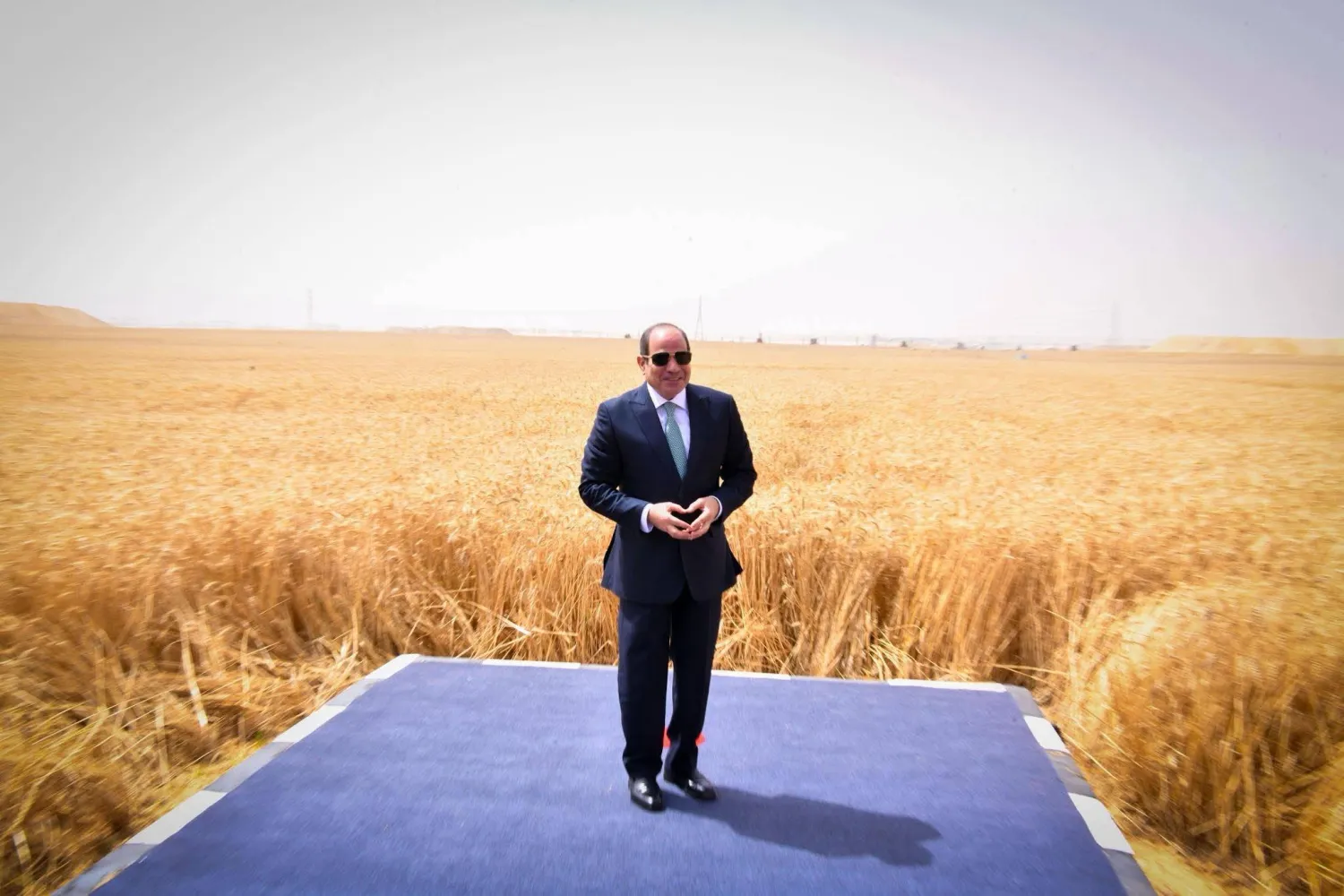

With 19 Ports and 70 Upgraded Silos, Egypt Aims to Become Global Grain Hub

Egyptian President Abdel Fattah al-Sisi during the inauguration of the New Delta project days ago. (Egyptian Presidency)
TT

With 19 Ports and 70 Upgraded Silos, Egypt Aims to Become Global Grain Hub

Egyptian President Abdel Fattah al-Sisi during the inauguration of the New Delta project days ago. (Egyptian Presidency)

Egypt is intensifying efforts to position itself as a global hub for grain storage and trade as regional conflicts continue to disrupt international food supply chains.

Cairo’s push is anchored in its strategic geographic location, a network of 19 commercial ports and recently upgraded grain silos with expanded storage capacity. Economists interviewed by Asharq Al-Awsat described the initiative as part of Egypt’s broader ambition to play a larger role in regional food security and global supply stability.

In televised remarks Monday, Amr Abdo, a member of the Federation of Egyptian Chambers of Commerce, said that plans to establish a global strategic grain storage center were “an urgent necessity” amid escalating regional conflicts and supply-chain disruptions.

Abdo noted that Egypt’s strategic partnership with Russia — the world’s largest grain exporter — gives Cairo access to advanced storage technologies and technical expertise that help reduce spoilage and moisture loss while securing wheat imports at competitive prices.

The initiative gained momentum during the Fifth International Grain Forum, held in the Russian city of Sochi from May 20 to 23. On the sidelines of the event, Egypt’s Supply and Internal Trade Minister Sherif Farouk met Russian Agriculture Minister Oksana Lut and outlined Egypt’s goal of establishing “an integrated global logistics center for grains and edible oils.”

Farouk characterized the project as one of Egypt’s most important strategic initiatives, designed to transform the country into a regional and international hub for the storage, trading and processing of grains and food commodities.

He added that Egypt’s strategic location, combined with major upgrades to ports, economic zones and transportation networks, creates significant opportunities for Russian companies and institutions to participate through direct investment and technology transfer in storage, transport, silo management and logistics services.

Major storage expansion

According to Egyptian government figures, Egypt now operates 70 grain silos nationwide built to modern technological standards as part of a national program aimed at increasing wheat and grain storage capacity and safeguarding strategic reserves.

Economic expert Medhat Nafea, a member of the cabinet’s economic advisory committee, said that Egypt boasts substantial advantages that could help make the project viable.

He pointed to the country’s location, its 19 commercial ports, expanded silo capacity, modern storage infrastructure and Egypt’s potential role as a transit hub for exports.

Nafea stressed that transforming Egypt into a regional grain center would require major investments in storage capacity, digitalization and transportation networks, though he added that the goal “appears realistic” through cooperation with Russia.

Khaled El-Shafei, head of the Capital Center for Economic Studies, described the initiative as a potentially transformative step that could significantly strengthen Egypt’s role in securing global supply chains.

“Egypt’s move toward establishing a global grain hub could represent an unprecedented economic and developmental leap,” El-Shafei remarked, noting that Egypt’s geographic position linking East and West, along with its status as a gateway to Africa, gives it major strategic advantages.

International coordination

On April 20, Egyptian Prime Minister Mostafa Madbouly chaired a meeting to review developments related to plans for a global center for the storage, supply and trade of grains and edible oils.

Officials indicated that technical studies are being prepared for discussions between President Abdel Fattah al-Sisi and leaders of several countries as part of broader efforts to strengthen cooperation on food security.

Days later, on April 26, Russia’s Maritime Board announced that Russian presidential aide and board chairman Nikolai Patrushev discussed prospects for establishing a grain and energy hub in Egypt during talks in Cairo with Egyptian Transport Minister Kamel al-Wazir, according to Russian media.

The Russian official added that Moscow plans to direct a significant share of its exports to South Asia and Africa through Egyptian territory.

Nafea underscored the importance of attracting large-scale foreign investment from countries expected to benefit from the project, predicting substantial financial returns that could help reduce Egypt’s import bill and ease global food-security pressures.

El-Shafei acknowledged that the initiative still faces challenges but maintained that Egypt’s diplomatic relationships and ongoing infrastructure development could help secure international backing.

“The project is highly promising if there is genuine commitment and sustained cooperation to implement it,” he stressed, adding that global grain supplies increasingly require secure hubs for storage and trade.

He added that Egypt’s broader vision extends beyond becoming merely a grain-trading center to positioning itself as a global commercial and logistics hub.



Jordan’s King Leads International Effort to Support Lebanon’s Stability, Army

Jordan’s King Abdullah II receives Lebanese Army commander Gen. Rodolphe Haykal in Amman on Aug. 30, 2026 (Royal Hashemite Court) 
TT

Jordan’s King Leads International Effort to Support Lebanon’s Stability, Army

Jordan’s King Abdullah II receives Lebanese Army commander Gen. Rodolphe Haykal in Amman on Aug. 30, 2026 (Royal Hashemite Court) 

Amid regional developments, Amman has stepped up a diplomatic effort led by King Abdullah II and Foreign Minister Ayman Safadi to mobilize international backing for Lebanese state institutions, foremost among them the Lebanese Army.

The initiative aims to forge a joint Arab, European and US position that would help preserve Lebanon’s territorial integrity, uphold its sovereignty across all its territory, halt Israeli attacks and enable the country’s political institutions to carry out their responsibilities.

King’s Directives

Senior Jordanian sources said King Abdullah had instructed the relevant institutions years ago, particularly the Jordan Armed Forces, to assist Lebanon by providing military, humanitarian and medical aid and to stand by the country in safeguarding its security and sovereignty.

The policy helps explain part of the « unusually close » Jordanian-Lebanese relationship that has developed in recent years, according to the sources.

The Jordanian monarch maintains close ties with Lebanese leaders at both official and public levels. He has met Lebanese President Joseph Aoun on several formal and informal occasions, while the two leaders have held four telephone calls in recent months.

Lebanese Army commander Gen. Rodolphe Haykal, who visited Amman on Aug. 30, also has a close relationship with his Jordanian counterpart, Maj. Gen. Yousef Ahmad Al-Huneiti, who left his post on Wednesday and was succeeded by Maj. Gen. Majdi Al Harasis. Lebanese political and party figures have likewise continued to visit Amman and meet King Abdullah.

Jordan earlier sent military assistance that included 62 armored personnel carriers to help strengthen the Lebanese military’s defensive capabilities and contribute to security and stability.

King Abdullah also met Haykal in Amman late last month, while military sources said the kingdom was ready to meet the Lebanese Army’s needs in areas including administration and training.

As part of its assistance to Lebanon, Jordan has dispatched 12 aid convoys since the beginning of 2026 in response to humanitarian conditions. In 2024, it also sent 14 aircraft loaded with medicines, medical supplies, essential goods and food.

Over the past five years, Amman has delivered dozens of convoys carrying food, medicines, relief supplies and mobile homes. Following the devastating 2020 Beirut port explosion, Jordan deployed a fully equipped field hospital capable of handling emergency cases as well as major and minor surgeries.

Jordanians also recall King Abdullah’s announcement during the 2006 war that the first Royal Jordanian Air Force aircraft had arrived carrying army engineering teams to help reopen Beirut airport, breaking the wartime air blockade. Three aircraft carrying a field hospital and medical equipment followed, while a Jordanian relief air bridge continued throughout the July 2006 war.

Jordan Rallies Support in Paris

Political sources told Asharq Al-Awsat that Jordan and France are working this month to bolster the Lebanese Army, with Amman seeking to bring Arab and foreign countries together in Paris after playing a key role in persuading the United States and other states to take part in the conference.

The sources also reaffirmed that a special round of the “Aqaba Meetings” will be held in Paris on Sept. 17 to support the Lebanese military and enable it to perform its role as a sovereign institution capable of extending its control across all Lebanese territory.

Jordan will take part in the meeting, which it will co-chair with France and Lebanon and which will bring together military commanders from several Arab and foreign countries.

The Aqaba Meetings were launched by King Abdullah in 2015 to strengthen coordination, cooperation and the exchange of expertise among countries in addressing regional and international challenges.

Previous rounds have been held in Jordan as well as Spain, Albania, Indonesia, Italy, Brazil, Bulgaria, Rwanda, Singapore, the United Kingdom, Norway, Nigeria, the Netherlands and the United States, in addition to meetings held at the United Nations in partnership with the kingdom.


Sudanese Army Continues Military Buildup in Blue Nile

Sudanese Army Commander-in-Chief Abdel Fattah al-Burhan attends an event in Khartoum on Aug. 15 marking the anniversary of the army’s founding (AFP)
TT

Sudanese Army Continues Military Buildup in Blue Nile

Sudanese Army Commander-in-Chief Abdel Fattah al-Burhan attends an event in Khartoum on Aug. 15 marking the anniversary of the army’s founding (AFP)

Sudanese Army Chief of Staff Gen. Yasser al-Atta said the armed forces plan in the coming phase is to deploy troops continuously to the battlefronts, signaling an intensification of military operations in Darfur, Kordofan and Blue Nile.

During an inspection of special forces at a frontline position in Khartoum on Tuesday, al-Atta strongly criticized the Rapid Support Forces (RSF), accusing them of systematically committing killings, ethnic cleansing and genocide on ethnic and tribal grounds, according to an army statement.

The chief of staff ordered the continuous deployment of all troop contingents to reinforce forces already positioned in operational areas toward Darfur in western Sudan.

“They killed and exterminated our brothers in El Geneina, North Darfur and villages in Al Jazira in central Sudan, and they continue to this day to kill civilians in West Kordofan,” he stated.

Al-Atta also accused the RSF of exploiting traditional administration leaders, including tribal chiefs and mayors, to recruit children and send them into battle under the pretext of protecting women from killing and rape. He stressed that the Sudanese Army is “a national and professional force that does not fight civilians.”

“We reassure our people in Darfur that we are coming to protect them from the violations of the rebel and lawless RSF, so that they can enjoy security and stability like the states that have been cleared of the rebellion,” he said.

Al-Atta had earlier vowed to eliminate the RSF before the end of this year.

Blue Nile

Last month, the Sudanese Army recaptured several strategic areas in North Kordofan, including the towns of Bara, Jabra al-Sheikh, Umm Sayala and Umm Qirfa, while the RSF retreated to positions it continued to control in West Kordofan state.

The army chief’s remarks came as the RSF continued to strengthen its control over strategic positions in the Blue Nile region of southeastern Sudan after seizing the areas of Bakori and Sarkam in recent days.

At the same time, the Sudanese Army has continued to amass additional troops and military equipment to halt the RSF advance in Blue Nile.

The 4th Infantry Division, headquartered in Damazin, the regional capital, on Tuesday received the first contingent of the Joint Force comprising armed movements that support the army. The troops are to join elite forces deployed in recent days to frontlines around Bakori and Sarkam.

The division’s commander, Maj. Gen. Ismail al-Tayeb, said the forces were fully prepared to continue their operations in the region, adding that “the rebellion is suffering successive and painful blows on various battlefronts.”

Humanitarian Situation

Separately, the UN Office for the Coordination of Humanitarian Affairs (OCHA) said humanitarian organizations continue to provide lifesaving assistance in Sudan despite the ongoing conflicts and funding shortages.

The International Organization for Migration, for its part, revealed that 730 people fled several villages in South Kordofan on Sunday.

According to the World Health Organization, more than 2,600 cholera cases had been reported across several states through early August, with Kordofan at the center of the latest outbreak.

UN spokesman Stephane Dujarric said Tuesday that the United Nations and its partners were stepping up efforts to combat cholera, as health workers continued to provide treatment, conduct vaccination campaigns and distribute essential medical supplies.

He added that humanitarian organizations were expanding efforts to provide clean water in Kordofan, where a water network rehabilitated with UNICEF support in Abu Jubeiha provides safe water to about 25,000 people a day, including 5,000 displaced people.


Public Anger, Lawsuits Mount Against Badr Chief Hadi al-Amiri in Iraq

A protest in Iraq in October 2019 (File photo)
TT

Public Anger, Lawsuits Mount Against Badr Chief Hadi al-Amiri in Iraq

A protest in Iraq in October 2019 (File photo)

Public anger and criticism are mounting against Badr Organization chief Hadi al-Amiri after he acknowledged the involvement of what he called the “resistance” in events surrounding Iraq’s October 2019 protest movement.

The movement lasted nearly two years, leaving more than 600 demonstrators dead and over 20,000 wounded.

Many families of the victims said they planned to sue al-Amiri over his latest “admissions.”

“The resistance courageously stood against the Tishreen sedition and preserved the state and the political system,” al-Amiri said last Monday.

Most activists and observers saw the remarks as “an explicit admission that armed factions describing themselves as the ‘resistance’ were implicated in the bloodshed of demonstrators and protesters.”

Iraqi authorities formed numerous committees over the past several years to investigate the protests and the events surrounding them. But they announced no significant findings despite the high death and injury toll.

That reinforced a widespread belief that “armed factions feared by the authorities were involved in massacres of protesters.”

In September 2020, the office of Iraq’s top Shi’ite cleric, Ali al-Sistani, called on the authorities to “work with utmost seriousness to uncover everyone who committed criminal acts — including killing, wounding or otherwise — against demonstrators, security forces or innocent citizens.”

The authorities did not respond. Instead, they suggested a “third party” was behind the killings and other violence that accompanied the protest movement.

Hussein al-Gharabi, head of the National Home Party, which emerged from the Tishreen movement, said in a Facebook post: “Al-Amiri is publicly admitting that the third party in Tishreen was the resistance.”

He called al-Amiri’s statement “extremely dangerous” and said it contradicted the position of the religious authority, which called the Tishreen youth “the beloved” and described the blood of those killed as pure.

“Yet he comes forward and admits that the force that suppressed the ‘Tishreen sedition’ — as he unjustly and maliciously calls it — was the resistance’s weapons,” al-Gharabi said.

“Who gives him this advice and these hurtful words that divide the people?” he asked.

“How has he turned the resistance, which many Iraqis view through a patriotic lens, into a force that restrains the people’s aspirations and suppresses their legitimate demands — even burdening it with responsibility for the blood spilled during Tishreen?”

Sheikh Aws al-Khafaji, a former commander of the Abu al-Fadl al-Abbas faction, also lashed out at al-Amiri.

“God reveals the truth, even after a time,” al-Khafaji said in a television interview. “The blood shed in Tishreen carries a reckoning — the consequence of injustice. That reckoning has emerged in several stages and at many levels, including this moment when the leader of an Iraqi faction admits that he and his faction took part in killing hundreds of Iraqi youths.”

“I hope this declaration is used to submit a statement and a complaint to Iraq’s public prosecutor over his responsibility for this bloodshed,” he added, referring to al-Amiri.

Rights groups and political figures issued a stream of statements over the next two days rejecting al-Amiri’s remarks.

Al-Amiri and his organization are close allies of Iran and fought alongside it in its 1980-1988 war against Iraq.

The Nazil Akhudh Haqqi Democratic Movement, which emerged from the Tishreen movement, said: “At a time when state institutions are working to entrench the rule of law, combat corruption and address challenges, some political parties are issuing irresponsible statements describing Tishreen as a ‘sedition.’”

“Tishreen was and remains an honest expression of Iraqis’ concerns and their aspirations for reform and change,” it added. “Its young people shed their pure blood in defense of their freedom, while questions remain over the parties that targeted them.”

Ali al-Abadi, head of the Iraq Center for Human Rights, called on the Supreme Judicial Council and other relevant authorities to “address the Tishreen events and open a serious and transparent investigation that identifies those responsible for the violations in accordance with the law.”

“Al-Amiri’s statements require serious judicial scrutiny, away from political calculations,” he said.

Al-Abadi also urged international organizations, the United Nations and the International Criminal Court to follow the case “to ensure that those involved in violations do not escape accountability and justice.”

What ‘resistance’?

Writer and analyst Falah al-Mashaal said in a post on X that “the revolutionaries of the Tishreen uprising represent the conscious and courageous vanguard expressing the broad, national popular rejection of the quota-based system and the departure from the constitution, rights and justice.”

“Are these people to be killed in the name of the ‘resistance’ to preserve a system of thieves ... who violated the country, plundered its wealth and impoverished its people?” he asked.

“What kind of ‘resistance’ defends the most corrupt political system in history? Is it conceivable that revolutionaries should be killed for seeking to reclaim their country from the gangs of political parties and corrupt officials?”

Analyst and writer Yahya al-Kubaisi said on X that al-Amiri’s comments about those who killed Tishreen protesters were “not a slip of the tongue or a belated admission.”

Rather, he said, they were “a veiled threat that the militias will confront any future protest with the same machinery of death and will escape punishment, as usual.”

Former lawmaker Sajjad Salim said in a similar post: “Hadi al-Amiri has confirmed what everyone knows and what the resistance denies — and what led to us being inundated with lawsuits that pursue me today wherever there is a court in Iraq.”

“Al-Amiri confessed as though delivering the confession of a victor,” he added. “He confessed as thousands of young people from southern Iraq left the country after the resistance turned it into hell for them and their families.”

Complaint filed with the public prosecutor

Lawyer Hazem Mazen al-Badri filed a formal complaint with the public prosecutor in Wasit province on Wednesday, seeking legal proceedings and al-Amiri’s summons over his remarks about the “Tishreen sedition.”

According to the complaint, al-Badri cited a widely circulated video in which al-Amiri is heard saying: “The resistance courageously stood against the Tishreen sedition and preserved the state and the political system.”

Al-Badri said the remarks “raise serious questions requiring a judicial investigation to determine the nature of the tasks and actions carried out by the groups known as the ‘resistance.’”

The investigation should determine whether those actions were linked to attacks on protesters, their suppression, or the deaths and injuries recorded during the demonstrations, he said.

Al-Badri urged the judiciary to open a formal investigation, secure the original video recording and summon al-Amiri for questioning. He also called for al-Amiri’s testimony to be compared with previous investigations and the files of those killed and wounded.