


Hadi’s Death Ends a Journey Through Transformation in Yemen

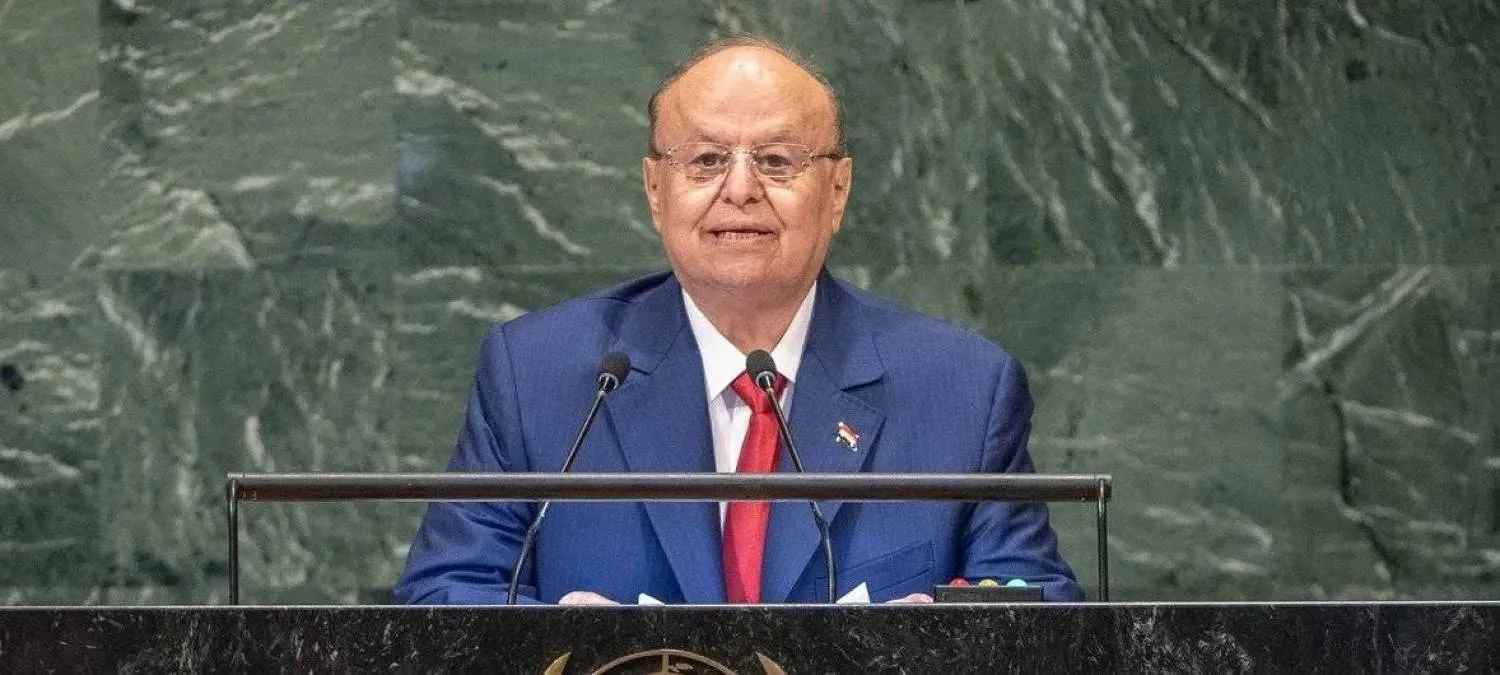
 Former Yemeni president during his address to the UN annual meeting (United Nations)
Former Yemeni president during his address to the UN annual meeting (United Nations)
TT

Hadi’s Death Ends a Journey Through Transformation in Yemen

 Former Yemeni president during his address to the UN annual meeting (United Nations)
Former Yemeni president during his address to the UN annual meeting (United Nations)

Former Yemeni President Field Marshal Abdrabbuh Mansur Hadi died on Thursday in the Saudi capital, Riyadh, at the age of 81, closing one of the most complex political and military chapters in Yemen’s history since unification in 1990.

Hadi’s name became closely associated with Yemen’s transitional period, the National Dialogue Conference, and the prolonged war that erupted after the Houthis overthrew the state in late 2014.

He was neither a confrontational leader nor a populist figure. Throughout his career, he was seen as a quiet institutional figure who preferred to work behind the scenes and avoided sharp confrontations, even while at the center of some of the gravest crises in Yemen’s modern history.

That left his legacy divided between two contrasting views. Supporters regarded him as a consensus figure who spared the country an even deeper collapse, while critics held him responsible for failing to confront the Houthis’ expansion as most of northern Yemen fell under their control.

Hadi was born on Sept. 1, 1945, in the village of Dhakin in Al-Wadea district of Abyan province in southern Yemen. He grew up in a modest rural setting before turning to a military life early.

He received military training at several foreign academies, most notably Britain’s Royal Military Academy Sandhurst, where he graduated in 1966. He also pursued higher military studies at Egypt’s Nasser Military Academy and took specialized courses in the former Soviet Union.

Hadi rose through the ranks of the People’s Democratic Republic of Yemen (formerly South Yemen) and held command posts in the armored corps. The bloody events of January 1986 became the defining turning point in his political and military path.

After the faction of former Southern President Ali Nasser Mohammed lost those confrontations, Hadi left for Sanaa with thousands of southern military personnel. There, he began a new phase inside the northern Yemeni state before Yemen’s two parts united in 1990.

Hadi’s profile rose during the summer war of 1994, when the late President Ali Abdullah Saleh appointed him defense minister to fight the attempted secession led by the then vice president, the late Ali Salem al-Beidh.

After the war ended and unity was consolidated, Saleh named Hadi vice president in October 1994. He remained in the post for about 18 years, one of the longest vice presidential tenures in Yemen’s history.

During those years, Hadi became known inside the ruling establishment as the “silent man.” He rarely entered battles among centers of power or became a visible party to the tribal and military rivalries surrounding Saleh.

He kept the image of a disciplined administrative and military official, making him acceptable to domestic and foreign players as a non-confrontational figure.

President of the transition

When protests erupted in 2011 against Saleh’s rule, Yemen entered a period of deep political turmoil that ended with the Gulf initiative, which transferred power to Hadi as a consensus president for the transition.

In February 2012, Hadi was elected Yemen’s consensus president with broad local, regional, and international backing, amid hopes he could rescue the country from collapse and rebuild the state on new foundations.

The main early milestone of his rule was the comprehensive National Dialogue Conference between 2013 and 2014. The conference brought together political and social forces, including the Houthis and the Southern Movement, to draft a project for a modern federal state.

Many Yemenis saw the National Dialogue as a historic chance to end chronic conflicts and build a new state. But later events pushed the country in a completely different direction.

In September 2014, the Houthis swept into the capital Sanaa, and seized state institutions before placing Hadi under house arrest.

Although he submitted his resignation under pressure, Hadi fled to Aden in February 2015 and said he remained committed to his constitutional legitimacy. Expanding Houthi attacks later drove him to Riyadh.

From the Saudi capital, Hadi led the internationally recognized government throughout the years of war. He relied on broad support from the Saudi-led Arab coalition and on the political and legal cover provided by UN Security Council Resolution 2216.

During those years, his government retained the recognition of the United Nations and the international community. Hadi continued to represent Yemen abroad despite losing effective authority over the seized capital, Sanaa, and large parts of the north.

A contested legacy

Hadi’s personality and governing style divided Yemenis and observers.

Critics said his calm temperament and tendency to wait weakened state institutions at decisive moments. They said his slow decision-making allowed the Houthis to expand and take Sanaa. He was also criticized for relying on partisan and tribal networks that failed to settle the battle.

Supporters said he inherited an exhausted country and a divided army, and faced an armed project backed by a regional power in highly exceptional circumstances.

They argue that Hadi preserved the legal legitimacy of the Yemeni state and prevented its complete slide into international isolation.

People close to him also say his commitment to dialogue and consensus was not a weakness, but a political conviction that spared Yemen wider wars in the early stages of the crisis.

Throughout his rule, Hadi enjoyed exceptional regional and international support. Gulf states, led by Saudi Arabia, backed the transfer of power in Yemen through the Gulf initiative.

After the Houthi takeover, Hadi became the face of the only internationally recognized Yemeni legitimacy. He received broad political and military support from the Arab coalition, as well as backing from the United States and European countries.

During the war years, Yemen kept its seat at the United Nations and other international organizations in the name of Hadi’s government. That was seen as one of his most important political achievements, especially as the Houthis sought international recognition.

Leaving power quietly

In April 2022, Hadi announced he was transferring all his powers to the Presidential Leadership Council headed by Rashad al-Alimi, a move widely seen as a pivotal shift inside the internationally recognized camp.

The decision followed Yemeni-Yemeni consultations hosted by Riyadh, amid pressure to reorganize anti-Houthi forces and unite their political and military components.

The step drew a broad regional and international welcome as a peaceful and orderly transfer of power. Hadi then chose to withdraw almost completely from politics during his final years.

The Yemeni presidency announced on Thursday that Hadi had died after health problems, praising what it described as his “national positions” and his role in preserving legitimacy and Yemen’s unity.

With his death, Yemen loses the last president to lead the unified country under full international recognition before state institutions fragmented and the open war was triggered by the Iran-backed Houthis.

He leaves behind a political and military legacy that will remain the subject of long debate among Yemenis.

The man who came to power as the “consensus candidate” found himself leading a country collapsing under divisions and the Houthi takeover. He remained committed to the legitimacy of the state until he left office, then departed quietly, drawing the curtain on one of the most complex chapters in Yemen’s contemporary history.



Israel Military Says will Keep Operating in South Lebanon

A child flashes a victory sign as he and his family return to their village with their belongings on a highway near the southern port city of Tyre, Lebanon, Thursday, June 18, 2026. (AP Photo/Hassan Ammar)
TT

Israel Military Says will Keep Operating in South Lebanon

A child flashes a victory sign as he and his family return to their village with their belongings on a highway near the southern port city of Tyre, Lebanon, Thursday, June 18, 2026. (AP Photo/Hassan Ammar)

The Israeli military said on Thursday it will continue operating in southern Lebanon and "remove threats" beyond its so-called security zone, after the US and Iran signed an agreement to end the Middle East war, including in Lebanon.

The military published a map of its declared "security zone" -- which runs some 10 kilometres (six miles) inside Lebanese territory.

It said troops would continue to be deployed there "to remove threats and strengthen the defence of Israel's northern residents".

In a later statement, an Israeli military official said the army "will continue to remove threats to soldiers and the civilians of the State of Israel that are identified beyond the security zone".

The announcement came after the United States and Iran signed a memorandum of understanding on Wednesday meant to end the Middle East war, with fighting supposed to be halted on all fronts, including in Lebanon.

Hours after the agreement was signed, Lebanese state media reported one person killed in an Israeli drone strike in southern Lebanon.

Israel's military meanwhile announced the death of one of its soldiers the night before during an incident in south Lebanon that also left seven other troops wounded.

The military official on Thursday called on the Lebanese Armed Forces to operate in coordination with Israeli forces and urged Lebanese civilians to avoid entering the security zone.

Since Iran and the US announced they had reached an agreement on Monday, there has been a sharp decrease in the level of violence in Lebanon.

Lebanon and Israel have been holding direct talks in Washington since April, seeking to end the hostilities between Israel and Hezbollah and separate their conflict from the wider regional war.

"Further steps are still being discussed within the framework of direct negotiations between Israel and Lebanon," the Israeli military official said on Thursday, adding that "the representatives will reconvene next week".


Israel Seized More Land from Neighbors since 2023 than it Has in Decades

An Israeli soldier occupies a military position overlooking the so-called Yellow Line in the central Gaza Strip, Tuesday, May 26, 2026. (AP Photo/Ariel Schalit)
TT

Israel Seized More Land from Neighbors since 2023 than it Has in Decades

An Israeli soldier occupies a military position overlooking the so-called Yellow Line in the central Gaza Strip, Tuesday, May 26, 2026. (AP Photo/Ariel Schalit)

Over the past two and a half years, Israel has taken control of swaths of Gaza, Lebanon and Syria that amount to its biggest expansion of militarily occupied lands in decades.

It is an area larger than many major cities — roughly 1,000 square kilometers (386 square miles) — and Israel has said it plans to stay indefinitely.

The land seizures began in the aftermath of Hamas’ 2023 cross-border attack, which ignited wars on multiple fronts. The Israeli military took over large portions of Gaza as part of a broad invasion, and later seized control of chunks of Lebanon and Syria.

Israel calls these areas “buffer zones” and says they are needed to prevent future attacks by militant groups.

In Gaza and Lebanon, Israeli land seizures and evacuation warnings have pushed out more than 3 million people, and troops have demolished towns and neighborhoods, creating large, depopulated zones, The AP news reported.

The “buffer zones” — equivalent to roughly 5% of Israel’s area soon after its founding — are not new borders, which require an agreement between two countries. But many fear these changes could become long-lasting. Iran has made Israel’s withdrawal from Lebanon a condition for ending its war with the US.

Since its founding in 1948, Israel has never had clear borders. Its boundaries have shifted through wars, annexations, ceasefires and peace agreements.

Here is a deeper look at the Israeli expansions:

Lebanon Israel and Hezbollah have fought multiple wars since the Iran-backed Lebanese militant group was formed in 1982.

Israel occupied much of southern Lebanon between 1982–2000, saying it was necessary to protect northern Israeli communities. After Israel’s withdrawal in 2000, the UN drew up a boundary between the two countries.

A year of fighting between Israel and Hezbollah ended with an October 2024 ceasefire. That truce collapsed in March, days into the US-Israeli war against Iran. Following missile and drone attacks by Hezbollah, Israel launched a ground invasion into Lebanon.

When fighting was halted in April, Israel said the military would occupy an area up to 10 kilometers (6 miles) deep.

Israel now holds 608 square kilometers (234 square miles) in Lebanon, according to experts with the Carnegie Middle East Center.

Evacuation warnings have forced about 1.2 million Lebanese to flee, and Israel has warned civilians against returning.

Hezbollah has condemned Israel’s presence inside Lebanon, and the Lebanese government has called for Israel to withdraw.

Gaza Israel seized the Gaza Strip from Egypt in the 1967 Mideast War. It unilaterally withdrew troops and settlers from the territory in 2005.

Hamas militants overran the territory two years later, and their Oct. 7, 2023, attack on Israel launched the devastating war in Gaza.

When the Gaza ceasefire went into effect in October 2025, Israel withdrew its troops to a zone demarcated by the so-called “yellow line,” giving it control of just over half the strip.

Almost the entire population of Gaza, more than 2 million people, has been squeezed into vast, squalid tent cities dependent on international aid. The military has bulldozed or demolished wide swaths of the zone, and the area, where most of Gaza’s agricultural land lies, is inaccessible to Palestinians.

Israeli forces are meant to complete a fuller withdrawal under the US-brokered ceasefire. But the US-backed diplomat overseeing the truce says progress is deadlocked over the central sticking point of disarming Hamas.

With the ceasefire process stuck, Israel has since moved the line west and expanded its control to more than 60% of Gaza — 194 square kilometers (75 square miles), according to rights group Gisha. Prime Minister Benjamin Netanyahu says Israeli control of Gaza will increase to 70%.

Syria Israel captured the Golan Heights from Syria during the 1967 Mideast war and later annexed it -- a move not widely recognized by the international community.

After the 1973 Mideast war, the UN created a buffer zone in southern Syria next to the Israeli-controlled Golan Heights, patrolled by a UN force of about 1,100 troops.

In December 2024, after the surprise downfall of Syrian President Bashar Assad, Israel moved its troops into the UN buffer zone, saying it was concerned that Syrian opposition could attack Israel. It also wanted to disrupt Iran’s ability to smuggle weapons through Syria to Hezbollah militants in Lebanon.

The UN and other critics say the seizure of land violates a 1974 ceasefire agreement. Civilians in the area have not been instructed to evacuate but have faced checkpoints and tension, with occasional clashes between Israeli soldiers and villagers.

Syria’s interim president, Ahmad al-Sharaa, has called on Israel to withdraw from the area that the UN says is 235 square kilometers (91 square miles).

West Bank Since capturing the West Bank in the 1967 Mideast war, Israel has built well over 100 settlements across the occupied territory.

The government has approved 47 new settlements and formalized or expanded 55 existing settlements just since 2022, according to Peace Now.

After the war in Gaza began, Israel expanded its military operations in the West Bank, displacing tens of thousands of Palestinians from their homes.

Some of the new settlements approved recently are retroactive legalizations of tiny outposts, while others are neighborhoods of existing settlements.

The precipitous growth of settlements stems from settler leaders and supporters holding key positions in Israel’s government and a US administration that is largely pro-settlement.

The international community considers them illegal. The expanded settlements have put enormous restrictions on the daily lives of Palestinians, who view them as the main barrier to a lasting peace agreement because they are built on lands they seek for a future state.


Israeli Official: Israel in Talks with US over Continuing its Lebanon Troop Deployment

FILE PHOTO: Smoke rises following an Israeli strike on the southern suburbs of Beirut, as seen from Baabda, Lebanon, April 8, 2026. REUTERS/Mohamed Azakir/File Photo
TT

Israeli Official: Israel in Talks with US over Continuing its Lebanon Troop Deployment

FILE PHOTO: Smoke rises following an Israeli strike on the southern suburbs of Beirut, as seen from Baabda, Lebanon, April 8, 2026. REUTERS/Mohamed Azakir/File Photo

Israel is holding negotiations with the US as it seeks to continue its deployment of troops in southern Lebanon, two Israeli officials including a senior Israeli official close to Prime Minister Benjamin Netanyahu told Reuters on Thursday.

The officials, who spoke on condition of anonymity to discuss the sensitive talks, made the comments a day after the US and ‌Iran signed ‌an interim pact that calls ‌for ⁠parties to ensure "the territorial ⁠integrity and sovereignty of Lebanon."

Israel expanded its invasion of southern Lebanon after the Lebanese militia Hezbollah opened fire at Israel on March 2 in support of its ally Iran. It has since staged a devastating ⁠air and ground campaign that it says ‌aims at rooting ‌out Hezbollah.

Israel describes the territory it has seized ‌in Lebanon, Gaza and Syria as "buffer zones" between ‌it and its enemies, a core facet of Israel's recent security policy. Netanyahu has rejected calls for Israel to withdraw from those territories.

The senior ‌Israeli official told Reuters that Israel was "conducting stubborn negotiations" with Washington ⁠over continuing its ⁠deployment of troops in southern Lebanon.

The official said Israel would not back down on its positions, including keeping troops deployed in the area south of Lebanon's Litani River.

A second Israeli official told Reuters that the outcome of the talks would ultimately depend on whether US President Donald Trump "decides to force the issue" by threatening repercussions if Israel does not abide by the interim Iran pact's terms.

Netanyahu's office did not immediately respond to a request for comment.