

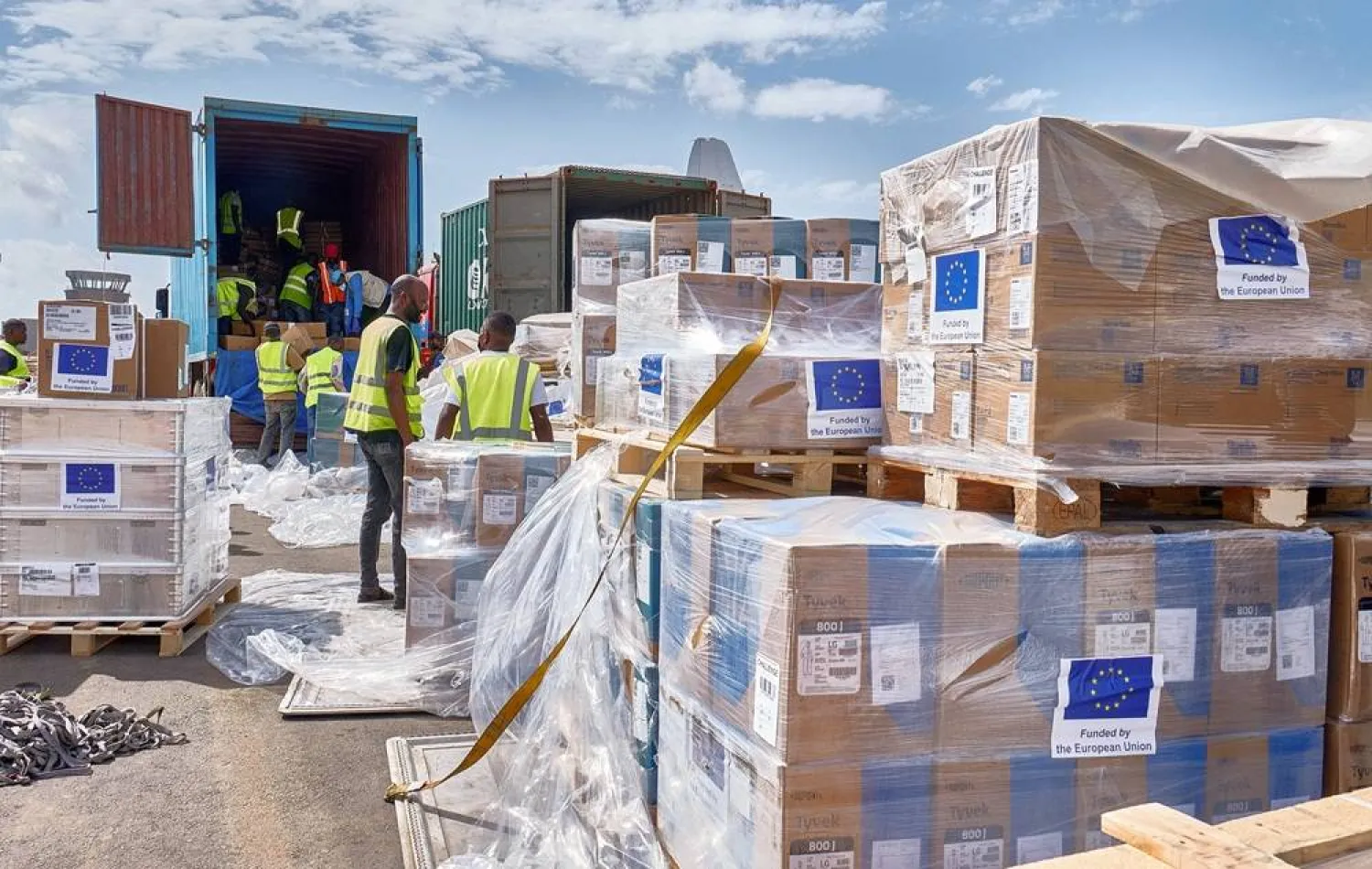

Aid Supplies Reach Heart of Congo’s Ebola Outbreak

UNICEF staff and airport workers load trucks with aid from the European Civil Protection and Humanitarian Aid Operations (ECHO) for the Ebola outbreak caused by the Bundibugyo strain, at Bunia National Airport in Bunia, Ituri province, Democratic Republic of Congo, May 28, 2026. (Reuters)
TT

Aid Supplies Reach Heart of Congo’s Ebola Outbreak

UNICEF staff and airport workers load trucks with aid from the European Civil Protection and Humanitarian Aid Operations (ECHO) for the Ebola outbreak caused by the Bundibugyo strain, at Bunia National Airport in Bunia, Ituri province, Democratic Republic of Congo, May 28, 2026. (Reuters)

Aid workers rushed supplies Thursday to the center of Congo's outbreak of a rare type of Ebola virus while beleaguered medical personnel struggled with a lack of equipment, a distrustful population and armed groups in a volatile region.

A white cargo plane with aid donated by the European Union delivered masks, gloves, boots and medications, which all are in short supply, to the northeastern town of Bunia at the heart of the outbreak in Congo's Ituri province. UN-branded forklifts lifted several cases into trucks.

Health workers with scant supplies have been struggling to contain an outbreak of the Bundibugyo virus, a kind of Ebola that has no approved treatment or vaccine. In some areas, doctors have resorted to wearing expired medical masks while treating suspected patients.

Dangers faced by health workers have been heightened by anger among residents over the stringent medical protocols for dealing with the bodies of victims, which clash with local burial rites. Residents have launched at least three attacks against health centers in Ituri province.

Congolese Health Minister Samuel Roger Kamba said that during outbreaks people in remote communities can feel overwhelmed by an incoming flood of information and people.

“We’ve seen in every epidemic that there’s always resistance,” Kamba said. "Communities always ask themselves, ‘What’s going on?’ And in epidemics like this one, it is really risk communication and community engagement that ultimately change perceptions.”

Aid donated by the EU is expected to arrive in batches over the next eight days, said Jérôme Kouachi, head of emergency operations at UNICEF in Congo.

World Health Organization Director-General Tedros Adhanom Ghebreyesus was on his way to Congo to witness the efforts. The WHO has declared the outbreak a public health emergency of international concern, in the hope of ramping up aid.

The United States on Thursday said it is increasing aid to Congo and Uganda by $80 million, bringing its commitment to more than $112 million since the outbreak.

The additional money would pay for personal protective equipment for health care workers, Ebola test kits, support for health screening at airports and contact tracing, the US State Department said.

Dr. Jean Kaseya, the Africa Centres for Disease Control director-general, said the organization on Monday believed it had secured funding pledges of nearly $500 million toward Africa’s emergency response, but as of Thursday afternoon the amount had dwindled to $290 million as partners withdrew or reduced pledges.

He also said the Africa CDC hoped to have treatments and a vaccine for the Bundibugyo virus by the end of the year and there were some vaccine candidates already in the works.

The Congolese government has confirmed more than 1,000 suspected cases, with at least 220 deaths, since it declared an outbreak on May 15. But the virus had been spreading undetected for weeks and the WHO suspects it is much larger than what has been reported.

The virus also has reached neighboring Uganda, which has confirmed seven cases and one death.

On Wednesday, the Congolese government said the first survivor to recover from the virus had left a health center.

“We are trying to catch up,” Congo Foreign Minister Thérèse Kayikwamba Wagner said earlier this week. “It is a race against the clock.”

The ground response has been hampered by multiple challenges including customs' red tape, insufficient storage facilities, bad roads and weak telecommunications, humanitarian agencies said in a report Thursday.

Tedros on Wednesday called for a ceasefire in a region where armed groups have staged violent attacks for decades.

“We cannot build community trust or isolate the sick while bombs are falling,” he said.

Tucked in the northeastern part of Congo close to the Ugandan border, Ituri province has been reeling from attacks by the Allied Democratic Force, a rebel group allied with the ISIS group, and a coalition of ethnic militias. In early May, the ADF killed at least 40 people and burned several homes in Ituri.

The illness also has been reported in the Congolese provinces of North Kivu and South Kivu, south of Ituri, where the Rwanda-backed M23 rebel group controls many key cities including Goma and Bukavu. The rebels have reported two cases.

The region’s main airport in Goma, which doubles as a staging ground for humanitarian efforts into the region, has been closed since January 2025, when M23 seized the city.

The conflict has precipitated one of the world’s largest humanitarian crises, with at least 7 million people displaced in eastern Congo.



Trump Says Now Making ‘Final Determination’ on Iran Deal

US President Donald Trump looks on during a Cabinet meeting in the Cabinet Room of the White House in Washington, DC, USA, 27 May 2026. (EPA)
TT

Trump Says Now Making ‘Final Determination’ on Iran Deal

US President Donald Trump looks on during a Cabinet meeting in the Cabinet Room of the White House in Washington, DC, USA, 27 May 2026. (EPA)

US President Donald Trump on Friday said he was now making a "final" decision on whether or not to strike a peace deal with Iran.

"I will be meeting now, in the Situation Room, to make a final determination," Trump said in a lengthy social media post, stressing that Iran must agree never to have nuclear weapons and to open the Hormuz shipping lanes.

In the post, Trump said that Iran "will complete the immediate removal" of mines in the strait and that the US naval blockade of Iranian ports "will now be lifted," allowing oil and other tankers to start moving.

However, it was not clear if Iran had agreed to this or whether the US blockade had actually been lifted ahead of Trump making his decision.

Trump also specified that enriched uranium stockpiles in Iran "will be unearthed by the United States... in close coordination and conjunction with Iran, plus the International Atomic Energy Agency, and DESTROYED."

Following reports that Iran has demanded financial compensation for the war and that the White House has floated the idea of investments, Trump said "no money will be exchanged, until further notice."

The US president added that only "items, of far less importance, have been agreed to."

US Vice President JD Vance said Thursday that the sides continued to debate "a couple of language points” and he couldn't say whether Trump would approve the proposal. 

Iranian Parliament Speaker Mohammad Bagher Qalibaf said Friday on X that his country has “no trust in guarantees or words,” only actions, and “no step will be taken before the other side acts.” 

“We do not gain concessions through talks, but through missiles. In negotiations, we only make them understand that,” wrote Qalibaf, who was involved in negotiations in Qatar this week. He added: “The winner of any agreement is the one who is better prepared for war the day after it is signed.” 

According to a US official familiar with the matter, the tentative agreement would continue the ceasefire in the 3-month-old war by 60 days and start a new round of talks on Iran’s nuclear program. 

Among the first issues to be negotiated during the 60-day ceasefire would be what will happen to Iran’s highly enriched uranium, said the official, who was not authorized to comment publicly and spoke on condition of anonymity.  

Tehran has 440.9 kilograms (972 pounds) of uranium that is enriched up to 60% purity, a short, technical step from weapons-grade levels of 90%, according to the International Atomic Energy Agency. 

Vance said Thursday evening that the sides were going back and forth on “a couple of issues on the nuclear stuff, the highly enriched stockpile, and also the question of enrichment.” The vice president suggested negotiators were trying to strike general terms on the uranium issue in the tentative agreement, with the specifics to be hammered out in the ensuing talks. 

Though Trump and his team said from the start of the conflict that one of their prime objectives was to ensure that Iran can never have a nuclear weapon, Vance framed the war’s accomplishments as something far less definitive. 

“We’re in a position where we could substantially set back their nuclear program, not just during the term of this president but over the long term,” Vance said. “That’s a very very good thing for the American people.” 

Iran, which has long maintained its nuclear program is peaceful, has not publicly committed to giving up the stockpile. It is believed to be buried under a trio of nuclear sites that were badly damaged by US airstrikes last year. 

Nuclear analysts have said that Iran might consider China or Russia, which have close relations with Tehran, to be a potential acceptable third party to take possession of the enriched uranium. But Trump said Wednesday that he “wouldn’t be comfortable” with such a plan. 

The proposed memorandum makes clear that Iran will not be able to impose tolls on the Strait of Hormuz and that Iran will have to remove all mines from the vital waterway within 30 days, according to the official who spoke on condition of anonymity. 

During the war, Iran has effectively closed the strait, which had been the conduit for about a fifth of the world's traded oil and natural gas. Its closure has sent oil prices skyrocketing around the world. 

Iran has said it's letting some commercial vessels pass — about two dozen daily in recent days, compared with more than 100 a day before the war. But Tehran also has charged tolls for at least some ships and established a formal gatekeeper agency earlier this month, spurring a new round of US sanctions this week. 

Under the tentative agreement, the US would gradually lift its naval blockade on Iranian ports and would also agree to relax sanctions, allowing Iran to sell more of its oil. 

Yet even as word of the potential deal emerged, the US Treasury Department imposed additional sanctions on the Iranian military's oil sales arm. The new penalties, first reported by The Associated Press, extend the Trump administration’s economic pressure campaign on the country. 

Iran has insisted that any deal must include an end to Israel’s military operations in Lebanon against the Iranian-backed group Hezbollah. Tensions deepened Thursday in Lebanon as Israel conducted an airstrike on a southern suburb of the capital, Beirut, and other strikes in the southern coastal city of Tyre. At least 14 people were killed across the country’s south. 

Since the ceasefire began about seven weeks ago, the US and Iran have traded strikes and accusations of ceasefire violations. But they have not returned to full-scale hostilities and have kept negotiating. 


Poland President Says Wants Zelensky Stripped of Award

Polish President Karol Nawrocki (C) attends the ceremony marking the 86th anniversary of the outbreak of World War II in Wielun, central Poland, 01 September 2025. EPA/Marian Zubrzycki POLAND OUT
TT

Poland President Says Wants Zelensky Stripped of Award

Polish President Karol Nawrocki (C) attends the ceremony marking the 86th anniversary of the outbreak of World War II in Wielun, central Poland, 01 September 2025. EPA/Marian Zubrzycki POLAND OUT

Poland's president said Friday he wanted Volodymyr Zelensky to be stripped of his country's highest civilian award, after the Ukrainian leader named a military unit after a historical faction accused of killing scores of Poles in World War II.

Karol Nawrocki told the media he was "outraged" and had proposed "the withdrawal of the Order of the White Eagle from President Zelensky".


China Opposes any Country Using Freedom of Navigation to Undermine Its Sovereignty

FILE PHOTO: A cargo ship with containers docks at a terminal of the Yantian port in Shenzhen, Guangdong province, China October 30, 2025. REUTERS/Tingshu Wang/File Photo
TT

China Opposes any Country Using Freedom of Navigation to Undermine Its Sovereignty

FILE PHOTO: A cargo ship with containers docks at a terminal of the Yantian port in Shenzhen, Guangdong province, China October 30, 2025. REUTERS/Tingshu Wang/File Photo

China said on Friday it firmly opposes any attempt by any country to undermine its sovereignty and security "under ‌the pretext ‌of freedom ‌of navigation", ⁠in response to ⁠a Canadian warship passing through the Taiwan Strait.

Canadian media reported that the frigate HMCS Charlottetown made ⁠the transit last ‌week ‌without being accompanied by ‌any allied countries' ships, reported Reuters.

Chinese ‌foreign ministry spokesperson Mao Ning added that China respects all countries' ‌rights to navigation under international law.

The Canadian Department ⁠of ⁠National Defense and Taiwan's defense ministry did not immediately respond to requests for comment.