


Pentagon Chief Says US Seeks 'Stable Equilibrium' with China in Asia

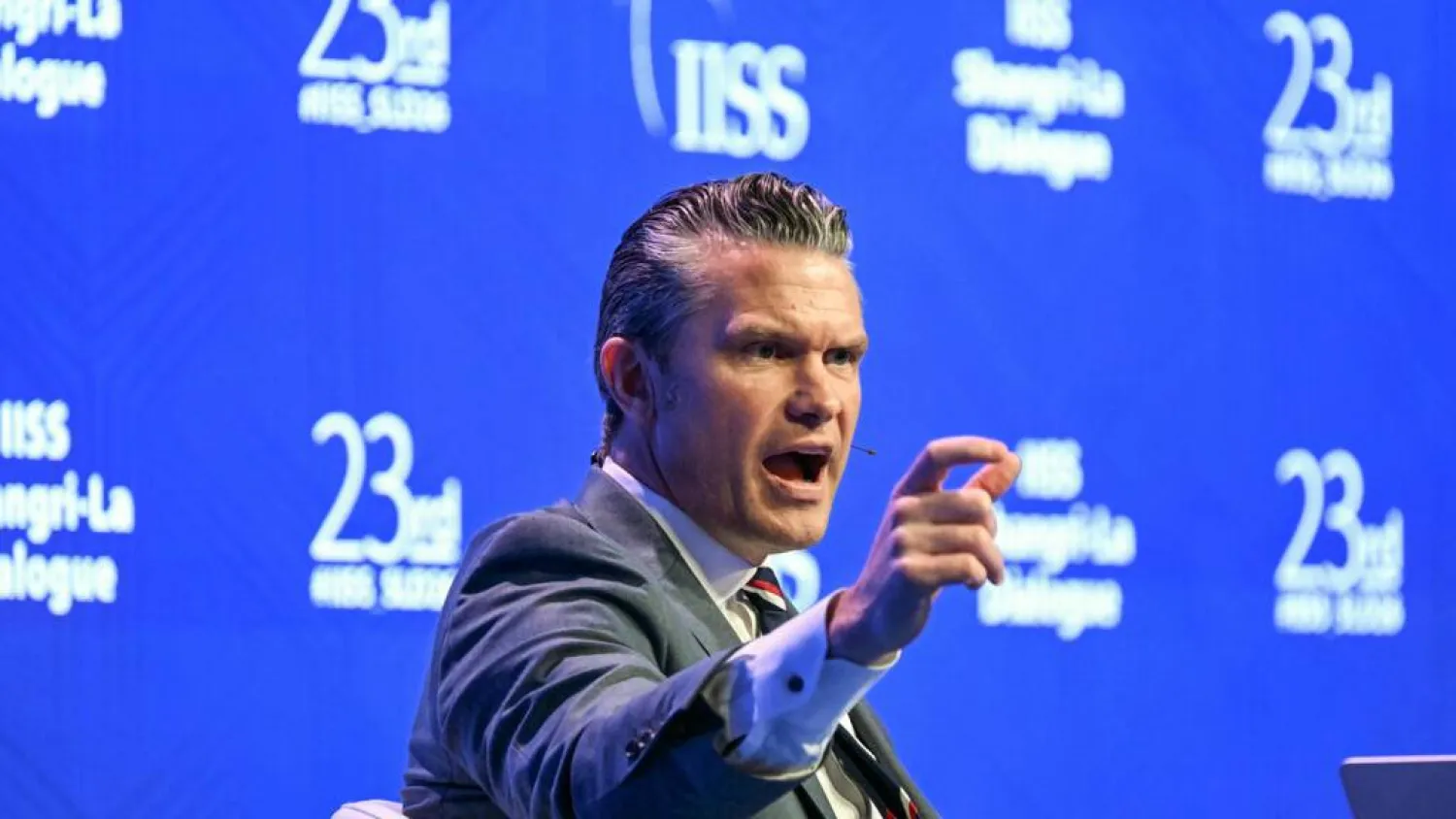
US Secretary of Defense Pete Hegseth speaks during a plenary session of the 23rd Shangri-La Dialogue summit in Singapore on May 30, 2026. JAM STA ROSA / AFP
TT

Pentagon Chief Says US Seeks 'Stable Equilibrium' with China in Asia

US Secretary of Defense Pete Hegseth speaks during a plenary session of the 23rd Shangri-La Dialogue summit in Singapore on May 30, 2026. JAM STA ROSA / AFP

Pentagon chief Pete Hegseth struck a measured tone towards China at a major defense forum on Saturday, noting "rightful alarm" over Beijing's military build-up but saying the United States sought a "stable equilibrium" in Asia.

Hegseth's headline speech at Singapore's Shangri-La Dialogue, which brings together top defense officials and experts from about 45 countries, contrasted with his strongly confrontational remarks on China at last year's gathering.

Unlike Beijing, which has sent a panel of military experts and scholars instead of Defense Minister Dong Jun for the second year running, Hegseth is leading a bumper US delegation to the event that provides chances for both open debate and behind-closed-doors diplomacy.

"When we look across the region today, there is rightful alarm regarding China's historic military build-up and the expansion of its military activities in the region and beyond," Hegseth said.

Washington does not seek "needless confrontation in the region", but rather "a genuinely stable equilibrium (in Asia) that works for Americans as well as our allies", he said.

That means "a favorable but durable balance of power in which no state, including China, can impose its hegemony and hold the security or prosperity of our nation and our allies in question", he added.

Hegseth said the United States sought "respectful" and "good-faith" engagement with Beijing, adding: "I wish my counterpart was here at this conference, but I look forward to other options when we can cross paths."

Trump visited China this month, talking up "fantastic" trade deals but giving few details and later suggesting Washington could use its arms sales to self-ruled Taiwan as a bargaining chip with Beijing.

There had been "no change" in Washington's stance towards Taiwan, but "any decision about future Taiwan arms sales... will rest with" Trump, Hegseth said.

- Vibe shift -

The remarks contrasted sharply with last year's event, when Hegseth painted China as a potentially "imminent" threat to security and outlined a swaggering vision of muscular American deterrence.

He also took potshots at Beijing's absent minister last year, saying: "We are here this morning, and somebody else isn't."

Chinese delegate Da Wei, director of the Center for International Security and Strategy at Beijing's Tsinghua University, said this year's address was "much more moderate".

However, he found Hegseth's depiction of China "ironic", adding: "Everyone in the room must have been thinking: who is really hegemonic?

"Given what the US is doing in Iran and has done in Venezuela, I think it's clear to everyone," Da said.

US delegate Tammy Duckworth, a Democratic senator and strong Trump critic, said she was "somewhat disturbed" by Hegseth's remarks, viewing them as overly conciliatory towards China.

"I worry that this administration is being distracted into wars that they've started in other parts of the world at the expense of our commitment here in the Indo-Pacific," she told reporters.

Instead of Dong, China has sent experts and scholars from its army's academic institutions, led by Major General Meng Xiangqing of the National Defense University.

Analysts have said Dong's no-show reflects Beijing's confidence as an established power with little inclination to answer publicly for its assertive moves in the region.

But some argue that China is also running the risk of having no senior policymaker present if two major security issues come up: reopening the Strait of Hormuz, and Beijing's claim to Taiwan.

Hegseth again urged US allies to spend more on their own defense, singling out South Korea, Japan, Australia and the Philippines for praise while threatening consequences for nations that "free-ride on the generosity of the American taxpayer".

"Those days are over. Allies who refuse to step up and carry their own weight for our collective defense will face a clear shift in how we do business."

- Iran threat -

Hegseth's remarks came as a peace deal between the United States and Iran to end their war remained elusive.

A White House official told AFP on Friday that Trump, who is weighing a final decision on a potential accord, would only commit if Iran met all his conditions.

But Iran has said "no final agreement" is in place, and its state media has rebutted parts of Trump's characterization of the deal.

Hegseth said Washington was "more than capable" of restarting the war if it wanted.

The head of the Pentagon is also due to meet his British and Australian counterparts as part of the AUKUS security alliance.

Australian media outlets have reported, citing unidentified sources, that the AUKUS nations are expected to announce a major project, perhaps involving uncrewed underwater vehicles.



Ukrainian Drones Strike Port, Oil Depot in Southern Russia, Authorities Say

Servicemen of the 13th Khartiia Brigade of the National Guard of Ukraine take part in a tactical training exercise on a shooting range at an undisclosed location in the Kharkiv region, northeastern Ukraine, 29 May 2026, amid the Russian invasion. (EPA)
TT

Ukrainian Drones Strike Port, Oil Depot in Southern Russia, Authorities Say

Servicemen of the 13th Khartiia Brigade of the National Guard of Ukraine take part in a tactical training exercise on a shooting range at an undisclosed location in the Kharkiv region, northeastern Ukraine, 29 May 2026, amid the Russian invasion. (EPA)

Ukrainian ‌drones struck a tanker at Russia's port of Taganrog overnight and hit an oil depot in the city of Armavir, authorities in the southern regions of Rostov and Krasnodar said on Saturday.

Rostov region Governor Yury Slyusar said on Telegram ‌that fires on ‌the tanker and in ‌the ⁠port of Taganrog - ⁠a city of about 240,000 - had been extinguished, with no oil spill reported. Two people were injured, he said.

The city's mayor, Svetlana Kambulova, ⁠said a local state of emergency, ‌introduced ‌on May 27, had been extended.

In ‌the neighboring Krasnodar region, ‌authorities in Armavir, which has a population of 185,000, said a fire at an oil depot in the ‌city's industrial zone had been brought under control and ⁠that ⁠there were no injuries.

Rostov governor Slyusar said that almost 50 drones had been downed in the region, with attacks reported across the province, which borders Ukraine's Donbas, the focus of fighting between Russia and Ukraine.

Outside Taganrog, he said, only minor damage was reported.


US Sanctions Iranian Buyers of Military Technology

People wave Iranian flags during a rally in Tehran, Iran, May 29, 2026. Majid Asgaripour/WANA (West Asia News Agency) via Reuters
TT

US Sanctions Iranian Buyers of Military Technology

People wave Iranian flags during a rally in Tehran, Iran, May 29, 2026. Majid Asgaripour/WANA (West Asia News Agency) via Reuters

The United States announced Friday that it is "dismantling a sophisticated Iranian network" used to obtain sensitive military technology.

The network "impersonated and defrauded" dozens of American technology companies out of millions of dollars to "acquire advanced equipment, including spectrum analyzers and security detection devices, for Iran's defense sector," State Department Tommy Pigott said in a statement.

The statement did not name the technology companies who were lured into doing business through fake websites that "mimicked real American companies, using intermediaries in Dubai to receive shipments, and then smuggling the technology into Iran in violation of US sanctions."

The network was led by Iran-based Ali Majd Sepehr, the State Department spokesman said.

On Thursday, the State Department announced a $15 million reward for any information "leading to the disruption of the financial mechanisms of Iran's Revolutionary Guard Corps (IRGC) and its various branches."

On Friday, the White House said US President Donald Trump will only sign an agreement to end the war with Iran if it meets all his demands, amid uncertainty over the outcome of talks between Tehran and Washington.


Top US and Cuban Military Officers Meet at Guantanamo Bay

This photo posted on the X account of the US Southern Command (SOUTHCOM) on May 29, 2026, shows SOUTHCOM Commander General Francis L. Donovan (C), the Chief of the General Staff and First Deputy Minister of Cuba's Revolutionary Armed Forces (MINFAR) General Roberto Legra Sotolongo (2nd/L) and other Cuban military officials, during their meeting at the perimeter of the US Naval Station in Guantanamo Bay, Cuba, on May 29, 2026. (Handout / US Southern Command / AFP)
TT

Top US and Cuban Military Officers Meet at Guantanamo Bay

This photo posted on the X account of the US Southern Command (SOUTHCOM) on May 29, 2026, shows SOUTHCOM Commander General Francis L. Donovan (C), the Chief of the General Staff and First Deputy Minister of Cuba's Revolutionary Armed Forces (MINFAR) General Roberto Legra Sotolongo (2nd/L) and other Cuban military officials, during their meeting at the perimeter of the US Naval Station in Guantanamo Bay, Cuba, on May 29, 2026. (Handout / US Southern Command / AFP)

Senior US and Cuban military officers met on Friday at Guantanamo Bay, the US base on the communist island, as relations between the two countries deteriorate over President Donald Trump's threatened takeover.

US General Francis Donovan met with Cuban General Roberto Legra Sotolongo "for a brief exchange on operational security matters," US Southern Command said in a statement issued along with a photograph of the meeting.

"Gen. Donovan also led a perimeter security assessment of the naval base and discussed force protection, safety of service members and their families, and operational readiness with base officials."

Cuba's Ministry of Revolutionary Armed Forces stressed that "both delegations consider the meeting to have been positive" and they agreed "to maintain communication between the two military commands," according to a statement released on Facebook.

The uniformed men met at the US base at the southeastern tip of the island.

- Deteriorating relations -

Relations between Havana and Washington have continued to worsen since January, when the United States imposed a de facto oil blockade on the island by operating a military raid to remove leftist Nicolas Maduro from power in Venezuela.

Without Caracas as a lifeline, Cuba has struggled to keep electricity on, or food and medicine in stock.

Cuba's other allies in Russia, China and Iran are also facing US pressure to back off, through a fresh round of sanctions against Cuban companies and leaders. US officials also brought an indictment against former president Raul Castro, in a case that dates back to 1996.

Now Cuba is facing the brink of collapse.

Secretary of State Marco Rubio, who is Cuban American, has said the US is seeing a diplomatic solution to the standoff.

Reports last week suggested that Havana was considering drone strikes on the base in the event of an American attack.

Donovan led a perimeter security assessment of the US facility and discussed safety of service members and operational readiness, the statement said.

Guantanamo Bay, 430 miles (700 kilometers) southeast of Miami, on the southeastern coast of Cuba, is notorious as the site of abuse against terror suspects detained after the September 11, 2001 attacks.

Trump has also planned to use the base as a holding center for undocumented migrants.

"Naval Station Guantanamo Bay is a vital operational and logistical hub that supports US military efforts to counter threats that undermine security, stability and democracy in our hemisphere," US Southern Command said.