


As Ebola Scourges Congo, Experts Warn of Link to Eating Wild Animals

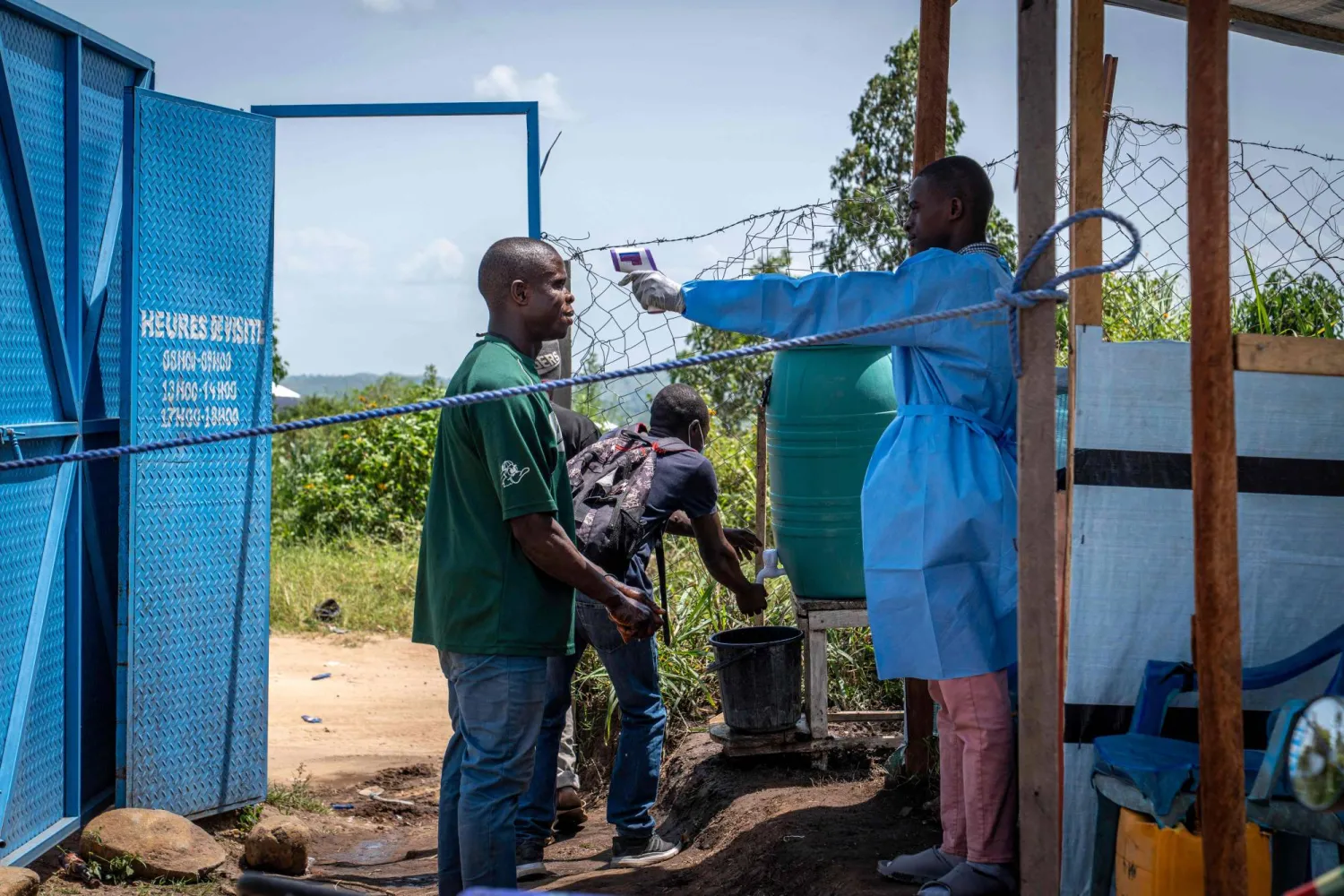
A healthcare worker takes a visitor's temperature at Rwampara Hospital in Ituri, in the eastern Democratic Republic of the Congo, on May 26, 2026. (Photo by Glody MURHABAZI / AFP)
TT

As Ebola Scourges Congo, Experts Warn of Link to Eating Wild Animals

A healthcare worker takes a visitor's temperature at Rwampara Hospital in Ituri, in the eastern Democratic Republic of the Congo, on May 26, 2026. (Photo by Glody MURHABAZI / AFP)

The vendors of wild meat at the sprawling Masina Market in the Congolese capital don’t always display their goods openly. Customers must ask for whatever they're looking for, whether it is a giant swamp rodent or the severed parts of an antelope.

Others occasionally sell in the open, like the women who preside over impossibly large baskets of squirming caterpillars at the market in Kinshasa.

For many in Congo and elsewhere in Central and West Africa wild meat is a craving and a key part of the cultural milieux. Even a disease as punishing as Ebola, currently ravaging a remote part of eastern Congo, has failed to stem demand for wild meat from the Congo Basin, an expansive forested ecosystem sometimes called Earth’s second lung.

The Congo Basin is rich in all kinds of wildlife, from great apes to serpents — both of which are hunted for their meat. One consequence for locals is exposure to zoonotic diseases such as Ebola, The Associated Press said.

Although Ebola is generally not spread by food, cases in Africa have been associated with hunting, butchering and processing meat from infected animals, the US Centers for Disease Control and Prevention has said.

“Once there is human, animal and environment interface. We have these kinds of outbreaks on a frequent level,” said Dr. Tolbert Geewleh Nyenswah of the Africa Centers for Disease Control and Prevention. “And this is why one health approach in dealing with virus outbreaks is important, because we still interact with the bats, and our hunters are still killing monkeys, and we are close to the environment.”

The link between wild meat and Ebola

The Congolese government has confirmed more than 1,000 suspected cases, with at least 220 deaths, since it declared an outbreak of Ebola on May 15. It appears the virus spread undetected for weeks, and the World Health Organization suspects it is much larger than what has been reported.

Ebola, named for a tributary of the Congo River, was first discovered in 1976 in simultaneous outbreaks in Congo and present-day South Sudan. Outbreaks are believed to start with the virus spilling over into humans from an infected animal such as a fruit bat. These cross-species infections often happen when people handle and eat wild meat, experts say.

But since Ebola outbreaks happen only sporadically in communities that regularly eat wild meat, some people “don't believe the linkage” and others are “totally ignorant” of the health threat from eating wild meat, said Dr. Misaki Wayengera, a microbiologist who advises Uganda's Ministry of Health on epidemics.

“It is very difficult to change some of these core practices,” he said.

Locals have paid a heavy price for occasional outbreaks of Ebola, whose bloody symptoms can terrorize entire villages and cause many to believe they are under an evil spell.

The Ebola virus is responsible for 17 outbreaks in Congo and many others elsewhere in the region. The deadliest outbreak, in West Africa between 2014 and 2016, infected an estimated 28,000 people and killed more than 11,300.

According to the Food and Agriculture Organization — which studied the Ebola risk stemming from the eating and handling of wild meat after West Africa’s epidemic — animal-to-human spillovers of Ebola are rare, but "their consequences are nonetheless disastrous.”

Once Ebola has infected one person, the virus then spreads through close contact with sick or deceased patients’ bodily fluids, such as sweat, blood, feces, or vomit. Health workers without sufficient protective gear are seen as highly vulnerable.

The current outbreak in eastern Congo is caused by the Bundibugyo virus, a rare type of Ebola that has no approved medicines or vaccines.

The outbreak is occurring in a part of Congo that also faces armed violence by rebel groups and the displacement of large numbers of people fleeing the violence.

A need for education While Congolese authorities have prohibited hunting endangered wildlife, including great apes sent to the brink of extinction by poachers, there is no blanket ban on the wildlife trade and illegal hunting persists for totemic creatures like the bonobo.

Many in and around the Congo Basin have wild meat as their primary source of animal protein. The yearly extraction rate of wild meat from the Congo Basin is estimated at 4.5 million tons, according to the Center for International Forestry Research.

Viande de brousse, as wild meat is known in French, is a popular food, even served in trendy restaurants. That's intensified pressure on the dwindling resources of the Congo Basin. Despite the ongoing biodiversity losses, the Congo Basin remains the world's largest carbon sink, surpassing the Amazon in its ability to capture and store carbon.

Public health campaigners need to step up education campaigns on how Ebola starts and is spread among communities that face recurring outbreaks, said Gladys Kalema-Zikusoka, founder of the Uganda-based Conservation Through Public Health group.

People need to be told that “eating meat from an unknown source, or a dead animal, is a no-no,” Kalema-Zikusoka said. “It’s a very cultural thing.”

Some fruit bats are believed to be natural hosts of the viruses that cause Ebola, according to the WHO. Yet bats are known to be a delicacy in many parts of Central and West Africa. The soup of a roasted fruit bat is highly sought after, as are the parts of a wide range of monkeys.

In Kinshasa’s Masina Market one recent morning, before the latest Ebola outbreak, traders said they sold antelope, rodent and snake meat sourced from the Congo Basin.

They said they long ago stopped selling the meat of monkeys, possible reservoirs of the Ebola virus.

One vendor, Guyva Mputu, was selling python, whose frozen flesh started to steam in the humid weather.

Another, Charles Ntanga, wielded a flywhisk to swat flies that settled on the rancid carcass of a giant rodent, with a kilogram going for about $17. Ntanga said he gets clients from all walks of life.

“We sell wild meat," he said. “We make our lives through this business.”


Russia Recalls Envoy to Armenia for 'Consultations' over Yerevan's EU Ties

Armenia's Prime Minister Nikol Pashinyan gives a speech during a state dinner in honor of the French leader at the presidential palace in Yerevan on May 4, 2026. (Photo by Ludovic MARIN / AFP)
TT

Russia Recalls Envoy to Armenia for 'Consultations' over Yerevan's EU Ties

Armenia's Prime Minister Nikol Pashinyan gives a speech during a state dinner in honor of the French leader at the presidential palace in Yerevan on May 4, 2026. (Photo by Ludovic MARIN / AFP)

Russia said Saturday it had recalled its ambassador to Armenia for "consultations" over Yerevan's growing ties with the EU, a day after President Vladimir Putin warned the Caucasus country against pivoting to Brussels.

Armenia has angered the Kremlin by warming ties with the EU in recent years, frustrated with Russia's perceived failure to protect it during conflicts with Azerbaijan, AFP said.

"The Russian ambassador to the Republic of Armenia, S. Kopyrkin, has been recalled to Moscow for consultations on steps taken by the Armenian leadership on a rapprochement with the European Union, undermining cooperation within Eurasian Economic Union," Moscow's foreign ministry said in a statement, referencing the Russian-led customs union.

The diplomat was called back after Putin escalated his rhetoric on Armenia during a summit with allies.

Speaking in Kazakhstan on Friday, Putin said the "Ukrainian scenario" began with Kyiv trying to join the EU and called on Armenia to hold a referendum on the issue "as soon as possible".

Putin said Armenia had to choose between the EU and the EEU, as it was "impossible to reconcile the two".

Armenia will hold an election next Sunday in a test of the premiership of Nikol Pashinyan, who has pursued ties with both Russia and the West.

Armenia held a European summit earlier this month, with the EU hailing a "leap forward" in ties.


Ukrainian Drones Strike Port, Oil Depot in Southern Russia, Authorities Say

Servicemen of the 13th Khartiia Brigade of the National Guard of Ukraine take part in a tactical training exercise on a shooting range at an undisclosed location in the Kharkiv region, northeastern Ukraine, 29 May 2026, amid the Russian invasion. (EPA)
TT

Ukrainian Drones Strike Port, Oil Depot in Southern Russia, Authorities Say

Servicemen of the 13th Khartiia Brigade of the National Guard of Ukraine take part in a tactical training exercise on a shooting range at an undisclosed location in the Kharkiv region, northeastern Ukraine, 29 May 2026, amid the Russian invasion. (EPA)

Ukrainian ‌drones struck a tanker at Russia's port of Taganrog overnight and hit an oil depot in the city of Armavir, authorities in the southern regions of Rostov and Krasnodar said on Saturday.

Rostov region Governor Yury Slyusar said on Telegram ‌that fires on ‌the tanker and in ‌the ⁠port of Taganrog - ⁠a city of about 240,000 - had been extinguished, with no oil spill reported. Two people were injured, he said.

The city's mayor, Svetlana Kambulova, ⁠said a local state of emergency, ‌introduced ‌on May 27, had been extended.

In ‌the neighboring Krasnodar region, ‌authorities in Armavir, which has a population of 185,000, said a fire at an oil depot in the ‌city's industrial zone had been brought under control and ⁠that ⁠there were no injuries.

Rostov governor Slyusar said that almost 50 drones had been downed in the region, with attacks reported across the province, which borders Ukraine's Donbas, the focus of fighting between Russia and Ukraine.

Outside Taganrog, he said, only minor damage was reported.


US Sanctions Iranian Buyers of Military Technology

People wave Iranian flags during a rally in Tehran, Iran, May 29, 2026. Majid Asgaripour/WANA (West Asia News Agency) via Reuters
TT

US Sanctions Iranian Buyers of Military Technology

People wave Iranian flags during a rally in Tehran, Iran, May 29, 2026. Majid Asgaripour/WANA (West Asia News Agency) via Reuters

The United States announced Friday that it is "dismantling a sophisticated Iranian network" used to obtain sensitive military technology.

The network "impersonated and defrauded" dozens of American technology companies out of millions of dollars to "acquire advanced equipment, including spectrum analyzers and security detection devices, for Iran's defense sector," State Department Tommy Pigott said in a statement.

The statement did not name the technology companies who were lured into doing business through fake websites that "mimicked real American companies, using intermediaries in Dubai to receive shipments, and then smuggling the technology into Iran in violation of US sanctions."

The network was led by Iran-based Ali Majd Sepehr, the State Department spokesman said.

On Thursday, the State Department announced a $15 million reward for any information "leading to the disruption of the financial mechanisms of Iran's Revolutionary Guard Corps (IRGC) and its various branches."

On Friday, the White House said US President Donald Trump will only sign an agreement to end the war with Iran if it meets all his demands, amid uncertainty over the outcome of talks between Tehran and Washington.
