


Ukraine Keeps up Assault on Russian Oil Sites as Kyiv Expects More Strikes

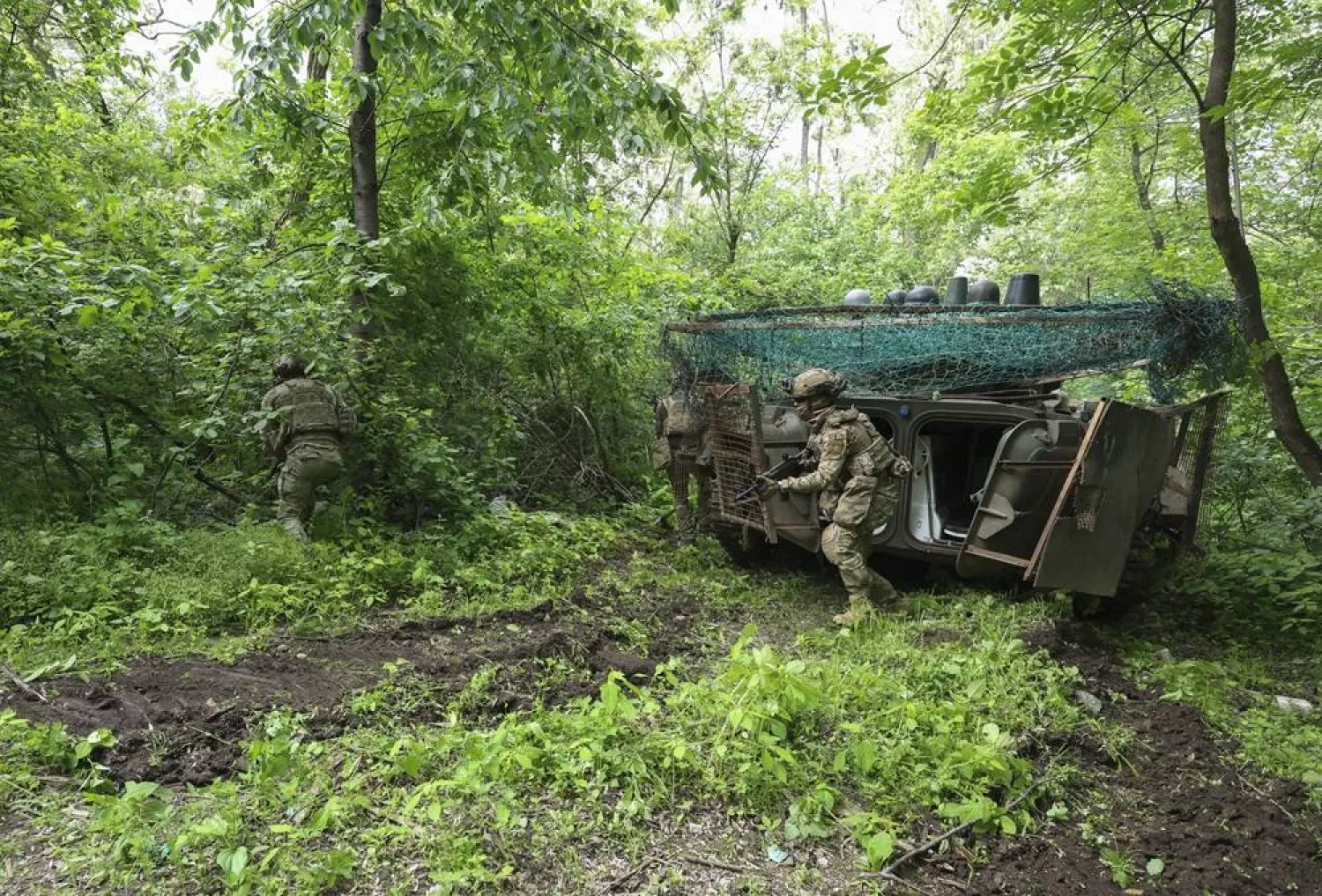
Servicemen of the 13th Khartiia Brigade of the National Guard of Ukraine take part in a tactical training exercise on a shooting range at an undisclosed location in the Kharkiv region, northeastern Ukraine, 29 May 2026, amid the Russian invasion. (EPA)
TT

Ukraine Keeps up Assault on Russian Oil Sites as Kyiv Expects More Strikes

Servicemen of the 13th Khartiia Brigade of the National Guard of Ukraine take part in a tactical training exercise on a shooting range at an undisclosed location in the Kharkiv region, northeastern Ukraine, 29 May 2026, amid the Russian invasion. (EPA)

Ukrainian drone strikes caused fires at more Russian oil facilities overnight into Saturday, Russian officials said, in what appeared to be the latest attack on Moscow’s vital oil industry. 

Authorities in Russia’s Rostov region said falling drone debris sparked a fire that damaged an oil depot and tanker in the port of Taganrog, while officials in the neighboring Krasnodar region reported a fire breaking out at an oil depot in Armavir for the same reason. 

“Another facility of Russia’s oil industry has been reached — Armavir,” Ukrainian President Volodymyr Zelenskyy wrote on X, referring to the Krasnodar attack, and noting that Armavir is “500 kilometers from our state border.” 

“We are rightfully bringing the war back to where it came from,” he wrote. 

Ukraine has expanded its mid- and long-range strike capabilities, deploying drone and missile technology that it has developed domestically to battle Russia’s 4-year-old invasion. Attacks on Russian oil assets that play a key part in funding the invasion have become almost daily occurrences. 

For its part, Russia has used its long-range ballistic missiles to damage Ukraine’s power grid and hammer its cities. The Ukrainian capital is bracing for further heavy bombardments after what the Russian Foreign Ministry said earlier this week would be upcoming “systemic strikes” on Kyiv. 

Zelenskyy said Thursday that he’s being “very persistent” in pressing the United States to provide his country with more Patriot air defense missiles that can counter devastating Russian ballistic missile attacks. 

The attacks on Russian oil infrastructure came a day after a Russian drone that was part of an attack on Ukraine struck an apartment building in eastern Romania, injuring two people in the NATO member country. The incursion added to concerns that the war could spread across the alliance’s borders, and drew strong condemnation across Europe. 

Meanwhile, Russia’s state-owned nuclear energy company Rosatom said Saturday that a Ukrainian drone struck the Russian-controlled ‌Zaporizhzhia nuclear power plant. 

There was no damage to key equipment, but the attack left a hole in the wall of a turbine hall, Rosatom CEO Alexei Likhachev said. He was quoted as saying by Russian state media that the fact that the drone was controlled via fiber optics “completely rules out the possibility of an accidental impact.” 

Ukraine did not immediately comment on the incident. 

The plant is in an area under Russian control since early in Moscow’s full-scale invasion of Ukraine and is not in service, but it needs reliable power to cool its six shutdown reactors and spent fuel to avoid any catastrophic nuclear incidents. 

The International Atomic Energy Agency has repeatedly expressed alarm about the nuclear plant, Europe’s biggest. 


Return to US-Iran Hostilities Is Huge Setback for Civilians, UN Rights Chief Says

An aircraft prepares to land aboard the USS George H.W. Bush, at an unknown location, released July 14, 2026, in this still image taken from a handout video. US Central Command (CENTCOM)/Handout via Reuters
TT

Return to US-Iran Hostilities Is Huge Setback for Civilians, UN Rights Chief Says

An aircraft prepares to land aboard the USS George H.W. Bush, at an unknown location, released July 14, 2026, in this still image taken from a handout video. US Central Command (CENTCOM)/Handout via Reuters

The United Nations human rights chief said on Tuesday the resumption of hostilities between the United States and ‌Iran was ‌a huge ‌setback ⁠for civilians in ⁠the region, and he urged restraint.

"The return to wider hostilities in the ⁠Middle East ‌between the ‌US and Iran ‌is a huge ‌setback for civilians in the region and beyond. It undermines ‌peace efforts and deepens instability, with grave ⁠risks ⁠for human rights across the entire region," the UN high commissioner for human rights Volker Turk said in a statement.

Iran fired missiles at Jordan and Bahrain on Tuesday after the United States launched a five-hour attack on Iranian targets, stepping up a battle for control of the Strait of Hormuz that has pushed up oil prices to four-week highs.

US forces carried out waves of attacks for the third night in a row after Tehran said it had closed the strait, prompting US President Donald Trump to reinstate a blockade of Iranian shipping.

Iran hit back by attacking a Jordan with ballistic missiles while Bahrain said it had fended off an Iranian aerial attack. Jordan said it had shot down four ballistic missiles and explosions were heard in Manama, Bahrain's capital.

The worsening attacks have increased doubts that a memorandum of understanding signed last month will lead to a permanent halt in the war, which has disrupted global energy supplies and raised fears of a rise in inflation globally.


Netanyahu Says Israel Will Deliver ‘Decisive Blow’ if Iran Attacks

Israeli Prime Minister Benjamin Netanyahu looks on during a ceremony marking the 50th anniversary of Operation Entebbe at the President's Residence in Jerusalem, July 12, 2026. (Reuters)
TT

Netanyahu Says Israel Will Deliver ‘Decisive Blow’ if Iran Attacks

Israeli Prime Minister Benjamin Netanyahu looks on during a ceremony marking the 50th anniversary of Operation Entebbe at the President's Residence in Jerusalem, July 12, 2026. (Reuters)

Israeli Prime Minister Benjamin Netanyahu vowed Tuesday to strike powerfully against Iran if it staged a new attack on his country.

"I will say it to the leaders of Iran: Do not count on things remaining quiet if you attack us," Netanyahu said at a conference in Dimona.

The southern town hosts a facility officially dedicated to nuclear research but is widely believed to house Israel's undeclared nuclear arsenal.

"The days are over when someone strikes us and we don't hit back with a decisive blow," Netanyahu added.

He said the strikes would be more powerful than the ones carried out jointly with key ally the United States earlier this year.

"Do not count on a rerun," Netanyahu said, referring to the previous attacks on Iran, according to a video released by his office.

"Because it will not be a rerun, and that was already powerful enough. This will be a different event, much more powerful."

Netanyahu's threat came amid new US strikes on Iran and as US President Donald Trump vowed to reimpose a blockade on Iranian ports.

US strikes on Tuesday also hit the Iranian port city of Bushehr, which hosts Tehran's only civilian nuclear plant.

In retaliation to US strikes that began three days ago, Iran has launched missiles targeting US allies in the region.


Trump Steps Back from Proposal for Hormuz Fees

 A vessel at the Strait of Hormuz, as seen from Musandam,Oman, July 14, 2026. (Reuters)
A vessel at the Strait of Hormuz, as seen from Musandam,Oman, July 14, 2026. (Reuters)
TT

Trump Steps Back from Proposal for Hormuz Fees

 A vessel at the Strait of Hormuz, as seen from Musandam,Oman, July 14, 2026. (Reuters)
A vessel at the Strait of Hormuz, as seen from Musandam,Oman, July 14, 2026. (Reuters)

US President Donald Trump stepped back from a proposal to charge a 20% fee to guard the Strait of Hormuz as part of the conflict with Iran, saying on Tuesday he would instead seek investment deals in the region.

US forces had carried out waves of attacks for ‌the third night ‌in a row after Tehran said it had ‌closed ⁠the strait, prompting Trump ⁠on Monday to reinstate a blockade of Iranian shipping and propose the fee.

But just a little under five hours before the fee had been due to come into effect at 2000 GMT, Trump said the strait was open to all shipping traffic except that of Iran.

Oil futures prices pared their ‌gains after the post after rising earlier on Tuesday.

The worsening attacks had increased doubts that a memorandum of understanding signed last month would lead to a permanent halt in the war, which has disrupted global energy supplies ‌and raised fears of a rise in inflation globally.

Iran had hit back by attacking ⁠Jordan with ballistic missiles while Bahrain said it had fended off an Iranian aerial attack. Jordan said it had shot down four ballistic missiles and explosions were heard in Manama, Bahrain's capital.

Before the war, about a fifth of global oil and gas traffic passed through Hormuz daily. If the US were to impose a 20% fee, it could generate around $240 million a day.

The UN shipping agency said it opposed any fees for straits used in international navigation and that there was no legal basis for introducing mandatory tolls on strait transits.
