


Regional Turmoil Drives Growth at Egyptian Ports While Cutting Suez Canal Revenues

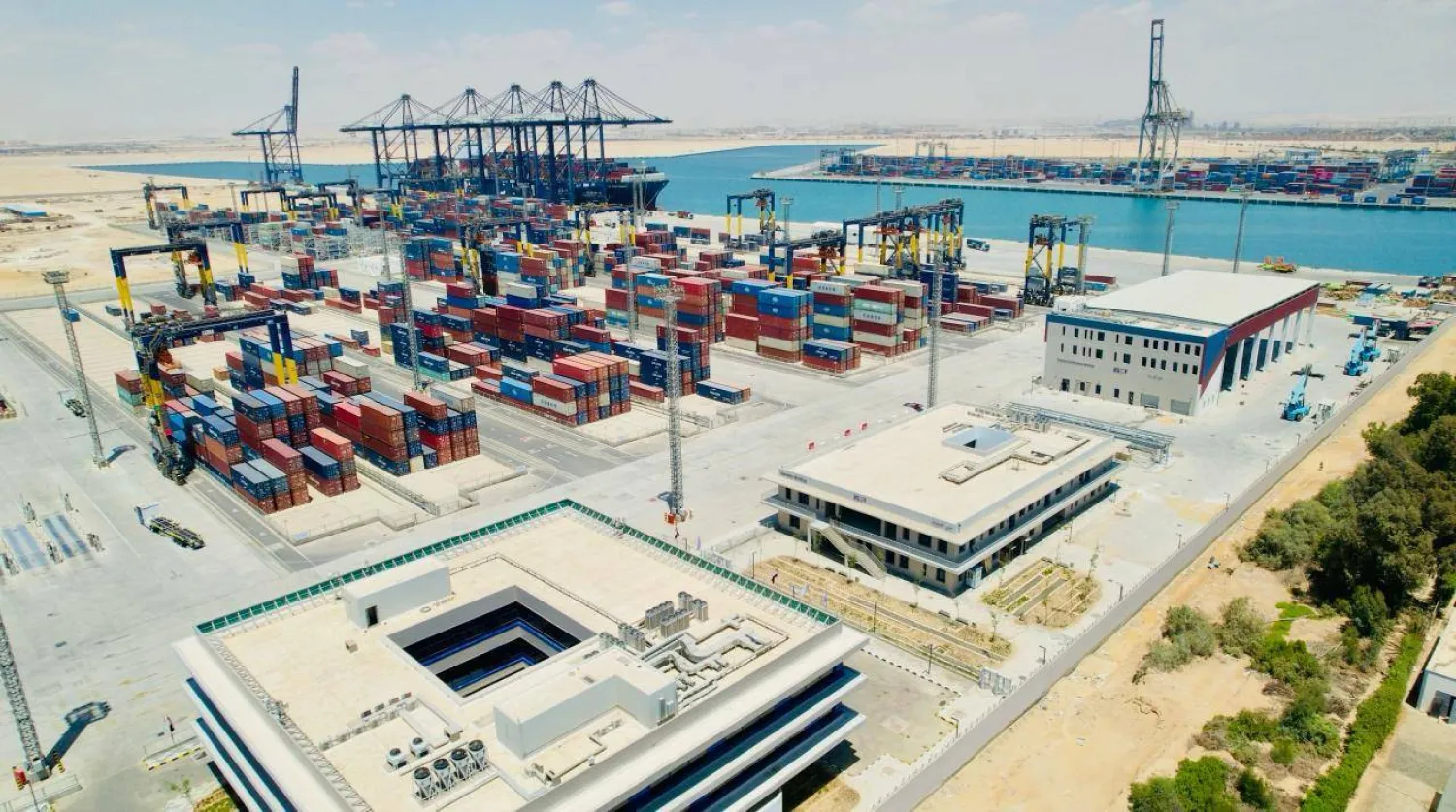
Egypt has an extensive network of seaports along both the Red Sea and the Mediterranean. (Egyptian Ministry of Transport)
TT

Regional Turmoil Drives Growth at Egyptian Ports While Cutting Suez Canal Revenues

Egypt has an extensive network of seaports along both the Red Sea and the Mediterranean. (Egyptian Ministry of Transport)

The Suez Canal may have incurred heavy losses due to regional tensions and instability in recent years — from the war in Gaza to the conflict involving Iran — those same disruptions have contributed to a significant surge in activity at Egyptian ports and in transit trade.

However, Egyptian economists said the strong increase in container traffic at the country’s ports is not enough to compensate for the canal’s losses.

They stressed that government initiatives, including efforts to expand transit trade, may only help reduce part of the revenue shortfall.

At the end of April, Egyptian President Abdel Fattah al-Sisi said Egypt had lost nearly $10 billion in Suez Canal revenues because of attacks on ships in the Bab el-Mandeb Strait.

Egyptian ports have experienced increased activity in recent months amid supply-chain disruptions linked to the Iran conflict. Maritime connections with regional countries have expanded, including the launch of the NEOM–Safaga multimodal logistics corridor linking Gulf Cooperation Council countries with Europe.

The Egyptian government has also reinforced trade links between the Gulf and Europe through the “Ro-Ro” shipping line connecting Damietta Port with Italy’s Port of Trieste to increase trade volumes.

In the energy sector, oil flows through Egypt’s SUMED pipeline rose following disruptions in global energy supply chains caused by the closure of the Strait of Hormuz.

Amr El-Samadouni, secretary-general of the International Transport and Logistics Division at the Cairo Chamber of Commerce, said the recent tensions in the Strait of Hormuz have “strengthened Egypt’s position as a regional hub for logistics services and supply-chain management.”

In a statement, El-Samadouni said the developments provide Egypt with “an important opportunity to offset part of the decline in Suez Canal revenues by attracting a share of urgent shipments that cannot tolerate long delays, especially in sectors linked to fast-moving trade and time-sensitive supply chains.”

According to a statement by Egypt’s Ministry of Transport on Thursday, the country’s port sector recorded a major increase in cargo and container handling. Egyptian ports handled 11.1 million twenty-foot equivalent units (TEUs) in 2025, compared with 8.9 million in 2024, representing growth of 24.3 percent.

Transit container traffic also increased sharply, reaching 6.7 million containers in 2025, a rise of 36 percent. The number of ships calling at Egyptian ports climbed to 17,288 voyages in 2025, up 6.6 percent, according to the ministry.

Egypt has an extensive network of seaports along both the Red Sea and the Mediterranean and is investing heavily in upgrades to strengthen its role in regional and international trade.

The Ministry of Transport said the modernization program aims to transform Egypt into a regional hub for transport, logistics, and transit trade while boosting the ports’ ability to attract investment and handle growing trade volumes.

Despite the improvements in port activity, “they cannot compensate for the losses of the Suez Canal,” said Walid Gaballah, a member of the Egyptian Association for Political Economy, Statistics and Legislation.

He noted that revenues from trade and container handling “may reduce the losses but cannot fully replace them,” adding that shipping traffic through the canal has yet to return to pre-Gaza war levels.

Gaballah told Asharq Al-Awsat that continued regional instability makes recovery in Suez Canal traffic increasingly difficult.

Egyptian economist Mostafa Badra also said there can be no direct comparison between canal revenues and port trade income. “There is no substitute for the canal as a major source of foreign currency,” he told Asharq Al-Awsat, noting that revenues generated by port trade remain far below the canal’s earnings under normal conditions.

Badra added that the government’s port-development strategy is intended to strengthen Egypt’s logistics capabilities and reinforce the Suez Canal’s role as a global trade corridor while primarily supporting domestic trade. By contrast, he said, the canal itself remains a vital artery in global supply chains.

Egypt recently rose three places in the UNCTAD Liner Shipping Connectivity Index, ranking 19th globally, first in Africa, and second in the Arab world, according to the Ministry of Transport.



Caspian Pipeline Consortium Oil Loadings Suspended After Drone Attacks on Tankers, CPC Says

The full moon rises in the background over the infrastructure on D Island, the main processing hub, at the Kashagan offshore oil field in the Caspian sea in western Kazakhstan August 21, 2013. (Reuters)
TT

Caspian Pipeline Consortium Oil Loadings Suspended After Drone Attacks on Tankers, CPC Says

The full moon rises in the background over the infrastructure on D Island, the main processing hub, at the Kashagan offshore oil field in the Caspian sea in western Kazakhstan August 21, 2013. (Reuters)

Two oil tankers were attacked at the Caspian Pipeline Consortium (CPC) terminal off Russia's Black Sea coast, CPC said on Sunday, adding that oil loadings are suspended.

The ASIA and NISSOS IOS ‌tankers were ‌attacked during loading operations, ‌CPC ⁠said.

The ASIA ⁠tanker caught fire, which was extinguished, it added.

"There were no injuries or fatalities amongst CPC staff or contractors. There was no oil ⁠spill," CPC said, adding ‌that ‌the tankers remained afloat.

CPC did not ‌identify any party as ‌responsible for the incident.

The past week has seen a sharp escalation in attacks by ‌both Russia and Ukraine on shipping in the Black ⁠and ⁠Azov seas.

The CPC is a 940-mile (1,510 km) oil pipeline connecting Kazakhstan's Caspian Sea oil deposits with Russia's Black Sea port of Novorossiysk. Oil loaded at Novorossiysk is then taken by tanker to world markets.

CPC accounts for about 80% of Kazakhstan’s oil exports.


Chinese Company Demands Compensation from the UK Over British Steel Nationalization

Workers work at the British Steel site in Scunthorpe, Lincolnshire, Britain April 17, 2025. (Reuters)
TT

Chinese Company Demands Compensation from the UK Over British Steel Nationalization

Workers work at the British Steel site in Scunthorpe, Lincolnshire, Britain April 17, 2025. (Reuters)

The Chinese company that formerly owned British Steel demanded Sunday compensation from the UK government for investment losses following the nationalization of the manufacturer last week.

The British government took operational control of the company last year after Jingye Group said that it was considering closing the blast furnaces at its Scunthorpe plant in northern England, the last in the United Kingdom to make “virgin steel” from raw materials.

Jingye Group said in a WeChat statement that the nationalization move tarnished the credibility of the British government, spooked international investors and caused great losses to the company’s operation and British taxpayers' funds. It also demanded that the UK government stop “trampling on international investment rules.”

The Chinese company announced it had initiated negotiation procedures under relevant bilateral investment agreements, reserving all rights, including to international arbitration. Jingye said it will also represent British taxpayers seeking to hold the UK government and British Steel’s management legally liable. However, it did not specify how it would handle the case.

“The UK disregarded Jingye's continuous investment and significant contribution and was only willing to provide almost zero compensation,” it said.

An independent evaluation will be carried out to determine whether any compensation will be paid to Jingye Group, the UK government said last week.

The Department for Business and Trade announced the move on July 17, saying it would save thousands of jobs and protect the UK’s national interest by ensuring a supply of domestically produced steel for major construction projects and the defense industry.

British Steel and its forebears have been making steel at Scunthorpe for more than 130 years, building on the UK’s development of improved steelmaking technology during the Industrial Revolution. The plant currently employs about 2,700 people.

Jingye bought British Steel in 2020 and said it saved the steel company from crisis.

The Chinese Foreign Ministry on Saturday said the way the UK handles the issue would directly influence how Chinese investors view the British investment environment and the credibility of the British government.

“China urges the UK to earnestly respect market principles and the spirit of contract, and find solutions on compensation and other issues acceptable to both sides,” it said in a statement.

It added China supports enterprises in safeguarding their legitimate rights through legal means.


ACWA Power to Lead Saudi Arabia’s Green Hydrogen Export Drive

The NEOM Green Hydrogen Project (NEOM) 
TT

ACWA Power to Lead Saudi Arabia’s Green Hydrogen Export Drive

The NEOM Green Hydrogen Project (NEOM) 

Saudi Arabia is opening a new chapter in its energy export strategy by entrusting ACWA Power with exporting green hydrogen and its derivatives, while also tasking the company with developing projects to generate, transmit and export renewable electricity, including interconnection links with Europe and the Arab world.

The move reinforces the Kingdom’s strategy of expanding its presence in low-carbon energy markets, building on major investments in renewable energy and clean fuels, led by the NEOM Green Hydrogen Project, one of the world’s largest of its kind and a cornerstone of Saudi Arabia’s future export ambitions.

According to a filing by ACWA Power with the Saudi Exchange (Tadawul), the government has granted the company exclusive rights to export green hydrogen and its derivatives, including green ammonia, green methanol, green methane and other fuels produced using green hydrogen.

Fuad Al-Zayer, an energy adviser and former head of the information department at the Organization of the Petroleum Exporting Countries (OPEC), said ACWA Power was a natural choice given its scale and market position. He noted that the company has more than $124 billion in assets, nearly 98 gigawatts of generation capacity—including over 52 GW from renewable sources—and projects in 15 countries.

Al-Zayer told Asharq Al-Awsat that the decision strengthens the company’s position in the green hydrogen sector, which Saudi Arabia sees as a key pillar of the global transition to clean energy. He added that the Kingdom’s abundant solar and wind resources make renewable energy and green hydrogen economically competitive, supporting Vision 2030’s target of raising renewables’ share of electricity generation to around 50 percent by the end of the decade.

The NEOM Green Hydrogen Project is expected to produce about 600 tons of green hydrogen a day in the form of green ammonia once fully operational, with the first export shipments anticipated in 2027.

Al-Zayer said Europe is expected to be the primary market as it seeks secure low-carbon energy supplies. He added that Saudi Arabia’s strategic location and its large-scale projects in the Kingdom’s northwest give it a competitive advantage in serving European markets. Partnerships with countries including Italy, France and South Korea are also helping develop the supply chains and infrastructure needed to expand the global green hydrogen trade.

Despite the sector’s rapid growth, he said continued investment in transport, storage, electrolysis facilities, water supply and logistics will be essential to support production and exports. Over the next decade, exports of renewable electricity and green hydrogen are expected to transform Saudi Arabia into a reliable supplier of multiple forms of energy while reducing domestic crude oil consumption for power generation, freeing up larger volumes for export and creating new sources of economic growth.