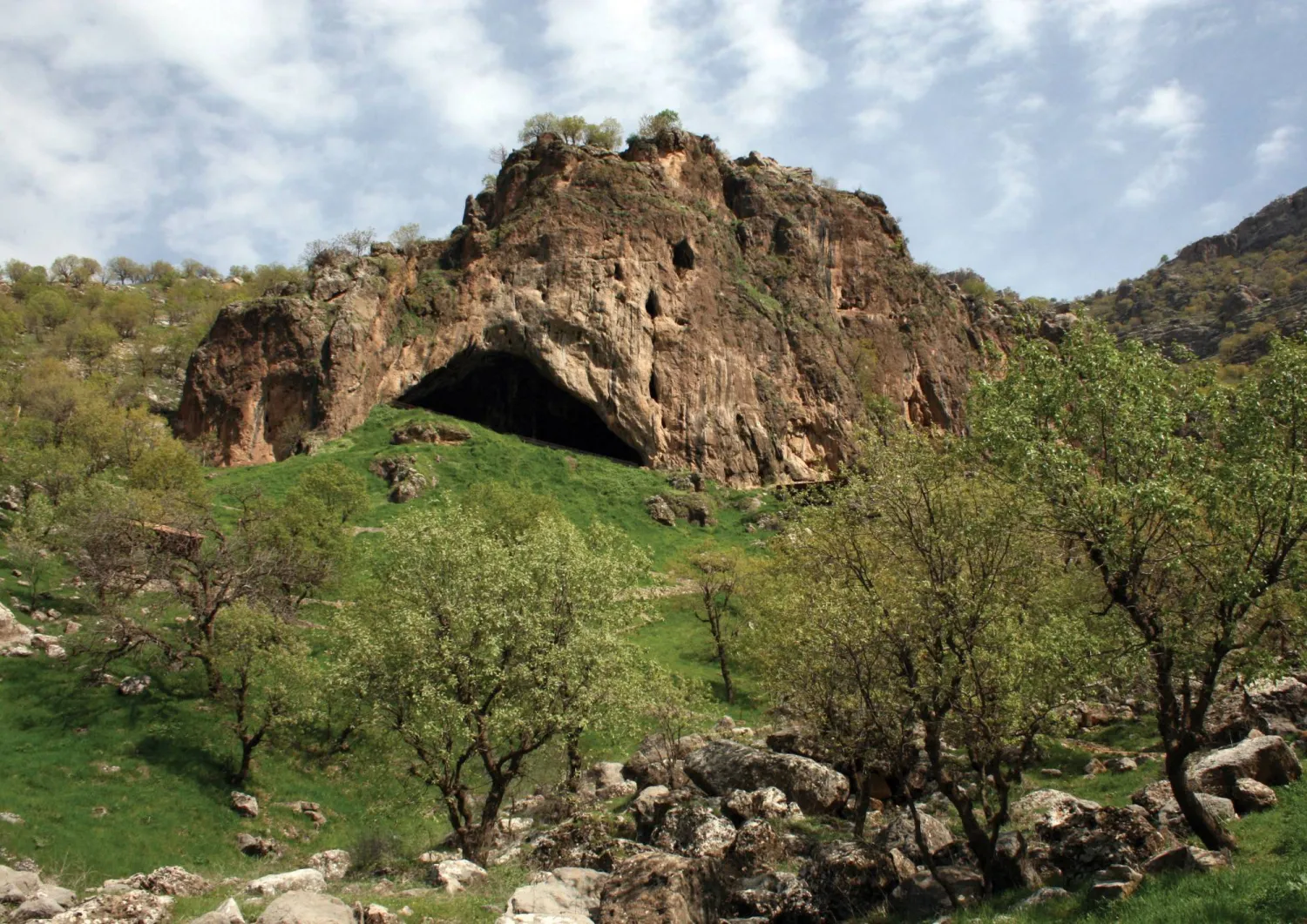
The bones of a Neanderthal from a cave in Iraq's Kurdistan region are offering evidence of both violence and compassion in the closest evolutionary cousins of our species, exhibiting a wound apparently from a fatal spear attack as well as signs of an earlier nonfatal injury that may have elicited kindly care.
Researchers have discovered at Shanidar Cave in the Zagros Mountains of northern Iraq a partial skeleton of a Neanderthal, aged in the mid-40s, that included a left shoulder blade, or scapula, with a circular hole six-tenths of an inch (15 mm) wide indicative of a deeply penetrating stab.
The bones of this individual, who they call Shanidar A, were unearthed from under about 25 feet (7.5 meters) of rocks and sediment inside the cave and date to about 75,000 years ago.
The researchers were unable to determine Shanidar A's sex.
According to Reuters, the researchers said the injury's shape suggests it was caused by a forceful thrust using a sharpened wooden spear, a type of weapon Neanderthals are known to have used, rather than a spear with a stone tip. It was a weapon employed in hunting large mammals that were an important food source.
"The spear would have gone through the skin and major muscles, especially the pectoralis, as well as the ribcage and muscles between the ribs, and the lung," said biological anthropologist Emma Pomeroy of the University of Cambridge in England, lead author of the study published on Thursday in the journal Scientific Reports.
"The location could be like the kind of 'heart shot' hunters use to kill animals quickly by puncturing the heart, but that is a bit speculative. We do see heart shots as a hunting strategy both today and in the archaeological record. Neanderthals would have known this would lead to a quick death," Pomeroy said.
University of Cambridge archaeologist and study co-author Graeme Barker, who has led Shanidar Cave excavations since 2015, said the likeliest scenario is interpersonal violence.
The researchers said the violence probably occurred either between members of a particular Neanderthal group or between members of rival Neanderthal groups, calling a Homo sapiens attack or an accidental injury less likely.
The researchers found shards of bone displaced by the weapon. The injury indicated that the spear entered from above with a downward trajectory, penetrating the left chest cavity from the front and traveling through the body before punching the hole in the scapula, causing quick death.
In addition to the scapula, the researchers found some ribs, a nearly complete right hand and seven teeth, mostly from the front of the lower jaw, belonging to Shanidar A. The teeth bore evidence that this Neanderthal had survived brutal injury at least a year before death — a blow to the face resulting in front teeth being smashed and lost. One tooth was split, with half remaining rotated in the mouth and others pushed out of position.
"The pain would have been extreme, and basic needs like eating and drinking would have been difficult, perhaps meaning Shanidar A needed food mashing and being able to rest. It's likely that Shanidar A did need some care from members of the group for some basic needs during recovery," Pomeroy said.
Shanidar A was one of five Neanderthals, four adults and one infant, whose bodies were carefully tucked behind a rock pillar in the cave in a burial cluster within a generation or so of each other. The cave was occupied by Neanderthals for tens of thousands of years as a seasonal campsite, and later by Homo sapiens.
Neanderthals were more robustly built than Homo sapiens, with larger brows. They lived as hunter-gatherers and inhabited Eurasia from the Atlantic coast to the Ural Mountains from about 400,000 years ago until a bit after 40,000 years ago, disappearing after Homo sapiens became established in the region.
The two species interbred, with modern non-African human populations bearing residual Neanderthal DNA.
The cave, overlooking the Great Zab river valley, has been a source of information about Neanderthals since the 1950s, with Shanidar A now offering new insight into their behavior.
"We see evidence of two contrasting facets of human nature – care and violence – juxtaposed in the same individual," Pomeroy said.
"We see evidence all around us today that violence and care are both aspects of how we humans behave, and we see this here in Shanidar A, too. Neanderthals were like us in many respects, both the good and the bad, and this find really highlights that, going against stereotypes of Neanderthals as unintelligent, uncaring cavemen and cavewomen," Pomeroy said.