Australian Researchers Teach Brain Cells to Play 'Doom'

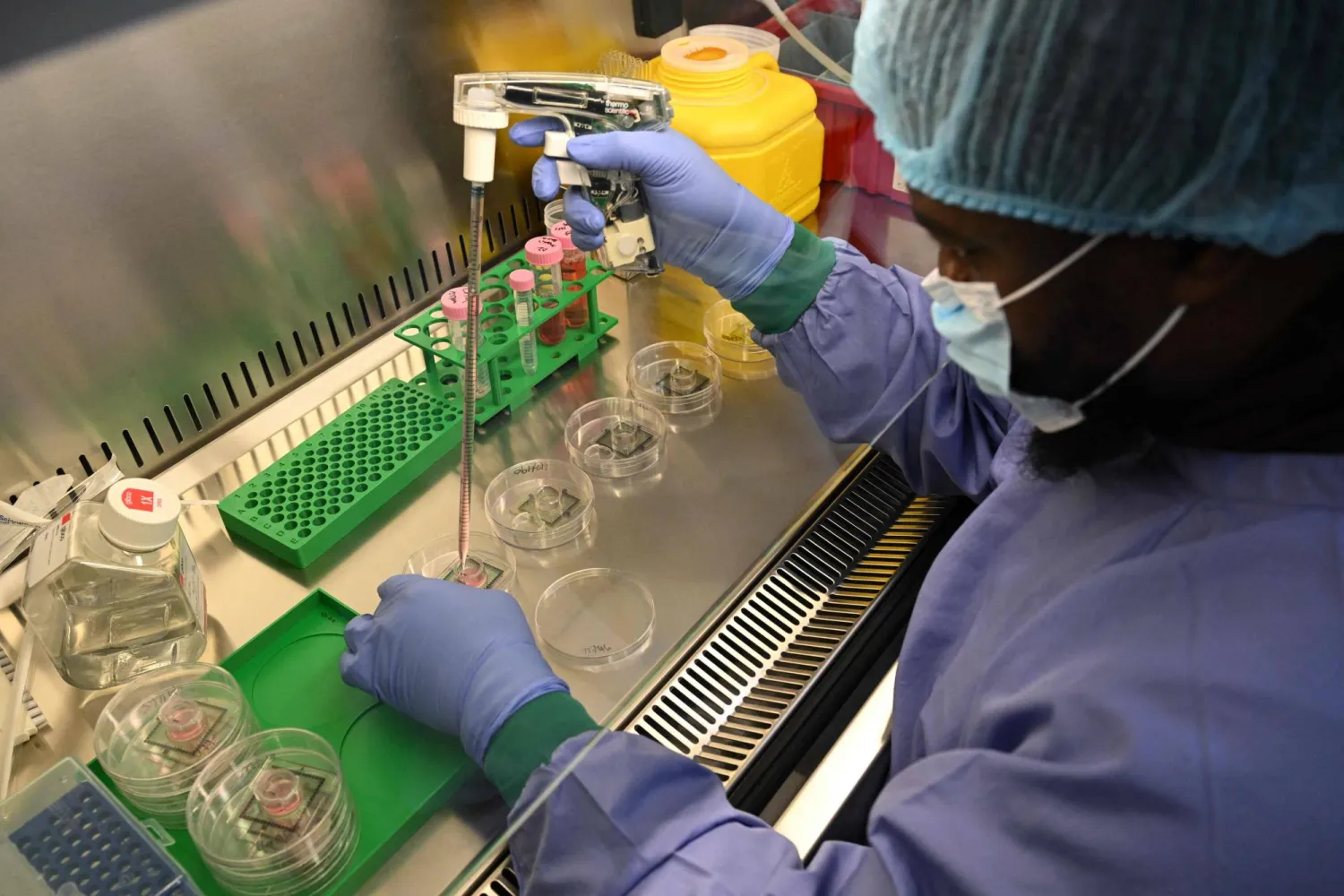
In this photo taken on May 5, 2026, senior scientific specialist Kwaku Dad Abu Bonsrah pipettes nutrients onto neurons on Micro Electrode Array (MEA) chips at Cortical Labs' Physical Containment Level 2 (PC2) laboratory in Melbourne. (Photo by William WEST / AFP)
TT

Australian Researchers Teach Brain Cells to Play 'Doom'

In this photo taken on May 5, 2026, senior scientific specialist Kwaku Dad Abu Bonsrah pipettes nutrients onto neurons on Micro Electrode Array (MEA) chips at Cortical Labs' Physical Containment Level 2 (PC2) laboratory in Melbourne. (Photo by William WEST / AFP)

Australian researchers have trained lab-grown brain cells on a silicon computer chip to play the nineties shooter game "Doom" and say they are just scratching the surface of what the neurons could be capable of doing.

It's the science-fiction work of biotech boffins at Cortical Labs, who researched and developed the technology that harnesses the workings of the brain's networking system.

Each so-called "biological computer" contains around 200,000 living human brain cells, grown from stem cells that were harvested from blood donations.

Having mastered the simple computer game "Pong", where a paddle is moved up and down to send a ball across a screen, the brain cells have moved on to bigger things.

Initially, the neurons were at the "level of a beginner who's never played a video game before," Alon Loeffler, Cortical Labs' senior application scientist, told AFP.

"Doom" involves a chaotic 3D game-world where the user is required to explore its surroundings and dispatch enemies -- no easy task for a clump of cells.

"They were walking into walls a lot, shooting the walls, turning around, doing funny things like that," Loeffler said.

"And then eventually they started targeting the enemies more regularly and correctly."

It's not the cleanest execution, however. One demon takes several attempts to slaughter, with shots fired in multiple directions before the target is hit.

But the mind-bending research proves the neurons can adapt to stimuli in real time and complete goal-directed learning, Cortical Labs say.

The researchers converted the digital environment in "Doom" into patterns of electrical signals the neurons on the chip could understand.

When an enemy appears, specific electrodes stimulate the neurons on the special chip called a CL1, causing them to react.

Different patterns of neuron activity produce specific responses, such as firing the gun or moving left or right.

Researchers monitor the electrical activity of the neurons from a computer screen connected to the CL1, represented by thousands of tiny dots.

From this data, the team adjusts their input to influence and train the neuron's activity.
The CL1 isn't limited to computer games -- the chip can be coded to perform a range of applications, from drug screening to AI-like machine learning.

"We are just scratching the surface of what these neural cultures can achieve when integrated in systems like our CL1," said chief scientific and operations officer Brett Kagan.

"Our neural cultures have been explored for a variety of tasks," he said -- everything from "robotics, real-time learning tasks that are similar to AI, as well as healthcare, medicine, disease modelling, drug screening and even personalised medicine".

Kagan describes the CL1 chip as "a more sustainable and more powerful form of intelligence".

The human brain runs on an estimated 20 watts of power, a level of efficiency that silicon computing and artificial intelligence have not yet been able to replicate.

While it's "not aimed to replace what AI is doing" it's intended to "give us abilities that we've never had before", Kagan said.

The cells have a six-month lifespan and aren't yet capable of producing consistent, programmable results.

But analysts say the project's value could lie in its more sustainable power consumption compared to regular chips.

"We need better ways to manage that power envelope and get higher levels of efficiency," William Keating, CEO of semiconductor research company Ingenuity, said.

"This isn't wacky science or some bunch of scammers. This is real science and it's making real progress."


No More Taking Out the Trash at Your Airbnb

A general view of apartment and office buildings in Hanoi, Vietnam, 21 October 2026. EPA/LUONG THAI LINH
TT

No More Taking Out the Trash at Your Airbnb

A general view of apartment and office buildings in Hanoi, Vietnam, 21 October 2026. EPA/LUONG THAI LINH

The days of having to take out the trash or wash the dishes before leaving an Airbnb are numbered as the short-term rental platform is tightening rules on what conditions hosts may impose on guests.

"Our rules regarding accommodations allow travelers to receive guidelines from hosts; however, our community has let us know that they can be confusing, restrictive, and difficult to manage," Airbnb said Thursday to AFP.

New rules published this week that will apply to reservations made from November 20 will seek to reduce that confusion.

In particular the new rules will generally prohibit hosts from asking guests "to complete tasks that require significant effort or time, or would typically be performed by a cleaner, including stripping the bed, taking trash offsite, or washing and putting away dishes."

Hosts can still ask guests to put dirty dishes in the sink or separate trash and recyclables.

Hosts will also no longer be able to impose fines or penalties on guests, who instead must seek compensation for any damage from insurance provided through Airbnb.


Champion-chip: Best Fries Contest Heats Up Belgium

Fries are a national passion in Belgium. Nicolas TUCAT / AFP
TT

Champion-chip: Best Fries Contest Heats Up Belgium

Fries are a national passion in Belgium. Nicolas TUCAT / AFP

Thick or thin, greasy or crispy, with samurai sauce or a more traditional mayo dip? A TV show has been on a quest to find the best fries in potato-mad Belgium.

For four years running "La meilleure friterie" (the best chip shop), a lighthearted culinary competition aired by broadcaster RTL-TVI, has been seeking out perfection among fry peddlers in the country's French-speaking region.

Watching it is a "sacred Thursday night ritual", said David Antoine, the host.

Crowning a winner among a dozen contestants is no picnic.

"There's sometimes friction among the judges, but we always find that famous Belgian compromise" over a portion of fries, Antoine told AFP in a joking reference to the country's penchant for lengthy political negotiations.

Fried potatoes are a national dish and symbol of pride in Belgium, home to about 4,600 diners specializing in the dish known as "friteries" in French or "frituren" in Flemish.

That number "has remained stable for many years," said Bernard Lefevre of the National Chip Shop Union, an industry group, noting the "market is doing well".

Each has its own flair.

To Lefevre, a good chip is preferably cut from a Belgian potato of the Bintje variety and double fried in beef fat. And size is paramount.

"Anything under nine millimeters is too thin and anything over fourteen is too thick," he explained.

- Hand-peeled 'gold' -

At Hill's Burger, a diner in Brussels, chef Massimo Sefa has gone for a "size twelve" -- that is "a two-millimeter crust and ten millimeters of creamy flesh", he said.

The 23-year-old smiled nervously when the TV show's judges entered his joint and the cameras started rolling.

But the stress is worth it, he explained. The broadcast will shine a spotlight on his friterie and a win would likely send sales skyrocketing.

Sefa opened up shop with his two younger brothers, Lorenzo and Marco. For them chips are a family matter: their grandfather ran about 10 chip shops in Brussels.

"Wow, delicious, crispy, and peeled by hand," Fabienne De Corte, one of the judges, raved upon tasting the goods.

"Fries in Belgium are our gold," added her husband Patrick De Corte, who is also on the judging panel.

"Every little detail makes a difference."

The show has a devout following, including some who tag along for filming sometimes dressed as fry cones and chanting "We've got the fries, we've got the potatoes!".

It has also had its share of controversies, particularly on the hot topic of sauces.

A technical glitch caused trouble during public voting in the first season and some grumbled the winner had bamboozled jurors with dazzling sauces, while the fries were not to everyone's taste.

Still the show has established itself in the French-speaking Belgian media landscape at a time where fries are sometimes changing along with Belgian society.

"There are halal, vegetarian, and vegan fry shops -- that's perfectly normal; society is evolving. We're not a museum of bygone folklore," Lefevre insists.


Aging Japanese Village Turns to Peru in Search of New Residents

A general view of Nanmoku village, Gunma prefecture is seen on September 26, 2026. (Photo by Rie KIKUCHI / AFP)
TT

Aging Japanese Village Turns to Peru in Search of New Residents

A general view of Nanmoku village, Gunma prefecture is seen on September 26, 2026. (Photo by Rie KIKUCHI / AFP)

In a misty mountain village in Japan, residents recently welcomed unlikely guests from a Peruvian district along the Amazon River, seeing a chance to revive an aging community facing extinction.

The mayor of Belen and two young women visited a care home on their trip to Nanmoku, a village of just 1,300 people in Gunma Prefecture, greeting the elderly with broad smiles as some looked on slightly puzzled.

"From the moment I arrived, I began to admire everything about this place," 19-year-old student Wendy Sangama told AFP during a week-long tour of Japan that followed the signing of a sister-city agreement between her hometown and the village last year.

"And yes, it's a town where I could see myself living and settling down," she said.

The village is the oldest municipality in Japan, with 70 percent of its residents aged 65 or above. A 2014 think tank report described it as "most at risk of disappearing."

The main street along the Nanmoku River is lined with houses and shops, some abandoned, and appeared largely deserted on the rainy weekend AFP visited.

Village officials hope the sister-city agreement, which promotes cultural and people-to-people ties, will ultimately attract young people from Belen to live in Nanmoku, although how they might obtain residency remains unclear.

While Peru has the world's third-largest population of Nikkei -- Japanese immigrants and their descendants -- Nanmoku Mayor Saijo Hasegawa told AFP the pact was down less to strategy than to a chance meeting with a Japanese-Peruvian businessman.

The village needed "to broaden its horizons and attract more residents, including foreigners,” no matter where they came from, he said.

"Without them, we could reach a point where even public transportation stops operating."

Despite its rapidly aging population and labor shortages, opposition to immigration is growing within Japan, prompting a push by Prime Minister Sanae Takaichi for tighter regulations on foreign nationals.

Nanmoku has tried various initiatives to attract young people from elsewhere in the country, but employment opportunities remain scarce, and farmland is limited in the mountainous area.

"Around 60 people die each year here, and just two or three babies are born," Hasegawa said.

Belen, meanwhile, is young. The impoverished district of Iquitos, a remote Amazonian city in northeastern Peru, has a median age of about 27 years old.

Home to more than 60,000 residents, the "Venice of Latin America" -- accessible only by plane or boat -- is filled with wooden houses built on stilts to withstand seasonal flooding.

"I think the young people would be more enthusiastic about wanting to settle in other cities because of the economic situation we have," Mayor Lina Arista Lopez told AFP.

The district's residents rely largely on informal trade and agriculture, growing crops such as yuca, rice and corn.

"We have a harsh reality in Belen," Lopez said. "There is no work."

Ketsi Yahuarcani, a 23-year-old student, called the visit to Nanmoku "incredible,” citing the sense of warmth she felt.

"If I had the opportunity to settle here, I would," she said.

Sangama, the other student, said moving to the Japanese village could be "a better option" if it allowed them to build a brighter future and support their families back home.

Not being able to see her family regularly, however, would "certainly be a challenge", she conceded.

While municipalities near Nanmoku have accepted foreign workers, particularly caregivers, it has typically been via short-term programs for skilled workers and technical interns.

Mayor Hasegawa said his vision was different.

Rather than attracting people who stay only a few years for work, he hopes to welcome residents of Belen as fellow villagers ready to build long-term lives in Nanmoku.

"The approach of simply bringing in workers from an agency just because we're short-staffed isn't right for our village," he said.

Yuki Wanibuchi, 34, who moved to Nanmoku several years ago from the Kyoto area, said potential newcomers would face hurdles, including the language barrier.

"You cannot live here without a car, and getting a driver's license will require Japanese skills," Wanibuchi said.

"But personally, I think it's more interesting when people from different backgrounds come here to live."

Hiroshi Ihara, an 87-year-old villager, told AFP he had watched his community grow greyer and greyer, with young people, including his three children, moving to bigger cities to make a living.

"I want more younger people to come and live in the village," he said.

"The Japanese population is shrinking. I think it would be best if people from overseas could come here and do what they can to support us."