

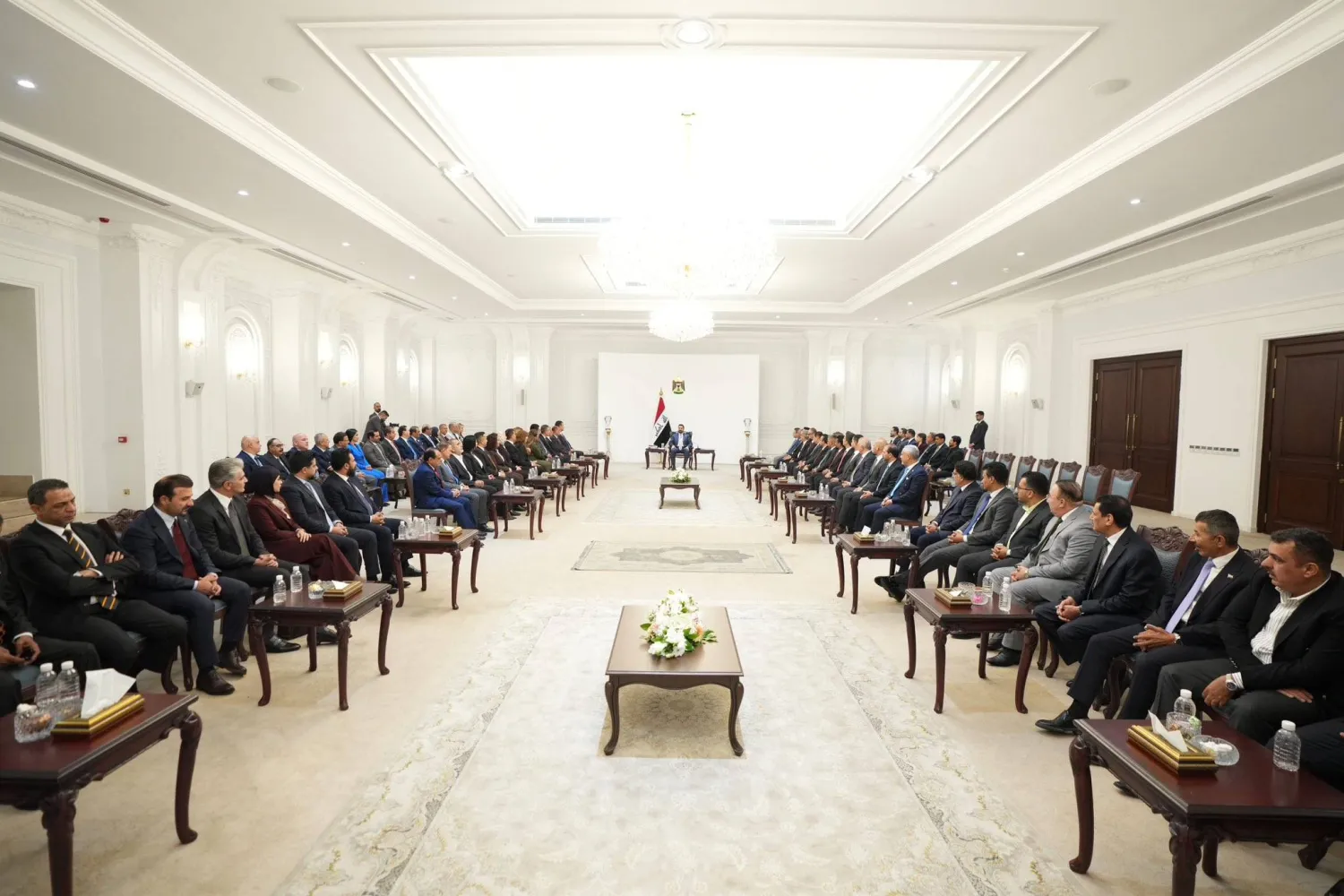

Zaidi Raises Stakes in Confrontation with Iraq’s Armed Factions

Iraqi Prime Minister Ali al-Zaidi meets with journalists on Saturday. (Iraqi PM's office)
TT

Zaidi Raises Stakes in Confrontation with Iraq’s Armed Factions

Iraqi Prime Minister Ali al-Zaidi meets with journalists on Saturday. (Iraqi PM's office)

Iraqi Prime Minister Ali al-Zaidi has intensified his campaign against armed groups operating outside state control, emboldened by public backing from influential Shiite cleric Moqtada al-Sadr and renewed support from Iraq’s top religious establishment in Najaf.

Although Zaidi reportedly intended to keep his recent visit to Najaf private, cameras captured him among worshippers at the shrine of Imam Ali ibn Abi Talib, fueling speculation that he also met senior religious and political figures in the city, home to Iraq’s highest Shiite authority.

The prime minister’s latest moves reflect growing confidence after receiving support from Sadr, whose Saraya al-Salam faction has agreed to begin voluntarily surrendering its weapons. Zaidi has also revived long-standing calls by top Shiite authority Ali al-Sistani for tighter state control over arms and stronger action against corruption.

Previous attempts to disarm armed factions failed under former Prime Minister Mohammed Shia al-Sudani, particularly after tensions between the United States and Iran escalated in 2025 and Iraqi groups aligned themselves militarily with Tehran.

Speaking Saturday at the government palace before a group of journalists attended by Asharq Al-Awsat, Zaidi declared that Iraq faced “a zero-sum equation: either the state or the absence of a state.”

He said his government was determined to eliminate all weapons outside official authority despite mounting pressure from powerful political actors.

According to Zaidi, the disarmament process will unfold in stages, beginning with Saraya al-Salam.

A joint committee formed with Sadr’s movement has been tasked with completing the process within a week.

He added that tribal weapons outside state control would also be targeted.

“There can be no parallel armed force under any pretext,” Zaidi declared, acknowledging the intense political pressure surrounding the initiative.

He also announced that the Asaib Ahl al-Haq faction would begin surrendering weapons this week, while five other groups are preparing to hand over heavy arms to the government.

The campaign, however, has triggered growing unease within the ruling pro-Iran Shiite Coordination Framework, the coalition that helped bring Zaidi to power.

A government said the coalition leaders plan to meet the prime minister for discussions on the disarmament drive and Sadr’s role in the process.

Another meeting involving security officials and faction leaders is expected to address implementation mechanisms, integration of fighters into state institutions, dismantling faction facilities, and guarantees offered to participating groups.

Political sources told Asharq Al-Awsat that some factions fear the campaign could eventually expand into broader investigations and legal accountability measures targeting armed groups and their leadership.


Israeli Families Move into New West Bank Settlement Near Nablus

06 May 2026, Palestinian Territories, Sa-Nur: An aerial view shows rebuilt structures at the Sa-Nur settlement south of Jenin in the Israeli-occupied West Bank. Photo: Gil Cohen-Magen/dpa
TT

Israeli Families Move into New West Bank Settlement Near Nablus

06 May 2026, Palestinian Territories, Sa-Nur: An aerial view shows rebuilt structures at the Sa-Nur settlement south of Jenin in the Israeli-occupied West Bank. Photo: Gil Cohen-Magen/dpa

Israeli families moved into a new settlement on a mountain towering over the city of Nablus in the occupied West Bank on Thursday, the settler regional council for the area said.

"This morning, families from the Ebal founding group are transferring their equipment and moving into caravans in the new Ebal settlement, established in Samaria," the Samaria Regional Council said, using the Biblical name for the north of the West Bank.

Excluding east Jerusalem, more than 500,000 Israelis live in settlements in the West Bank, which Israel has occupied since 1967, among some three million Palestinians.

All Israeli settlements are illegal under international law.

In a video shared by the council, a dozen Israeli settlers were seen carrying moving boxes and furniture into mobile-homes typical of new settlements.

A newly paved road lined with Israeli flags on the mountain was lined with around 10 mobile homes.

Mount Ebal is one of the highest peaks in the West Bank. In the valley below, residents of Nablus' Old City told AFP they could see the settlement's homes.

"Palestinian citizens used to go to Mount Ebal to stroll and breathe fresh air, but today they have cut off our air by encircling Nablus from all sides with settlements and attacks," said Ghassan Daghlas, governor of the Nablus region.

He said that a military camp and parts of a settlement on the other mountain near Nablus, Mount Gerizim, had already made Palestinian residents feel encircled.

Samaria Regional Council head Yossi Dagan said that 600 families were expected to live at Ebal settlement in the future.

"We are establishing here a thriving settlement that will illuminate the entire region, and this is a huge step on the way toward expanding our presence throughout the northern Samaria area," Dagan said at the site.

Since taking office, Prime Minister Benjamin Netanyahu's government, one of the most right-wing in the country's history, has approved the establishment of 102 settlements in the West Bank, according to Israeli anti-settlement watchdog Peace Now.


Israel's Latest Strikes Kill a Dozen People in Gaza, Including Police Officers

Palestinians mourn victims killed in an Israeli strike on a residential building in central Gaza on Wednesday. (AP)
TT

Israel's Latest Strikes Kill a Dozen People in Gaza, Including Police Officers

Palestinians mourn victims killed in an Israeli strike on a residential building in central Gaza on Wednesday. (AP)

Israeli airstrikes have killed at least a dozen people in Gaza over the past two days, local health officials said Wednesday, as strikes continue almost daily despite a months-old ceasefire with Hamas.

On Wednesday, three members of a family were killed in central Gaza, Al Aqsa Hospital officials said.

On Tuesday, woman and six police officers were among those killed in an airstrike on a police station in the densely populated Jabaliya refugee camp in northern Gaza, hospital officials said. A man died in the bombing of a tent camp in Khan Younis in the south, Nasser Hospital officials said. And Israeli forces shot and killed a child in the Muwasi area outside the southernmost city of Rafah, according to hospital officials.

The Israeli military did not immediately comment on the strikes in central and southern Gaza. In a statement on the attack in Jabaliya, it claimed that four of the slain police officers were Hamas militants, without providing evidence on how those killed were involved in planning or carrying out attacks.

One of the officers, Col. Mohamad Marwan Salem, was a senior police commander and head of the Jabaliya police station, the Hamas-run Interior Ministry said.

Hamas, which ruled Gaza for years, maintains an armed wing as well as civilian police and security services that are overseen by its Interior Ministry. Throughout the war, Israel has targeted local police, including those guarding humanitarian aid convoys.

Israel's military has claimed it considers police stations legitimate targets if they're “being used to advance military activities, or if those present are military operatives involved in advancing terrorist activities.”

It did not say what military activities it believed were taking place at the Jabaliya police station, nor did it provide evidence that attacks were being planned. Hamas says the police force is engaged in maintaining law and order.

Israeli attacks on Gaza’s police have been condemned by the United Nations human rights office, which said last month that police personnel had been attacked at least a dozen times in 2026, including “during ordinary law enforcement operations, including directing traffic and patrolling streets and markets.”

“The pattern of attacks raises concerns that Israeli forces apply no distinction between police personnel and fighters belonging to armed groups in Gaza,” it said in a June 3 statement.

Ofer Guterman, a researcher at Israel’s Institute for National Security Studies, said Israel’s targeting suggests that it regards parts of Hamas' policing apparatus as closely integrated with its military infrastructure, including through dual-role personnel and the use of facilities for weapons storage, operations and logistics.

The fragile ceasefire deal in October attempted to halt a two-year-long war between Israel and Hamas.

The heaviest fighting has subsided but at least 1,123 people have been killed in Gaza since the ceasefire took effect, according to the territory’s Health Ministry. The ministry, which has been part of the Hamas-led government, maintains detailed casualty records that are seen as generally reliable by UN agencies and independent experts. It does not give a breakdown of civilians and militants but says women and children make up most of the dead.

Militants have carried out shooting attacks on troops, and Israel says its strikes are in response to that and other violations. Five Israeli soldiers have been killed since the ceasefire.

The war began after the Hamas-led attack on southern Israel on Oct. 7, 2023, killed around 1,200 people and saw 251 taken hostage. Israel’s retaliatory offensive in Gaza has killed more than 73,264 Palestinians, including those killed since the ceasefire, Gaza’s Health Ministry said.


Algeria Orphanage Fire Kills 11

A general view of the capital, Algiers (Reuters file photo)
TT

Algeria Orphanage Fire Kills 11

A general view of the capital, Algiers (Reuters file photo)

A fire burning at an orphanage on the outskirts of the Algerian capital has killed at least 11 people and injured 19, the country's civil defense said Thursday.

The civil defense was "continuing efforts to put out the fire" in the Mohammadia district of Algiers, with the cause of the blaze unknown.

"The provisional toll is 11 dead," it said, without specifying the age of the victims.

Ten of the injured suffered burns of varying severity, while emergency crews evacuated five people ⁠with disabilities from the orphanage to safety, the civil protection agency said.

National television showed Prime Minister Sifi Ghrieb visiting the wounded in hospital.

Algeria has been sweltering under a heatwave for several days, and nearly 1,000 fires have been recorded in the space of a week.