


Israel Orders Strikes on South Beirut ahead of UN Meeting

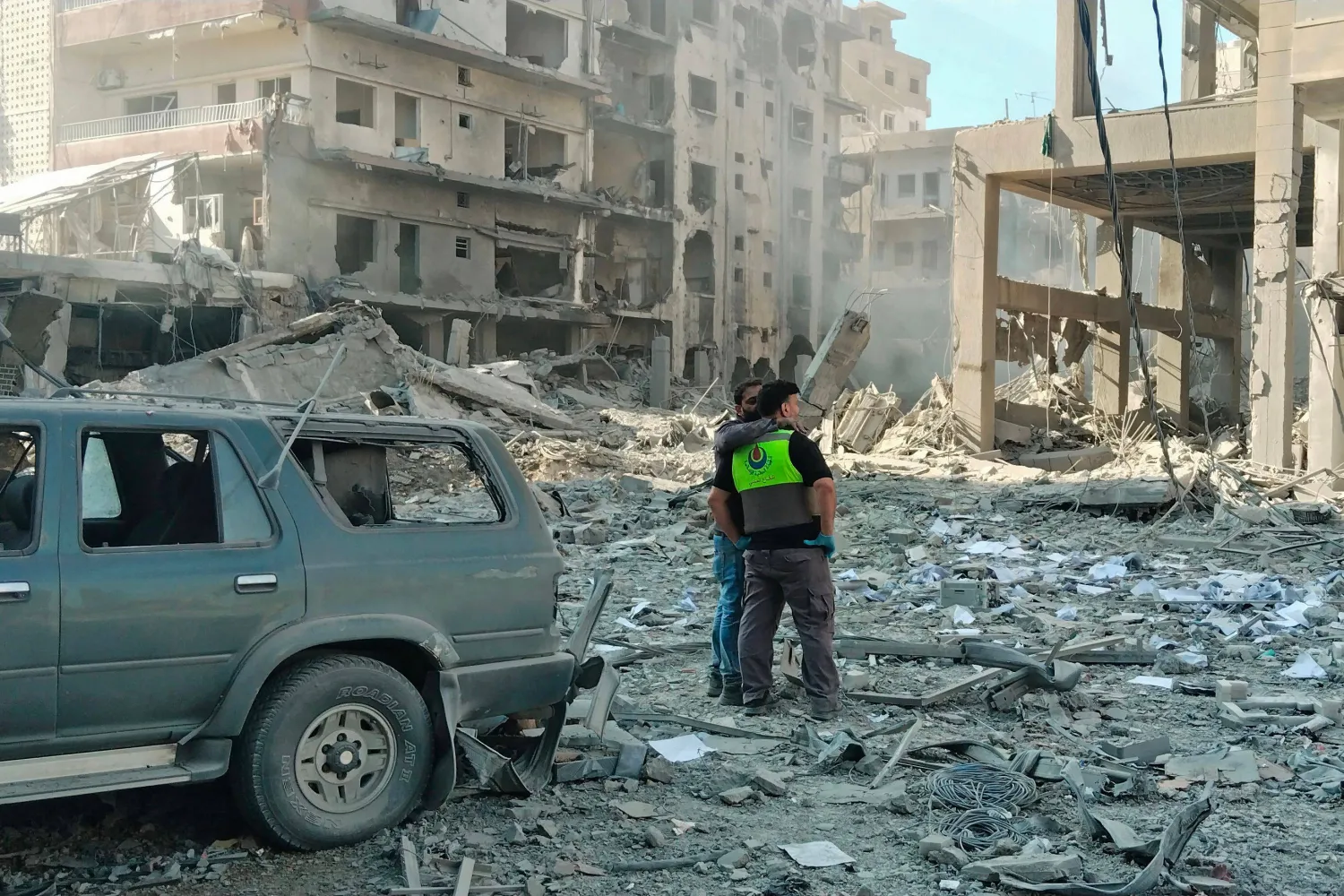
 Civil defense workers inspect the site of an Israeli strike in the southern Lebanese city of Tyre on May 31, 2026. (Photo by KAWANT HAJU / AFP)
Civil defense workers inspect the site of an Israeli strike in the southern Lebanese city of Tyre on May 31, 2026. (Photo by KAWANT HAJU / AFP)
TT

Israel Orders Strikes on South Beirut ahead of UN Meeting

 Civil defense workers inspect the site of an Israeli strike in the southern Lebanese city of Tyre on May 31, 2026. (Photo by KAWANT HAJU / AFP)
Civil defense workers inspect the site of an Israeli strike in the southern Lebanese city of Tyre on May 31, 2026. (Photo by KAWANT HAJU / AFP)

Israel said Monday it would once again target Beirut's southern suburbs, a Hezbollah stronghold mostly spared heavy attacks since April, as it stages its deepest incursion into Lebanon in two decades.

The UN Security Council is expected to hold an emergency meeting later Monday on Israel expanding its operations in Lebanon, and the European Union called on Israel to "stop its military escalation".

Iran, in stalled negotiations on an end to its wider war with the United States, said a Lebanon ceasefire remains a key condition for any deal.

Israel's Prime Minister Benjamin Netanyahu and Defense Minister Israel Katz said they had ordered strikes on Beirut's usually densely populated southern suburbs, AFP reported.

"In light of the repeated violations of the ceasefire in Lebanon by the terrorist organization Hezbollah and the attacks on our cities and citizens", Netanyahu and Katz "instructed the army to strike terror targets in the Dahiyeh district of Beirut", a joint statement said.

Katz said separately there would be "no calm in Beirut" if Hezbollah attacks continued, vowing to establish a military-controlled zone in the area of south Lebanon's Litani River.

The Israeli military's Arabic-language spokesman Colonel Avichay Adraee, posting on X, urged Dahiyeh residents to evacuate "to preserve their safety".

AFP journalists saw hundreds of families fleeing the southern suburbs, some on foot or on motorbikes, others in cars packed with belongings.

Hours later, a correspondent said shops were closed and the area's streets were largely deserted.

Lebanon was dragged into the Middle East war on March 2 when Hezbollah fired rockets towards Israel in retaliation for the US-Israeli killing of Iran's supreme leader.

A truce to halt the fighting in Lebanon began on April 17, but has never been observed. Both Israel and Hezbollah accuse each other daily of violating the ceasefire, justifying their attacks by the other's alleged breaches.

- 'Vicious aggression' -

South Beirut resident Hadi, 24, said he had hoped for some stability during the truce.

"That feeling did not last long... Our fears intensified this morning after I received a series of messages about orders to bomb the southern suburbs, which caused widespread panic, and we immediately left the area," he told AFP by phone.

Iranian foreign ministry spokesman Esmaeil Baqaei told a weekly press briefing that "a ceasefire in Lebanon is an essential condition for any deal aimed at ending the war" with the US.

Lebanese President Joseph Aoun said his country was facing "a vicious and reprehensible Israeli aggression", with the two nations set to hold a fourth round of US-hosted talks on Tuesday and Wednesday.

He called the talks "the only solution to stop the war with the least possible damage".

Beirut's southern suburbs and their surroundings have been struck twice since April 8, when huge Israeli attacks across Lebanon killed hundreds in minutes.

Israel's military on Monday also issued evacuation warnings for more than a dozen south Lebanon locations.

A day earlier, Israeli troops seized Beaufort castle, which commands sweeping views of south Lebanon, as the military expands its ground operations.

Israeli forces used the castle as a base during their previous two-decade occupation of southern Lebanon that ended in 2000.



Iraq Investigates Foiled Attempt to Smuggle Missiles, Drones into Syria

A member of Syria’s security forces holds parts of a drone smuggled from Iraq and seized at the al-Tanf border crossing. (Syrian Interior Ministry)
TT

Iraq Investigates Foiled Attempt to Smuggle Missiles, Drones into Syria

A member of Syria’s security forces holds parts of a drone smuggled from Iraq and seized at the al-Tanf border crossing. (Syrian Interior Ministry)

Iraq's Joint Operations Command announced on Thursday that it had formed an investigative committee to examine the circumstances surrounding the foiled attempt to smuggle a shipment of weapons and missiles across the Iraqi border into Syria.

Sources familiar with the matter said the Iraqi government intends to hold officials at a border crossing with Syria accountable if they are found to have facilitated the shipment's passage into Syria.

The developments come amid growing scrutiny of cross-border overland freight traffic between the two countries, including routes used to transport goods and fuel, as well as heightened monitoring of weapons supply routes to Lebanon's Hezbollah.

The Joint Operations Command said the committee was formed under an urgent directive from armed forces commander-in-chief Ali al-Zaidi and included security agencies and specialists to investigate the operation.

Baghdad would coordinate with Damascus to establish what happened and hold accountable any party found to have been negligent, it said.

The measures were aimed at strengthening security along the shared border and preventing Iraqi territory from being used for activities that threaten national security or regional stability, the statement added.

The Iraqi announcement came hours after Syrian authorities said they had intercepted a shipment of weapons and missiles at the Syrian-Iraqi border.

The cargo was hidden inside an oil tanker and, according to the Syrian account, was intended for Lebanon’s Hezbollah.

Syria’s state news agency SANA quoted an Interior Ministry source as saying specialized units had seized what it described as a shipment of advanced weapons entering Syrian territory.

The source said the cargo appeared to be bound for the Lebanese group.

Syria’s General Authority for Land and Sea Ports said an inspection at the al-Tanf border crossing uncovered large quantities of missiles, weapons, and drones inside an oil tanker heading to Banias.

Weapons hidden in an oil tanker

Iraqi security sources said the tanker left Iraq about nine days earlier after being officially registered as carrying fuel.

It completed customs procedures and was sealed before crossing the border, they said.

The tanker was moving as part of Iraqi fuel traffic to Syria, including shipments linked to supplying the Banias refinery with crude oil or petroleum products under commercial arrangements between the two countries.

The sources said fuel tankers could be harder to inspect than ordinary cargo, particularly when authorities relied on conventional screening methods.

The investigation would determine how the shipment passed through Iraqi checkpoints, including the al-Waleed border crossing, before it was seized at al-Tanf on the Syrian side, they said.

An Iraqi government source said the authorities were considering action against officials at al-Waleed if investigators found evidence of collusion or negligence.

Media reports citing sources said Syrian authorities did not inform Iraq of the seizure until after they had completed their investigation.

The reports said the detained driver had given statements indicating that employees at al-Waleed helped shipments pass through to Lebanon’s Hezbollah.

Sensitive frontier

The Iraqi-Syrian border is one of the region’s most sensitive security zones.

Stretching more than 600 km, it cuts through vast desert areas that have long complicated efforts to monitor the movement of people and goods.

Armed groups and smuggling networks have used the area in recent years to move fighters, weapons and prohibited materials, particularly during the war against ISIS, which controlled large parts of Iraq and Syria between 2014 and 2017.

Although Baghdad and Damascus have moved to strengthen border cooperation, smuggling remains a complex security challenge because of the terrain and the number of armed groups operating near the crossings.

The seizure comes as Iraq seeks to balance stronger economic ties with Syria with its security and diplomatic commitments to the United States and other Western countries that have imposed sanctions on networks linked to armed groups in the region.

The disclosure also coincided with Iraqi financial institutions beginning to enforce a new package of U.S. sanctions targeting financing and logistical support networks linked to Hezbollah.

The measures included asset freezes and restrictions on several individuals and companies.

Hezbollah has not commented on the Syrian allegations.

Iraqi authorities have yet to release final findings or identify those behind the attempted shipment.

The case comes amid continued international pressure on supply routes used by Iran-aligned armed groups, including overland corridors running from Iran through Iraq and Syria to Lebanon.

Iraqi and Syrian investigations are continuing into how the tanker crossed the border, who organized the shipment and how the fuel route to the Banias refinery was used.

Banias is economically important to both countries. It is home to one of Syria’s main oil refineries and provides access to the Mediterranean.

Iraq has recently sought to expand options for moving oil and petroleum products through Syria as part of efforts to diversify transport routes and reduce reliance on a single export corridor.

Reuters previously reported that Baghdad was seeking to increase oil shipments to Banias by road through Syria under existing agreements between the two countries.

Iraqi officials say the routes could bring economic gains, but border security and logistical concerns may require tighter controls on freight traffic.


Lebanese Army Steps Up Security in the South Ahead of Technical Talks with Israel

A Lebanese soldier stands at a newly established checkpoint in the southern town of Froun, which is included in the proposed pilot zone. (AP)
TT

Lebanese Army Steps Up Security in the South Ahead of Technical Talks with Israel

A Lebanese soldier stands at a newly established checkpoint in the southern town of Froun, which is included in the proposed pilot zone. (AP)

The Lebanese army has stepped up military and security measures in an area proposed for inclusion in a pilot zone in southern Lebanon, announcing deployments across towns in the districts of Bint Jbeil, Tyre and Nabatieh.

The measures come amid an Israeli military escalation and the start of construction of a line of permanent positions inside the security zone Israel occupies in southern Lebanon, Israel’s Maariv newspaper reported.

The Lebanese army said it had deployed patrols, checkpoints and observation posts in Froun, Ghandouriyeh, Qalawayh, Burj Qalawayh and Kfar Dounin in the Bint Jbeil district, as well as Qaaqaiyat al-Jisr in the Nabatieh district and Srifa in the Tyre district.

It also released photographs showing military vehicles and personnel deployed in the towns.

The measures were introduced ahead of a technical meeting scheduled to take place by video conference on Friday, with representatives of the Lebanese, Israeli and US militaries expected to discuss implementation mechanisms for the pilot zone and determine which towns it would cover.

The proposed zone could include Zawtar al-Sharqiya, which is occupied by Israel, and Zawtar al-Gharbiya, part of which is under Israeli occupation. It could also cover Froun, Ghandouriyeh, Srifa, Qalawayh and Burj Qalawayh, where Israel maintains fire control but has no forces stationed.

Airstrikes

Meanwhile, the Israeli military continued its violations of the ceasefire agreement.

Israeli warplanes carried out two strikes on Thursday afternoon targeting the outskirts of the al-Deir neighborhood in Nabatieh al-Fawqa, firing several air-to-surface missiles.

The explosions echoed across the Nabatieh area, sending thick plumes of smoke into the air.

Two people were killed in the strikes, Lebanon’s state-run National News Agency reported.

The Israeli military also set fire to several homes and plots of land on the outskirts of Beit Yahoun in the Bint Jbeil district.

Later in the afternoon, an Israeli drone carried out a guided-missile strike on the Ali al-Taher woodland on the outskirts of Nabatieh al-Fawqa.

At dawn, Israeli warplanes had also struck the outskirts of Baraachit and Beit Yahoun in the Bint Jbeil district.


Houthi Escalation Threatens Yemen's Imports, Deepens Humanitarian Crisis

Shipping disruptions threaten the flow of imports into Yemen. (Local media)
TT

Houthi Escalation Threatens Yemen's Imports, Deepens Humanitarian Crisis

Shipping disruptions threaten the flow of imports into Yemen. (Local media)

Concerns are mounting over a worsening humanitarian crisis in Yemen as renewed military escalation by the Houthis coincides with the fallout from the resumption of the war involving Iran, which has begun to disrupt trade flows and commodity supplies to the country. At the same time, the United Nations has warned of expanding hunger and a declining ability of aid agencies to respond because of severe funding shortages.

Government and commercial sources told Asharq Al-Awsat that importers are facing growing difficulties in delivering shipments to Yemen as disruptions to regional maritime traffic persist.

The sources said hundreds of containers have remained stranded at regional ports for months due to disruptions affecting shipping routes linked to the Strait of Hormuz, while concerns are growing over delays to new shipments and further increases in freight costs.

The situation is directly affecting commodity prices in a country that relies on imports for about 90 percent of its food needs, at a time when Yemenis are already grappling with declining purchasing power, currency depreciation, and rising poverty.

According to the sources, prices of several essential goods rose by more than 20 percent during the first round of the war. Price increases were even steeper in Houthi-controlled areas after the group imposed customs duties exceeding 100 percent on wheat and flour shipments entering through government-controlled ports. The measures drove up flour prices, despite flour being the main staple for most Yemenis, particularly in the country's mountainous governorates.

UN Warnings

These developments come as the United Nations says Yemen continues to face one of the world's worst humanitarian crises amid the ongoing conflict, worsening economic conditions, and expanding food insecurity.

According to a recent UN report, the continuation of the conflict, declining funding, deteriorating infrastructure, and rising import costs are pushing millions of Yemenis toward deeper poverty and hunger unless additional resources are secured to sustain humanitarian operations.

The report said 18.3 million people are experiencing acute food insecurity, with more districts expected to slip into the emergency phase of food insecurity and some areas facing catastrophic levels of hunger.

It also estimated that 22.3 million people, more than two-thirds of Yemen's population—will require humanitarian assistance and protection services this year, including 5.2 million internally displaced people, as well as migrants, refugees, and asylum seekers.

Funding Shortfall

The United Nations warned that Yemen's humanitarian response is facing an unprecedented funding crisis. As of the end of May, only 12.7 percent of the $2.16 billion required under the 2026 Humanitarian Response Plan had been secured, forcing aid agencies to scale back operations and focus assistance on those with the most urgent needs.

The report said children and women remain the hardest-hit groups. It projected that 2.2 million children under the age of five will suffer from acute malnutrition, including more than 500,000 with severe acute malnutrition. Another 1.3 million pregnant and breastfeeding women are also expected to face malnutrition.

The UN report added that around 40 percent of Yemen's health facilities are either completely or partially out of service. It warned that continued outbreaks of cholera, measles, and diphtheria, coupled with deteriorating water and sanitation services, are increasing the risk of large-scale public health emergencies. Meanwhile, 14.4 million people require water, sanitation, and hygiene (WASH) services.