


Steampunk Festival Creates an Unlikely Capital for Victorian Style and Sci-Fi Oddity in New Zealand

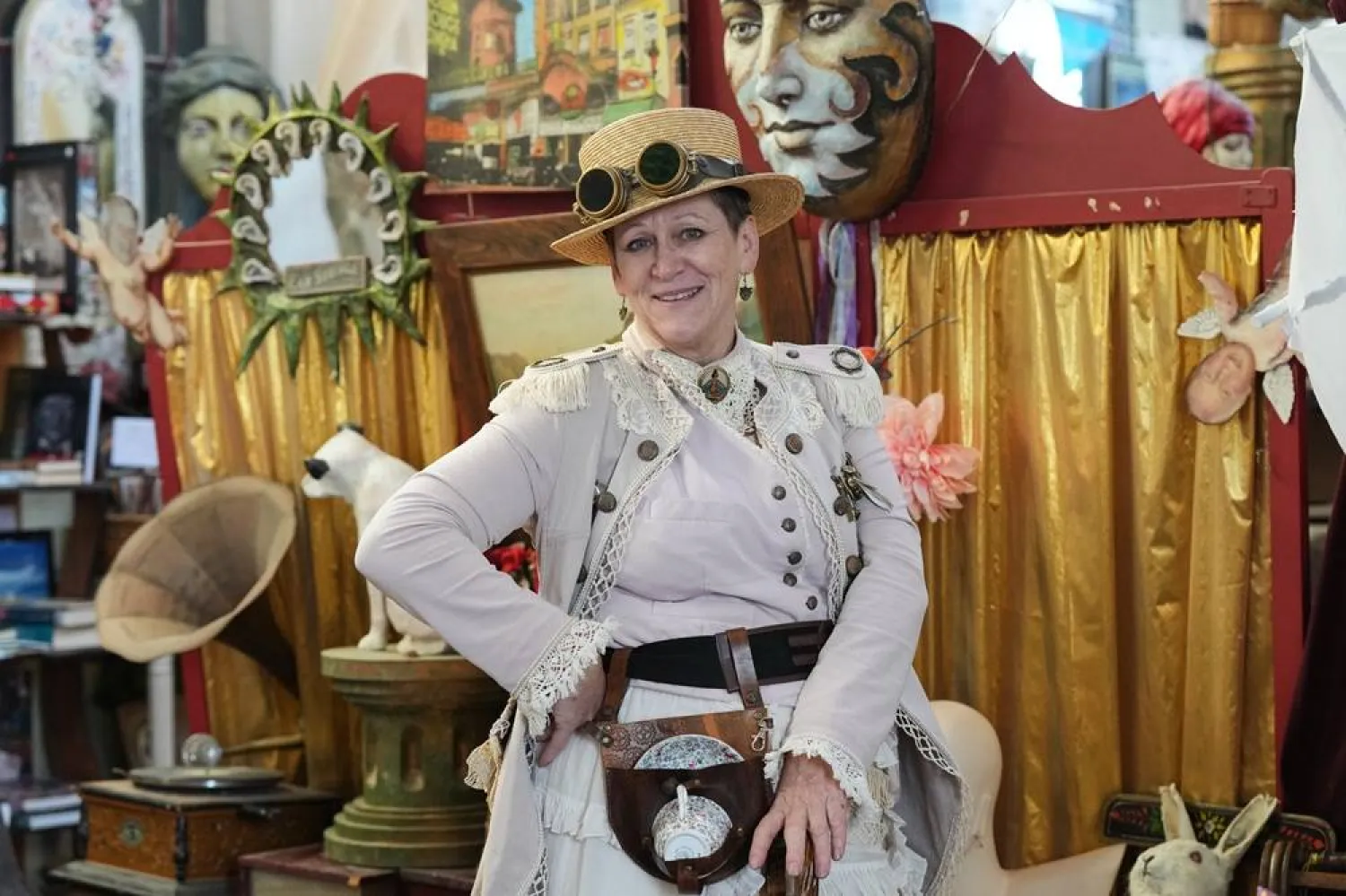
 Steampunk NZ Festival chair Lea Campbell, dressed as her steampunk persona Dusty Traveller, poses for a portrait during the annual event in Ōamaru, New Zealand, Friday, May 29, 2026. (AP)
Steampunk NZ Festival chair Lea Campbell, dressed as her steampunk persona Dusty Traveller, poses for a portrait during the annual event in Ōamaru, New Zealand, Friday, May 29, 2026. (AP)
TT

Steampunk Festival Creates an Unlikely Capital for Victorian Style and Sci-Fi Oddity in New Zealand

 Steampunk NZ Festival chair Lea Campbell, dressed as her steampunk persona Dusty Traveller, poses for a portrait during the annual event in Ōamaru, New Zealand, Friday, May 29, 2026. (AP)
Steampunk NZ Festival chair Lea Campbell, dressed as her steampunk persona Dusty Traveller, poses for a portrait during the annual event in Ōamaru, New Zealand, Friday, May 29, 2026. (AP)

The woman in the pink frock coat announced herself as steam curled from a strange brass contraption on her back.

“I am Lady Sarsaparilla Ovabyte, of the Coventry Ovabytes,” she said. “We are purveyors of fine cordials.”

Her companion peered through glasses made from fused-together forks.

“Captain Bob McSpoon, inventrepreneur,” he said.

On a Victorian-era street in rural Ōamaru, New Zealand, Ovabyte and McSpoon, who usually go by Juliet and Greg Thorn, weren’t the only ones wearing goggles or forks, or emitting steam. They were in the small town to attend the annual steampunk festival, a four-day love letter to being as odd as possible, which draws thousands of visitors from around the country and abroad.

Steampunk fuses Victorian aesthetics and mechanics with a science fiction twist to create a parallel universe imagining what the age of steam might have produced if it had continued to the present day. The genre is limited only by imagination, and the weirder the better.

Steampunks pride themselves on a knack for recycling and DIY, honing skills in sewing, metalworking, hat-trimming and steam mechanics as they dream up fantastical personas with outfits to match. During the year, attendees are bricklayers, engineers, artists and farmers, with many describing themselves as normally shy or reserved. But they had come to the festival to be seen.

“The first time you dress up and go out in public is really scary and then people get such a buzz out of it,” Juliet Thorn said. “It’s so cool that you take on a different personality.”

In its 17th year, whole traditions and sporting codes have sprung up around the steampunk festival, which is among the world’s best-known.

Hundreds crowded into upstairs rooms and old community halls for steampunk-themed contests. They raced to dunk cookies in cups of tea and cram the soggy results into their mouths before their competitors. A parasol-dueling contest looked like competitive vogueing judged on speed and style.

Michele Cotten won a fashion show displaying wild and upcycled outfits that participants spent months finessing. Cotten fused steampunk with the Star Trek universe to create a hooped dress made in the style of a navy Starfleet uniform. It was rigged with Christmas lights to evoke a galaxy and Cotten, a crowd favorite, strutted and posed to whoops from onlookers.

Then there was the teapot racing, in which competitors sent remote-controlled vehicles mounted with teapots around a fiendish obstacle course to the gasps and groans of a watching crowd.

“If you go out of bounds, that’s a disqualification,” said Ross McKay, one of the sport’s creators, who dreamed it up with his late wife and a friend. He has since introduced teapot racing to other steampunk events worldwide.

“It’s lots of fun and the judges will take bribes,” he added.

When McKay’s wife showed him pictures of steampunks, he recalled thinking, “What a bunch of weirdos," but the self-confessed “history geek and science fiction nerd” found plenty to love about the genre. The retired banker was soon enrolled in night classes for sewing.

Now he is Captain Roscoe Dangerfield, Inspector of Nuisances to Her Majesty Queen Victoria III, which combines the historical element of a real Victorian job with the fiction of a monarch who never lived.

The steampunk community had become his tribe, he said.

Small town is an unlikely steampunk capital

Ōamaru is the placid home to 14,000 people and 3,000 endangered native penguins, the latter of which live at the far end of town in a colony so pungent it can be smelled from the hill above.

The town on New Zealand’s South Island doesn’t feature the sweeping vistas popularized by the Lord of the Rings films, which bring tourists to nearby regions, and for years was mostly seen as a stopping point between the cities of Christchurch and Dunedin.

An architectural quirk has put Ōamaru on the map as what locals call the steampunk capital of the world. The town features a completely preserved Victorian street by the harbor, a legacy from the 19th century days when Ōamaru was a commercial and mercantile powerhouse as a departure point for meat, wool and grain exports from New Zealand to Britain.

The cream-colored stone buildings now form the backdrop for the festival's steampunk adventures. Later in the year the town also hosts a Victorian festival celebrating a historically accurate version of the era, with the events coexisting peacefully after the steampunks and Victorians decided the town was big enough for everyone.

Steampunk, a term coined in the 1980s, gives participants an opportunity to rewrite Victorian-era social conventions on the basis that if you are flying on a magic carpet or traveling through time, it doesn’t matter if you make the rest up.

“We’re an equal opportunity society,” said Iain Clark, who co-founded the festival and is widely known in the community as Agent Darling. “Women, unlike in Victorian times, can be anything. We have female engineers, captains of industry, captains of airships, adventurers, explorers, scientists.”

Sometimes all in the same week. Bringing a different outfit for each day of the event is common and fitting rooms at the festival’s headquarters allow for quick changes, with nothing strange enough to raise eyebrows.

In the street, a Star Wars trooper trudged past, followed by a pack of wolves. A French tourist nervously adjusting his crocheted and leather gloves was introduced to steampunk only three days earlier and immediately fell in love with the genre.


Researchers: 'Master Key' Vaccine Technique May 'Prevent Next Pandemic'

FILE - A sign for flu & COVID-19 vaccines is displayed outside a CVS store in Buffalo Grove, Ill., Sept. 23, 2025. (AP Photo/Nam Y. Huh, file)
TT

Researchers: 'Master Key' Vaccine Technique May 'Prevent Next Pandemic'

FILE - A sign for flu & COVID-19 vaccines is displayed outside a CVS store in Buffalo Grove, Ill., Sept. 23, 2025. (AP Photo/Nam Y. Huh, file)

Known by acronyms that need no explanation, viruses like Covid, Sars and Ebola conjure up images of medics in protective suits and spark fear in populations worldwide.

Vaccines for individual viruses have provided some relief, but new strains pose a constant challenge.

Now, new AI-aided vaccine technology developed by scientists at Cambridge University offer potential immunity against whole families of viruses and could even prevent the next pandemic, according to researchers.

Professor Jonathan Heeney of Cambridge University likened the new technique to having the "master key" for an apartment block.

The main problem with vaccines, he said, was that they were "all historic" so the strain you are vaccinated with might not be the one you end up being exposed to in six months time.

Vaccines were "always chasing the virus", the project lead researcher told AFP in an interview.

"So we're getting rid of that variability by making something that's across the board recognizable by your immune system that should cover you from all these eventualities ... a real big paradigm change," he said.

Canadian Heeney, of the lab of viral zoonotics at Cambridge University's Department of Veterinary Medicine, began work on the project after the 2013-16 Ebola outbreak in west Africa where he was then based.

Ebola had previously been seen in the central African Democratic Republic of Congo, not in west Africa and it was initially misidentified as lassa fever, gastroenteritis or cholera.

The west African outbreak eventually claimed around 11,300 lives, according to the World Health Organization (WHO).

But Heeney said three or four months were spent trying to discover what it was before work could even begin on a vaccine.

"In that time, it spread from Guinea, to Sierra Leone to Liberia, three different countries quickly. The horse had bolted, the fire was raging," he said, adding many health workers were among the victims.

Returning to Cambridge after the west African outbreak, Heeney said there was a determination that "we've got to change the way this works, we can't go through it again".

Harnessing early AI, he said, his team used all the information they could get about various viruses and brought it together.

This allowed them to look for the "similarities and the differences in the important parts of the virus that the immune system responds to", recognizing not just one variant but all of them.

The new technology was all the more vital given the frequency with which viruses are now emerging due to population growth, greater movement across borders and human encroachment on animal habitats, he said.

Viruses that had previously existed harmlessly, residing in animals that had grown resistant, were coming into contact with a new species, humans, and "wow, there's no immunity, no natural defenses... and the virus goes crazy", he said.

A trial involving 39 volunteers -- sponsored by the University Hospital Southampton and published in the Journal of Infection -- found "no significant safety concerns" with the universal Sarbeco coronavirus vaccine made using the AI-aided technology.

The vaccine developed by the Cambridge scientists and biotechnoloy firm DIOSynVax will now move to larger tests.

Plagues have existed throughout history, said Heeney, from the Black Death of the Middle Ages to the 1918-20 influenza pandemic which killed an estimated 25-50 million globally.

Heeney's most pressing concern was a potential influenza outbreak, he said, describing it as one of the "trickier" viruses.

But he was hopeful the new technology could help prevent another deadly pandemic.

"Now, there's a whole different layer of AI, and we have a team using the latest AI technology ... to build a real powerful platform so we can work even faster with more data," he said.

"This, I hope is the start of a whole new era of vaccine manufacturing ... From my point of view it's about proving this technology to the world that it's safe, that it's more effective and actually jump on board.

"I think this opens the door to a whole new kind of technology. Hopefully that can change the future," he said.


Swedish Minister Breaks Ground Bringing Baby to EU Talks

European Union flags flutter outside the EU Commission headquarters in Brussels, Belgium May 5, 2021. REUTERS/Yves Herman/File Photo
TT

Swedish Minister Breaks Ground Bringing Baby to EU Talks

European Union flags flutter outside the EU Commission headquarters in Brussels, Belgium May 5, 2021. REUTERS/Yves Herman/File Photo

Sweden's environment minister brought her baby to an EU meeting Thursday, in a barrier-breaking move she said showed it was possible to be both "a present minister and a present mother".

Romina Pourmokhtari arrived at the ministerial talks in Luxembourg with her three-month-old son, Adam, in a sling with a pram-pushing aide in tow -- becoming the latest public figure to shake up conventions around motherhood and work, AFP said.

"Happy also to be an example of not having to choose between being a present minister and a present mother," the 30-year-old told journalists as Adam rested on her chest.

"There are many things that make Europe a wonderful place to live. One of them being just this, that we can have the possibility of attending meetings and attending to my child."

Her French colleague Monique Barbut promptly gave her a baby gift.

An EU official said it was thought to be the first time a baby was brought to one of the bloc's ministerial meetings.

Mothers are particularly affected by the challenge of juggling work and childcare, with studies showing women tend to miss out on promotions, career opportunities and higher earnings after having a child.

In a bid to make the lives of female lawmakers easier, the European Parliament recently changed its internal rules to allow new mothers the right to vote by proxy.

Pourmokhtari is not the first politician to highlight maternity struggles.

In 2018 former New Zealand leader Jacinda Ardern won accolades for bringing her three-month-old daughter, Neve, to the United Nations General Assembly in the first such appearance by a baby in the organization's history.

A year earlier Larissa Waters made Australian political history by becoming the first woman to nurse her newborn baby in the nation's parliament.

Ardern is still only the second prime minister to have given birth while in office after Pakistan's Benazir Bhutto in 1990.


Norway Brought Its Own Food to the World Cup. But Not Because It Distrusts US Products

Soccer Football - FIFA World Cup 2026 - Group L - England v Ghana - Boston Stadium, Foxborough, Massachusetts, US - June 23, 2026 General view inside the stadium during the warm up before the match REUTERS/Pilar Olivares/File Photo
TT

Norway Brought Its Own Food to the World Cup. But Not Because It Distrusts US Products

Soccer Football - FIFA World Cup 2026 - Group L - England v Ghana - Boston Stadium, Foxborough, Massachusetts, US - June 23, 2026 General view inside the stadium during the warm up before the match REUTERS/Pilar Olivares/File Photo

As Norway excels in its first World Cup appearance since 1998, false claims about what the team is eating are also grabbing attention online, The Associated Press said.

The allegations focus on the quality of American food — more specifically, that the Norwegians distrust it so much that they brought food from home to avoid eating it. Norway's team is based in Greensboro, North Carolina, for the duration of the 2026 tournament, which is being co-hosted by the US, Canada and Mexico.

It's true that the team shipped certain products from Norway for the World Cup, but the reason has nothing to do with concerns about quality.

Here's a closer look at the facts.

CLAIM: The Norwegian men's national soccer team brought its own food to the 2026 World Cup because it doesn't trust the quality of food in the US.

THE FACTS: This is false. The team brought some products from Norway to maintain consistency in players' diets and provide a taste of home, according to its head chef Aron Espeland. Other ingredients have been sourced locally. Nutrition experts say that such a practice is common among elite athletes who play internationally.

“When athletes are competing at the highest level, consistency is important,” Espeland said. “The players are used to certain products and flavors, and familiar foods can contribute both to nutrition and overall well-being during a demanding competition.”

He continued: “Overall, the experience of cooking for the team in the US has been excellent. We have had access to high-quality local ingredients, and our approach has been to combine those with a selection of Norwegian products that help create continuity and a sense of home for the players during the tournament.”

Many of the claims spreading online say the team brought in 1,000 kilograms (2,200 pounds) of food from Norway for the World Cup. Espeland confirmed that the amount is actually about 580 kilograms (1,276 pounds). That consists of 300 kilograms (660 pounds) of Norwegian salmon and trout, 100 kilograms (220 pounds) of halibut, 80 kilograms (176 pounds) of Norwegian brown cheese, and 100 kilograms (220 pounds) of Jarlsberg cheese.

The team, whose support staff includes three chefs, did not bring oranges from Norway, despite social media posts claiming otherwise. Espeland said that players are served freshly squeezed orange juice every morning, made from oranges sourced locally in the US.

Plenty of other teams travel with their own chef and have taken their own food to past World Cups. For example, Argentina and Uruguay each brought thousands of pounds of meat to Qatar in 2022. The US squad traveled to Brazil in 2014 with oatmeal, Cheerios, peanut butter and A1 Steak Sauce.

Such practices are not unusual for elite athletes who compete in different countries, according to experts. The reasons include maintaining routine and consistency, reducing risk of adverse reactions, providing cultural familiarity and accommodating personal preferences.

“Interpreting this practice as a lack of trust in the host nation’s food system misunderstands the purpose of high-performance nutrition,” said Rafaela G. Feresin, an associate professor of nutrition at Georgia State University. “The goal is not to evaluate local food quality; it is to eliminate unnecessary variability during competition. Bringing a chef and familiar ingredients to a major tournament is standard, performance-driven logistics.”

Amy Goodson, a sports dietitian who has worked with professional teams including the Dallas Cowboys and the Texas Rangers, explained that bringing food to international competitions is more about “control, consistency, and performance” rather than distrust.

“Nutrition is a performance variable at the World Cup level,” she said. “These athletes train, travel, and compete with elite intensity, often multiple times in a short window, while managing weather and time zone changes. What they eat directly impacts energy availability, hydration status, recovery, immune function, and even decision-making on the field. When margins are razor thin, fueling consistency becomes critical.”
