Hawaii’s Kilauea Sets Record for Lava Fountaining Episodes in Any 1 Eruption for the Volcano

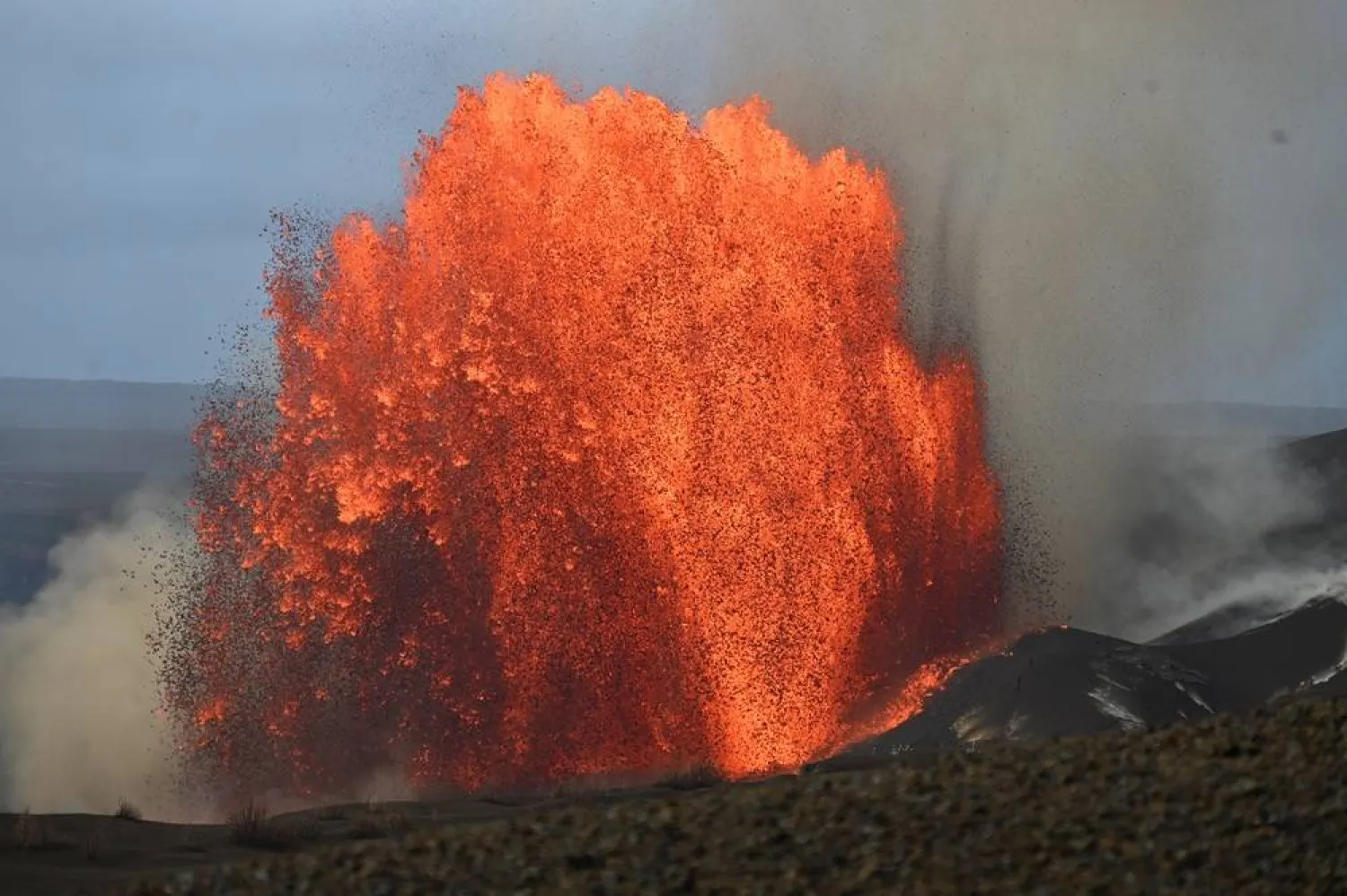
This image released by the United States Geological Survey shows lava fountains from Kīlauea volcano on Monday, June 1, 2026, in Hawaii. (L. Gallant/USGS via AP)
TT

Hawaii’s Kilauea Sets Record for Lava Fountaining Episodes in Any 1 Eruption for the Volcano

This image released by the United States Geological Survey shows lava fountains from Kīlauea volcano on Monday, June 1, 2026, in Hawaii. (L. Gallant/USGS via AP)

The on-and-off eruption of Hawaii’s Kilauea volcano broke a record Monday with the number of periods it has produced fountains of lava since it began erupting in December 2024, the Hawaiian Volcano Observatory said.

Monday marked 48 fountaining episodes, setting the record for any one eruption on Kilauea, said Katie Mulliken, a geologist and spokesperson with the observatory.

Episodes are separated by periods during which little to no lava erupts. Since lava is coming from the same vents in a crater at Kilauea's summit, it is the same overall eruption, she said in an email.

There are several notable aspects of the current eruption, she said, including how accessible it is for viewing by residents and tourists.

An eruption during the 1980s, in which 47 lava fountaining episodes occurred over about 3 1/2 years, occurred in a more remote area, she said.

The ongoing eruption is also reshaping the topography at the summit, she said.

But the lava fountains also can impact neighboring communities with volcanic fragments and ash, known as tephra.

Kilauea, located on Hawaii’s Big Island, is one of the world’s most active volcanoes.


Northeast Spain Wildfire Destroys Over 12,000 Hectares

Firefighters work at a site, following a wildfire in the municipality of Ores, northern Aragon region, Spain July 15, 2026, in this screengrab obtained from a video. (Spanish Military Emergency Unit/Handout via Reuters)
TT

Northeast Spain Wildfire Destroys Over 12,000 Hectares

Firefighters work at a site, following a wildfire in the municipality of Ores, northern Aragon region, Spain July 15, 2026, in this screengrab obtained from a video. (Spanish Military Emergency Unit/Handout via Reuters)

A major wildfire that has been raging for two days in northeast Spain has reduced more than 12,000 hectares of land to ash, regional authorities said Friday, warning of a "very high risk of spreading".

"The night has been very complex, very difficult. At this time, we estimate that the burned area exceeds 12,000 hectares" (29,650 acres), Roberto Bermúdez de Castro, who is responsible for security issues within the regional government of Aragon, told the media.

Spain is still reeling from another fire last week in the southern Andalusia region that killed 13 people -- including seven Britons and an American -- and destroyed 7,000 hectares, the deadliest such disaster in the country's recent history.

More than 450 firefighters backed by army reinforcements were battling the growing blaze near the city of Zaragoza, in a sparsely populated part of the Aragon region, where five small villages have been evacuated.

Peak temperatures of up to 40C have hit Aragon in recent days.

Scientists say human-driven climate change is increasing the length, intensity and frequency of extreme heat, which creates favorable conditions for the spread of wildfires and complicates firefighting efforts.

Prime Minister Pedro Sanchez warned Tuesday on a visit to fire-devastated Andalusia that Spain was facing a "complicated summer" for wildfires.


Scientists Find New Monkey Species in Congo's Rainforest

Two 'Likweli' monkeys of a newly-identified species of Colobus monkey, discovered in Lomami National Park, sit on a tree branch, in the Democratic Republic of the Congo, in this undated handout image. Daniel Rosengren, Frankfurt Zoological Society/Handout via REUTERS
TT

Scientists Find New Monkey Species in Congo's Rainforest

Two 'Likweli' monkeys of a newly-identified species of Colobus monkey, discovered in Lomami National Park, sit on a tree branch, in the Democratic Republic of the Congo, in this undated handout image. Daniel Rosengren, Frankfurt Zoological Society/Handout via REUTERS

Scientists have identified a new species of monkey in Democratic Republic of Congo's rainforest, distinguished by patches of light-colored skin around its mouth, Florida Atlantic University said in a statement.

The discovery marks only the fifth new monkey species identified in Africa in the last 75 ⁠years, according to ⁠the statement issued this week.

The species known by locals as "Likweli" was named Colobus congoensis by scientists.

Small in size, the black monkey ⁠has a distinctive "mask-like appearance" with a vivid orange-cream patch surrounding its mouth and nose.

The newly identified primate's roaring possesses a distinct acoustic structure, the research showed.

"This discovery reinforces how much biodiversity remains undocumented in the Central Congo Basin," Reuters quoted John ⁠Hart, ⁠a conservation scientist from the Lukuru Wildlife Research Foundation, as saying.

Researchers warn the monkey may already be at risk due to its small range area and population size and propose the International Union for Conservation of Nature should classify it as endangered.


Japan Imperial Rules Tweaked, but Still No Woman Emperor

FILE -Well-wishers wave Japanese flags as Emperor Naruhito with his imperial families makes a public appearance at the balcony of Imperial Palace, Jan. 2, 2026, in Tokyo. (AP Photo/Eugene Hoshiko, File)
TT

Japan Imperial Rules Tweaked, but Still No Woman Emperor

FILE -Well-wishers wave Japanese flags as Emperor Naruhito with his imperial families makes a public appearance at the balcony of Imperial Palace, Jan. 2, 2026, in Tokyo. (AP Photo/Eugene Hoshiko, File)

Japan's parliament tweaked the imperial succession law on Friday but maintained the bar on women emperors -- despite surveys suggesting wide public support for the idea.

The future of the imperial household -- mythically descended from the Shinto sun goddess Amaterasu -- depends currently on Prince Hisahito, the 19-year-old nephew of Emperor Naruhito, 66.

If Hisahito -- a fan of dragonflies, who is currently studying biology and is not married -- has no son, then under the rules as they stand he will have no heir and the bloodline will end.

There have been eight female emperors on the Chrysanthemum Throne in Japan's imperial family, whose divine status was renounced after World War II.

But an 1889 imperial house law stipulated that only men could become emperor, and only through the paternal line. This was carried over in 1947 into the current Imperial Household Law.

This rules out the popular Princess Aiko, 24, daughter of Naruhito, or any other royal woman ever becoming emperor.

The bill, passed by the upper house on Friday, allows the adoption of male distant relatives aged over 15 back into the imperial family -- as long as they are single -- and for their future sons to become eligible to ascend the throne.

They are members of 11 families that left the imperial register after Japan's defeat in World War II.

The new rules also end the practice of women having to lose their royal status after marrying a commoner, although because of their gender their children still cannot become emperor.

The legislation passed after wrangling within the ruling Liberal Democratic Party (LDP) led by Japan's first woman prime minister, Sanae Takaichi, who opposes female succession.

Seiichiro Murakami, a veteran of the conservative LDP, said after the bill passed the lower house on July 10 that it was "utterly outrageous" to rule out Aiko becoming emperor.

Asahiro Kuni, 81, a member of one of the 11 imperial branches, has also said he would advise his grandchildren to refuse the opportunity of becoming royals.

"By the age of 15, a person has grown up breathing the air of freedom," Kuni told the Asahi Shimbun daily.

A poll conducted by the Mainichi Shimbun last month found only 23 percent of people in favor of the sons of re-adopted imperial family members becoming emperor, and 34 percent against.

By contrast, more than 70 percent supported a woman emperor, and 40 percent a matrilineal one.

An Asahi Shimbun poll in May also showed 72 percent of respondents in favor of changing the rules to allow women to ascend the throne.

The imperial family now has 16 members in total, including five men -- retired emperor Akihito, 92, his brother, 90, the emperor, his brother, and Hisahito.

Hideya Kawanishi, a professor at Nagoya University and expert in Japan's emperor system, told AFP that the new bill "fails to reflect public opinion".

"For the conservative camp of the ruling Liberal Democratic Party and the likes, the overriding goal is to preserve the male-line, male-only succession to the throne, and that is precisely why they do not want to listen to the voices of the people," he said.

"I believe these amendments carry the risk of undermining public support for the symbolic Emperor system."

"Maybe it would have been good if they talked more about the possibility of female emperors and other stuff reflecting modern society," office worker Yoshiki Yaguchi, 66, told AFP while walking in the Yurakcho area of Tokyo.

"The male chauvinism has to be scrapped," high-school student Yumi told AFP as she came out of a shopping mall with her like-minded friend, Misa, also 17.