


EU Strikes Migration Deal for More Deportations and Detention Centers Abroad

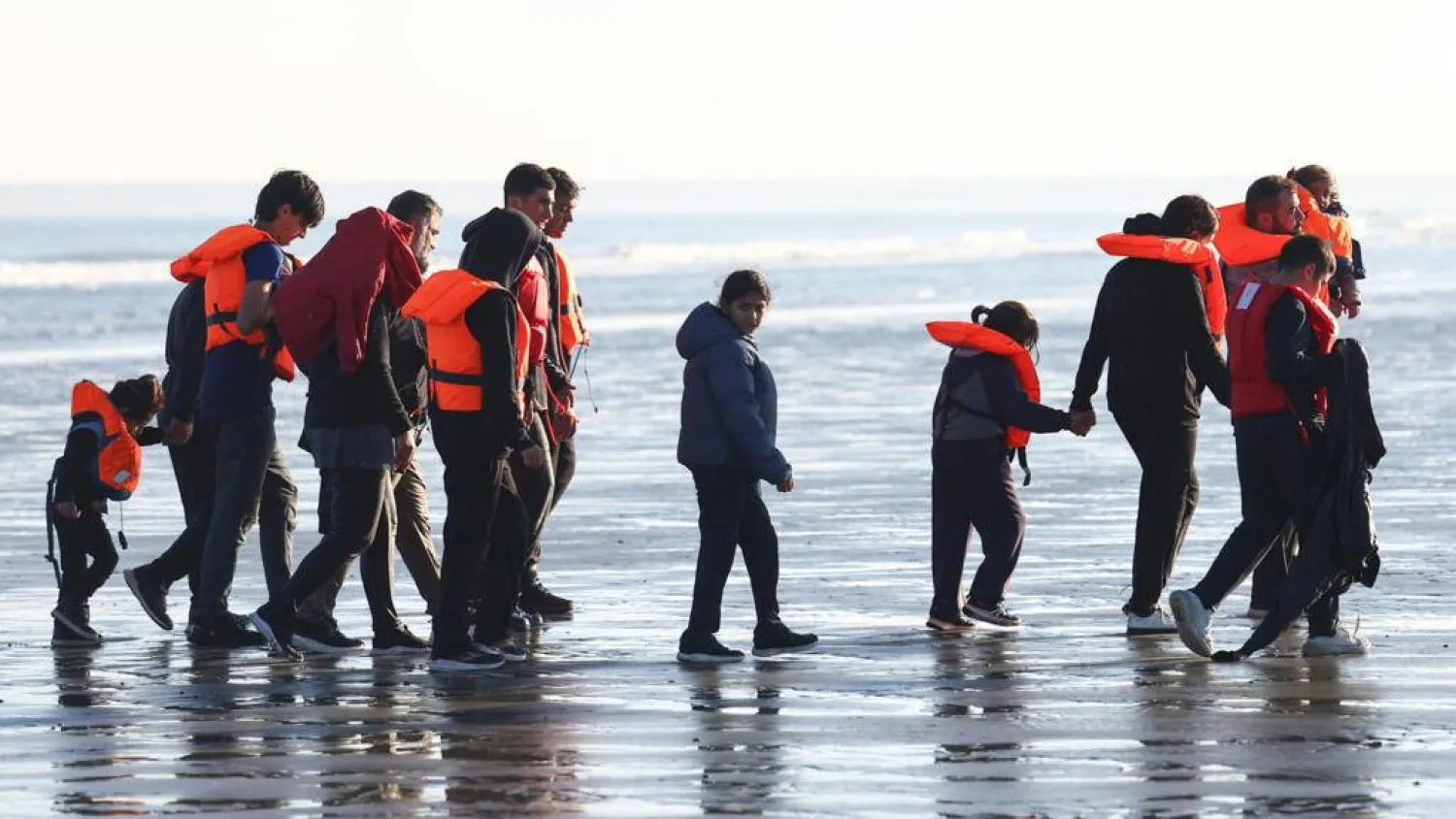
Migrants walk away from the beach after a failed attempt to cross the English Channel to reach Britain, from Petit-Fort-Philippe beach in Gravelines, near Calais, France, September 27, 2025. Abdul Saboor, Reuters
TT

EU Strikes Migration Deal for More Deportations and Detention Centers Abroad

Migrants walk away from the beach after a failed attempt to cross the English Channel to reach Britain, from Petit-Fort-Philippe beach in Gravelines, near Calais, France, September 27, 2025. Abdul Saboor, Reuters

The European Union has moved forward with a vast overhaul of its migration policy, aiming to ramp up deportations and ink controversial deals to build detention centers abroad, in what rights groups compare to the Trump administration's aggressive immigration policies.

“The new regulation will speed up the return process and increase returns of persons who have no legal right to stay in the EU,” said Nicholas Ioannides, deputy migration minister for Cyprus, which holds the rotating presidency of the 27-nation bloc, The Associated Press said.

The deal was struck between the EU's three main institutions — the European Commission, the European Council and European Parliament — during a so-called “trilogue” Monday evening.

Critics compared the regulation to the immigration strategy of the Trump administration, which has struck a series of secretive agreements with nations around the world to deport thousands of people to other countries. The United Kingdom also planned to deport migrants to Rwanda, but the plan was bogged down in legal red tape and the new government dropped the plan as soon as it came into power.

"The Regulation is going to create a draconian detention and deportation machine,” said Silvia Carter, spokesperson for the Brussels-based Platform for International Cooperation on Undocumented Migrants.

“Across the Atlantic, we see the violence and fear created by ICE’s brutal immigration enforcement. Europe should be learning from the harms of that model, not building its own version of it.”

The provisional agreement will now head to the EU lawmakers and heads of state, where approval will likely be swift.

EU member nations will soon be able to set up bilateral deals with countries outside the bloc to build deportation centers. At least five EU nations — Germany, Austria, the Netherlands, Denmark and Greece — are already in talks with third countries, mostly in Africa, to host “return hubs” on the model of Italy's detention deal with Albania.

The EU has continually tightened migration policies after right-wing parties took power in some countries in 2024. European Commission President Ursula von der Leyen, from the center-right European People’s Party coalition, has said that the new measures will prevent a repeat of the 2015 crisis caused by Syria’s civil war, when about 1 million people arrived to seek asylum.

Fueled by people fleeing conflict and poverty across Africa and the Middle East, the 2015 refugee crisis and successive years of irregular migration to Europe have driven a rightward shift in the bloc's politics not unlike the anti-immigrant sentiment that buoyed a “ red wave ” in the 2024 election in the United States.

Center-right political groups allied with the far-right to overcome opposition from centrist and left-wing parties, said Mélissa Camara, a French lawmaker and member of the Greens who called the deal “a historic setback” for human rights in the bloc.

“The legalization of return hubs outside the European Union, the green light for the detention of minors, home visits inspired by ICE practices: the legal arsenal serving a xenophobic ideology is now complete,” she said.

Activist groups warned the legislation would cut deep into the protections granted by the EU fundamental charter on human rights and expose people to risks outside the bloc.

“This deal will give governments much broader powers to detain and deport people," said Marta Welander, a spokesperson for the International Rescue Committee. "It looks set to normalize immigration raids, expand the use of detention in prison-like facilities outside EU territory that are essentially legal black holes, and increase the risk of people being deported to countries where they could face persecution, torture or worse.”



EU Says No Place for Serbia’s ‘Glorification’ of War Criminal Mladic

A Bosnian woman looks at the names of victims at the memorial cemetery where the victims of the Srebrenica genocide are buried, following the death of Bosnian Serb Ratko Mladic, former general convicted of Bosnia genocide, in Potocari, Bosnia and Herzegovina, August 28, 2026. (Reuters)
TT

EU Says No Place for Serbia’s ‘Glorification’ of War Criminal Mladic

A Bosnian woman looks at the names of victims at the memorial cemetery where the victims of the Srebrenica genocide are buried, following the death of Bosnian Serb Ratko Mladic, former general convicted of Bosnia genocide, in Potocari, Bosnia and Herzegovina, August 28, 2026. (Reuters)

EU Enlargement Commissioner Marta Kos on Monday criticized Serbia's plans to bury former Bosnian Serb military leader and convicted war criminal Ratko Mladic with state honors.

Mladic died on Thursday while serving a life jail term in The Hague for war crimes committed during the 1990s Bosnian war.

"Regarding Ratko Mladic, the glorification of war criminals is contrary to fundamental European values and has no place in the European Union or in countries that aspire to become members," Kos told reporters.

Serbia's justice minister Nenad Vujic said Friday that Mladic "will receive all the military and state honors to which he is entitled".

Serbian officials were awaiting details on when authorities in The Hague would release the body, he said.

Serbia is among Balkan countries seeking EU accession.

Kos said she would travel to Serbia on September 9.

"Ratko Mladic was a convicted war criminal, serving a life sentence for the genocide in Srebrenica and for crimes against humanity. And this will be the basis on which we will also assess developments," Kos added, speaking on the sidelines of the Bled Strategic Forum, a regional conference, taking place at the Bled lake resort in Slovenia.

Mladic, who had suffered several strokes in recent months, was serving a life sentence for genocide, war crimes, and crimes against humanity during the Bosnian war, including for his role in the Srebrenica massacre, Europe's worst act of bloodshed since World War II.

His conviction for the wartime killings as the former Yugoslavia descended into carnage after the fall of communism led the international press to dub him the "Butcher of Bosnia".

The 1992-1995 war left around 100,000 people dead and 2.2 million displaced.

Mladic was the military face of a brutal trio, led on the political side by ex-Yugoslav president Slobodan Milosevic and former Bosnian Serb leader Radovan Karadzic.


Trump Was Sending Message to Iran with Kharg Island Post, Says Vance

Vice President JD Vance speaks to reporters before boarding Air Force Two at Joint Base Andrews, Md., Aug. 31, 2026. (AP)
TT

Trump Was Sending Message to Iran with Kharg Island Post, Says Vance

Vice President JD Vance speaks to reporters before boarding Air Force Two at Joint Base Andrews, Md., Aug. 31, 2026. (AP)

US President Donald Trump was sending a message to Iran with his social media post about Iran's energy hub of Kharg Island being blown to smithereens, Vice President JD Vance said on Monday.

"The president likes to switch it up ‌on social ‌media a little bit. He ‌would ⁠be the first ⁠to say he doesn't make announcements about military actions on social media, but I think that he's sending a message to the Iranians," Vance said when asked ⁠about Trump's post.

Trump's one-line social ‌media post ‌on Sunday was accompanied by an AI-generated ‌video clip. A US official ‌said on Monday the military had not targeted Kharg Island in overnight strikes. An Iranian official dismissed Trump's post ‌as "laughable".

Attacking Kharg, which handled 90% of Iran's oil exports before the ⁠war ⁠launched by US and Israeli attacks on February 28, would severely disrupt its energy trade and put huge pressure on its economy.

In describing the first known US military strikes since late July, a US official said forces attacked two Iranian launchers on Larak Island.


Iran Sentences Two Women to Death Over 2026 Protests, Say Rights Groups

A woman walks past a wall mural of Iran's slain supreme leader Ali Khamenei, along a street in downtown of Tehran on August 31, 2026. (AFP)
TT

Iran Sentences Two Women to Death Over 2026 Protests, Say Rights Groups

A woman walks past a wall mural of Iran's slain supreme leader Ali Khamenei, along a street in downtown of Tehran on August 31, 2026. (AFP)

Iranian courts have issued death sentences for two women charged over anti-government protests in January, rights groups said Monday, as Tehran ramps up executions of people arrested in the demonstrations.

The two women were sentenced in separate cases but both were related to incidents in the central city of Isfahan, which was a hub of the nationwide protest activity that peaked on the nights of January 8 and 9.

Against the backdrop of the war with the United States, Iran has already executed 29 men on charges related to the demonstrations, according to the Norway-based NGO Iran Human Rights (IHR).

So far, no woman has been executed over the unrest, although Iran has hanged at least 16 women this year on other charges, per IHR.

Taraneh Rahimi, 20, was sentenced to death along with nine men over incidents during the protests in a square in Isfahan that saw two people killed, including a member of the security forces, the Norway-based Hengaw group and US-based Human Rights Activists News Agency (HRANA) said Monday.

Other defendants in the case were given sentences of up to 36 years in prison, including Taraneh's sister Romina, they added.

"Defendants' lawyers did not have access to a substantial portion of the case file and objected that they had not been given sufficient time to review the documents and evidence," HRANA said.

In the other case, Leila Abolhasani, a 43-year-old mother of two teenagers, was convicted by a court in Isfahan of setting fire to a store during the protests, the Dadban legal affairs monitor and HRANA said.

Her relatives have denied the accusation, saying she was only present at the scene and was filming the burning store, the groups said.

But she was convicted on the capital charge of "waging war against God". The case has been sent to the Supreme Court for review.

President Donald Trump in April re-posted a claim on X by a pro-Israel youth activist in the United States that eight Iranian women faced death by hanging, with the US leader urging them to be freed.

However, not all the women had been sentenced to death and some were no longer in custody.

One of the women, Bita Hemmati, had indeed been sentenced to death over the protests on charges of throwing concrete blocks from a building onto police. However, HRANA said in April that her death sentence had been overturned.