

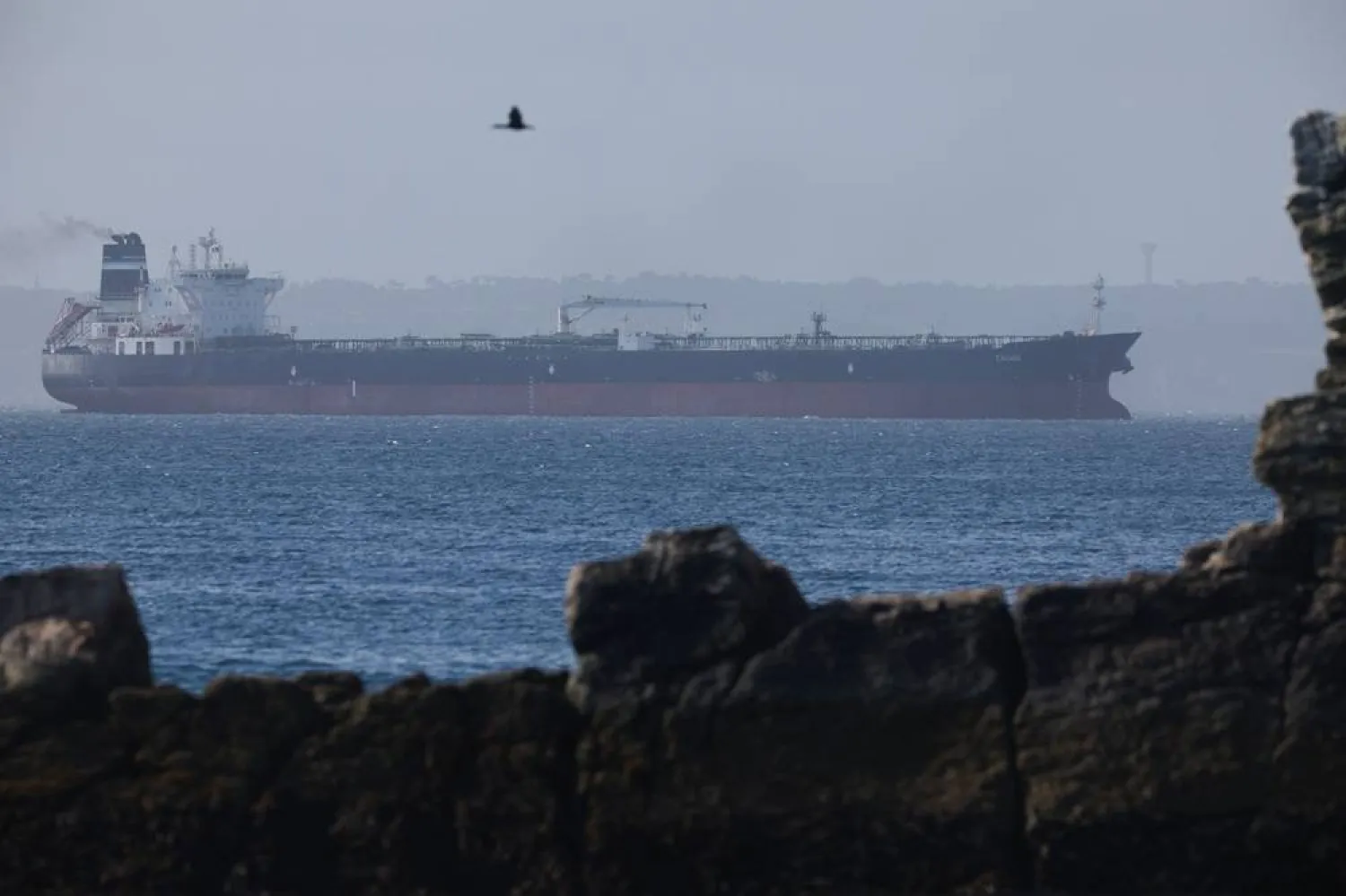

Detained Russia-Linked Tanker Arrives in France

The Russian oil tanker "Tagor", suspected of flying a false Cameroonian flag and boarded by the French Navy on May 31, 2026, arrives in Douarnenez Bay, western France on June 2, 2026. (AFP)
TT

Detained Russia-Linked Tanker Arrives in France

The Russian oil tanker "Tagor", suspected of flying a false Cameroonian flag and boarded by the French Navy on May 31, 2026, arrives in Douarnenez Bay, western France on June 2, 2026. (AFP)

An oil tanker believed to be part of Russia's "shadow fleet" sailed into a French harbor Tuesday, an AFP reporter said, after the French navy detained it on suspicion of flying a false flag.

It is the fourth such ship that France has seized since September last year on suspicions of belonging to the "shadow fleet," which Russia is believed to use to circumvent Western sanctions.

The French navy boarded the Tagor on Sunday morning in international waters with the help of Britain, after its Russian captain refused to comply with orders, French authorities said.

The Kremlin likened the seizure to "international piracy".

The Tagor sailed into the Bay of Douarnenez in western France's region of Brittany on Tuesday morning, the AFP reporter said.

Suspected of carrying Russian or Iranian oil despite international sanctions, the Tagor is linked to petroleum shipping magnate Mohammad Hossein Shamkhani, according to open-source database Opensanctions.org.

Shamkhani is the son of security official Ali Shamkhani, who was an adviser to the former Iranian supreme leader Ali Khamenei, both of whom were killed on February 28, the first day of the US-Israeli attacks that started the Middle East war.

According to French authorities, the Tagor was on its way from Murmansk in northwestern Russia when it was boarded.

It was falsely flying a Cameroonian flag and was heading toward Limbe, a seaside city in the west of the African country, they added.

- Flag-hopping -

"Shadow fleet" vessels frequently change the flags they fly, a practice known as flag-hopping, or use invalid registrations in an attempt to escape tracking.

France previously detained two tankers in the Mediterranean, the Deyna in March and the Grinch in January, but they were allowed to set sail after paying fines.

In another case, a French court in March issued a one-year jail sentence in absentia and a 150,000-euro ($177,000) fine against the Chinese captain of another tanker, the Boracay, for failing to comply with orders to stop his ship in September last year off the coast of Brittany.

In April, France announced a plan to double penalties for ships that fail to fly a flag or refuse to comply.

Several Western countries have imposed sanctions on hundreds of vessels believed to be part of Russia's "shadow fleet" over its 2022 invasion of Ukraine.

Nearly 600 ships suspected of belonging to the fleet are subject to European Union sanctions.


EU Says No Place for Serbia’s ‘Glorification’ of War Criminal Mladic

A Bosnian woman looks at the names of victims at the memorial cemetery where the victims of the Srebrenica genocide are buried, following the death of Bosnian Serb Ratko Mladic, former general convicted of Bosnia genocide, in Potocari, Bosnia and Herzegovina, August 28, 2026. (Reuters)
TT

EU Says No Place for Serbia’s ‘Glorification’ of War Criminal Mladic

A Bosnian woman looks at the names of victims at the memorial cemetery where the victims of the Srebrenica genocide are buried, following the death of Bosnian Serb Ratko Mladic, former general convicted of Bosnia genocide, in Potocari, Bosnia and Herzegovina, August 28, 2026. (Reuters)

EU Enlargement Commissioner Marta Kos on Monday criticized Serbia's plans to bury former Bosnian Serb military leader and convicted war criminal Ratko Mladic with state honors.

Mladic died on Thursday while serving a life jail term in The Hague for war crimes committed during the 1990s Bosnian war.

"Regarding Ratko Mladic, the glorification of war criminals is contrary to fundamental European values and has no place in the European Union or in countries that aspire to become members," Kos told reporters.

Serbia's justice minister Nenad Vujic said Friday that Mladic "will receive all the military and state honors to which he is entitled".

Serbian officials were awaiting details on when authorities in The Hague would release the body, he said.

Serbia is among Balkan countries seeking EU accession.

Kos said she would travel to Serbia on September 9.

"Ratko Mladic was a convicted war criminal, serving a life sentence for the genocide in Srebrenica and for crimes against humanity. And this will be the basis on which we will also assess developments," Kos added, speaking on the sidelines of the Bled Strategic Forum, a regional conference, taking place at the Bled lake resort in Slovenia.

Mladic, who had suffered several strokes in recent months, was serving a life sentence for genocide, war crimes, and crimes against humanity during the Bosnian war, including for his role in the Srebrenica massacre, Europe's worst act of bloodshed since World War II.

His conviction for the wartime killings as the former Yugoslavia descended into carnage after the fall of communism led the international press to dub him the "Butcher of Bosnia".

The 1992-1995 war left around 100,000 people dead and 2.2 million displaced.

Mladic was the military face of a brutal trio, led on the political side by ex-Yugoslav president Slobodan Milosevic and former Bosnian Serb leader Radovan Karadzic.


Trump Was Sending Message to Iran with Kharg Island Post, Says Vance

Vice President JD Vance speaks to reporters before boarding Air Force Two at Joint Base Andrews, Md., Aug. 31, 2026. (AP)
TT

Trump Was Sending Message to Iran with Kharg Island Post, Says Vance

Vice President JD Vance speaks to reporters before boarding Air Force Two at Joint Base Andrews, Md., Aug. 31, 2026. (AP)

US President Donald Trump was sending a message to Iran with his social media post about Iran's energy hub of Kharg Island being blown to smithereens, Vice President JD Vance said on Monday.

"The president likes to switch it up ‌on social ‌media a little bit. He ‌would ⁠be the first ⁠to say he doesn't make announcements about military actions on social media, but I think that he's sending a message to the Iranians," Vance said when asked ⁠about Trump's post.

Trump's one-line social ‌media post ‌on Sunday was accompanied by an AI-generated ‌video clip. A US official ‌said on Monday the military had not targeted Kharg Island in overnight strikes. An Iranian official dismissed Trump's post ‌as "laughable".

Attacking Kharg, which handled 90% of Iran's oil exports before the ⁠war ⁠launched by US and Israeli attacks on February 28, would severely disrupt its energy trade and put huge pressure on its economy.

In describing the first known US military strikes since late July, a US official said forces attacked two Iranian launchers on Larak Island.


Iran Sentences Two Women to Death Over 2026 Protests, Say Rights Groups

A woman walks past a wall mural of Iran's slain supreme leader Ali Khamenei, along a street in downtown of Tehran on August 31, 2026. (AFP)
TT

Iran Sentences Two Women to Death Over 2026 Protests, Say Rights Groups

A woman walks past a wall mural of Iran's slain supreme leader Ali Khamenei, along a street in downtown of Tehran on August 31, 2026. (AFP)

Iranian courts have issued death sentences for two women charged over anti-government protests in January, rights groups said Monday, as Tehran ramps up executions of people arrested in the demonstrations.

The two women were sentenced in separate cases but both were related to incidents in the central city of Isfahan, which was a hub of the nationwide protest activity that peaked on the nights of January 8 and 9.

Against the backdrop of the war with the United States, Iran has already executed 29 men on charges related to the demonstrations, according to the Norway-based NGO Iran Human Rights (IHR).

So far, no woman has been executed over the unrest, although Iran has hanged at least 16 women this year on other charges, per IHR.

Taraneh Rahimi, 20, was sentenced to death along with nine men over incidents during the protests in a square in Isfahan that saw two people killed, including a member of the security forces, the Norway-based Hengaw group and US-based Human Rights Activists News Agency (HRANA) said Monday.

Other defendants in the case were given sentences of up to 36 years in prison, including Taraneh's sister Romina, they added.

"Defendants' lawyers did not have access to a substantial portion of the case file and objected that they had not been given sufficient time to review the documents and evidence," HRANA said.

In the other case, Leila Abolhasani, a 43-year-old mother of two teenagers, was convicted by a court in Isfahan of setting fire to a store during the protests, the Dadban legal affairs monitor and HRANA said.

Her relatives have denied the accusation, saying she was only present at the scene and was filming the burning store, the groups said.

But she was convicted on the capital charge of "waging war against God". The case has been sent to the Supreme Court for review.

President Donald Trump in April re-posted a claim on X by a pro-Israel youth activist in the United States that eight Iranian women faced death by hanging, with the US leader urging them to be freed.

However, not all the women had been sentenced to death and some were no longer in custody.

One of the women, Bita Hemmati, had indeed been sentenced to death over the protests on charges of throwing concrete blocks from a building onto police. However, HRANA said in April that her death sentence had been overturned.
