

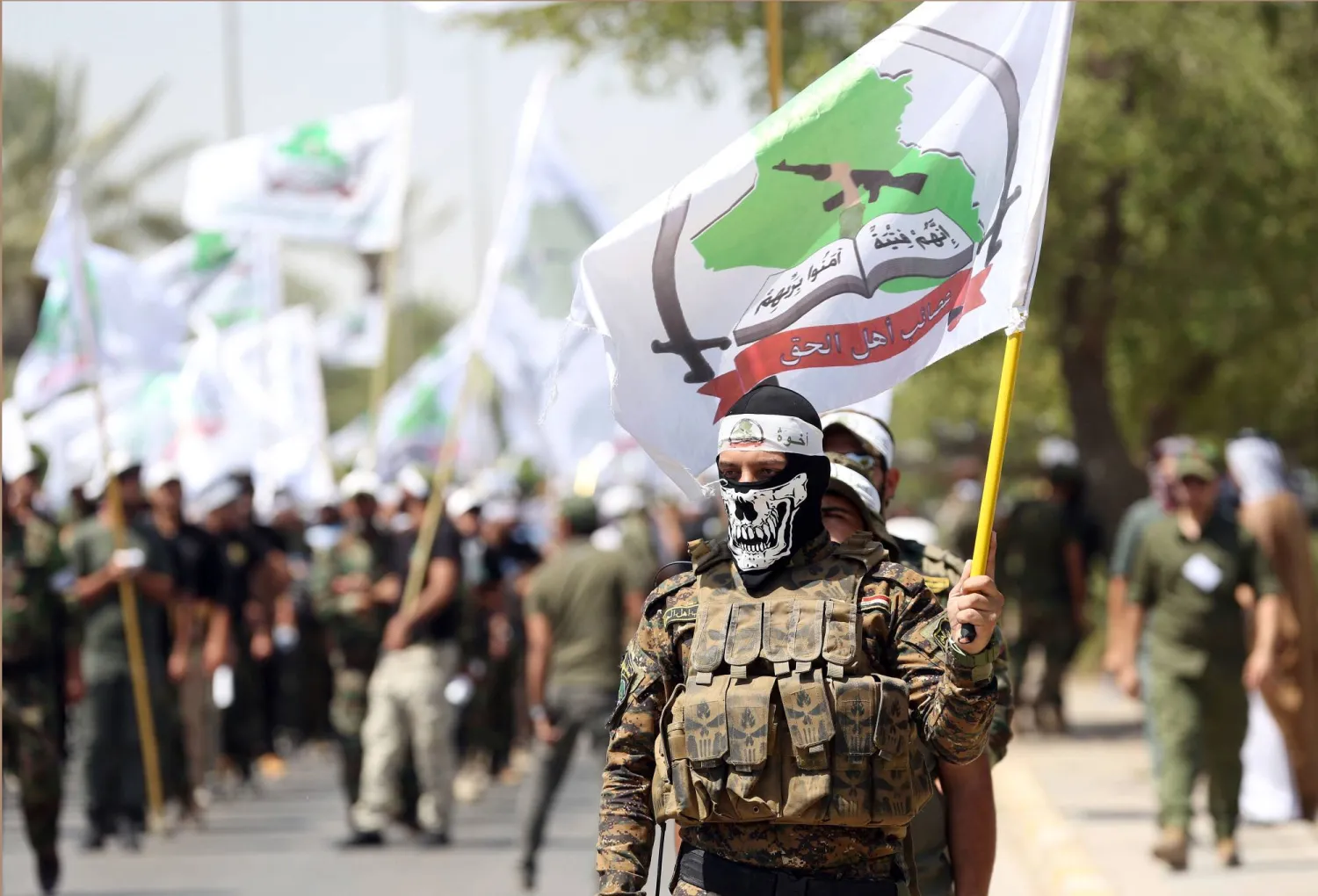

Iraq’s Asaib Ahl Al-Haq Says It Will Start Handing Its Weapons to the State

Members of the Iraqi Popular Mobilization Forces parade of the Asaib Ahl al-Haq, participate in a Quds Day march in Baghdad, Iraq, Friday, July 1, 2016. (AP)
TT

Iraq’s Asaib Ahl Al-Haq Says It Will Start Handing Its Weapons to the State

Members of the Iraqi Popular Mobilization Forces parade of the Asaib Ahl al-Haq, participate in a Quds Day march in Baghdad, Iraq, Friday, July 1, 2016. (AP)

One of Iraq’s most powerful Iran-backed armed groups said Tuesday it would begin putting its weapons under government control, a major step in the new government’s effort to bring armed factions that have long operated on their own under state command.

Asaib Ahl al-Haq said it had formed a committee to oversee the move, including an inventory of its fighters, weapons and equipment, and to coordinate with the commander-in-chief of the armed forces. The group cast the decision as a response to calls by Iraq’s top Shiite religious authority and the Iran-aligned Coordination Framework, the largest bloc in parliament that dominates Iraqi politics.

The war in the Middle East has exposed the fragility of Iraq’s state institutions and their limited ability to restrain these groups. A parallel confrontation between Washington and the factions has deepened the crisis, with factions acting as an extension of Iran’s regional campaign and escalating attacks on US assets in Iraq before a tenuous ceasefire deal was reached in April.

The first significant move came a week ago, when the influential Shiite cleric Moqtada al-Sadr said his Saraya al-Salam faction would split from his political movement and integrate into state institutions.

Under pressure from Washington, Prime Minister Ali al-Zaidi has been working to assert state authority over weapons.

Zaidi, a 40-year-old banker sworn in last month has made a state monopoly on arms a centerpiece of his program. The Trump administration has warned against any government influenced by Iran-linked factions and tied defense cooperation and funding to efforts to curb them.

Many Iran-backed factions are funded through the Iraqi state budget and embedded within the security apparatus, although not under the government's control. This has drawn criticism from the United States and other countries that have borne the brunt of their attacks and say Baghdad has failed to take a tougher stance.

Several armed factions aligned with Iraq’s Coordination Framework have taken a different stance on efforts to bring weapons under state control. Two important groups, Kataib Hezbollah and Harakat al-Nujaba, have rejected disarmament, tying the issue to Iraq’s sovereignty and the presence of foreign troops.

Kataib Hezbollah welcomed moves by other factions to place weapons under state authority but said its own armed activity will continue as part of what it describes as “resistance work." In a recent statement attributed to its Abu Mujahid al-Assaf, the group said it would offer coordination with the Popular Mobilization Forces rather than surrendering arms.

The PMF, a state-backed umbrella of armed groups, was formed in 2014 to fight the ISIS group. Many of its groups still keep their own command and ties to Iran.



Israeli Strikes in Gaza Kill Two Including Senior Policeman

Palestinian firefighters attempt to extinguish a fire after an Israeli military strike targeted a vehicle belonging to Gaza Police Chief Jamal Abu Kamil south of Gaza City, 13 August 2026. (EPA)
TT

Israeli Strikes in Gaza Kill Two Including Senior Policeman

Palestinian firefighters attempt to extinguish a fire after an Israeli military strike targeted a vehicle belonging to Gaza Police Chief Jamal Abu Kamil south of Gaza City, 13 August 2026. (EPA)

Israeli strikes in Gaza killed two people including a senior police officer on Thursday, health officials said, the second straight day of bombardment after a lull due to a US peace push.

The Israeli military said it struck a Hamas commander in the Khan Younis area who it said had been planning attacks against troops, in the second such targeting in as many days.

"The terrorist was struck in an aerial strike in order to remove the threat to Israeli troops," the military said, adding that "steps were taken to mitigate harm to civilians."

Gaza's civil defense agency, which operates as a rescue service under Hamas, said an airstrike west of Khan Younis killed one person, with the city's Nasser Hospital confirming the arrival of a body following the attack.

In a separate incident in Gaza City, the civil defense said one person was killed and several others injured in an Israeli strike on a vehicle in the Sheikh Ajlin neighborhood.

Al-Shifa Hospital said it had received the body of Gaza City's police governor Jamal Abu Kamil.

Gaza's interior ministry confirmed Abu Kamil "was assassinated in an Israeli airstrike targeting his vehicle on Al-Rashid Street, southwest of Gaza City".

When contacted by AFP, the Israeli military said it was checking the reports.

Israel on Wednesday carried out its first airstrike in Gaza since August 3.

The hiatus in airstrikes came after US President Donald Trump's announcement of a "major milestone" in his plan to end the war.

Hamas had announced that it would disarm by giving its weapons to a nascent Palestinian governing committee.

Trump's Board of Peace, in charge of implementing the ceasefire deal, had initially announced that Israel in turn would start a phased withdrawal from much of the Gaza Strip.

But Prime Minister Benjamin Netanyahu on Sunday publicly rejected the deal and vowed no Israeli pullout, even after the Board of Peace reassured him that Israel would not have to withdraw until complete Hamas disarmament.

Israeli operations in Gaza have killed 1,260 Palestinians since the ceasefire, according to the territory's health ministry, which operates under Hamas authority and whose figures are considered reliable by the United Nations.

The Israeli army has reported five deaths in its ranks during the same period.


EU Welcomes Israeli Green Light to Extend Gaza Border Mission

An internally displaced Palestinian man walks past the rubble of buildings destroyed by the Israeli military, in Khan Younis southern Gaza Strip on August 11, 2026. (AFP)
TT

EU Welcomes Israeli Green Light to Extend Gaza Border Mission

An internally displaced Palestinian man walks past the rubble of buildings destroyed by the Israeli military, in Khan Younis southern Gaza Strip on August 11, 2026. (AFP)

EU top diplomat Kaja Kallas Thursday welcomed an Israeli decision to extend the mandate of the bloc's border assistance mission at the Rafah crossing between the Gaza Strip and Egypt until mid-2027.

Initially set up in 2005 to help monitor the key crossing, the civilian EUBAM mission was put on standby for nearly two decades after the Hamas group took control of Gaza in 2007.

The Rafah crossing shut down entirely during Israel's war with Hamas, but has reopened on a limited basis since February with monitors from the EU, which announced last week that more than 10,000 people had since passed between Gaza and Egypt.

Kallas said Israeli authorities had agreed to extend until the end of June 2027 the mandates of both the Rafah monitoring mission and the EUPOL COPPS scheme that provides training for Palestinian police forces and advice on rebuilding Gaza's judicial system.

The EU foreign policy chief called it "an important step after months of diplomatic negotiations."

"The missions have a clear purpose: to help make crossings safer and more effective, support Palestinian police, and contribute to stability in the region," she wrote on X.

Contacted by AFP, the Israeli foreign ministry had yet to respond.

The EUBAM monitoring mission aims to provide a neutral, third-party presence at the Rafah crossing and involves police from Italy, Spain and France.

Israel had been expected to renew the authorization for the mission's deployment in late June, but EU-Israeli ties have come under heavy strain since the start of the Gaza war.

The green light clears the way for EU states to formally extend the missions' mandates, which they agreed in June to prolong until September this year.


Lebanon Has Not Agreed to Shortlist of Countries That Could Verify Hezbollah’s Disarmament, Official Says

This picture taken from the southern Lebanese village of Zawtar al-Gharbiyeh shows Israeli humvees driving through the nearby village of Zawtar al-Sharkiyeh on August 13, 2026. (AFP)
TT

Lebanon Has Not Agreed to Shortlist of Countries That Could Verify Hezbollah’s Disarmament, Official Says

This picture taken from the southern Lebanese village of Zawtar al-Gharbiyeh shows Israeli humvees driving through the nearby village of Zawtar al-Sharkiyeh on August 13, 2026. (AFP)

Lebanese official denied on Thursday a Reuters report that Beirut had agreed with Israel to a shortlist of countries that could send troops to Lebanon to verify the disarmament of Lebanese group Hezbollah, and said it was following up on the issue with Washington.

A ‌June 26 ‌deal brokered by ‌the ⁠US linked the ⁠progressive withdrawal of Israeli troops from southern Lebanon to the "verified disarmament" of all non-state armed groups by the Lebanese government.

Hezbollah, which is not a party to ⁠the agreement, has rejected disarming.

Reuters ‌reported last ‌week that Lebanon and Israel had agreed ‌to a shortlist and reported on ‌Wednesday, citing three sources, that the list included Britain, Italy, Switzerland and Indonesia as potential contributors to the verification ‌mechanism.

A Lebanese official on Thursday said there was no ⁠such agreement ⁠and that Beirut was still in discussions with the United States on the matter.

A State Department official said on Tuesday that a round of US-brokered meetings between Lebanon and Israel in Rome last week discussed the "third-party verification" of the Lebanese army's "clearance operations" but did not mention the shortlist or the countries involved.