


Lebanon Launches Safety Audit of Middle East Airlines Amid Pilot Groups’ Complaints

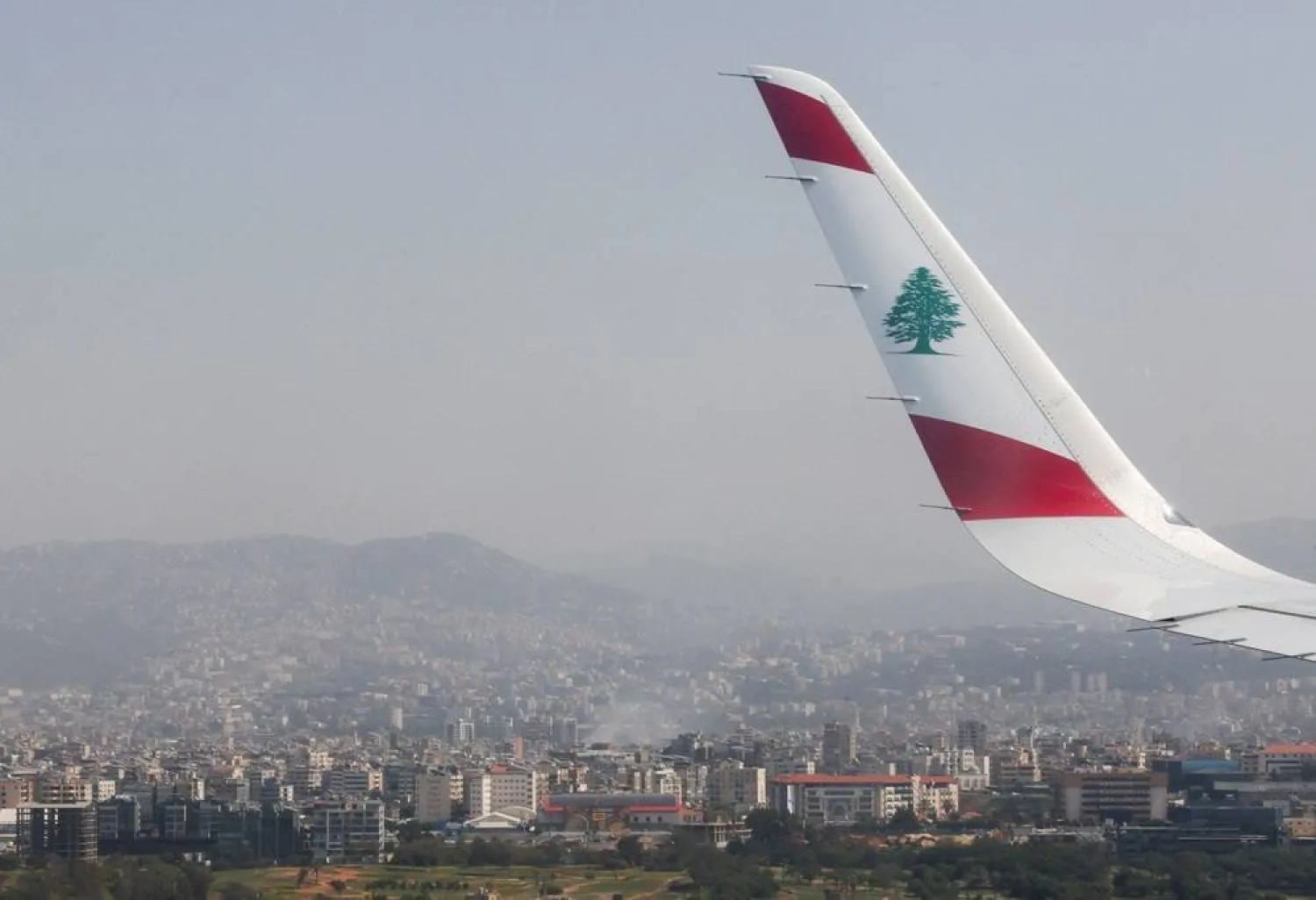
An aerial view from the window of a Lebanese Middle East Airlines (MEA) airplane shows smoke rising, after Israeli strikes following an escalation between Hezbollah and Israel, amid the US-Israeli conflict with Iran, in the southern suburbs of Beirut, Lebanon, March 12, 2026. (Reuters)
TT

Lebanon Launches Safety Audit of Middle East Airlines Amid Pilot Groups’ Complaints

An aerial view from the window of a Lebanese Middle East Airlines (MEA) airplane shows smoke rising, after Israeli strikes following an escalation between Hezbollah and Israel, amid the US-Israeli conflict with Iran, in the southern suburbs of Beirut, Lebanon, March 12, 2026. (Reuters)

Lebanon's aviation regulator has launched a safety audit of Middle East Airlines (MEA) as pilot groups raised concerns that crews were being asked to fly close to airstrikes and penalized for reporting safety incidents, according to letters seen by Reuters.

The audit puts scrutiny on the Beirut-based flag carrier, which has kept the country connected through war and financial collapse even as many foreign airlines have avoided large parts of Middle East airspace because of missile and drone risks since the US-Israeli war against Iran began in February.

MEA, which has a fleet of around 20 planes operating in the Middle East, Europe and West Africa, has been praised at home for continuing to fly during regional conflict and helping to prop up a weak economy that is more dependent than ever on tourism and remittances from expatriates.

The airline said it has a strong and proven safety record, and that any flights during military hostilities were conducted based on risk assessments developed alongside Lebanon's government and aviation regulator, the Lebanese Civil Aviation Authority (LCAA).

But since 2024, multiple Israeli airstrikes have landed near Lebanon's largest airport, raising concerns among the International Federation of Air Line Pilots' Associations (IFALPA), a global ‌federation of pilot unions, ‌given the history of civilian aircraft being shot down in or near conflict zones.

The aviation concerns ‌have ⁠grown as Israeli ⁠strikes on Lebanon stepped up this year during a widening conflict with Iran-backed Hezbollah.

"While some may think that flying civilian aircraft and passengers in high-risk and conflict zones during war conditions is heroic, we consider this an unconscionable risk," IFALPA President Ron Hay wrote in a May 12 letter to Lebanon's central bank, which holds a majority share in MEA.

The central bank, known as the Banque du Liban, referred Reuters to MEA.

"The son of the chairman of MEA and the son of the chairman of LCAA are both captains at MEA and flew throughout the period," the airline said.

LEBANESE REGULATOR CONDUCTS SAFETY AUDIT OF MEA

LCAA head Mohammed Aziz, an air crash investigator, told IFALPA in a May 15 letter that his team would conduct an aviation safety audit on MEA and "engage in a ⁠dialogue with MEA to discuss the concerns you stated in your letter."

MEA said oversight activity conducted by ‌the LCAA on MEA from May 18 to June 1 confirmed the carrier's compliance with "regulatory ‌and operational safety requirements."

Aziz told Reuters a closing meeting with the airline was held on Monday, but the LCAA audit was still being processed, and "we were in ‌the process of mediating" between the pilots and MEA.

One MEA pilot interviewed by Reuters said aviators had a financial incentive to fly since ‌per-flight payments made up a majority of their salaries, with their base salary slashed due to a Lebanese economic collapse that began in 2019.

IFALPA, supported by other aviator groups, flagged cases where pilots reported unintentional errors for the purpose of improving safety, but faced punishment such as being sent for "training", where they lose out on the per-flight payments.

"We know definitely that pilots have spoken up and there have been actions taken against them," Hay told Reuters by phone.

MEA called IFALPA's allegations "unfounded" and said training ‌assignments were conducted in line with regulatory requirements and "should not be misconstrued as disciplinary or retaliatory measures."

PILOTS CONTACT PARTNER AIRLINES IN US, EUROPE

The safety concerns led pilot groups to contact the SkyTeam airline network ⁠alliance, which includes carriers like MEA, ⁠Air France and Delta Air Lines, to raise awareness.

Dara van Langen, chair of the SkyTeam Pilots Association, said in an interview: "If you put your passengers in the plane of a colleague airline then for sure you want to be sure the level of safety is where you want it to be."

Both the US Federal Aviation Administration (FAA) and the European Union Aviation Safety Agency (EASA) require airlines in their jurisdictions to audit foreign codeshare partners to ensure comparable safety.

Air France, which has a codeshare agreement with MEA, said it regularly audits all codeshare partners. SkyTeam and Delta, which has a less extensive interline agreement, said they were aware of pilots' concerns and were monitoring the situation, adding that safety was imperative.

MEA PAYS CIVIL AVIATION WORKERS

IFALPA said it was also concerned that MEA provided payments to LCAA workers overseeing aviation safety.

An internal spreadsheet of financial assistance for the month of November reviewed by Reuters showed that dozens of LCAA employees received payments from the airline, including three aviation safety workers.

"If the oversight of your airline is being (partly) paid by your airline," then "you don't want to speak up, do you?" IFALPA's Hay said.

MEA said it had provided financial support in coordination with Lebanon's government to ensure the country's aviation infrastructure functioned after the financial crisis caused a currency collapse. Air traffic controllers' pay was cut by more than 90% to less than $100 a month, it said.

The carrier said its support did not affect the LCAA's "independence, authority, or oversight responsibilities" and auditors and the agency's leaders, including Aziz, did not receive payments.


Jordan's Army Says Shot Down 10 Iranian Missiles

This screen grab made on July 18, 2026 from handout video footage released by the US Central Command (CENTCOM) on July 17, 2026 shows what the US military says is the latest wave of precision strikes on strategic Iranian military sites. (Photo by US Central Command (CENTCOM) / AFP)
TT

Jordan's Army Says Shot Down 10 Iranian Missiles

This screen grab made on July 18, 2026 from handout video footage released by the US Central Command (CENTCOM) on July 17, 2026 shows what the US military says is the latest wave of precision strikes on strategic Iranian military sites. (Photo by US Central Command (CENTCOM) / AFP)

Jordan's army said on Saturday it had shot down 10 Iranian missiles with no casualties or damage, as Tehran retaliated against American strikes by pressing attacks on other countries.

"Air defense systems... intercepted 10 Iranian missiles that had entered Jordanian airspace and were targeting the Kingdom's territory (which) were intercepted and shot down," the army said in a statement, adding that there were no casualties or material damage.

The United States and Iran exchanged strikes aimed at infrastructure and military targets on Saturday as their battle over the Strait of Hormuz intensified.

The region has endured days of back-and-forth attacks in a conflict increasingly focused on control of the strait. The collapse of an interim ceasefire leaves no clear end in sight for the war that the US and Israel began more than four months ago.


Lebanon: Aoun Departs for Washington to Meet Trump

FILED - 16 February 2026, Lebanon, Beirut: FILE PHOTO - Lebanese President Joseph Aoun speaks during a press conference. Photo: Markus Lenhardt/dpa
TT

Lebanon: Aoun Departs for Washington to Meet Trump

FILED - 16 February 2026, Lebanon, Beirut: FILE PHOTO - Lebanese President Joseph Aoun speaks during a press conference. Photo: Markus Lenhardt/dpa

Lebanese President Joseph Aoun on Saturday left Beirut for Washington, where he is expected to meet Donald Trump, the Lebanese presidency said, after talks between Lebanon and Israel wrapped up in Italy.

Aoun will hold discussions "with several American officials on the situation in Lebanon and ways to strengthen the ceasefire,” particularly in Lebanon's south, as well as on "the withdrawal of Israel from the Lebanese regions it occupies,” the presidency said.

Meanwhile, the United States has postponed a virtual meeting between Lebanese, Israeli and US military delegations that had been expected on Friday to discuss the first phase of the “pilot zones” plan.

The delay puts the practical rollout of the framework agreement between Lebanon and Israel on hold, particularly the pilot zone arrangements, and renews questions over an implementation process that still has no clear timetable.

The technical meeting was agreed during the latest round of negotiations in Rome. It was intended to finalize the first phase mechanism: Israeli forces would withdraw from several pilot zones, allowing the Lebanese army to deploy there under the supervision of the monitoring committee. The plan would then expand in later stages.

Sources familiar with the negotiations told Asharq Al-Awsat that Washington requested the postponement, saying more time was needed to complete technical files, operational plans and implementation procedures.


Transport Costs: A Daily Burden Weighing on Khartoum Residents

A general view of a public transport terminal in Khartoum (Asharq Al-Awsat)
TT

Transport Costs: A Daily Burden Weighing on Khartoum Residents

A general view of a public transport terminal in Khartoum (Asharq Al-Awsat)

Getting to work, hospital or university in Sudan’s capital, Khartoum, has become a test of survival in a city battered by war.

As transport fares rise, incomes fall and unemployment spreads, thousands of families are being forced to choose between commuting and paying for food, medicine and education.

The crisis has deepened as displaced people return to Khartoum and its three cities while services remain limited and the number of operating vehicles falls far short of demand. Higher fuel, spare parts and operating costs have pushed fares up further.

Passengers face long waits, frequent fare changes and shortages of vehicles on several routes. Damaged infrastructure and road closures have altered routes, lengthened journeys and forced many commuters to use more than one vehicle, sharply increasing daily costs.

Official figures reflect the wider economic strain. Gold export revenues reached about $370 million in the first quarter of this year, while fuel imports exceeded $697 million over the same period, highlighting the gap between export earnings and the cost of essential imports as large parts of the economy remain shut by the war.

For bus driver Abdullah Ali, 50, the transport crisis mirrors his personal losses. His bus was stolen when fighting began, and he was wounded by shrapnel in his right hand before fleeing to Gezira state, then Atbara and Shendi.

After returning to Khartoum about six months ago, he began working as a hired driver on a bus he does not own.

Ali told Asharq Al-Awsat that his income barely covered his daily needs and was not enough to renew his driver’s license. Many drivers were also unable to pay licensing and maintenance fees as fuel, oil, tire and spare-parts prices continued to rise, he said.

Moussa al-Safi, a laborer supporting four children, said transport consumed much of his daily income.

“The war has not only raised prices, but also reduced job opportunities,” he told Asharq Al-Awsat. “A worker pays to travel there and back without any guarantee of finding work or earning money by the end of the day.”

Private-sector employee Sami Abdel Qayoum said he often used more than one vehicle to reach work, taking up a large part of his monthly salary. To save money, he gets off before his destination and walks long distances.

University student Shehab Othman said some students arrived late or missed lectures because they could not afford transport, while others walked long distances to cut daily expenses.

Ezzedine Jaber, a member of the bus union, said short-route fares were about 2,000 Sudanese pounds, while some longer routes cost up to 6,000 pounds. Lower fuel prices were the main way to reduce operating costs and ease the burden on passengers, he said.

The impact extends beyond passenger transport.

“The price of a gallon of diesel has exceeded 40,000 pounds, raising the cost of transporting goods from Port Sudan and production areas to markets and export ports,” economist Mohamed al-Nayer told Asharq Al-Awsat. “That is ultimately reflected in the prices of goods and services.”

In Khartoum, where displaced people and refugees continue to return, transport fares have become part of the cost of survival.

Each increase can mean one less meal for a family, delayed medicine for a patient, a missed lecture for a student or kilometers of walking for a worker trying to protect what remains of their income.
