


Scientists Find Yeast in Ancient Iceman's Guts -- and Make Bread

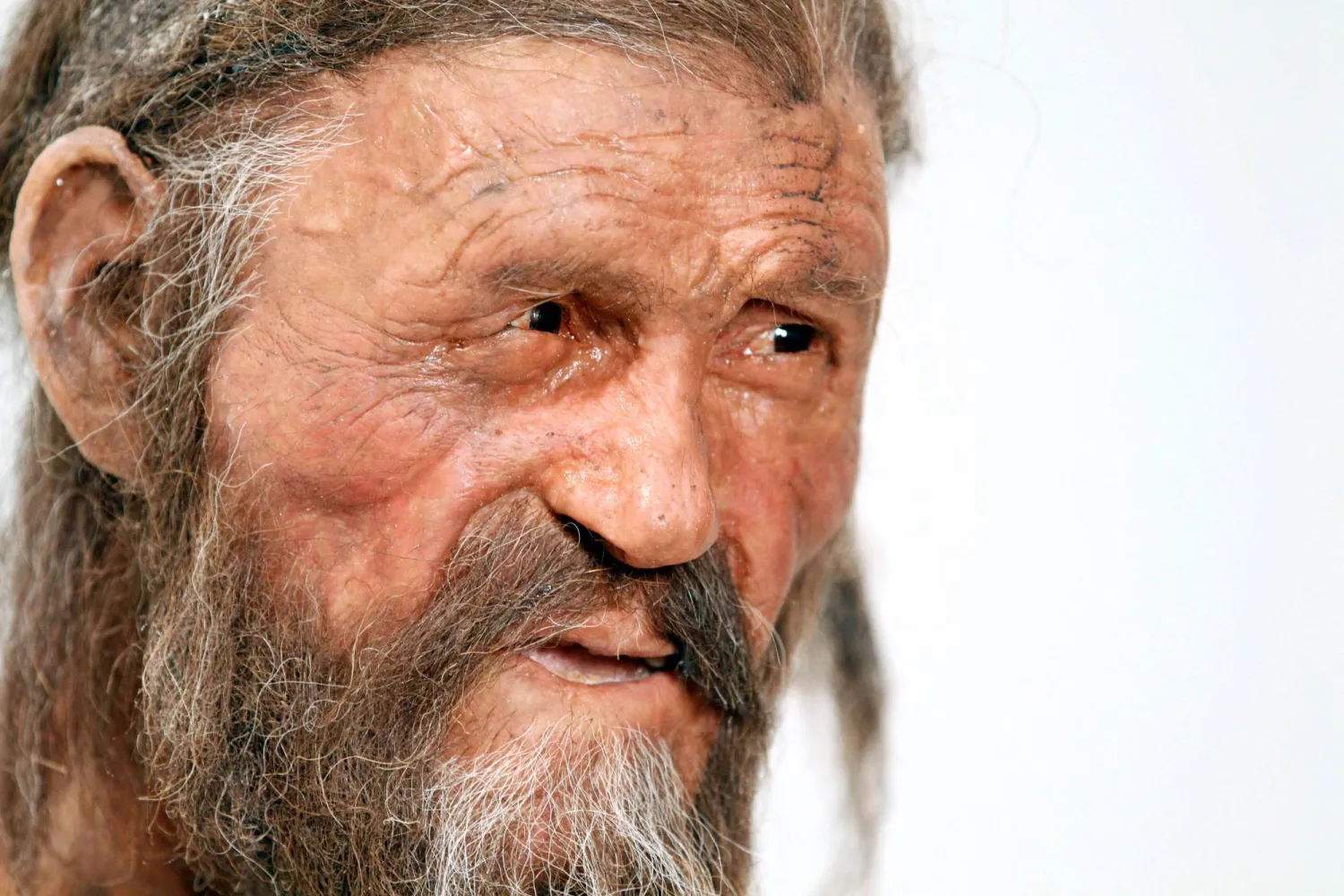
(FILES) A statue representing an iceman named Oetzi. (Photo by Andrea Solero / AFP)
TT

Scientists Find Yeast in Ancient Iceman's Guts -- and Make Bread

(FILES) A statue representing an iceman named Oetzi. (Photo by Andrea Solero / AFP)

Yeast has been growing in the guts of a frozen mummy called Oetzi the Iceman for thousands of years, scientists have discovered, telling AFP they used it to make a tasty sourdough bread.

More than 5,300 years ago -- before the Egyptian pyramids were built -- Oezti was strolling through the Alps on the border of Austria and Italy when he was killed by an arrow in the back.

He remained frozen in the ice until two German hikers stumbled across his mummified remains in 1991 in the northern Italian region of South Tyrol.

Since then, his stunningly well-preserved remains have been kept at the same temperature -- minus six degrees Celsius -- as his icy tomb.

This has allowed scientists to carefully study Oetzi, who offers an incredibly rare window into ancient human life.

For the latest research, published in the Microbiome journal on Wednesday, an Italy-based team found evidence that both ancient and modern microbial life remain active in the frozen body.

"What we didn't expect to find was yeast," lead study author Mohamed Sarhan of the Eurac Research institute in the Italian city of Bolzano told AFP.

The scientists discovered four different yeasts that can survive sub-zero temperatures in Oetzi's guts, skin and "brownish" water that melted off his body when he was partially unfrozen.

These kinds of yeast only live in very cold conditions such as Antarctica, so are believed to have entered Oetzi's body at some point after he died.

Genetic analysis revealed "DNA damage levels very comparable to the original microbes" in the Iceman's guts, suggesting the yeast entered his body soon after death, Sarhan said.

"These yeasts have accompanied Oetzi on his long journey through the millennia," study co-author Frank Maixner said in a statement.

The scientists then reproduced the gut yeast in a fridge.

"If you tell anyone you have yeast, they immediately ask: can we use it for bread?" Sarhan said.

So they tried to make a sourdough loaf.

"Initially it didn't work," the microbiologist admitted.

But after three months of effort "we had a very, very good sourdough," Sarhan said with a laugh.

The study contained more serious possible uses for the yeast.

When the mummy was found in 1991, it was initially treated as a normal cadaver. A chemical called phenol was used to stop fungus from growing in the body.

However, the strange yeast was able to eat the phenol, meaning that in the future it could help break down the chemical in contaminated environments, the scientists said.

The yeast was not the only surprising discovery in Oetzi's body.

An analysis of his microbiome revealed a particular kind of a gut bacteria that is almost non-existent among modern humans.

Though gone from the stomachs of people in the industrialized world, the bacteria has been detected among tribes in Africa and South America, Sarhan said.

It has also been found in 3,000-year-old feces preserved in a salt mine in Hallstatt, Austria -- which serves as one of the only other available views into the ancient human microbiome.

Oetzi and these Bronze Age salt miners ate more fiber and whole grain than modern-day people, Sarhan explained.

The study said it "reveals that the Iceman is not a biologically 'frozen' time-capsule but rather a complex ecosystem.”

It is too early to say whether the yeast is harming the mummy, Sarhan said, calling for more research.

Nikolay Oskolkov, a researcher at the Latvian Institute of Organic Synthesis not involved in the study, told AFP it was interesting that "the Iceman's microbiome is not 'frozen'.”

However Oskolkov, who previously discovered ancient fungus in the mummy's guts, cautioned that the yeast samples were only taken in 2010 and 2019.

This provides "very little evidence that the yeasts have been multiplying over millennia," he said, adding that he believed they were "relatively recent colonists of the mummy's body.”


Massive Fire Destroys 100 Homes in Norway and Forces Hundreds to Evacuate

17 July 2026, Norway, Drammen: Smoke rises from a major residential fire that destroyed row houses and forced mass evacuations in Krokstadelva, Drammen. Photo: Thomas Fure/NTB/dpa
TT

Massive Fire Destroys 100 Homes in Norway and Forces Hundreds to Evacuate

17 July 2026, Norway, Drammen: Smoke rises from a major residential fire that destroyed row houses and forced mass evacuations in Krokstadelva, Drammen. Photo: Thomas Fure/NTB/dpa

A major fire in southern Norway destroyed more than 100 homes Friday and forced hundreds of people to evacuate the area, according to police and the country's public broadcaster.

The blaze started in a townhouse in the city of Drammen around 3:30 p.m. Friday, police said.

It then spread through the area and into nearby forests.

Firefighters continued their efforts Saturday morning to bring the blaze under control.

The Associated Press quoted NRK, Norway's public broadcaster, as saying that hundreds of people went to an evacuation center.

No residents have been reported missing, police said. It was not immediately clear what caused the fire.

Drammen is roughly 34 kilometers (21 miles) southwest of Oslo.


India Successfully Launches 1st Private Orbital Rocket

Indian space startup Skyroot Aerospace launched its Vikram-1 rocket, marking the first attempt by an Indian private company to place a satellite in orbit, from the Satish Dhawan Space Center in Sriharikota, Andhra Pradesh, India, July 18, 2026. REUTERS/Priyanshu Singh
TT

India Successfully Launches 1st Private Orbital Rocket

Indian space startup Skyroot Aerospace launched its Vikram-1 rocket, marking the first attempt by an Indian private company to place a satellite in orbit, from the Satish Dhawan Space Center in Sriharikota, Andhra Pradesh, India, July 18, 2026. REUTERS/Priyanshu Singh

India's first privately built orbital rocket took its maiden flight on Saturday, its company said, marking a significant step for the South Asian giant as it eyes a bigger slice of the global space economy.

The Vikram-1 rocket, built by Skyroot Aerospace and designed to carry small satellites into low-Earth orbit, took off from the Satish Dhawan Space Center in Sriharikota amid loud cheers.

"Hello space, we have arrived!" Skyroot Aerospace said in a post on X.

"Vikram-1's Test Flight-1 has completed its mission. The first ever Indian private sector launch has been successfully completed."

Vikram-1 is about as tall as a seven-story building and capable of carrying payloads weighing up to 350 kilograms (771 pounds).

Pawan Goenka, chairman of the government's Indian National Space Promotion and Authorisation Center, said the achievement went "way beyond expectation for the very first orbital launch ever taken by an Indian private company".

Prime Minister Narendra Modi hailed the endeavor as "a defining moment in India's space journey".

"The growing participation of our private sector is opening new frontiers and accelerating innovation," AFP quoted Modi as saying.

"This achievement will encourage countless youngsters to dream bigger and innovate fearlessly."

The rocket is carrying a diverse range of payloads, including a lab-grown diamond and robotic arms capable of removing space debris.

A miniature 18-karat gold rocket that has mini sculptures of Indian physicists Vikram Sarabhai, CV Raman and former Indian president and noted aerospace engineer APJ Abdul Kalam is also aboard the vehicle.

India's space ambitions, built on decades of investment by the Indian Space Research Organization (ISRO), have gathered pace in recent years.

The country's space economy -- valued at around $8.4 billion -- has rapidly expanded since the sector opened up to private players in 2020, and is now home to more than 400 space startups.

"India's space ambitions soar to new heights!" Foreign Minister S. Jaishankar said after the successful launch.

In August 2023, India became only the fourth country to successfully land an unmanned spacecraft on the Moon, after Russia, the United States and China.

Former ISRO chairman K. Sivan hailed the work done by space startups, adding that the country was witnessing the "fruits of the seeds sown" when it opened up the sector to private players.

"With Skyroot especially, the rocket is one of the most challenging and complex technologies in the space system... It is going to motivate many people," he told AFP.

Sivan added that "there is no doubt" the launch will have a global impact.

"If an Indian startup can make one of the most challenging things in the space industry, then it gives a huge boost to India's reputation globally."


UK Sculpture Designed to Attract Visiting Insects

'Penleigh Queen Bee' will raise awareness of declining bee populations (Brendon Murless/BBC)
TT

UK Sculpture Designed to Attract Visiting Insects

'Penleigh Queen Bee' will raise awareness of declining bee populations (Brendon Murless/BBC)

A new sculpture, designed to raise awareness of the world's declining bee population, will help host visiting insects inside its structure, according to BBC.

The new piece of art will be installed at Penleigh Park in Westbury, Wiltshire.

Brendon Murless, an artist from Bridport in Dorset, will use clay, steel and logs to create a 220 cm sculpture called 'Penleigh Queen Bee' which will sit on an oak plinth and be full of holes for bees to live in.

His aim is to create a “moment of calm” for visitors to Penleigh Park but also “inspire, and offer a moment of reflection on the wonder of bees and how we are connected to them in different ways.”

His design was chosen after a public vote in Westbury, which sought to find a nature-inspired statue for Penleigh Park.

Murless said: “I was lucky enough to win and I'm on it [ the sculpture] as we speak."

“The piece is called Queen Bee to highlight the plight of these pollinators. Wild bee populations are in decline globally, which directly impacts nature as a whole and our food security,” he added.

In the back of the Queen Bee's head there will be a stack of mixed logs and stones with holes drilled into them to help encourage homes for masonry bees and solitary bees.

Murless continued: “In folklore, bees are also associated with family, protection and teamwork, which I think connect perfectly with this community project.”

Westbury Town Council has worked with Penleigh residents and local schoolchildren on the project to improve the park with additional funding from Wiltshire Council.

Benjamin Griffiths, business development manager at the Town Council, said the sculpture “will be an incredible addition to an already beautiful and much deserving space in Penleigh Park.”

He added: “The whole group have worked really hard to make this happen.”

Wiltshire Council's public art officer, Ella-mai Robey said the “brilliant” idea to transform Penleigh Park all stemmed from local people.

“Using public art developer contributions to create such a great art project for the community is really exciting,” she added.
