


Gold Eases as Middle East Tensions Lift Oil, US Economic Data in Focus

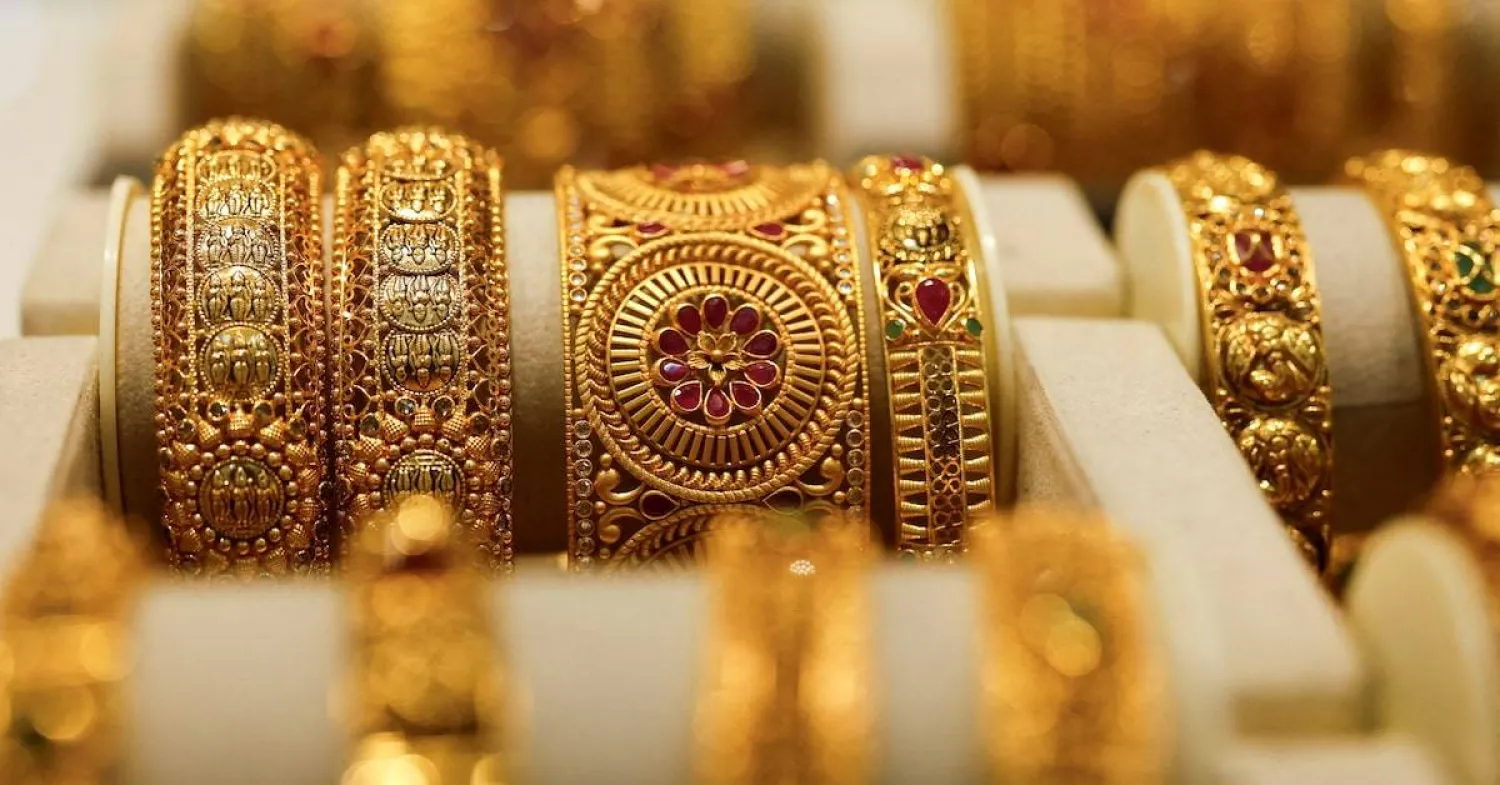
Gold bangles are displayed at a jewellery store in Mumbai, India, March 20, 2025. (Reuters)
TT

Gold Eases as Middle East Tensions Lift Oil, US Economic Data in Focus

Gold bangles are displayed at a jewellery store in Mumbai, India, March 20, 2025. (Reuters)

Gold prices slipped on Wednesday, as renewed hostilities in the Middle East pushed crude higher and stalled US-Iran talks, while investors awaited upcoming U.S. economic data.

Spot gold fell 0.5% to $4,460.36 per ounce by 0702 GMT, after rising more than 1% in the previous session. US gold futures for August delivery slipped 0.7% ‌to $4,488.90.

Gulf hostilities ‌flared anew, with the US military ‌saying Iranian ⁠missile attacks on ⁠Bahrain, Kuwait and other regional targets were either thwarted or failed.

US Secretary of State Marco Rubio said on Tuesday that President Donald Trump's negotiating team has not offered Iran sanctions relief in exchange for reopening the Strait of Hormuz and insisted that any sanctions relief was tied ⁠to Tehran giving up its nuclear program.

"The market ‌is now looking at ‌the possibility that this ceasefire with Iran may not hold even ‌though Trump is going to push for a peace ‌deal resolution," said Kelvin Wong, a senior market analyst at OANDA.

"If we start to see further escalation, that could also dampen whatever recovery that gold might have had."

Oil prices rose more ‌than 1%, deepening concerns over inflation and interest rate hikes.

Cleveland Federal Reserve President Beth ⁠Hammack said ⁠on Tuesday the US central bank may need to raise interest rates soon should already-high inflation pressures continue to mount.

Investors are now awaiting the US nonfarm payroll data, due later in the day, and employment report due on Friday to gauge the Fed's monetary policy path.

Although gold is typically viewed as a hedge against inflation, it tends to lose its appeal as a non-yielding asset in a high interest-rate environment.

Spot silver fell 1.1% to $74.27 per ounce, platinum lost 0.5% to $1,928, and palladium fell 0.6% to $1,361.75.



Vietnam Signs Free Trade Deal with Four European Countries

Vietnam's President To Lam (C), Liechtenstein's Prime Minister Brigitte Haas (3rd L) and Switzerland's President Guy Parmelin (3rd R) pose with delegates during the signing ceremony for the Vietnam-EFTA Free Trade Agreement (VEFTA) in Hanoi on October 18, 2026. (Photo by Nhac NGUYEN / AFP)
TT

Vietnam Signs Free Trade Deal with Four European Countries

Vietnam's President To Lam (C), Liechtenstein's Prime Minister Brigitte Haas (3rd L) and Switzerland's President Guy Parmelin (3rd R) pose with delegates during the signing ceremony for the Vietnam-EFTA Free Trade Agreement (VEFTA) in Hanoi on October 18, 2026. (Photo by Nhac NGUYEN / AFP)

Vietnam and four European nations outside the EU signed a free trade agreement in Hanoi on Sunday, seeking to diversify their markets as US tariffs disrupt global commerce.

The deal, between Southeast Asia's fastest-growing economy and the European Free Trade Association (EFTA), which includes Iceland, Liechtenstein, Norway and Switzerland, eliminates or reduces customs duties, including on imports of industrial, fish and agricultural products.

The deal was signed in the capital in the presence of Vietnam's top leader To Lam and representatives of EFTA governments.

Vietnam said the agreement showed the parties' resolve to "reinforce the rules-based trading system amid continued volatility in the global economy", according to a government statement.

It was also expected to help Vietnam "diversify its import and export markets" and "integrate more deeply into global value chains", the government said.

Vietnam and EFTA concluded negotiations in July, more than a decade after the free trade talks officially began in 2012.

The parties relaunched negotiations in September last year, after they had stalled since 2018.

The agreement followed a global trade-disrupting tariff blitz by the United States under President Donald Trump which has left Vietnam with a hefty tax on its US exports amid ongoing negotiations with Washington.

Experts say the new deal reflected a shared initiative to diversify commercial ties and reduce reliance on major trading partners.

"As the US increasingly exerts trade pressure on European countries, the agreement is a joint effort to turn economic integration into greater strategic autonomy and to develop alternative commercial relationships rather than relying exclusively on their largest partners," history and politics scholar Do Dinh Lam Khang told AFP.

For Vietnam, closer ties with EFTA economies could support its ambition to move into higher-value-added activities, Khang added.

The agreement covers trade in goods and services, intellectual property rights, trade remedies and sustainable development, among other areas, both parties say.

Bilateral trade between the EFTA and Vietnam last year was valued at 4.8 billion euros ($5.4 billion), according to the association.

Electrical and mechanical machinery, fish and pharmaceutical products were the EFTA nations' top exports to Vietnam last year.

Machinery, footwear and apparel were manufacturing hub Vietnam's major exports to the EFTA.

The association was created as a counterpart to the European Economic Community, precursor of the European Union which its four member states are close to but have not joined.


Lagarde: Sustainable Finances Key for Economic Stability

European Central Bank President Christine Lagarde speaks during a press conference following the ECB Governing Council meeting at the guest house of the Deutsche Bundesbank in Berlin, Germany, September 10, 2026. REUTERS/Annegret Hilse/File Photo
TT

Lagarde: Sustainable Finances Key for Economic Stability

European Central Bank President Christine Lagarde speaks during a press conference following the ECB Governing Council meeting at the guest house of the Deutsche Bundesbank in Berlin, Germany, September 10, 2026. REUTERS/Annegret Hilse/File Photo

European Central Bank (ECB) president Christine Lagarde stressed on Saturday the importance of sound public finances when she addressed ministers in charge of budgets from around the world in Thailand.

In her statement to the International Monetary and Financial Committee that comprises global finance ministers and central bankers, she said fiscal sustainability remains a “crucial anchor” for broader economic stability, according to Bloomberg.

“It is important to maintain sound fiscal policies, including by adhering to fiscal rules, and, where debt is high, to consolidate, re-prioritize spending and enhance the efficiency and effectiveness of public finances to rebuild buffers,” Lagarde noted.

“Governments should strive to ensure that any fiscal response to the energy shock is temporary, targeted and tailored,” she added.

Her remarks come after a week of intense debate in the Thai capital, where the International Monetary Fund (IMF) held its annual meetings.

Discussions focused on the risks hanging over the global economy as it faces rising debt levels, an artificial intelligence revolution and increasingly complicated geopolitics.

“A return to an international economic order grounded in openness, predictability and the rule of law would help trade and investment flourish,” Lagarde said.

Turning to the eurozone, Lagarde reiterated the ECB’s assessment that economic growth faces downside risks, while inflation risks remain tilted upward.

“The energy shock is too large to ‘look through’ but a measured response remains appropriate to keep inflation in check,” she said.

ECB raised interest rates twice – in June and September – and is widely expected to deliver another hike at the end of the year.

Lagarde also said that more than 30 central banks have expressed interest in the Eurosystem’s enhanced repo facility, which aims to support the smooth transmission of monetary policy and reinforces the international role of the euro.


Georgieva: More Work Needed on Lebanon Program

IMF Managing Director Kristalina Georgieva speaks during the Annual Meetings Plenary at the Annual Meetings of the International Monetary Fund (IMF) and the World Bank Group (WBG) at the Queen Sirikit National Convention Center (QSNCC) in Bangkok on October 16, 2026. (Photo by Lillian SUWANRUMPHA / AFP)
TT

Georgieva: More Work Needed on Lebanon Program

IMF Managing Director Kristalina Georgieva speaks during the Annual Meetings Plenary at the Annual Meetings of the International Monetary Fund (IMF) and the World Bank Group (WBG) at the Queen Sirikit National Convention Center (QSNCC) in Bangkok on October 16, 2026. (Photo by Lillian SUWANRUMPHA / AFP)

International Monetary Fund Managing Director Kristalina Georgieva said on Saturday that ‌there were "intense" ‌discussions on support ‌for Lebanon ⁠reflecting significant progress ⁠towards a loan program.

"In the case ‌of ‌Lebanon, we are ‌in very intense ‌discussions with the Lebanese authorities," Georgieva told a closing news conference at ‌IMF and World Bank annual meetings in ⁠Bangkok.

"We ⁠have made significant progress towards the program. We have still a bit more work to do together, and I'm confident we will be successful."