


Canadian Government Endorses Plan to Move Whales from Shuttered Park to US, Spain

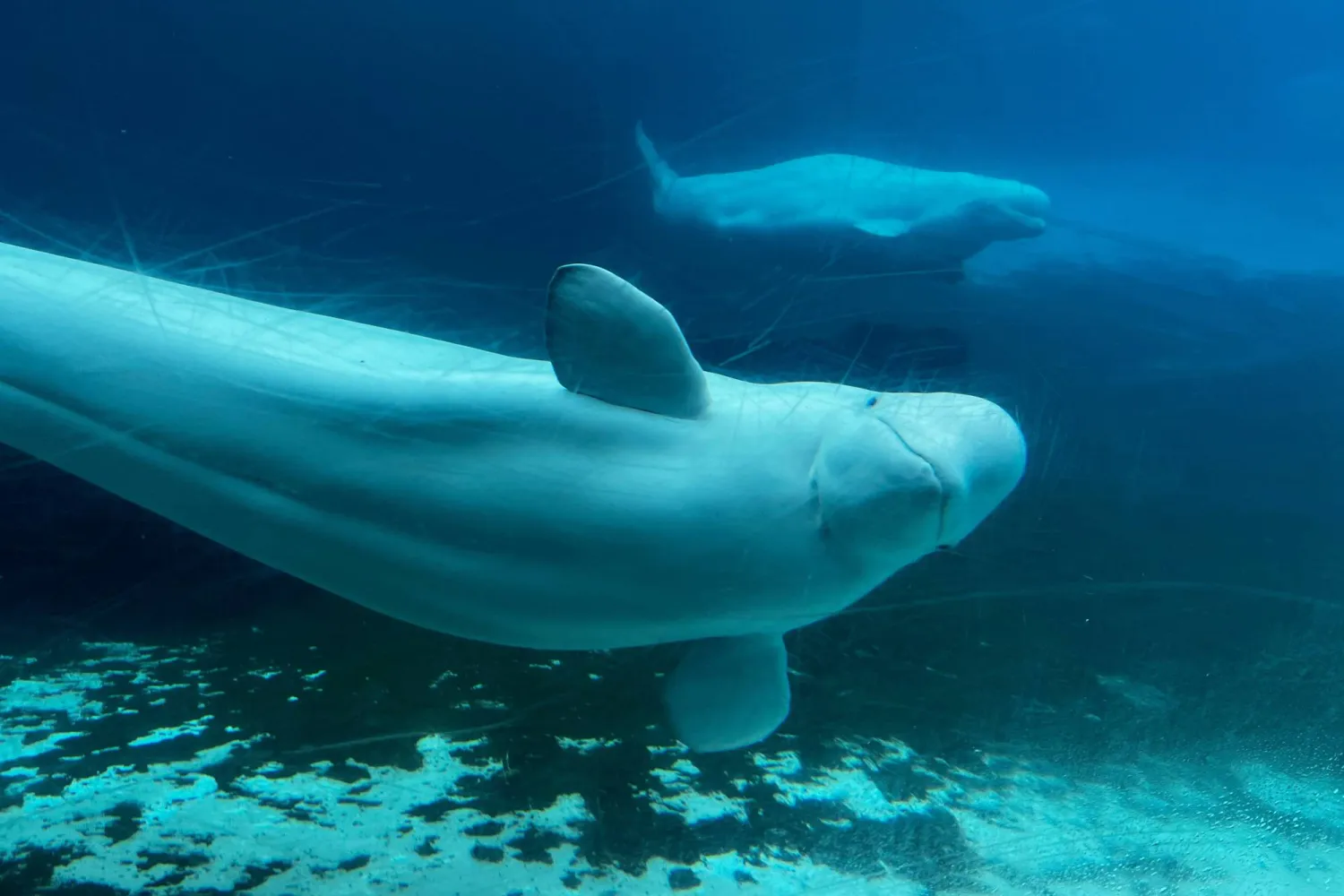
FILE - Beluga whales swim in a tank at Marineland amusement park in Niagara Falls, Ontario, Canada, June 9, 2023. (Chris Young/The Canadian Press via AP, File)
TT

Canadian Government Endorses Plan to Move Whales from Shuttered Park to US, Spain

FILE - Beluga whales swim in a tank at Marineland amusement park in Niagara Falls, Ontario, Canada, June 9, 2023. (Chris Young/The Canadian Press via AP, File)

Canada's government endorsed a plan Wednesday to move the last remaining captive whales from a shuttered theme park in Ontario to aquariums in the United States and Spain — a plan that could save them from mass euthanasia if the deal goes through.

There are 30 belugas and four dolphins left in the Marineland park and zoo in Niagara Falls, Ontario, which announced in early 2023 that it was for sale and closed to the public in late summer 2024. No sale has yet been announced, The Associated Press reported.

The former tourist attraction has since worked to move the park’s remaining animals and sell the sprawling property near Horseshoe Falls.

In 2024, Marineland was found guilty under Ontario’s animal cruelty laws in a case related to its care of three black bears.

The Department of Fisheries and Oceans has issued the first batch of permits to move the whales and is set to issue different permits closer to the move, expected to take place in the next few months. It recently issued permits for the whales and dolphins under the Convention on International Trade in Endangered Species of Wild Fauna and Flora, otherwise known as CITES permits.

“I think this is a positive step forward,” Fisheries Minister Joanne Thompson said. “There’s still more work to be done, but it’s a step forward.”

Twenty whales — 19 belugas and one killer whale — have died at Marineland since 2019, according to provincial government data obtained through freedom-of-information laws and official statements.

Thompson's office said the ministry is coordinating with the Canada Border Services Agency, Health Canada and other ministries to “ensure all requirements are met for a safe and timely transfer.”

Marineland said it is “fully committed to the safe and timely relocation of our beluga whales, and we want to be clear: this is our top priority.”

“Relocating these animals is an extraordinarily complex undertaking,” the park said in a statement.

The Canadian government has not decided whether it will provide taxpayer dollars to help move the whales.

The belugas and dolphins are set to head to five marine parks: Shedd Aquarium in Chicago, Georgia Aquarium in Atlanta, SeaWorld locations in San Antonio and San Diego, and Oceanografic Valencia.

Mystic Aquarium in Connecticut, where Marineland sent five belugas to in 2021, will also help with the move, the American consortium said.

Marineland's founder, John Holer, died in 2018. His wife, Marie Holer, took over operations of the park and put it up for sale in 2023, before she died in 2024.

The estate has been working since to dismantle the park, which features roller-coasters and other rides.



Floating Igloo Leaves France for Polar Exploration Mission

Wind patterns are left in the ice pack that covers the Arctic Ocean north of Prudhoe Bay, Alaska March 18, 2011. (Reuters)
TT

Floating Igloo Leaves France for Polar Exploration Mission

Wind patterns are left in the ice pack that covers the Arctic Ocean north of Prudhoe Bay, Alaska March 18, 2011. (Reuters)

A floating research station resembling a giant aluminium igloo on Sunday set out from France to begin a long-term mission in the Arctic that will see it drift with the polar ice in the most hostile of environments.

The Tara Polar Station's specific shape enables it to withstand ice pressure and drift for months on end in a controlled fashion with the pack ice to explore biodiversity and the impact of climate change.

While the vessel was built in France, some 30 research centers from 12 countries -- including Germany, Canada, Spain, the US, Switzerland, and Japan -- are participating in the expedition.

"The Arctic is an ocean that has been little studied and is already changing significantly. It is undergoing a major transformation," said Romain Trouble, executive director of the Tara Ocean Foundation.

"You cannot understand the environment if you only spend two months a year there," he added.

The vessel sailed from France's western port of Lorient with French Minister for the Sea Catherine Chabaud in attendance and hundreds of people cheering on the quayside.

The floating laboratory -- shaped like an igloo perched on a large buoy -- is designed to withstand sea-ice pressure and endure temperatures as low as -52C.

Starting in mid-August, the station will travel eastward along the Russian coast, with an icebreaker clearing the way.

Trapped in the pack ice by early September, the station is expected to drift at an average speed of 10 kilometers per day, eventually reaching the Fram Strait -- located between Greenland and Svalbard -- by the end of 2027.

Ten such expeditions are planned between 2026 and 2045, taking place every two years.

The vessel will carry 12 people during the winter, including six scientists, and 18 in the summer.

- 'Lose entire chapter of evolution' -

The international crew was carefully selected following medical and psychological aptitude tests and team-building.

"We weren't looking for adventurers who want to head to the North Pole alone. The idea is rather to have people who get along well to experience this confined human environment together," said Clementine Moulin, the expedition director.

Those staying through the winter will have to contend with five months of not just total darkness, claustrophobia and extreme cold, but also the presence of polar bears.

"Bears are a serious matter," said Eric Pelletier, a 58-year-old genomics researcher and crew member. "It's not a simple thing -- the bear is on its home turf and it's used to hunting and hides behind blocks of ice."

Every crew member has received firearms training to deal with potential attacks while a specially trained dog will accompany the crew to help spot approaching animals.

Using an opening in the hull and a wide array of onboard instruments, scientists will collect over 10,000 samples from the water, the atmosphere, and sea ice.

"There is biodiversity at the North Pole that is uniquely adapted to this environment. If the environment changes, that biodiversity might disappear," said Trouble.

"We could potentially lose an entire chapter of the evolution of life on this planet without even having had time to document it," he warned.


Greece Braces for Year’s First Heatwave

A drone view of one of the two fertile regions on the island, the dried-up village of Livadi on the island of Astypalaia, Greece, July 13, 2026. (Reuters)
TT

Greece Braces for Year’s First Heatwave

A drone view of one of the two fertile regions on the island, the dried-up village of Livadi on the island of Astypalaia, Greece, July 13, 2026. (Reuters)

Greece, which was spared the record hot weather that ravaged most of Europe in June, is finally bracing for its first heatwave of the year.

Maximum temperatures in Thessaly, parts of the Peloponnese and the greater Athens area "may hover around or exceed 40C" (104F), with a fall likely on Thursday, prominent meteorologist Theodoros Kolydas said Sunday on Facebook.

He said data for Monday to Wednesday showed that "we are not dealing with a simple warm spell, but with a heat episode with heatwave characteristics, mainly over the mainland."

Weather website meteo.gr on Saturday said the first measurement over 40C for the season had been recorded in the northwestern town of Konitsa, with a reading of 40.4C.

National weather service EMY on Sunday forecast temperatures of 40C to 41C on Monday and Tuesday in mainland Greece.

It is unusual for temperatures to rise so late in July in Greece. Rain spells in June and strong winds this month kept heatwaves at bay this season while heat record after record was broken across most of Europe.

Meteo.gr said it was the third most delayed 40-degree recording since 2011, after July 20 in 2015 and July 30 in 2013.


Wildfire Scorches 12,000 Hectares North of Madrid

A seaplane battles a wildfire that started on Thursday in La Mierla, Guadalajara, July 18, 2026. (EPA)
TT

Wildfire Scorches 12,000 Hectares North of Madrid

A seaplane battles a wildfire that started on Thursday in La Mierla, Guadalajara, July 18, 2026. (EPA)

A wildfire raging 100 kilometers (60 miles) north of Madrid has spread, burning more than 12,000 hectares and forcing several hundred people to evacuate, local authorities announced on Sunday.

The fire that started on Thursday in Guadalajara province, which includes the Sierra Norte Natural Park, has not caused any casualties so far but has been described as "difficult" by regional president Emiliano Garcia-Page and local authorities on X.

It broke out in a forest-covered, mountainous region that is home to endangered species including eagles, wolves and butterflies.

It comes hot on the heels of a blaze that started on Wednesday near Zaragoza, in the northeast, has burned nearly 16,000 hectares and is "far from under control", according to the latest update provided on Saturday evening by the regional government of Aragon.

No casualties have been reported.

Earlier this month, Spain witnessed one of the deadliest wildfires in its recent history, when a blaze in the southern province of Almeria killed 13 people and destroyed 7,000 hectares.

Spain is on the front line of climate change and has experienced increasingly long and frequent heatwaves in recent years, with temperatures well above 40C, creating conditions conducive to devastating fires.

Scientists say human-driven climate change is increasing the length, intensity and frequency of heatwaves, which dry out vegetation and contribute to the likelihood of wildfires.