


Genome Study Shows What Made the Extinct Ice Age Cave Lion Unique

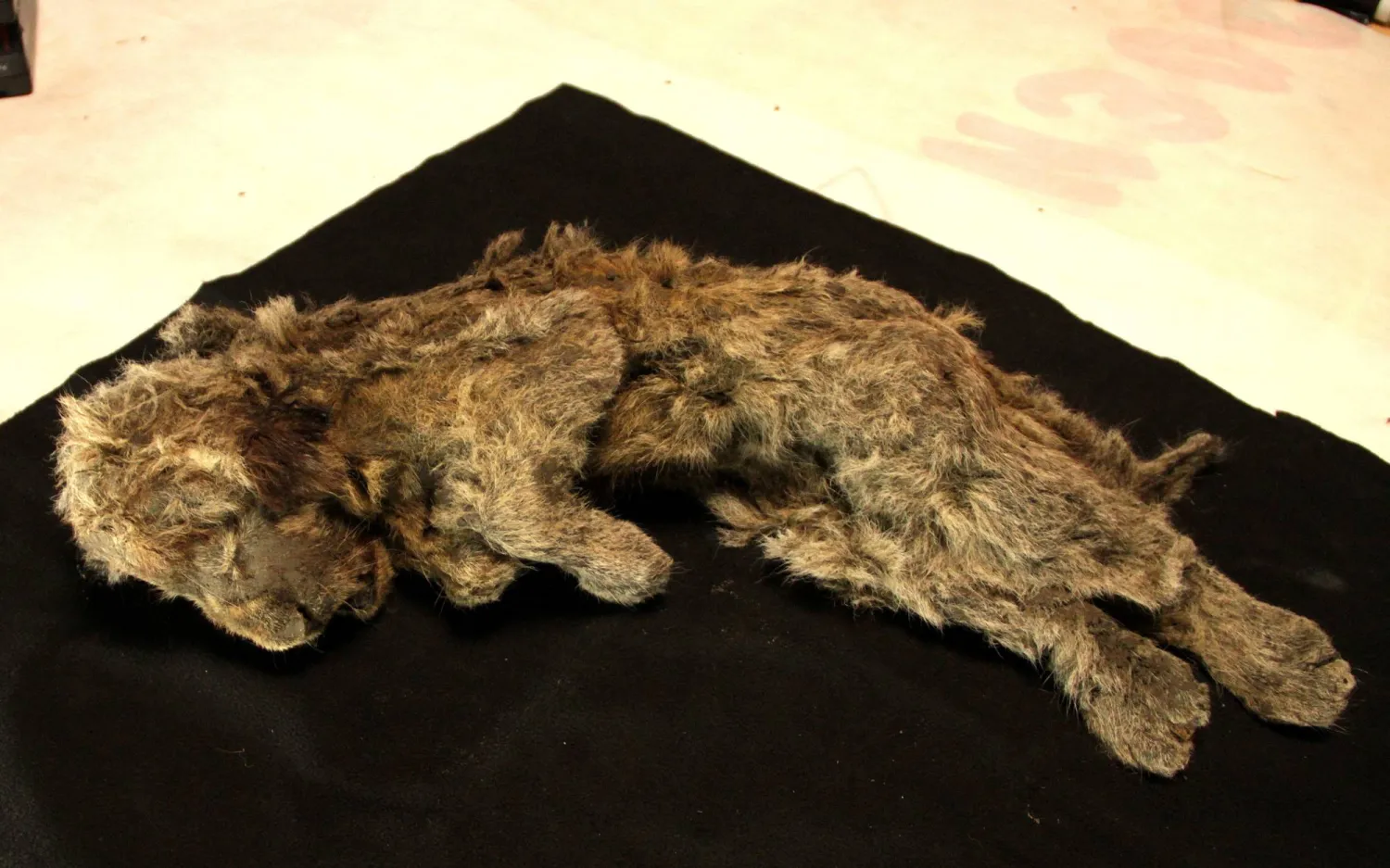
The remains of a frozen female cave lion cub named Sparta, about 32,000 years old and recovered in northeastern Siberia, are pictured in Yakutsk, Russia, in this photograph from 2018, obtained on June 3, 2026. Love Dalen/Handout via REUTERS
TT

Genome Study Shows What Made the Extinct Ice Age Cave Lion Unique

The remains of a frozen female cave lion cub named Sparta, about 32,000 years old and recovered in northeastern Siberia, are pictured in Yakutsk, Russia, in this photograph from 2018, obtained on June 3, 2026. Love Dalen/Handout via REUTERS

The cave lion was one of the biggest cats to ever live, prowling a huge swathe of territory from Western Europe across Siberia and into North America and hunting large prey - and perhaps even people - before going extinct around the end of the Ice Age.

New genome research reveals what made this big cat unique and how it differed from the modern lion, its smaller cousin, though the two species did sporadically interbreed. The cave lion, whose scientific name is Panthera spelaea, died out roughly 14,000 years ago.

The researchers compared the genomes of 12 cave lions that lived from 17,000 to 148,000 years ago in places such as Russia, Austria and Canada's Yukon territory with the genomes of 20 modern lions. Cave lion DNA was extracted mostly from bones and teeth, but also from soft tissue in well-preserved frozen cubs from Siberia, where cold conditions helped preserve ancient genetic material. One of these, a female called Sparta, is among the best Ice Age specimens ever found.

"We show that cave lions were not simply Ice Age versions of modern ⁠lions, but ⁠instead represented a highly distinct evolutionary lineage," said evolutionary geneticist Love Dalén of the Centre for Palaeogenetics, a collaboration between Stockholm University and the Swedish Museum of Natural History, senior author of the study published in the journal Cell.

According to Reuters, the study showed that the evolutionary lineages of the two species diverged probably around 1.7 million years ago during the Pleistocene Epoch. Each species possessed unique genetic variants that likely adapted them to their different habitats and behaviors. These genetic differences related to growth, vision, brain function and circulatory development.

The cave lion, which despite its name did not actually live in caves, was significantly larger and built more robustly than the modern lion. It dwelled in colder ⁠climes, favoring the open grasslands and tundras of northern Eurasia and northwestern North America. This vanished ecosystem, called the mammoth steppe in a nod to its most prominent inhabitant, resembled today's African savanna but with frigid temperatures.

"The cave lion was absolutely an apex predator, and as such filled an incredibly important and impactful ecological role," said evolutionary geneticist and study lead author David Stanton of Cardiff University in Wales. "They were one of the most widespread carnivores to ever live."

Among its probable prey were woolly mammoths - most likely young or elderly individuals - as well as woolly rhinoceroses, antelope, reindeer, horses and bison. Humans also dwelled in these regions in the Ice Age's later stages.

"While there is no clear evidence that cave lions preyed on humans, it seems highly likely that they occasionally did so. Cave paintings show that Ice Age people were highly familiar with these animals. They are often depicted with remarkable accuracy, and are usually shown without the large mane characteristic of modern male lions," Dalén said.

Other predators sharing the landscape included wolves, cave hyenas, ⁠brown bears, cave bears and ⁠the scimitar-toothed cat Homotherium. The powerful saber-toothed cat Smilodon was a more southern species, but may have come into contact with cave lions in the Yukon and Alaska regions during brief periods of Pleistocene climate warming.

The modern lion did not venture as far north as the cave lion's usual domain. But the study showed that the two species came into contact at particularly cold stretches of the Ice Age when growing continental ice sheets and expansion of the steppe tundra brought cave lions southward, causing their ranges to overlap.

"Climate appears to dictate the level of interbreeding that we see between these species," Stanton said.

The researchers said this interbreeding may have occurred in places like modern-day Iran. That region once was home to a sizable population of modern lions, though they are now largely restricted to Africa.

The warming at the end of the Ice Age contributed to the extinctions of many of the large Pleistocene animals, or megafauna, with human hunting presenting another destabilizing factor.

"Cave lions, like the rest of the megafauna at the end of the Pleistocene, were under a huge amount of pressure due to rapid changes in climate combined with increasing human population densities. The extinction of cave lions falls into the general pattern that we see of mass extinction of megafauna at this time, but for reasons that we don't completely understand," Stanton said.


Floating Igloo Leaves France for Polar Exploration Mission

Wind patterns are left in the ice pack that covers the Arctic Ocean north of Prudhoe Bay, Alaska March 18, 2011. (Reuters)
TT

Floating Igloo Leaves France for Polar Exploration Mission

Wind patterns are left in the ice pack that covers the Arctic Ocean north of Prudhoe Bay, Alaska March 18, 2011. (Reuters)

A floating research station resembling a giant aluminium igloo on Sunday set out from France to begin a long-term mission in the Arctic that will see it drift with the polar ice in the most hostile of environments.

The Tara Polar Station's specific shape enables it to withstand ice pressure and drift for months on end in a controlled fashion with the pack ice to explore biodiversity and the impact of climate change.

While the vessel was built in France, some 30 research centers from 12 countries -- including Germany, Canada, Spain, the US, Switzerland, and Japan -- are participating in the expedition.

"The Arctic is an ocean that has been little studied and is already changing significantly. It is undergoing a major transformation," said Romain Trouble, executive director of the Tara Ocean Foundation.

"You cannot understand the environment if you only spend two months a year there," he added.

The vessel sailed from France's western port of Lorient with French Minister for the Sea Catherine Chabaud in attendance and hundreds of people cheering on the quayside.

The floating laboratory -- shaped like an igloo perched on a large buoy -- is designed to withstand sea-ice pressure and endure temperatures as low as -52C.

Starting in mid-August, the station will travel eastward along the Russian coast, with an icebreaker clearing the way.

Trapped in the pack ice by early September, the station is expected to drift at an average speed of 10 kilometers per day, eventually reaching the Fram Strait -- located between Greenland and Svalbard -- by the end of 2027.

Ten such expeditions are planned between 2026 and 2045, taking place every two years.

The vessel will carry 12 people during the winter, including six scientists, and 18 in the summer.

- 'Lose entire chapter of evolution' -

The international crew was carefully selected following medical and psychological aptitude tests and team-building.

"We weren't looking for adventurers who want to head to the North Pole alone. The idea is rather to have people who get along well to experience this confined human environment together," said Clementine Moulin, the expedition director.

Those staying through the winter will have to contend with five months of not just total darkness, claustrophobia and extreme cold, but also the presence of polar bears.

"Bears are a serious matter," said Eric Pelletier, a 58-year-old genomics researcher and crew member. "It's not a simple thing -- the bear is on its home turf and it's used to hunting and hides behind blocks of ice."

Every crew member has received firearms training to deal with potential attacks while a specially trained dog will accompany the crew to help spot approaching animals.

Using an opening in the hull and a wide array of onboard instruments, scientists will collect over 10,000 samples from the water, the atmosphere, and sea ice.

"There is biodiversity at the North Pole that is uniquely adapted to this environment. If the environment changes, that biodiversity might disappear," said Trouble.

"We could potentially lose an entire chapter of the evolution of life on this planet without even having had time to document it," he warned.


Greece Braces for Year’s First Heatwave

A drone view of one of the two fertile regions on the island, the dried-up village of Livadi on the island of Astypalaia, Greece, July 13, 2026. (Reuters)
TT

Greece Braces for Year’s First Heatwave

A drone view of one of the two fertile regions on the island, the dried-up village of Livadi on the island of Astypalaia, Greece, July 13, 2026. (Reuters)

Greece, which was spared the record hot weather that ravaged most of Europe in June, is finally bracing for its first heatwave of the year.

Maximum temperatures in Thessaly, parts of the Peloponnese and the greater Athens area "may hover around or exceed 40C" (104F), with a fall likely on Thursday, prominent meteorologist Theodoros Kolydas said Sunday on Facebook.

He said data for Monday to Wednesday showed that "we are not dealing with a simple warm spell, but with a heat episode with heatwave characteristics, mainly over the mainland."

Weather website meteo.gr on Saturday said the first measurement over 40C for the season had been recorded in the northwestern town of Konitsa, with a reading of 40.4C.

National weather service EMY on Sunday forecast temperatures of 40C to 41C on Monday and Tuesday in mainland Greece.

It is unusual for temperatures to rise so late in July in Greece. Rain spells in June and strong winds this month kept heatwaves at bay this season while heat record after record was broken across most of Europe.

Meteo.gr said it was the third most delayed 40-degree recording since 2011, after July 20 in 2015 and July 30 in 2013.


Wildfire Scorches 12,000 Hectares North of Madrid

A seaplane battles a wildfire that started on Thursday in La Mierla, Guadalajara, July 18, 2026. (EPA)
TT

Wildfire Scorches 12,000 Hectares North of Madrid

A seaplane battles a wildfire that started on Thursday in La Mierla, Guadalajara, July 18, 2026. (EPA)

A wildfire raging 100 kilometers (60 miles) north of Madrid has spread, burning more than 12,000 hectares and forcing several hundred people to evacuate, local authorities announced on Sunday.

The fire that started on Thursday in Guadalajara province, which includes the Sierra Norte Natural Park, has not caused any casualties so far but has been described as "difficult" by regional president Emiliano Garcia-Page and local authorities on X.

It broke out in a forest-covered, mountainous region that is home to endangered species including eagles, wolves and butterflies.

It comes hot on the heels of a blaze that started on Wednesday near Zaragoza, in the northeast, has burned nearly 16,000 hectares and is "far from under control", according to the latest update provided on Saturday evening by the regional government of Aragon.

No casualties have been reported.

Earlier this month, Spain witnessed one of the deadliest wildfires in its recent history, when a blaze in the southern province of Almeria killed 13 people and destroyed 7,000 hectares.

Spain is on the front line of climate change and has experienced increasingly long and frequent heatwaves in recent years, with temperatures well above 40C, creating conditions conducive to devastating fires.

Scientists say human-driven climate change is increasing the length, intensity and frequency of heatwaves, which dry out vegetation and contribute to the likelihood of wildfires.
