

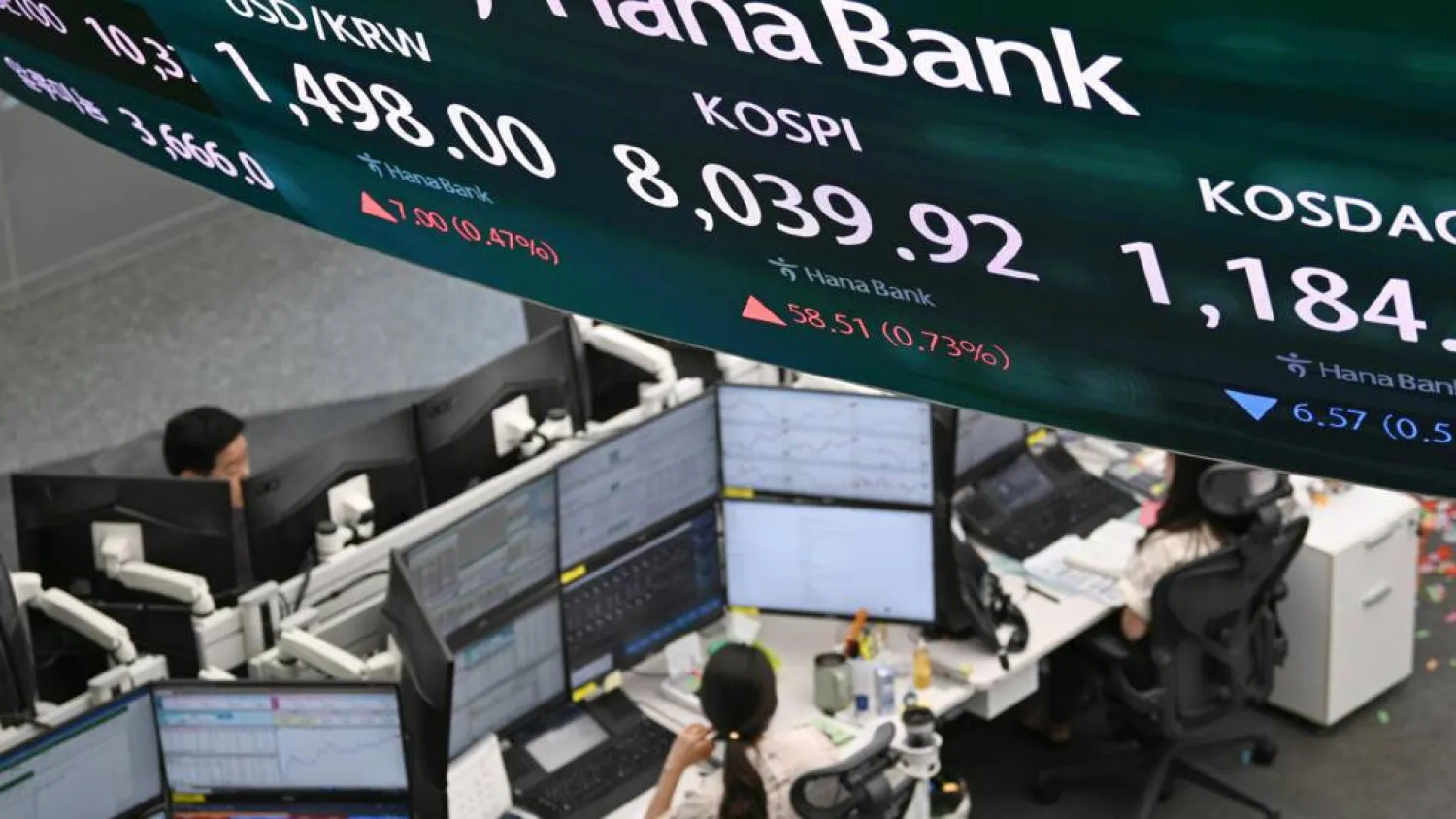

Asian Stocks Take another Hit from AI, Mideast Worries

Seoul's Kospi, which has hit multiple records this year as it led Asian markets higher, tumbled Friday. Jung Yeon-je/ AFP
TT

Asian Stocks Take another Hit from AI, Mideast Worries

Seoul's Kospi, which has hit multiple records this year as it led Asian markets higher, tumbled Friday. Jung Yeon-je/ AFP

Asian equities went into reverse Friday on continued worries about the AI trade after disappointing forecasts from chip titan Broadcom, while investors were also keeping a wary eye on stuttering Middle East peace efforts.

After leading several markets to record highs this year, technology firms are facing selling pressure on concerns that the eye-watering sums pumped into artificial intelligence may have been overdone and stock valuations are too high.

Broadcom on Wednesday sparked concern among traders who have piled into all things AI when its revenue forecast for the third quarter came in below expectations, sparking a sell-off in Wall Street's Nasdaq as dealers took profits and rotated into other sectors.

And the losses have bled through to Asia, where tech-heavy Seoul and Tokyo -- which have led the region's surge this year -- sank from record highs.

South Korean stocks tanked almost seven percent at one point Friday, having dropped 1.8 percent the day before. The Nikkei in Tokyo was off more than one percent, matching Thursday's retreat.

The losses come as investors contemplate a coming IPO by Elon Musk's SpaceX, which is aiming to raise $75 billion in the biggest initial public offering ever. The company said in a regulatory filing that it would offer more than 550 million shares at $135 each next week, which could value the company at $1.8 trillion.

There were also losses in Hong Kong, Sydney, Singapore and Taipei, though Shanghai, Wellington and Manila edged up.

Jakarta extended losses amid building fears about the state of the Indonesian economy and the rupiah, which have been hammered by surging oil prices.

"Broadcom's revenue miss sparked profit-taking across the semiconductor sector and gave investors a reason to pause after the recent AI-driven rally," said City Index's Fiona Cincotta.

"Broadcom's results suggest investor expectations may have run ahead of fundamentals."

The latest AI wobble came as investors grew nervous about grinding efforts to end the Middle East crisis.

The head of militant group Hezbollah on Thursday rejected a conditional truce announced by Lebanon and Israel, demanding a comprehensive ceasefire and full Israeli withdrawal from its northern neighbor.

Naim Qassem's message came after the two sides agreed to a conditional ceasefire that Lebanon's president called the "last chance" for a durable end to the fighting.

Talks between Iran and the United States also appeared to be going nowhere, with Iran reporting "no tangible progress", even as President Donald Trump again voiced optimism, telling reporters a deal "could happen... over the weekend".

Still, oil prices held their recent losses amid lingering optimism a deal will be struck and the Strait of Hormuz -- through which a fifth of global oil usually passes -- will reopen.

Official US jobs data due later in the day are also in focus following forecast-topping private data that indicated the economy remained healthy and fanned bets on the Federal Reserve hiking interest rates.



US Employers Likely Added 105,000 Jobs in May with Labor Market Stable Despite Costly Iran War

Workers continue putting the finishing touches on the Lincoln Memorial Reflecting Pool on June 04, 2026 in Washington, DC. (Getty Images/AFP)
TT

US Employers Likely Added 105,000 Jobs in May with Labor Market Stable Despite Costly Iran War

Workers continue putting the finishing touches on the Lincoln Memorial Reflecting Pool on June 04, 2026 in Washington, DC. (Getty Images/AFP)

The American job market has climbed out of a rut. But it's still trudging along tepidly, frustrating young people and others out of work.

The Labor Department is expected to report Friday that companies, non-profits and government agencies added 105,000 jobs last month, according to a survey of forecasters by the data firm FactSet. That would be solid by the labor market's recent, diminished standards -- but down from 115,000 in April.

Hiring has bounced back this year from a miserable 2025, showing unexpected resilience in the face of economic uncertainty and painfully high energy prices caused by the Iran war.

Unemployment is expected to have remained at a low 4.3% in May, FactSet says. But despite the improvement from last year, job creation is way down from the boom that followed pandemic lockdowns.

Workers, jobseekers and employers are stuck in an awkward “no-hire, no-fire" labor market. “Those who have jobs are clinging to them, while those without are left wanting,” Diane Swonk, chief economist at the tax and consulting firm KPMG, wrote in a commentary ahead of the jobs report. “The result is a sense of being frozen or left in a sort of labor market purgatory.”

Many young people are finding it tough to break into a stagnant job market and workers who have been laid off struggle to get back to work. More than a quarter of the unemployed in April had been jobless for more than six months, up from less than 20% two years ago.

Seeing their prospects diminished, Americans are reluctant to leave their jobs and seek something better elsewhere. In April, the number of people who quit dropped to the lowest level since the frightening days of August 2020, when the COVID-19 was running rampant.

Last year, employers added 9,700 jobs a month, fewest outside a recession since 2002.

This year, hiring has rebounded, averaging 76,000 new jobs a month from January through April. Big tax refunds — the product of President Donald Trump’s 2025 tax cuts — have given the economy a lift, offsetting the impact of higher energy prices since the United States and Israel attacked Iran in late February. But the refunds have mostly been pocketed, and gasoline prices remain above $4 per gallon.

Healthcare companies have been propping up the job market.

Over the past year, they've added more than 456,000 jobs; all other US employers have collectively cut 205,000.

Martha Gimbel and Ryan Nunn of Yale University's Budget Lab note that strong healthcare hiring isn't surprising as Americans age and need more prescriptions and trips to the doctor. In fact, the industry's job growth is in line with Labor Department predictions from a decade ago.

“The question is not why healthcare has kept hiring—it is why other industries have not,” they wrote in a report published Tuesday, suggesting that one explanation might be an immigration crackdown that has reduced the supply of foreign-born workers.

At least the United States doesn’t need as many new jobs as it used to. The drop in immigrants and rising Baby Boomer retirements mean that fewer people are competing for work. As a result, the so-called break-even point — the number of new jobs required to keep the unemployment rate stable — has likely dropped to near zero, from the 155,000 new jobs per month that was typical two or three years ago, according to a Federal Reserve report.

Some analysts fear that artificial intelligence will wipe out entry-level jobs. But economists Gregory Daco and Lydia Boussour of the tax and consulting firm EY-Parthenon wrote in a commentary Tuesday that AI “adoption is proving more gradual and costly than many anticipated. Firms are increasingly using AI to enhance productivity and control labor costs.” But AI, they wrote, has reduced hiring rather than “triggering broad-based layoffs.”

And a new study by the Federal Reserve Bank of New York identified a different culprit for young people's struggle to land jobs after college: the rise of remote work. Businesses, it seems, are reluctant to hire new grads for work-at-home jobs because it is harder to train and mentor them when they aren't coming into the office.


Turkish Monthly Inflation at 1.71% in May, Exceeding Forecasts

FILE PHOTO: A money changer holds Turkish lira and US dollar banknotes at a currency exchange office in Ankara, Türkiye December 16, 2021. REUTERS/Cagla Gurdogan/File Photo
TT

Turkish Monthly Inflation at 1.71% in May, Exceeding Forecasts

FILE PHOTO: A money changer holds Turkish lira and US dollar banknotes at a currency exchange office in Ankara, Türkiye December 16, 2021. REUTERS/Cagla Gurdogan/File Photo

Turkish consumer price inflation stood at 1.71% month-on-month in May, while the annual figure climbed to 32.61%, data from the Turkish Statistical Institute showed on Friday.

In a Reuters ⁠poll, monthly inflation ⁠was forecast to be 1.63%, with the annual rate seen at 32.50%, as ⁠the Iran war drives expectations of a slower-than-anticipated disinflation trend.

In April, consumer price inflation surged to 4.18% month-on-month, while the annual figure climbed to 32.37%, both figures above ⁠forecasts.

The ⁠data also showed the domestic producer index stood at 2.75% month-on-month in May for an annual increase of 28.93%.

Türkiye's trade deficit narrowed 15.7% year-on-year to $5.6 billion in May, mainly due to fewer working ⁠days during the ⁠month, Trade Minister Omer Bolat said ⁠on Thursday.

Bolat said exports fell by 9.3% to $22.5 billion in May, while imports fell by 10.7% ⁠to $28.1 ⁠billion in the same period.

Türkiye's unemployment rate rose 0.1 percentage points month-on-month to 8.2% in April, data showed ⁠on Thursday.

The Turkish ⁠Statistical Institute data showed the ⁠labor force participation rate decreased 0.6 points to 52.4% in April, while a seasonally adjusted measure of labor ⁠under-utilization dropped ⁠1.2 percentage points to 30.1% in April.


Putin to Confront Weak Economy at 'Russian Davos', under Threat of Ukrainian Drones

Russia's economy is in its trickiest spot since the start of the war in 2022. Ramil Sitdikov / POOL/AFP
TT

Putin to Confront Weak Economy at 'Russian Davos', under Threat of Ukrainian Drones

Russia's economy is in its trickiest spot since the start of the war in 2022. Ramil Sitdikov / POOL/AFP

Russia's Vladimir Putin will address a flagship investment forum in Saint Petersburg on Friday, as the war in Ukraine drags the economy into stagnation and days after brazen Ukrainian drone strikes rocked his home city.

Russia's offensive has led to rising prices, tax hikes, two-decade-high borrowing costs, business shutdowns and labour shortages, putting the economy in its trickiest spot since the start of the war in 2022.

Meanwhile, intensifying Ukrainian attacks on Russia's vital energy infrastructure -- oil depots, refineries, exporting hubs -- are threatening to dent Moscow's most important income stream.

In a highly symbolic strike, one attack hit a facility in Saint Petersburg as the conference opened on Wednesday, with arriving dignitaries greeted by a plume of back smoke in the background.

"The Russian economy is entering a stagnation, with high interest rates and high inflationary pressure," Alexander Kolyandr, a London-based Russian economy expert, told AFP on the eve of Putin's speech.

"I don't see the Russian economy entering the 1990s or something similar, it's just a slow degradation of everything," he added.

Russia's GDP contracted by 0.2 percent in the first three months of the year, according to official statistics -- the first quarterly slump in three years.

And the government posted an $80 billion budget deficit in the first four months of 2026 -- equivalent to 2.5 percent of annual GDP and more than was planned for the entire year.

- 'Russian Davos' -

The Saint Petersburg International Economic Forum (SPIEF) was once dubbed "Russia's Davos".

Western investors keen to make a buck in Russia's chaotic and fast-growing economy would gather to strike deals and hobnob with the Russian elite in the early years of Putin's rule.

But since the assault on Ukraine, it has become a marker of the ex-KGB spy's new place in the world.

Drones and machine guns are put on exhibition display.

Guests from China are now the top attendees. Americans and Europeans are few and far between.

Their slimmed-down ranks led by figures such as former Hollywood actor turned Putin-backer Steven Seagal, American conspiracy theorist Candace Owens, and MPs from the right-wing Alternative for Germany party.

Putin has previously used the event to insist the state can handle the billions being pumped into the military campaign, bash Western sanctions as a form of self-harm and insist that life at home will remain stable.

But in recent months, many Russians say life has become more expensive, as the economic costs of the war spread.

Asked by AFP about Russia's economic woes, the Russian leader on Thursday channeled Mark Twain.

"Rumors of my death have been greatly exaggerated," he said, rejecting the idea Russia was on the brink of a full-blown crisis.

- 'Shut down' -

Far away from where Putin will take to the stage on Friday, some small and medium businesses told AFP they were facing closure.

"Basically, we're planning to shut down," Svetlana, the owner of a maternity and kids brand in the Far East city of Khabarovsk, said.

"People are having less kids, tightening their belts, the costs are rising," the 40-year-old told AFP by phone.

Internet blackouts -- imposed by authorities as a means of thwarting Ukrainian retaliatory drone strikes -- mean her card payment terminal is often out of service.

"We are going back to life 18 years ago, when there was no internet or social media," she said.

"I'm tired of worrying about fines because of the new laws and the endless stream of new requirements that keep popping up," she said.

Vera, a 42-year-old owner of a beauty salon in the Moscow region, said her supplies have "doubled in price" this year.

But having survived "near collapse" in 2022, she is confident she can pull through.

"These difficulties are just unpleasantries," she told AFP.

- 'No good solution' -

The "slow degradation" of the economy would be irreversible unless the Kremlin made "political decisions" such as ending the war and restructuring the economy, expert Kolyandr said.

Russia has run a "two-tier" economy since the start of the war, prioritizing the state-dominated defense industry above everything else, he said.

While higher oil prices off the back of the Iran war have increased Russia's revenues, it has not been to the extent needed to refill the state budget, he added.

Labor shortages are also biting, with some 30,000 men a month being recruited for the war.

"There is no good solution," Kolyandr said.

"They will continue to kick the can for as long as possible."