


China Bets on AI to Promote President Xi Jinping's Thinking

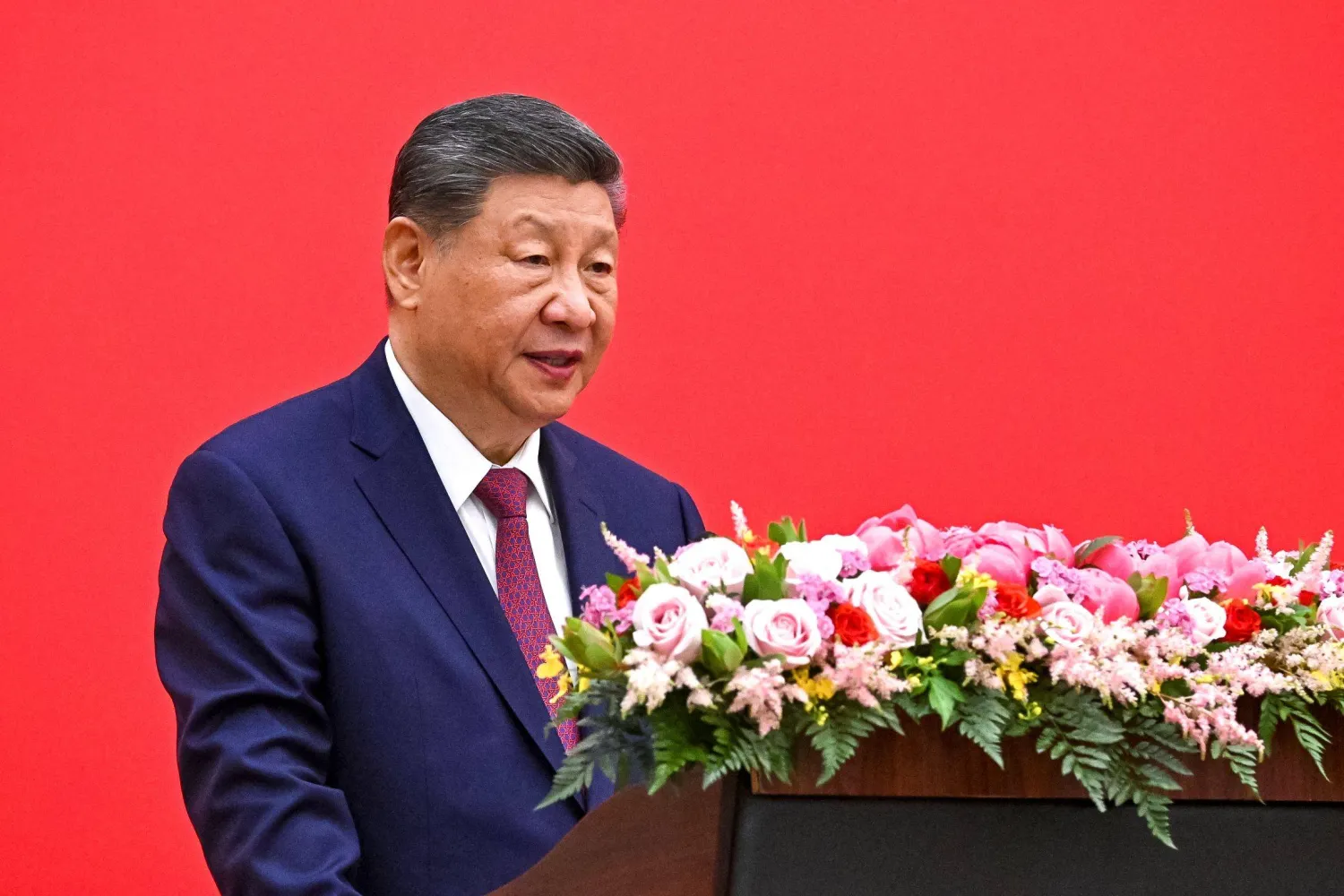
In this pool photograph distributed by the Russian state agency Sputnik, China's President Xi Jinping gives a speech during the opening ceremony of the Years of Russian-Chinese Cooperation in Education in Beijing on May 20, 2026. (Photo by Kristina Solovyova / POOL / AFP)
TT

China Bets on AI to Promote President Xi Jinping's Thinking

In this pool photograph distributed by the Russian state agency Sputnik, China's President Xi Jinping gives a speech during the opening ceremony of the Years of Russian-Chinese Cooperation in Education in Beijing on May 20, 2026. (Photo by Kristina Solovyova / POOL / AFP)

Xinhuanet, owned by China's official Xinhua news agency, plans to invest over 1.1 billion yuan ($162.38 million) on an "authoritative" AI agent to help promote President Xi Jinping's thinking, Shanghai Stock Exchange filings showed.

The project, known as "Xinhua Yudian," meaning Xinhua lexicon, is "an intelligent agent for learning, researching, and disseminating Xi Jinping Thought on Socialism with Chinese Characteristics for a New Era," the company said.

Driven by mainstream values and dedicated to "spreading the positive voice," the agentic AI will also provide users ⁠with current affairs and ⁠political news content to help them deal with information overload and "a dilemma of trust in distinguishing truth from falsehood.”

China in March launched a sweeping "AI+" blueprint to encourage the adoption of artificial intelligence across all sectors of the economy. It also ⁠follows previous tech-driven efforts to broaden the reach of official state ideology among an online-savvy younger generation.

In 2019, China rolled out a hit propaganda app known as "Xuexi Qiangguo," which literally translates as "Study to make China strong." At one point after its launch, it overtook WeChat and the Chinese version of TikTok to become the most popular app on Apple's China app store.

Xinhua's proposed agentic AI will ⁠present the ⁠essence of Xi's discourses to its users, who can rely on the tool as a politically sensitive citation checker, ensuring references to Xi's words "in official document writing and policy interpretation are accurate and error-free."

To be built on the state-run news agency's "pure and clean" corpus library, the AI will help deliver the party's voice to all sectors of Chinese society, lending further support to "consolidating the ideological and public opinion foundation," the company said.




IBM Unveils Tech for Chip Smaller than 1 Nanometer in AI Computing Push

FILE PHOTO: The IBM logo is seen during the Viva Technology conference dedicated to innovation and startups at Porte de Versailles exhibition center in Paris, France, June 12, 2025. REUTERS/Benoit Tessier/File Photo
TT

IBM Unveils Tech for Chip Smaller than 1 Nanometer in AI Computing Push

FILE PHOTO: The IBM logo is seen during the Viva Technology conference dedicated to innovation and startups at Porte de Versailles exhibition center in Paris, France, June 12, 2025. REUTERS/Benoit Tessier/File Photo

IBM on Thursday unveiled what it said was the world's first technology capable of producing chips smaller than one nanometer, as tech companies race to build semiconductors that can handle increasingly demanding AI workloads.

The announcement comes at a time when chipmakers are searching for ways to maintain the decades-long trend of cramming more computing power into smaller spaces, a phenomenon known as Moore's Law.

The new chip technology, which bolsters IBM's position to compete with contract chipmakers ⁠TSMC and Intel, ⁠has a transistor architecture of 0.7 nanometers, or 7 angstroms, Reuters reported.

Last week, Intel said the new generation of its 18A manufacturing process, which makes 1.8 nanometer chips, moved into risk production, the testing phase before commercial manufacturing.

IBM said the ⁠0.7-nanometer chip packs nearly 100 billion transistors onto a fingernail-sized surface, about twice the density of its 2-nanometer chip unveiled in 2021, delivering up to 50% higher performance or 70% greater energy efficiency.

To get there, IBM developed a new transistor design called "nanostack.”

Instead of laying transistors flat, the design stacks them on top of each other in three dimensions, fitting more into the ⁠same volume ⁠of space.

"With our new nanostack architecture, we’re not just making smaller transistors, we’re reinventing how chips are built to deliver dramatically more power and energy efficiency,” director of IBM Research Jay Gambetta said.

IBM says production could begin within five years. The company has previously licensed chip technologies to Samsung and Japan's Rapidus. It has not announced a manufacturing partner for this technology.


EU Says Amazon, Microsoft Cloud Services Should Face Stricter Rules

FILE PHOTO: A Microsoft logo is seen next to a cloud in Los Angeles, California, US June 14, 2016. REUTERS/Lucy Nicholson/File Photo
TT

EU Says Amazon, Microsoft Cloud Services Should Face Stricter Rules

FILE PHOTO: A Microsoft logo is seen next to a cloud in Los Angeles, California, US June 14, 2016. REUTERS/Lucy Nicholson/File Photo

The EU said Thursday that the cloud services of Amazon and Microsoft should face tougher digital competition rules in Europe because of their dominant position in the sector, AFP reported.

Amazon Web Services and Microsoft's Azure are the largest and second-largest cloud computing services in the European Union respectively. They "will only continue to grow in importance, which is why it is essential that we ensure a well-functioning and competitive market", EU antitrust commissioner Teresa Ribera said.


KSrelief Holds Workshop on AI’s Role in Advancing Humanitarian and Development Work

The workshop discussed emerging trends and risks. SPA
TT

KSrelief Holds Workshop on AI’s Role in Advancing Humanitarian and Development Work

The workshop discussed emerging trends and risks. SPA

The King Salman Humanitarian Aid and Relief Center (KSrelief), in collaboration with the UK Foreign, Commonwealth & Development Office (FCDO) and the Saudi Fund for Development (SFD), organized a two-day workshop titled “Data and Artificial Intelligence in the Humanitarian and Development Sectors: A Saudi-UK Partnership for Leadership and Impact” at its headquarters in Riyadh.

The workshop that started Tuesday was attended by KSrelief Director of Information Technology Eng. Tamim Al-Husain and UK Deputy Ambassador to Saudi Arabia Dr. Alice Burt.

The event brought together experts from the Saudi Data and Artificial Intelligence Authority (SDAIA), the King Abdulaziz City for Science and Technology (KACST), and specialists from KSrelief, SFD, and FCDO.

The workshop discussed emerging trends and risks, facilitated the exchange of expertise, and explored opportunities for future cooperation and partnerships between Saudi Arabia and the United Kingdom in the field of artificial intelligence to advance humanitarian and development work.

It also highlighted the importance of data and AI in humanitarian and development leadership, reviewed practical applications of AI in humanitarian needs assessments, early warning systems, inclusion efforts, and demographic trend analysis, and examined AI governance and safeguards for the safe and responsible use of emerging technologies.

In addition, participants discussed Saudi Arabia’s approach to leveraging technology in the humanitarian sector and developed a roadmap for the next round of strategic dialogue between the two countries.

The workshop was held as part of efforts to strengthen cooperation and coordination between Saudi Arabia and the UK in data and AI, to advance humanitarian, relief, and development work through the effective use of modern technologies.