


WFP: Middle East Conflict Pushing Millions Into Hunger

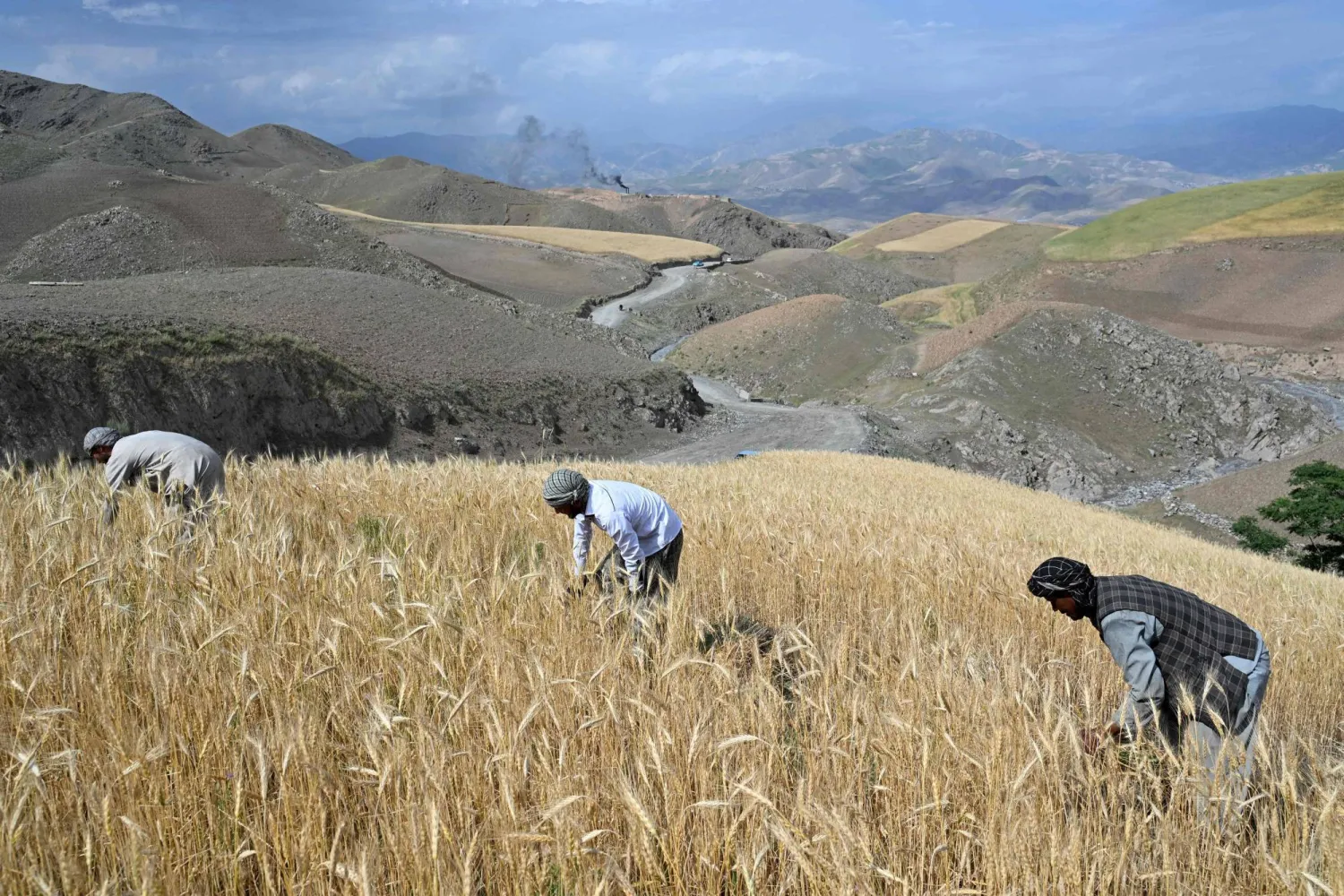
Farmers harvest wheat in a field on a hillside in the Argo district of Afghanistan's Badakhshan province on June 4, 2026. (Photo by Omer ABRAR / AFP)
TT

WFP: Middle East Conflict Pushing Millions Into Hunger

Farmers harvest wheat in a field on a hillside in the Argo district of Afghanistan's Badakhshan province on June 4, 2026. (Photo by Omer ABRAR / AFP)

The Middle East conflict is pushing millions of people closer to hunger, as rising fuel and transport costs drive up food prices while funding shortfalls force aid agencies to scale back assistance, the UN World Food Program said on Friday.

Joint US-Israeli strikes on Iran in February triggered a regional conflict stretching across the Gulf and into Lebanon, disrupting key shipping routes, including the Strait of Hormuz, forcing vessels to reroute and sharply constraining global energy flows and supply chains.

In March, the WFP forecast as many as 45 million people could fall into ⁠acute food insecurity ⁠if oil prices remained around $100 per barrel through June.

That scenario is now unfolding, the agency said, according to Reuters, with benchmark crude prices staying above that level since early March.

Households in Afghanistan, Somalia and Sri Lanka are among the most seriously affected and face mounting pressure due to higher fuel costs, ⁠food price spikes, income losses and disrupted trade.

In Somalia, 6.5 million people - roughly a third of the population - are expected to face severe hunger in 2026, while Afghanistan could see 17.4 million people affected, the WFP said.

The situation is projected to worsen, with an additional 2.5 million Somalis and 2.3 million Afghans at risk of falling into food insecurity if disruptions persist.

Both countries are reliant on imported energy and food.

The Middle East crisis comes amid a deep funding shortfall for ⁠aid agencies.

⁠The WFP said it expected to serve 1.5 million fewer people globally in 2026, and an extra 9 million fewer if the situation persists for six months.

In Afghanistan, surging fuel prices have driven up aid transport costs as much as fivefold, and delivery times have shot up from 10 days up to as many as 75 days as trucks had to use alternative corridors, the WFP said.

In Somalia, soaring jet fuel prices are leading to higher operational costs for the United Nations Humanitarian Air Service - the only means to safely access hard-to-reach areas, the WFP said.



Can Iran Rebuild its Military Arsenal?

Drones are seen at an undisclosed location in Iran. (Reuters file)
TT

Can Iran Rebuild its Military Arsenal?

Drones are seen at an undisclosed location in Iran. (Reuters file)

The full extent of damage to Iran’s military from US and Israeli strikes in 2026 remains unclear. “What is clear is that absent regime change, Iran will move quickly to reconstitute,” said a report by the Center for Strategic and International Studies (CSIS)

“Open-source evidence, though incomplete, points to significant degradation of Iran’s military in the recent conflict. Commercial satellite imagery confirms the loss of nearly all of Tehran’s conventional naval surface fleet and further damage to its principal military shipyards and naval bases, which have also been rendered partially inoperable by sunken vessels blocking military berths.”

Imagery also shows damage to aboveground weapon production sites and munitions facilities. Reports vary on the extent to which the 6,770 drone and missile launches as of April 1 have depleted Iran’s inventory. Recent US government assessments reported in the New York Times and the Washington Post say Tehran retains 70 percent of its prewar missile stockpile but only 40 percent of its drone arsenal.

“Based on the damage, Iran will look to clearing the ports, as without functional ports, the rest of the reconstitution effort is bottlenecked. Marine salvage operations to remove sunken hulls and restore channel access are necessary for much of what follows,” said the CSIS report.

Iran will seek to repair and rebuild weapons and munitions facilities. This is the precondition for reconstituting military production at scale. The work will require not just construction, but the replacement of damaged or destroyed manufacturing equipment.

“Drones are central to Iran’s military doctrine, its asymmetric posture, and its military export regime. Restoring and maintaining stockpiles will be a first-order priority.”

“With the conventional fleet degraded and shipyards damaged, Tehran is likely to lean further into the Revolutionary Guards small boat, fast attack, and unmanned maritime capabilities - platforms that are cheaper, faster to build, and better suited to the harassment and denial missions Iran is most likely to pursue in the near term,” said the report.

Clearing the ports requires specialized equipment, including enclosed marine salvage airbags, high-capacity submersible hydraulic pumps, and heavy-duty overhead gantry cranes.

Replenishing the drone fleet requires the sustained import of critical components. As recently as November 2022, according to leaked documents from a Russian delegation visit, Iran was assessed to be able to produce approximately 5,000 engines and 500 airframes for the Shahed-136 drone annually.

To do so, Iran requires a consistent supply of imported components, such as electronics and engines. Iran will also look to rebuild lost domestic production capabilities, importing not only components from abroad but also the fundamental equipment and materials needed to rebuild its partial self-sufficiency.

Iran’s procurement routes are being reshaped by the conflict. Iran is likely to develop more procurement pathways through countries bordering the Caspian in general.

“While Chinese materials, components, and equipment will likely be good enough to meet the bulk of Iran’s needs, Iran will likely continue its attempts to illicitly procure advanced Western technologies, such as German and Japanese machine tool controllers,” said the report.

“Diplomatic pressure on China could also lead to further trade obfuscation, with goods making multiple stops between China and Iran, making it more difficult to identify sources of supply but also slowing procurements and making them more costly,” it added.


Venezuela Earthquakes Kill Nearly 1,000, Tens of Thousands Missing

People drive past a collapsed building after an earthquake, in La Guaira, Venezuela, June 24, 2026. REUTERS/Maxwell Briceno
TT

Venezuela Earthquakes Kill Nearly 1,000, Tens of Thousands Missing

People drive past a collapsed building after an earthquake, in La Guaira, Venezuela, June 24, 2026. REUTERS/Maxwell Briceno

The death toll from twin earthquakes in Venezuela rose Friday to 920, with tens of thousands reported missing as international rescue teams boosted a desperate and slow-moving search for survivors.

Caracas residents jeered interim leader Delcy Rodriguez during her visit to a devastated neighborhood, as fury over the perceived lack of an official response mounted.

United Nations aid chief Tom Fletcher told AFP that more than 50,000 people were missing after two powerful earthquakes struck within a minute of each other on Wednesday evening, flattening buildings in the north of the country.

The coastal area of La Guaira, near the capital Caracas, was the worst hit, with one building after another crumpled by the magnitude 7.2 and 7.5 quakes.

Access to the disaster zone was restricted from 8:00 pm on Friday (0000 GMT Saturday), Interior Minister Diosdado Cabello announced in a televised address.

A rescue team from Chile arrived at one residential complex in La Guaira made up of four tall buildings housing hundreds of apartments that had largely been reduced to rubble.

"Unfortunately, the collapse is total, and there is little chance of finding survivors. Efforts are now focused on recovering the bodies of the deceased," team leader Nadiomar Polanco said at the site, which resembles many others in the city.

Elsewhere, family members, neighbors and volunteers used their bare hands to try to dig out survivors, bemoaning the lack of heavy machinery or official help to save those trapped alive.

"I am looking for my little Gael... he was only five months old," said an anguished Marjosly Salazar, 40, whose 16-year-old daughter died in the quake. The baby and Salazar's cousin are both missing.

"Please, we need support here. We need machinery to start lifting the columns," she said. "We haven't seen any government officials here, none at all."

In an upscale Caracas neighborhood, Rodriguez was greeted with angry chants from a crowd of people whose loved ones were trapped under the debris.

"The government isn't doing anything for the people," they yelled from behind cordons next to a pulverized building.

- 'Very complex' -

AFP saw workers using sledgehammers to break through detritus, calling for "absolute silence" to detect cries from survivors.

"It's a very, very complex emergency response," the UN's Fletcher told AFP, warning the death toll could rise significantly.

Aftershocks and destroyed buildings still posed significant dangers.

Venezuela's worst earthquake in more than a century has come after the oil-rich country endured more than a decade of economic collapse.

The crisis has hollowed out hospitals and public services, driving millions to leave the country.

The country is still in a fragile transition six months after the United States ousted leader Nicolas Maduro.

- Help arrives -

The UN humanitarian agency OCHA said search and rescue teams from at least 17 countries were being mobilized to help find survivors.

Spanish, Salvadoran, Swiss, Colombian, and Mexican rescue teams were already on the ground.

Rodriguez said Friday she had received a call from US President Donald Trump and Secretary of State Marco Rubio who "reaffirmed their commitment to supporting the response efforts by sending rescue workers, specialist equipment, support for temporary shelters and humanitarian aid for the affected families."

The United States said earlier it was sending a disaster response team of more than 250 personnel, including three special search-and-rescue units with dogs trained to locate people trapped beneath the rubble.

A senior US military official landed in Caracas to oversee Washington's relief efforts.

"Even before the earthquakes, millions of people across Venezuela were facing food insecurity, collapsing health services, protection risks, and limited access to basic services," the UN and other aid agencies said in a statement Friday.

"The international community must not allow this emergency to deepen into a larger human tragedy."

Earthquakes of similar magnitude claimed more than 200,000 lives in Haiti in January 2010 and 73,000 lives in Kashmir in October 2005.

- Foreigners killed -

Those killed included 28 Portuguese nationals, five Spaniards, two Brazilians, seven Chinese nationals, one Chilean and one Italian-Venezuelan.

85 Portuguese nationals and 119 Spaniards were missing or otherwise unaccounted for, according to their respective governments.

The quakes were the most powerful to hit Venezuela since a 7.7-magnitude tremor struck offshore in 1900.

Venezuela's northern coast sits on a boundary between the Caribbean and South American tectonic plates, but had not experienced a major quake since 1997.

Minutes of silence preceded Friday's World Cup 2026 matches to honor the victims of the tragedy.


Trump Unveils New US Passport -- with Picture of Himself

Image published by Trump of a new limited-edition American passport featuring his image ('Truth Social')
TT

Trump Unveils New US Passport -- with Picture of Himself

Image published by Trump of a new limited-edition American passport featuring his image ('Truth Social')

President Donald Trump on Friday unveiled a rendering of a new limited-edition US passport to mark the country's 250th anniversary of independence -- featuring his stern-faced likeness.

"The U.S.A.'s New Passport, which says, 'Welcome, but be good!'" Trump said in a post on his Truth Social platform featuring the passport mock-up, AFP reported.

The image features a glowering Trump leaning on his desk and his signature, with the text of the Declaration of Independence in the background. It appears to be based on a portrait taken by White House photographer Daniel Torok.

The opposite page shows a painting depicting the declaration's signing in 1776, with the words "United States of America 250."

The White House posted the same passport rendering, with the words "PATRIOT PASSPORT."

The State Department -- which had previously announced that a commemorative passport with "custom artwork" would be available from July 6 -- did not immediately respond to a request for comment.

In April, a department official said the Trump-themed passports would only be available at in-person appointments in Washington "for as long as there is availability."

Trump has aggressively put his personal stamp on government institutions, with banners of the president flying outside several government buildings, and the Treasury Department saying his signature will soon appear on the one-dollar bill.

Trump also added his name to the John F. Kennedy Center for the Performing Arts -- until a court ruled that it should be removed.

He will be the first sitting US president featured in Americans' travel documents.