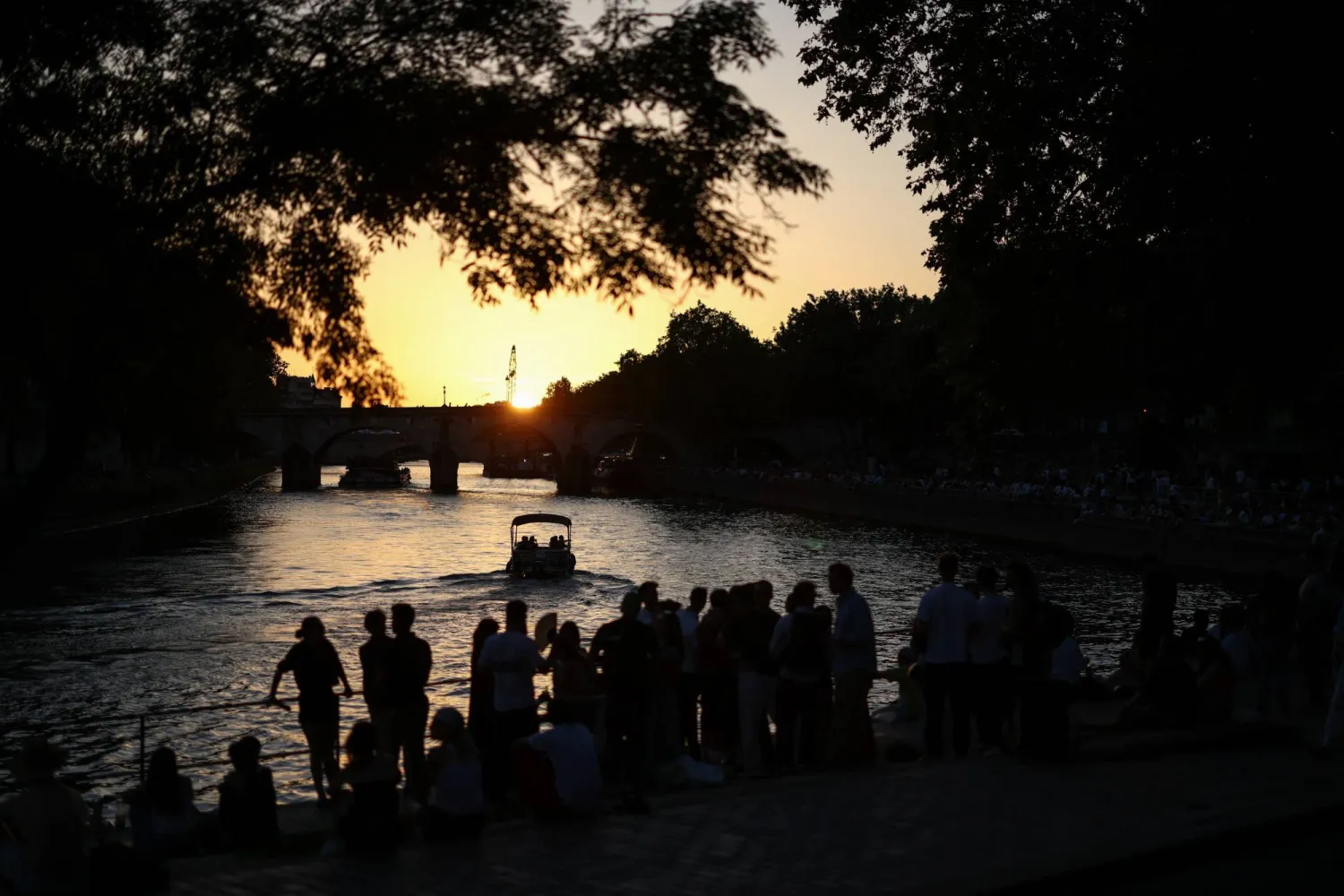
Parisians Will Get a New Chance of Seine Swimming

People gather on the banks of the Seine River as the sun sets amid a severe heat wave in Paris, France, May 26, 2026. (Reuters)
TT

Parisians Will Get a New Chance of Seine Swimming

People gather on the banks of the Seine River as the sun sets amid a severe heat wave in Paris, France, May 26, 2026. (Reuters)

Swimmers will for the second year be able to cool off at designated points along the Seine River in Paris this summer, authorities said Friday, as well as along the Marne River in the suburbs.

In Paris, the swimming season was to open at three official bathing sites on July 4, the mayor's office said.

The Seine reopened to swimmers last summer for the first time in a century, after Paris poured more than a billion euros ($1.15 billion) into a years-long effort to making the waters clean enough to use in the 2024 Olympics.

Sites this year will again include the Bras de Grenelle near the Eiffel Tower, the Bras Marie -- a short walk from Notre-Dame -- and Bercy, on the eastern side.

Some 100,000 people last year queued to jump in, the city said, despite a slow start to the season with rain disrupting the water quality.

Some 50,000 swimmers jumped into the Marne River in the eastern suburbs last year.

The bathing spots in Joinville-le-Pont, Champigny-sur-Marne, Saint-Maur-des-Fosses and Maison-Alfort would again welcome swimmers. A fifth spot would be added this year at Neuilly-sur-Marne northeast of Paris.

French authorities warned against swimming in parts of the rivers without lifeguards.


Heavy Rain Pounds Western Japan as 2 Tropical Storms Approach

 People clean mud and debris from a flooded area after heavy rain brought by Tropical Storm Mekkhala in Hsinchu, Taiwan, June 26, 2026. (Reuters)
People clean mud and debris from a flooded area after heavy rain brought by Tropical Storm Mekkhala in Hsinchu, Taiwan, June 26, 2026. (Reuters)
TT

Heavy Rain Pounds Western Japan as 2 Tropical Storms Approach

 People clean mud and debris from a flooded area after heavy rain brought by Tropical Storm Mekkhala in Hsinchu, Taiwan, June 26, 2026. (Reuters)
People clean mud and debris from a flooded area after heavy rain brought by Tropical Storm Mekkhala in Hsinchu, Taiwan, June 26, 2026. (Reuters)

Heavy downpours triggered flooding in parts of western Japan on Friday as two approaching tropical storms added to a seasonal rain front already stuck above the country.

Storm Mekkhala was off the western coast of Japan's southern remote island of Amami as of late afternoon Friday as it headed northeast, the Japan Meteorological Agency said.

Another storm, Higos, was traveling nearby and the two storms are expected to reach the Tokyo region Saturday while dumping heavy rain, the JMA said.

Earlier Friday, a man was injured as he fell into a waterway in Nara, according to Japan's NHK public television.

Television footage from Kyoto showed the Kamo River swollen with muddy water. A flooding alert was issued in parts of Kyoto, Osaka and other areas in western Japan.

The Fire and Disaster Management Agency said more than 30 homes were flooded in Nara and Hiroshima on Friday. Heavy rain also disrupted some train operations and flights in the area.


Swiss Glaciers Facing Drastic Loss from Heatwave

Switzerland's glaciers are taking a hammering from the European heatwave. Fabrice COFFRINI / AFP/File
TT

Swiss Glaciers Facing Drastic Loss from Heatwave

Switzerland's glaciers are taking a hammering from the European heatwave. Fabrice COFFRINI / AFP/File

Swiss glaciers are set to lose an enormous amount of ice due to the heatwave battering Europe, the head of Glacier Monitoring in Switzerland (GLAMOS) told AFP.

The snow and ice accumulated last winter by Switzerland's glaciers is expected to have all melted away by Monday, marking the alarming second-earliest arrival on record of the tipping point known as glacier loss day.

All further melting between now and October will see the size of glaciers in the Swiss Alps shrink.

In data going back to 2000, the only time that the tipping point arrived even earlier was in 2022, when it came on June 26.

The grim scenario is driven by the current heatwave, as well as the one in May -- both coming on the back of another winter with poor snowfall.

"We're just seeing enormous ablation, ice melt rates and snow melt rates all over the Alps," GLAMOS network chief Matthias Huss told AFP on Friday, as multiple Swiss weather stations registered new all-time records.

"We are three months too early compared to a healthy state."

This century, the tipping point, on average, has been reached in mid-August -- itself already bad news for the nation's glaciers, which are shrinking at a staggering rate.

- Glaciers in 'very bad state' -

Much of the water that flows into the Rhine and the Rhone, two of Europe's major rivers, comes from the Alpine glaciers.

Huss said he had just returned from the Rhone Glacier, and in the 10 days since his previous visit, "there was one meter of ice melted in the vertical direction -- one meter of melting within just the last 10 days".

"It's very impressive to see, and this is just the effect of the heatwave."

But, said Huss, "one heatwave alone is not a big problem for glaciers".

"The problem is rather that we have very high temperatures that last for a very long time.

"The more days that are added that are very high temperatures, not even mattering whether it's 35C or 40C, this is just very bad for the glaciers."

Huss said the "very bad state of the glaciers at the moment" was down to a "combination of bad circumstances", including less snowfall, and the arrival of dust from the Sahara Desert in March.

He said 2026 was "surprisingly similar" to 2022, which for glaciers was "by far the most extreme year ever recorded in the Alps, with melt rates shattering everything we had seen before".

- Melting away -

He said this year had seen 25 percent less snow replenishing the surface of the glaciers compared to the 2010-2020 figures.

Meanwhile May was warm, causing the snowpack to disappear earlier.

Once the reflective white snow coverage from winter is gone from the top of the glacier, the darker, more absorbent grey surface of the bare ice is exposed.

This absorbs radiation more quickly, meaning extreme melting produces an accelerating feedback effect, worsening the situation even further.

While the full scale of this year's damage will be measured in September, "it is clear already now that we will have very strong ice loss also this year".

Glaciers in the Swiss Alps began to retreat about 170 years ago.

The retreat was initially modest but in recent decades, melting has accelerated significantly as the climate warms.

The volume of Swiss glaciers shrank by 38 percent between 2000 and 2024.

Huss said Switzerland had already lost 1,200 glaciers in the past 50 years, and there now only 1,300 left.

"Those lost were small glaciers, but they were still relevant in peripheral regions of the Alps," the glaciologist said.

"If warming continues as it did over the last decades, by 2100 we will only be left with some little remnants of ice."


Greece Is Paying Fishermen to Catch Toxic Toadfish Invading the Warming Mediterranean

A silver-cheeked toadfish placed on the ground after being caught by fishermen on the southern island of Crete, Greece, Monday, June 22, 2015. (InTime News via AP)
TT

Greece Is Paying Fishermen to Catch Toxic Toadfish Invading the Warming Mediterranean

A silver-cheeked toadfish placed on the ground after being caught by fishermen on the southern island of Crete, Greece, Monday, June 22, 2015. (InTime News via AP)

Fishermen in Greece are getting cash payouts to catch toxic fish migrating north into the Mediterranean Sea due to climate change.

The silver-cheeked toadfish is a torpedo-shaped species with prominent, humanlike teeth. Its skin and organs contain a powerful neurotoxin that can cause heart failure in humans if consumed.

Authorities say the fish have not been sighted in bathing areas at Greek island resorts. But in recent weeks, the fish have wreaked havoc for fishermen off the coast of Crete and several other Greek islands, chomping through nets.

“It’s got to the point where we might go out fishing one day and then spend the next three days fixing our nets,” Giorgos Kyriakakis, of a Cretan fishermen’s association, told Greek public broadcaster ERT on Friday.

“They eat our catch and damage our nets — that’s very costly,” he said.

The fish are believed to have traveled up the Suez Canal and into the Mediterranean, attracted by warming waters. The invasion prompted Cyprus to launch a similar catch program earlier this year.

Starting Friday, Greece's government is offering 5.33 euros per kilogram (about $2.75 per pound) for catches of the fish, which is normally found in tropical waters.

“It’s the first time that such a measure has been taken in Greece,” Agriculture Minister Margaritis Schinas, a former European Commission vice president, said ahead of the program’s launch.

The fish – a member of the puffer fish family – will be frozen and incinerated at local government facilities, Schinas said. He added that the measure would likely be expanded from the currently affected islands to all Greek waters.

Public concern has been stoked in Greece by online videos posted by Greek fishing crews, showing the fish sinking their teeth into soda cans or pieces of wood.

The Greek Red Cross has issued a public health warning about the fish, outlining first-aid protocols for bleeding caused by potential bites and warning of the deadly neurotoxin in the fish’s organs.

But authorities and businesses on the island of Crete cautioned against overreacting to the fish’s offshore presence.

“The presence of these fish in the Mediterranean has been known for years,” a statement issued Friday by 16 medical and tourism associations on Crete said.

“There is, however, no ‘invisible’ or imminent danger to bathers. Marine predators do not threaten the safety of visitors and residents,” it said. “Exaggeration is often a feature of public debate.”