


Putin Rejects Zelenskyy’s Offer to Meet, Saying He Sees ‘No Point’ in It

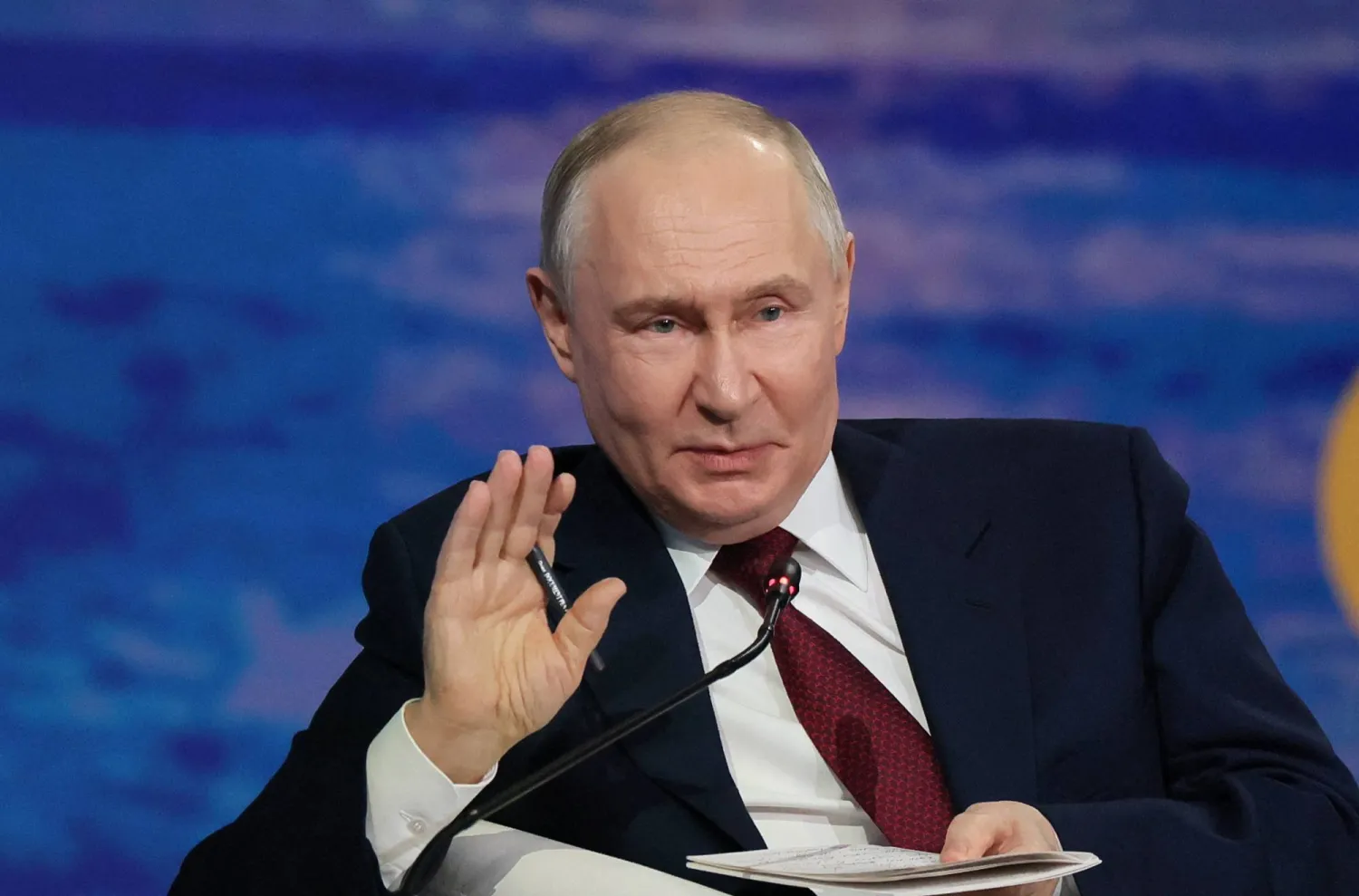
 Russia's President Vladimir Putin attends a plenary session of the St. Petersburg International Economic Forum (SPIEF) in Saint Petersburg, Russia June 5, 2026. (Reuters)
Russia's President Vladimir Putin attends a plenary session of the St. Petersburg International Economic Forum (SPIEF) in Saint Petersburg, Russia June 5, 2026. (Reuters)
TT

Putin Rejects Zelenskyy’s Offer to Meet, Saying He Sees ‘No Point’ in It

 Russia's President Vladimir Putin attends a plenary session of the St. Petersburg International Economic Forum (SPIEF) in Saint Petersburg, Russia June 5, 2026. (Reuters)
Russia's President Vladimir Putin attends a plenary session of the St. Petersburg International Economic Forum (SPIEF) in Saint Petersburg, Russia June 5, 2026. (Reuters)

Russian President Vladimir Putin on Friday rejected a proposal by Ukrainian President Volodymyr Zelenskyy for a face-to-face meeting on the 4-year-old conflict, saying he sees “no point” in it.

Thursday's letter, the first public message Zelenskyy has written directly to Putin since Russia sent troops into Ukraine in 2022, was a sweeping critique of the Russian leader’s 26 years in power as well as some taunts about his age.

Speaking at the St. Petersburg International Economic Forum, Putin described Zelenskyy’s open letter proposing the meeting as “boorish.”

“Is it a way to create conditions for personal meetings and talks, or create an environment which makes any personal meetings impossible?” Putin said at a question-and-answer session at his annual St. Petersburg International Economic Forum. “I think it’s the second.”

Putin added that a Russian businessman whom he didn’t identify traveled to Kyiv last month and met with Zelenskyy to hear his offer of a personal meeting.

However, Putin said that he sees “no point” in such a meeting, especially after a May 22 drone attack by Ukraine on a college dormitory in the Russian-controlled Luhansk region that Moscow said killed 21 and wounded scores of others.

In response to Zelenskyy’s barbs about his age and long stay in power, the 73-year-old Putin pointed at other global leaders who are older, adding that “the main thing isn’t age; the main thing is the ability to work.”

He also mocked Zelenskyy's rocky Oval Office meeting in 2025 and thanked US President Donald Trump for “educating” Zelenskyy “before the eyes of the whole world” and teaching him a proper dress code.

“There is still a lot to be done,” he said.

Zelenskyy acknowledged shifting US priorities, saying it would be wrong to simply wait for the Trump administration to return its attention to ending the fighting in Ukraine while it remains heavily focused on the Iran war.

In Washington, Trump said Thursday it “would be great” if Putin and Zelenskyy meet.

Putin has previously offered for Zelenskyy to come to Moscow for talks, an offer that the Ukrainian leader pointedly rejected. Putin said last month he doesn’t exclude a meeting in a third country, but only when there is a deal to sign.

On Thursday, Putin again rejected Zelenskyy’s push for an immediate ceasefire, arguing that Moscow wants a comprehensive settlement, not a temporary truce.

Putin said Russia is open for a compromise on Ukraine in line with understandings reached at his last year’s summit with Trump in Anchorage, Alaska, adding that Ukraine needs to accept them to make a deal to end the conflict.

“Naturally, the Ukrainian side would like us to suspend the advances made by Russian troops,” he said. “But it would be better to end the war by agreeing to the compromises that were discussed in Anchorage.”

Global turbulence

In a speech earlier Friday at the forum, Putin said developing countries have gained an increasingly important role in the global economy, while the share of output by Western countries has shrunk.

He accused the West of undermining the global economy and finances with unilateral sanctions. By freezing Russian assets abroad through sanctions, Western nations eroded trust in their own currencies, he said.

“The sanctions and blocking of Russia’s sovereign reserves have irreversibly impacted the standing of international currencies, the dollar and the euro,” he said. “Just like Russia, any other country could lose access to their legitimate assets in dollars or euros, as well as Western financial and payment systems.”

He alleged that high state debt had helped undermine global trust in Western institutions.

“The roots of the current global turbulence lie in the transition from a vertical, hierarchical model, which served the interests of a small number of states, to a more complex, distributed and multipolar one,” Putin said. “Russia views global changes not only as a threat but also as immense opportunities. And to capitalize on them, we aim to act swiftly and pragmatically.”

The Russian leader said the world needed a “modern, flexible and responsible financial architecture — free from risks, bans and barriers.”

Putin stresses Russia's macroeconomic stability

Putin played down Russia’s economic slowdown and sought to emphasize its macroeconomic stability. He noted that Russia’s state debt is a fraction of that in Western countries and its budget deficit is considerably smaller, compared with the West.

The forum comes at a time when Russia’s economic outlook has clouded amid the conflict in Ukraine. The government raised taxes and increased domestic borrowing to keep its budget deficit under control.

On Thursday, Putin told heads of international media on the forum's sidelines that it was an exaggeration to say Russia's economy was struggling. He noted that his government had taken deliberate steps to cool the economy to keep inflation under control.

Putin has used the St. Petersburg forum, likened to the World Economic Forum in Davos, Switzerland, to showcase his country’s economic advances and encourage foreign investment. While Western officials and business leaders have stayed away after Putin sent troops into Ukraine in 2022, Russia has sought guests from elsewhere to underline its declared goal of promoting a “multipolar world.”

Hours before the forum opened Wednesday, a Ukrainian drone attack set ablaze an oil terminal in St. Petersburg and also hit a nearby naval base.

Putin declared that Russia was “calmly and resolutely” moving to reach its goals in Ukraine. He acknowledged the damage from Ukrainian drone attacks deep inside Russia and vowed to build up defenses.

“They do inflict a certain damage,” he said. “For us, it means only one thing: we need to strengthen our security, strengthen air defenses, and we will do that.”



Trump Rules Out New Iran Attack before US Midterm Elections

US President Donald Trump delivers remarks during the "A New Golden Age" summit at the US Institute of Peace, renamed The Donald J. Trump Institute of Peace by the Trump administration, in Washington, DC, US, October 8, 2026. REUTERS/Evan Vucci
TT

Trump Rules Out New Iran Attack before US Midterm Elections

US President Donald Trump delivers remarks during the "A New Golden Age" summit at the US Institute of Peace, renamed The Donald J. Trump Institute of Peace by the Trump administration, in Washington, DC, US, October 8, 2026. REUTERS/Evan Vucci

President Donald Trump ruled out Thursday attacking Iran before the US midterms on November 3, saying Washington was holding "productive discussions" with Tehran.

Trump's announcement on his Truth Social platform followed a surge in oil prices driven by media reports suggesting potential new US strikes prior to the elections, reported AFP.

"I want to make it clear to everybody that, while Iran is in very bad condition, both Economically and Militarily, and while the Blockade will remain in full force and effect...we will not be attacking Iran at any time prior to the Midterm Elections," he wrote.

"We are having productive discussions with the Islamic Republic of Iran," he added.

The Atlantic magazine reported on Wednesday that the White House had asked the Pentagon to develop options to strike Iranian targets that could be used before the midterms.

The New York Times said Thursday the plans were being developed despite Trump's "ambivalence."

The surge in crude oil prices has also been fueled by persistent tensions in the Strait of Hormuz -- a strategic chokepoint for the global oil trade -- as well as Houthi hostilities on Saudi Arabia.

Polls suggest American voters are strongly dissatisfied with fuel prices, which have soared since US-Israeli strikes against Iran on February 28 triggered the conflict.

Brent North Sea crude, the international benchmark, rallied to as high as $105.88 a barrel on Thursday before retreating to $104.28.

- Putin vows to help -

Russian President Vladimir Putin promised Thursday to "do everything" to help end the Middle East war when he met Iranian counterpart Masoud Pezeshkian for talks ahead of a regional summit, Russian media reported.

"We are ready to do everything that is in our power to contribute to the settlement of this situation," Putin said after arriving in Turkmenistan for a summit of the Commonwealth of Independent States (CIS) that starts Friday in the Caspian Sea resort of Avaza.

He added that Iran had made "real efforts to end the war," according to Russian news agencies.

Russia and Iran have reinforced diplomatic and military links since Russia launched its offensive in Ukraine in February 2022, becoming increasingly reliant on each other.

Trump has repeatedly insisted in recent weeks that the United States has effectively won the Iran war, despite ongoing unrest and a recent security threat that forced the withdrawal of American bombers from a base in England.

Iran's President Masoud Pezeshkian insisted Tehran was "engaged in dialogue, but every time we negotiate with the United States, they attack again", Iranian state media quoted him as saying at the talks with Putin.

Pezeshkian said the Iranian republic wanted to see a "final framework" to end the war.

But he accused the United States of "trying to impose its policies and views on all countries".

"If the United States insists on pursuing a unilateral approach, a resolution will not be possible," he said, according to state media.

- Approaching election -

The midterm elections will shape the final two years of Trump's presidential term as his Republican Party risks losing its current grip on Congress.

Although Trump is not on the ballot, he is holding numerous rallies in an attempt to limit the damage or even turn the political tide.

Trump has warned he faces a possible third impeachment if Democrats retake the House of Representatives, and the White House is preparing for a slew of investigations into corruption and abuse of power.

The US president also sought to calm a furor on Thursday over his comments at a rally earlier this week that Iran could "take out" the cities of Los Angeles and San Diego.

The 80-year-old blamed the "fake and artificial news" for misinterpreting the remarks, which Democrats pounced on.

"In actuality, what I was talking about was that a temporary increase in the price of Gasoline is a small price to pay for Iran not having a Nuclear Weapon and, if you want to see a big price, can you imagine what it would be like if they bombed San Diego and/or Los Angeles?" Trump said on Truth Social.


Putin Offers Help to Iran to End Mideast War ahead of Summit

Russia and Iran have significantly deepened military and trade ties. Evgenia Novozhenina / POOL/AFP/File
TT

Putin Offers Help to Iran to End Mideast War ahead of Summit

Russia and Iran have significantly deepened military and trade ties. Evgenia Novozhenina / POOL/AFP/File

Russia's President Vladimir Putin vowed on Thursday to "do everything" to help end the Middle East war when he met Iranian counterpart Masoud Pezeshkian for talks ahead of a regional summit, Russian media reported.

The leaders of two of the world's most sanctioned nations met after arriving in Turkmenistan for a summit of the Commonwealth of Independent States (CIS) that starts on Friday in the Caspian Sea resort of Avaza.

"We are ready to do everything that is in our power to contribute to the settlement of this situation," said Putin.

He added that Iran had made "real efforts to end the war" since US-Israeli attacks started on February 28, according to Russian news agencies.

Putin also noted the "positive evolution" in Iran-Russia relations.

The two countries have reinforced diplomatic and military links since Russia launched its offensive in Ukraine in February 2022, becoming increasingly reliant on each other.

- Conflict impasse -

Kyiv and Western countries have accused Iran of supplying Russia with Shahed drones and short-range missiles to pummel Ukraine.

Russia has been accused of supplying data to Iran for its attacks on US targets in the Middle East.

Putin and Pezeshkian also met on the sidelines of the Shanghai Cooperation Organization summit in Kyrgyzstan last month. And in a call on Wednesday, Putin told Pezeshkian that he was ready to help mediate in the Middle East war, Iranian state news agency IRNA reported.

The contacts came with Iran-US talks at an apparent impasse. Pezeshkian said this week that negotiations with Washington were "meaningless".

Diplomatic efforts to resolve Russia's offensive in Ukraine also appear deadlocked, even as both sides intensify attacks.

"We are engaged in dialogue, but every time we negotiate with the United States, they attack again," Iranian state media quoted Pezeshkian as saying at the talks with Putin.

Trump ruled out attacking Iran again before the US midterm elections on November 3, saying on Thursday that Washington was holding "productive discussions" with the Iranian republic.

Pezeshkian said Tehran wanted to see a "final framework" to end the war.

But he accused the United States of "trying to impose its policies and views on all countries".

"If the United States insists on pursuing a unilateral approach, a resolution will not be possible," he said, according to state media.

- Sphere of influence -

Putin and Pezeshkian will attend the summit of the CIS -- originally a grouping of former Soviet nations -- with leaders of Armenia, Azerbaijan, Belarus, Turkmenistan and other Central Asia states.

The Putin-Pezeshkian meeting was one of several bilateral encounters scheduled on the sidelines of the summit, according to Kremlin foreign policy aide Yuri Ushakov.

The CIS was established in 1991 to ease the pain of the Soviet collapse and maintain ties among its former republics.

Some states have left -- Georgia withdrew following a 2008 war with Russia, Ukraine halted its participation after Moscow's 2014 annexation of Crimea and Moldova left in 2023 as it sought closer ties with the European Union.

For Russia, which has found itself isolated since launching the Ukraine conflict in 2022, the CIS proves that it "actually has the orbit and that it has its own sphere of influence that is fortified and institutionalized", Temur Umarov, a researcher at the Carnegie Russia Eurasia Center in Berlin, told AFP.

But Friday's meeting also comes at a time when several CIS members are seeking to diversify their economic and diplomatic partnerships, notably by strengthening ties with China and Western nations.

"Even if Russia decides to use this platform to propagate anti-Western or anti-Ukrainian rhetoric, that does not mean the other members will automatically subscribe to its position," Zhanibek Arynov, a Kazakhstan-based researcher specializing in Central Asian geopolitics, told AFP.


Deadly Attacks Leave Several Wounded in Southeastern Iran

An image published by the Mizan news agency showing unrest in Zahedan, the capital of Sistan and Baluchestan province, on July 8.
TT

Deadly Attacks Leave Several Wounded in Southeastern Iran

An image published by the Mizan news agency showing unrest in Zahedan, the capital of Sistan and Baluchestan province, on July 8.

Armed attacks on police and army personnel across Iran’s southeastern Sistan and Baluchestan province left security forces dead and wounded on Wednesday evening. The attackers’ identities and the full casualty toll remained unclear.

Iranian police said an explosion at police headquarters in Golshan County was followed by gunfire from armed attackers. Police killed one assailant and wounded several others, official sources said, while a search for the remaining attackers continued, according to the Tasnim news agency.

A minibus carrying military personnel also came under armed attack in the Nikshahr area as they traveled to a shift change, Tasnim reported, citing the public relations office of the Iranian army’s 88th Armored Division. The official account said serviceman Mohammad Reza Oukati was killed and three others were wounded.

In a third attack, gunmen targeted a police patrol carrying out a security mission along the “Lakhshak–Zahedan/Nosratabad” route, killing officer Vahid Enayat, Tasnim said.

Several attackers were wounded but escaped, prompting Iranian forces to launch a search.

The attacks follow a string of operations and assaults in recent days. On Oct. 5, Iranian sources reported that two police officers were killed and a third was wounded in an attack on a patrol in Bampur, in the same province.

The violence appears to form part of a series of attacks and clashes close together in time across the province. Reports in early October described hours-long clashes near Zahedan. The Revolutionary Guards later said they had killed six people they described as members of an armed group, though accounts concerning the opposing side remained disputed.

Days earlier, Iran’s Intelligence Ministry announced it had dismantled three armed cells in the southeast, arrested 10 people and killed two others in clashes. That suggests security agencies were already on heightened alert in the region before Wednesday’s attacks.