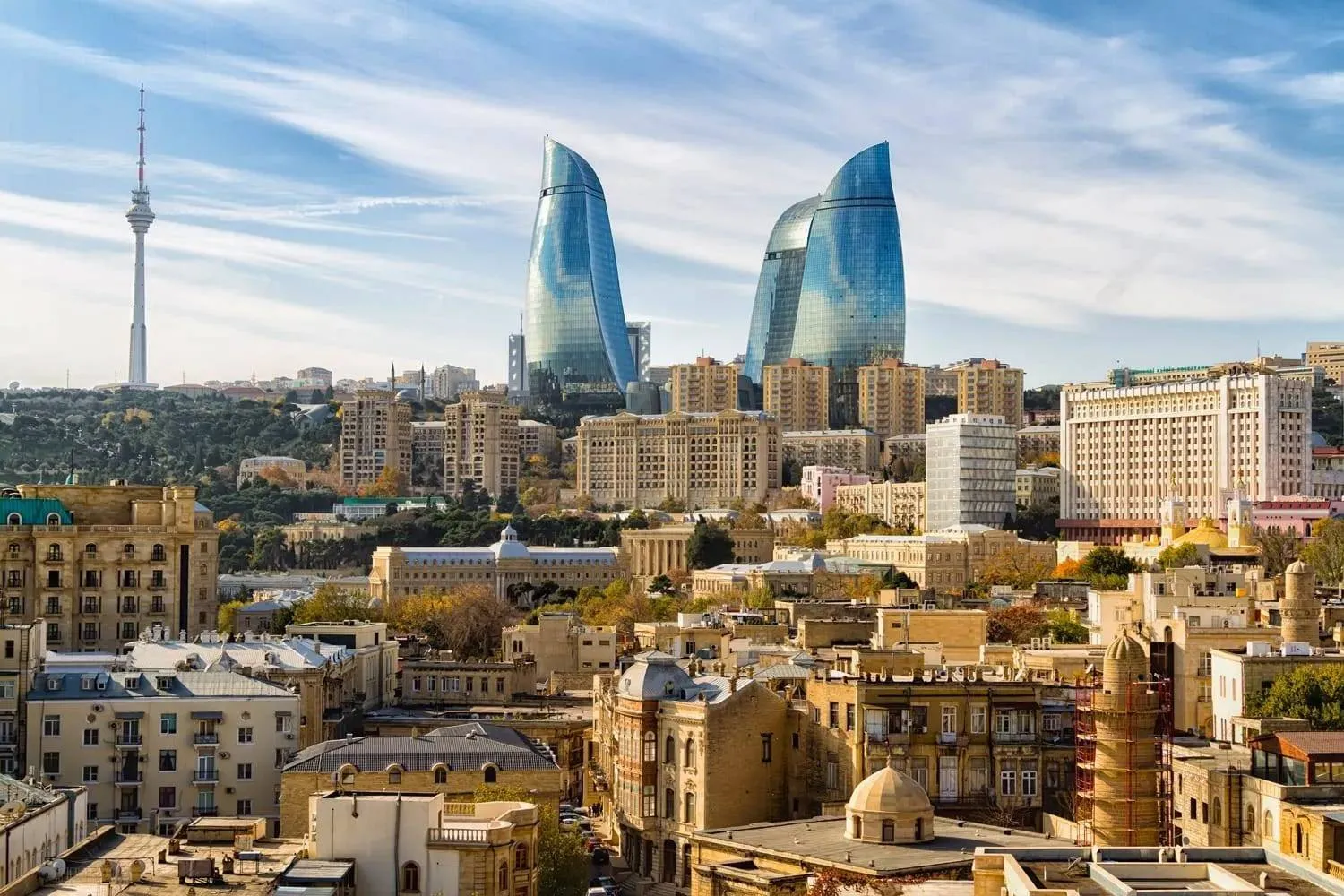

Report: Israel Sent Troops to Azerbaijan During Iran War

Azerbaijan’s capital, Baku (X)
TT

Report: Israel Sent Troops to Azerbaijan During Iran War

Azerbaijan’s capital, Baku (X)

Israel secretly deployed elite military and intelligence units to Azerbaijan during the war with Iran as part of a network of covert sites across the Middle East to facilitate operations against Iran, four sources familiar with the matter told CNN on Friday.

The forces operated out of several locations in southern Azerbaijan, two of the sources said, adjacent to Iran’s northern border and, at its closest point, only about 60 miles from the Iranian city of Tabriz, which Israel struck during the war.

Special commando units were also deployed to the location and carried out intelligence-gathering missions and drone operations, the other two sources said, giving Israel a valuable perch from which to see into northern Iran during the war.

The secret deployment to Azerbaijan, reported by CNN for the first time, was one of several military positions Israel maintained across the Middle East that gave its military unprecedented reach, highlighting the role Iran’s neighbors played in facilitating operations against Tehran and becoming entangled in the conflict.

Together, the deployments described by the sources placed Israeli forces along Iran’s southern, western, and northern periphery during the war, extending the military’s range by hundreds of miles, deep into Iranian territory.

The Azerbaijan operation consisted of several dozen troops, including members of Israel’s special operations forces, its elite heliborne combat and rescue force, and Mossad personnel, one of the sources said.

In return, a spokesperson for the Azerbaijani embassy in the United States said in a statement to CNN, “We firmly reject unfounded claims regarding the alleged use of Azerbaijan’s territory for operations against third countries.”

Israel has long viewed Azerbaijan as a strategic partner in its fight against Iran, and the preparations began weeks before the opening strikes of the war.

In mid-January, as Iran crushed wide-scale protests with the mass killing of demonstrators, Israel prepared a covert mission along the Azerbaijan-Iran border, two of the sources familiar with the plans told CNN.

Israel was planning to execute the operation under cover of what were to be the opening strikes of the war in mid-January. But US President Donald Trump called off the strikes at the last minute, saying that Iran had agreed to stop the killing of demonstrators. Israel proceeded on its own.

The Israeli Air Force used stealth jets and special forces as part of the operation to install the devices, as Israel’s political leadership believed negotiations between the US and Iran were doomed to fail.

The intelligence-gathering site became another means by which Israel could collect information on Iranian military movements and facilities, as well as potentially providing early warning of missile launches.

Joint Operations

One of the key operations launched from Azerbaijan, one of the sources said, was the killing on March 4 of Rahman Moghaddam, who led the Revolutionary Guard Corps’ (IRGC) intelligence division and who Israel said was responsible for planning an assassination attempt against Trump in 2024.

Israel and Azerbaijan maintain close ties around commercial and military interests. Baku provides Israel with a large share of its oil. In return, Israel sells Azerbaijan advanced weaponry.

“Israeli strategy in Azerbaijan remains deliberately low-profile, relying on arms transfers, intelligence cooperation, and long-term technological interdependence in the security sector,” wrote Gershon Kogan, a specialist on Iran at the Begin-Sadat Center for Strategic Studies, before the Iran war began.

The relationship also gives Azerbaijan access to a critical diplomatic resource, according to Joshua Kucera, a senior analyst for the Crisis Group, allowing Baku to utilize Israel’s lobby in Washington, DC.


Türkiye MPs Back Historic Law on Reintegrating Kurdish Militants

Lawmakers take part in a voting session on a bill offering limited amnesty for Kurdish PKK militants at Grand National Assembly of Türkiye in Ankara on August 10, 2026. (AFP)
TT

Türkiye MPs Back Historic Law on Reintegrating Kurdish Militants

Lawmakers take part in a voting session on a bill offering limited amnesty for Kurdish PKK militants at Grand National Assembly of Türkiye in Ankara on August 10, 2026. (AFP)

Turkish lawmakers on Monday voted through a bill offering limited amnesty for Kurdish PKK militants, a key step in the peace process that seeks to end decades of deadly violence.

The law is Türkiye's first legislative step towards ending the conflict and comes 18 months after Abdullah Ocalan, the jailed founder of the Kurdistan Workers' Party (PKK), urged his followers to disarm.

After 12 hours of debate, lawmakers voted by 468 in favor to 88 against, with six abstentions, for the so-called "terror-free Türkiye law" which envisages a return to civilian life for some of the PKK fighters who lay down their weapons without granting a total amnesty.

But crucially, the text does not specify what will become of Ocalan, 77, who has spent the past 27 years being held in solitary confinement on Imrali prison island near Istanbul.

Ocalan has played a key role in efforts to end the conflict, issuing a historic call in February 2025 for his fighters to disarm and embrace democratic means to defend the rights of Türkiye's Kurdish minority.

Backed by President Recep Tayyip Erdogan's ruling Justice and Development Party (AKP) and the pro-Kurdish DEM party, the bill suspends prosecutions and prison sentences for some offences for between five and 10 years.

The move is expected to involve the release of around 3,500 PKK-linked detainees in an initial phase, lawmakers said -- around a third of the number held in Turkish prisons.

If those covered by the measure do not reoffend during that period, investigations would be dropped and sentences considered served.

But those involved in serious crimes such as murder would be excluded -- with the text making no mention of Ocalan.

Last week, Türkiye's vice president Cevdet Yilmaz told CNN Turk Ocalan's case "does not fall within the scope of this law" but said he would be "in a position to contribute to the peace process" without giving further details.

Following the vote, Yilmaz hailed the new law as a "historic step", saying "the 468 'yes' votes are of the utmost importance in terms of political consensus".

"We expect the disarmament and dissolution processes to be implemented as quickly as possible.. and subsequently for the relevant articles of the law to come into effect," he wrote on X.

- 'Crossing a historic threshold' -

Devlet Bahceli, a close Erdogan ally and head of the hardline nationalist MHP whose unexpected olive branch to Ocalan kickstarted the process in October 2024, also hailed the vote.

"May it bring good luck and success," he said, shaking hands with pro-Kurdish MPs from DEM -- which also played a key role in the process, with its lawmakers regularly visiting Ocalan on Imrali island to pass messages back and forth.

With the vote, Türkiye was "crossing a historic threshold", DEM MP Ceylan Akca told AFP.

"This is the first step of a long walk towards absolute and authentic equality. I choose to be optimistic," she said, admitting the vote had made her "more hopeful."

Ahead of the vote, the government had been keen to stress that the text was not a general amnesty law, aware of the misgivings of the Turkish public which has been scarred by decades of bloody conflict.

And the tension was evident as lawmakers held a heated debate in a session broadcast live on TRT public television.

"How can you negotiate with terrorists? ... You said they would be laying down their weapons unconditionally," said Turhan Comez, a lawmaker with the nationalist opposition Iyi party.

In May last year, the PKK announced it was disbanding following Ocalan's call and two months later, its militants took part in a historic disarmament ceremony in the mountains of northern Iraq where they began symbolically destroying their weapons.

But the PKK leadership has said excluding Ocalan from the legislation would be a red line, warning on Sunday that many of the bill's provisions would remain a "dead letter" if he were not freed.


Report: Trump Left NATO Summit on Secret Flight Due to Iranian Threat

US President Donald Trump speaks during the signing of an executive order reviewing childhood vaccine recommendations in the Oval Office of the White House in Washington, DC, USA, 10 August 2026. EPA/BONNIE CASH / POOL
TT

Report: Trump Left NATO Summit on Secret Flight Due to Iranian Threat

US President Donald Trump speaks during the signing of an executive order reviewing childhood vaccine recommendations in the Oval Office of the White House in Washington, DC, USA, 10 August 2026. EPA/BONNIE CASH / POOL

President Donald Trump secretly flew out of last month's NATO summit in Ankara, Türkiye, on an alternate military aircraft while the White House made it appear that the Republican president was flying on Air Force One, according to a report published by The Washington Post on Monday.

The Post said the operation was prompted by an Iranian assassination threat against Trump. The ruse was carried out as journalists and some White House staff members were led to believe they were on the same plane as the president as he began his journey back to Washington from the annual gathering of NATO country leaders.

The Post cited material reviewed by the newspaper, a US official familiar with the operation and another person with knowledge of the president’s travel. The Associated Press has not independently confirmed the report.

Trump had flown to the summit in a white and navy-blue jet. But ahead of departing Türkiye, he said he would fly partway home on an older-model baby blue Air Force One plane instead.

The president at the time said the new luxury jet was being flown out ahead of his departure from Ankara to give some US troops based in eastern England a chance to check out the new Air Force One.

In Ankara, Trump boarded the old Air Force One jumbo jet in view of television cameras ahead of the plane flying to Royal Air Force Mildenhall in the United Kingdom.

However, according to the Post report, after boarding the legacy Air Force One jet, he was secretly shuttled minutes later to a smaller plane — an Air Force C-32A — via an airport catering truck typically used to load meals and other supplies. Trump flew to Mildenhall on that smaller jet.

The White House did not respond directly to questions about the Post report of the secret operation to whisk Trump out of the country on a third aircraft, or the reported elaborate ruse to make it appear he was on the baby blue Air Force One jet flying to Mildenhall.

“As the President has said recently, there are many enemies of America who have their sights on him, and we use every tool at our disposal to address those threats,” White House communications director Steven Cheung said in a statement.

The US Secret Service declined to comment. The Air Force, which maintains the fleet of executive travel aircraft, referred questions to the White House.


Trump Demands Iran Pay Compensation for Deaths as Hormuz Deal Hopes Fade

US President Donald Trump attends an event to sign executive orders related to birthright citizenship and the polysilicon industry, in the Oval Office at the White House in Washington, DC, US, August 6, 2026. (Reuters)
TT

Trump Demands Iran Pay Compensation for Deaths as Hormuz Deal Hopes Fade

US President Donald Trump attends an event to sign executive orders related to birthright citizenship and the polysilicon industry, in the Oval Office at the White House in Washington, DC, US, August 6, 2026. (Reuters)

US President Donald Trump on Monday demanded Iran pay compensation for the deaths of people he said it had killed in wars, attacks and protests, raising the rhetorical stakes with Tehran as hopes faded for an imminent deal to reopen the Strait of Hormuz. 

Trump said he was responding to Iran's earlier call for Washington to meet conditions, including recompensing Tehran for the damage caused in the more than five months since the US and Israel launched strikes on its territory. 

"I am likewise demanding compensation from Iran, for all of the people that they have killed and gravely wounded with their roadside bombs and many conflicts, for which they are famous," Trump wrote on ‌his Truth Social ‌service. 

The abrupt new US demand was not mentioned in any previous talks. Trump ‌said ⁠it would be ⁠included in all future negotiations with Iran, and would include calls for payments to families of hundreds of thousands of protesters he said Iran had killed. 

He also suggested Iran should compensate "families of those killed on the USS Cole", a reference to the October 12, 2000, attack on that naval vessel in Yemen which killed 17 US sailors, and has been blamed on al-Qaeda, not Iran. 

Iran had earlier said it was nearing a final pact with Oman defining new shipping lanes between them through the Strait of Hormuz but repeated that the US must meet conditions, including ⁠compensation and an end to sanctions and military threats before the key waterway ‌is reopened. 

The strait, through which about a fifth of global ‌oil and liquefied natural gas flowed prior to the conflict, has been effectively blocked since the US-Israeli attacks on Iran on February ‌28, pushing up oil prices and inflation. 

Oil prices had jumped 3% after the statement from ‌Iranian Foreign Ministry spokesman Esmaeil Baghaei, as initial optimism about a potential deal over the strait was tempered by Iran's talk of conditions. Brent crude extended gains to trade up 4.25% at 1720 GMT. 

Dutch and British front-month gas prices rose more than 10%. 

Trump, who has said the attacks on Iran were aimed at keeping Tehran from developing ‌nuclear weapons and degrading its ability to threaten the region, is under pressure to end a war that is deeply unpopular at home ahead of midterm elections ⁠in November. 

Washington and Tehran ⁠agreed to a ceasefire in June, but the US reimposed a blockade on Iranian shipping in the Gulf in July, a move that Tehran said violated the truce, which by then had already broken down.