

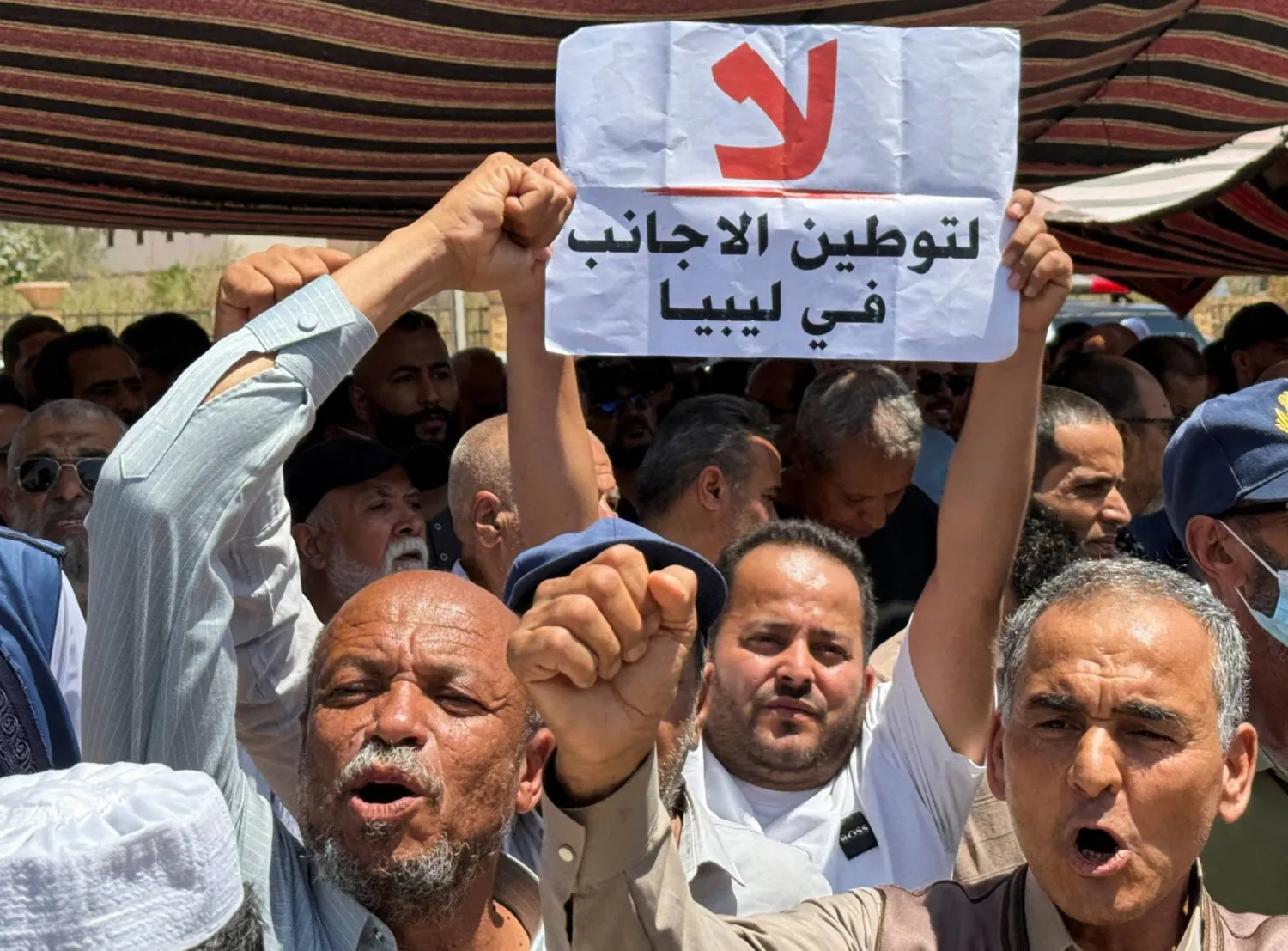

UN Mission Condemns Calls for Violence Against its Staff in Libya

Protesters gather outside the headquarters of the United Nations High Commissioner for Refugees (UNHCR), in Tripoli, Libya, June 4, 2026. Picture taken with a mobile phone. REUTERS/Ayman al-Sahili
TT

UN Mission Condemns Calls for Violence Against its Staff in Libya

Protesters gather outside the headquarters of the United Nations High Commissioner for Refugees (UNHCR), in Tripoli, Libya, June 4, 2026. Picture taken with a mobile phone. REUTERS/Ayman al-Sahili

The United Nations Support Mission in Libya denied on Friday that its refugee agency is seeking to resettle irregular migrants in the country, affirming that “allegations to the contrary are categorically false.”

UNSMIL said in a statement it took note of the demonstrations held in front of its premises and those of the Office of the United Nations High Commissioner for Refugees.

“The United Nations affirms the right of all Libyans to obtain accurate information, and their right to express their opinions peacefully in accordance with what is guaranteed by Libyan and international laws,” the mission said.

“UNSMIL is concerned about the spread of misinformation, disinformation and hate speech regarding the work of the UN in Libya, which has contributed to heightened tensions and incitement against UN national and international staff,” it added.

The UN in Libya reiterated that none of its agencies, including UNHCR, implement any resettlement programs to Libya. “Allegations to the contrary are categorically false,” the mission affirmed.

It said the Office works in cooperation with Libyan authorities and the international community, within the framework of full respect for Libya's sovereignty, to find solutions outside Libya for persons fleeing wars, conflicts, and persecution, including evacuations to third countries and voluntary returns to their home countries when circumstances permit.

The Mission condemned “any incitement to violence, threats against UN personnel, and acts of vandalism and/or attacks against United Nations staff, premises, and property.”

It called on all parties to respect the inviolability of UN premises, staff, property, and assets in accordance with international law.

The UN in Libya also expressed its appreciation to the relevant authorities in Tripoli for their efforts in maintaining public order and ensuring the safety and security of the demonstrators, as well as UN staff and facilities.

UNSMIL’s statement came amid heightened debate within Libya over the issue of irregular migration, and growing popular and official demands for tougher measures to address the trend.

On Thursday, angry Libyan demonstrators blocked off the office of the UN refugee agency in the capital Tripoli during a protest against migrants who have travelled to the country in search of work or passage to Europe.

They demanded the UN to shut down its offices in Libya, acting on reports that resettlement cards were being distributed by the UNHCR to refugees and illegal immigrants in Libya.

Later, other Libyan protesters who oppose the resettlement of migrants, stormed the mission’s headquarters in the Janzour area, west of Tripoli before Libyan security forces intervened, dispersed the crowds, and secured UN and local staff inside the compound.

On Friday night, the UN mission in Libya issued a statement affirming that a fruitful dialogue requires all parties to engage in good faith to achieve constructive and sustainable outcomes.

The mission again condemned any incitement to violence, saying, “There is no justification for violence or intimidation, which we know does not align with Libyan culture, traditions, and values.”



Yemeni Forces Consolidate West Coast Gains, Reinforce Bab al-Mandab Positions

 Yemeni government fighters sit in the back of a vehicle near Dhubab, Taiz Governorate, Yemen, in this still image taken from video released October 5, 2026.    Southern Giants Brigades/Handout via REUTERS
Yemeni government fighters sit in the back of a vehicle near Dhubab, Taiz Governorate, Yemen, in this still image taken from video released October 5, 2026. Southern Giants Brigades/Handout via REUTERS
TT

Yemeni Forces Consolidate West Coast Gains, Reinforce Bab al-Mandab Positions

 Yemeni government fighters sit in the back of a vehicle near Dhubab, Taiz Governorate, Yemen, in this still image taken from video released October 5, 2026.    Southern Giants Brigades/Handout via REUTERS
Yemeni government fighters sit in the back of a vehicle near Dhubab, Taiz Governorate, Yemen, in this still image taken from video released October 5, 2026. Southern Giants Brigades/Handout via REUTERS

Yemeni armed forces consolidated gains along the western coast and reinforced positions overlooking the Bab al-Mandab Strait as they pushed ahead in al-Wazi'iyah district in western Taiz province under Operation “Dawn of Yemen.” Fighting with the Houthis continued in the southern Taiz countryside and on fronts around the city.

The armed forces said they had neutralized more than 1,800 Houthi fighters in recent hours. Army figures put Houthi losses at nearly 10,000 killed or wounded over two weeks of air and ground strikes across multiple fronts.

Nation Shield forces, the Giants Brigades and the Joint Forces took full control of the Kahboub front, according to Yemeni military media. The advance strengthens government forces’ hold on heights overlooking Bab al-Mandab and boosts their ability to secure the strategic corridor as operations continue along the western coast.

Taiz province’s emergency committee suspended classes at public, community and private schools, institutes, colleges and universities in districts that have come under Houthi control. It also placed government employees there on temporary leave, citing exceptional security conditions.

The United Nations warned of a worsening humanitarian situation in Taiz as Houthi attacks spread, displacement rises and aid access faces growing restrictions. Major roads remain closed, adding to pressure on services and limited resources.

The eastern road into Taiz city remains closed, the United Nations said in a recent report. Road closures between Aden and Taiz have disrupted a major supply route from warehouses in Aden, hampering aid agencies’ ability to reach those affected and meet growing needs.


Iraq Rejects Syrian Request to Repatriate 4,000 Suspected ISIS Detainees

Members of the Iraqi border forces patrol along a concrete wall on the Iraqi-Syrian border, in the town of al-Baghuz in the Al-Qaim district of western Iraq, on January 21, 2026. (AFP)
TT

Iraq Rejects Syrian Request to Repatriate 4,000 Suspected ISIS Detainees

Members of the Iraqi border forces patrol along a concrete wall on the Iraqi-Syrian border, in the town of al-Baghuz in the Al-Qaim district of western Iraq, on January 21, 2026. (AFP)

Iraq has rejected Syria's request to repatriate thousands of suspected ISIS members transferred from Syrian detention centers to Iraqi custody earlier this year, a senior Iraqi security official said on Wednesday.

Iraqi National Security Advisor Qasim al-Aboudi said that a meeting had been held recently between Syria, Iraq and the United States to discuss the fate of the prisoners.

Al-Aboudi said Syria had requested that the 4,000 Syrian prisoners be handed over to be tried in Syria, but Iraq refused. Iraq has repatriated about 50 Syrian detainees who were determined not to be ISIS members, he told The Associated Press, while the Syrian prisoners remaining in Iraq include about 400 who are believed to be high-level members of the extremist group.

“Iraq is conducting investigations, and anyone proved to have committed crimes in Iraq will be tried under Iraqi law,” he said.

Some prisoners could later be transferred to their home countries to complete their sentences, he said.

Syria did not immediately respond to requests for comment.

More than 5,700 prisoners with alleged ISIS ties — including some 4,000 Syrians — were transferred from northeast Syria to Iraq after fighting broke out in January between Syrian government forces and the Kurdish-led Syrian Democratic Forces, which had long guarded the detention centers where they were held.

Some ISIS-linked prisoners managed to flee during the chaos of the clashes, and there were fears that a larger-scale escape would take place. While the extremist group lost control of the territory it once seized in Iraq and Syria years ago, its cells still periodically carry out attacks in both countries.

The discussions about the prisoners' fate come as the United States has ended a 12-year mission to fight ISIS in Iraq, with the last US troops withdrawing from the country last month.

Al-Aboudi said Iraq has asked for financial support from the US and other countries taking part in the global coalition against ISIS to help with the costs of housing the prisoners.

“Iraq asked for an allocation of $500 million. The coalition promised support, but Iraq is still waiting,” he said.

A US defense official and the office of Tom Barrack, the US envoy to Syria and Iraq, referred questions about the prisoners to Iraqi and Syrian authorities.

Many of the prisoners transferred to Iraq had been held in Syria for years without charges. Rights groups have raised concerns about detention conditions in both countries.


Arab Parliament President Stresses Houthi Attacks on Saudi Arabia Pose Direct Threat to Regional Security

Arab Parliament President Stresses Houthi Attacks on Saudi Arabia Pose Direct Threat to Regional Security
TT

Arab Parliament President Stresses Houthi Attacks on Saudi Arabia Pose Direct Threat to Regional Security

Arab Parliament President Stresses Houthi Attacks on Saudi Arabia Pose Direct Threat to Regional Security

President of the Arab Parliament Mohammed bin Ahmed Al-Yamahi stressed that repeated terrorist attacks by the Houthi militia against Saudi Arabia and its civilian and oil facilities pose a direct threat to regional security.

During his speech at the 153rd Assembly of the Inter-Parliamentary Union in Arusha, United Republic of Tanzania, Al-Yamahi addressed Iranian attacks that targeted several Arab countries and threatened civilians, infrastructure, and vital facilities, SPA reported.

He also discussed regional escalation and related threats to the security of Arab countries. He called on the international community to move beyond condemnation and take measures to protect states and their sovereignty and compel the parties to respect international law.