Excitement and Joy at Ljubljana Zoo after Birth of 3 Siberian Tiger Cubshttps://english.aawsat.com/varieties/5280972-excitement-and-joy-ljubljana-zoo-after-birth-3-siberian-tiger-cubs
Excitement and Joy at Ljubljana Zoo after Birth of 3 Siberian Tiger Cubs
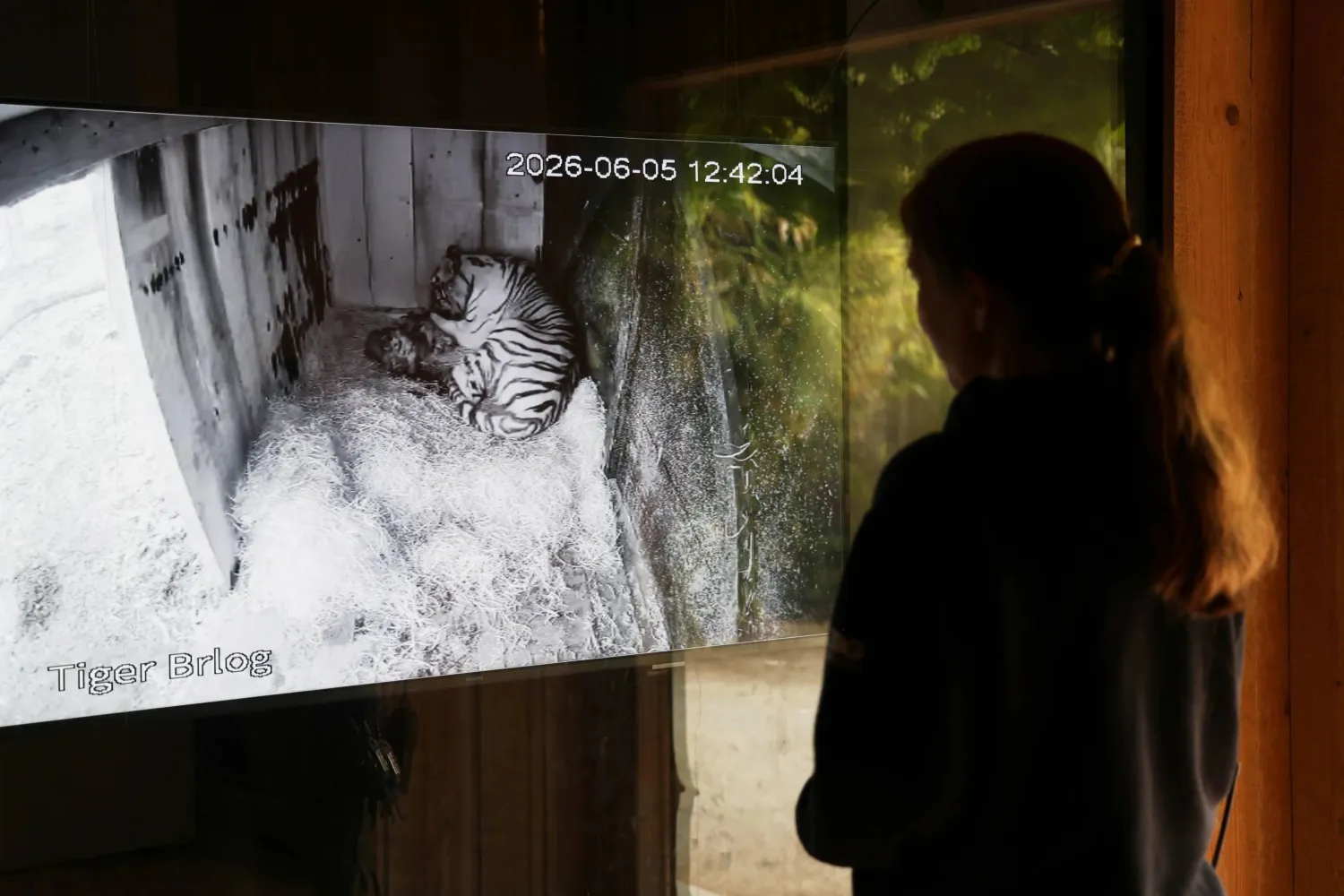
A visitor watches the Siberian tiger cubs with their mother on a screen at the zoo in Ljubljana. AP
A zoo in Slovenia's capital Ljubljana has presented its newest residents: three Siberian tiger cubs who were born there under two weeks ago.
The Siberian tiger is one of the world’s most endangered big cat species, with experts estimating that about 500 remain in the wild. Their survival is threatened primarily by habitat loss and poaching.
Zoo workers said the cubs were born to mother Arisa and father Ussuri, which arrived in Ljubljana in 2004, after careful planning and much hoping, The Associated Press reported.
“We were not really expecting, but hoping, working on it because we have a good breeding pair,” she said. Though the couple were introduced to each other at the right time “we weren't completely sure,” she added.
“So we were also a bit surprised and of course very happy,” Strus said.
Breeding wild animal species in enclosed spaces is known to be hard and often does not succeed.
The cubs, born on May 27, are highly vulnerable and need to be isolated from others except their mother, but zoo staff and visitors have been able see them on a screen streaming live video footage.
Visitors could be seen smiling as they watched the mother with her babies on the screen. Barbara Gallaido, from San Francisco, said the sight was “really fabulous.”
“I’ve seen tigers in the wild in India, but not like this, not with cubs,” she said. “It was really great.”
Arisa is a first-time mother at the age of 4, Strus said. She appears to be doing very well so far.
“She is constantly licking them (cubs,) breastfeeding them and they are resting together,” she said. “So far so good. But ... we still need to wait and see what will happen.”
According to Strus, tiger cubs open their eyes and begin hearing about two weeks after birth. She said the mother is expected to bring them out of the den for the first time when they are one month old.
People watch the launch of the H3 rocket, carrying the Martian Moons eXploration (MMX) spacecraft, at the Tanegashima Space Center in Kagoshima Prefecture on October 20, 2026. (Photo by JIJI Press / AFP)
Japan Launches Spacecraft to Mysterious Moons of Mars
People watch the launch of the H3 rocket, carrying the Martian Moons eXploration (MMX) spacecraft, at the Tanegashima Space Center in Kagoshima Prefecture on October 20, 2026. (Photo by JIJI Press / AFP)
A Japanese spacecraft rocketed toward Mars on Tuesday on a quest to explore its mysterious moons and bring back samples.
Five of the world’s space agencies joined forces for the five-year mission that will attempt to land a robotic prospector plus a rover on Phobos, the larger and closer of Mars’ two pint-sized moons.
The Japan Aerospace Exploration Agency, which is leading the bold sampling effort, launched the spacecraft before dawn from the country's main spaceport on Tanegashima Island.
Officials declared success an hour later when the spacecraft separated as planned from the rocket's upper stage. Flight controllers burst into applause and jumped to their feet, shaking hands and embracing.
No one has managed to get samples from Mars or its moons yet While NASA has successfully landed nine spacecraft on Mars over the past 50 years and China scored a 2021 touchdown, no one has ever reached Phobos or its sidekick Deimos. And no one has managed to fetch samples from Mars, let alone its moons.
If successful, bits of dust, soil and rocks from Phobos will arrive on Earth in 2031.
“There’s a lot of adrenaline and a lot of excitement and a lot of wow,” said NASA astrophysicist Tom Statler, who’s involved with the project.
Japan has an edge going in, with two asteroid sample returns already under its cosmic belt.
Mars' moon Phobos is a lumpy, little rock Phobos is a lumpy, potato-shaped rock just 22 kilometers (14 miles) or so across. Examining pieces of it can explain how Mars’ moons — and possibly moons elsewhere — came to be.
Dubbed MMX for Martian Moons Exploration, the $578 million mission features a hefty 5-ton spacecraft that should reach Mars by late next summer. It will sync up with Phobos’ tight orbit around the red planet, before ejecting the French-German rover that’s named Idefix after the white terrier in the Asterix comics.
No bigger than a microwave oven, Idefix will plop onto Phobos by itself, bouncing for several minutes before coming to a halt in the moon's extraordinarily low gravity.
Employees of Japan Aerospace Exploration Agency and others celebrate as a Japanese spacecraft launched aboard an H3 rocket successfully separated as planned, at the Tanegashima Space Center in Kagoshima prefecture, southern Japan, Tuesday Oct. 20, 2026. (Naoki Hiraoka/Kyodo News via AP)
What happens after European Idefix rover lands The four-wheeled rover is designed to right itself if it lands upside down. All bets are off, though, if it sinks into soft soil or gets wedged between rocks, said the French Space Agency’s Julien Baroukh. Once the rover’s solar panels are deployed, the vehicle can no longer right itself, he added, which is why it will move at a glacial 1 millimeter per second (0.04 inches per second).
Idefix will serve as a “scout for safety,” according to Baroukh, as it prowls around Phobos for 100 days. Japanese flight controllers want to avoid powdery soil and rough terrain when the mothership — a four-legged stationary lander — descends to the surface to gather samples in late 2028 or 2029.
The lander will spend just two hours on Phobos, drilling and vacuuming up at least 10 grams (one-third of an ounce) of material, before launching back into space. It will study Deimos during a series of flybys before leaving the Martian neighborhood in 2030 and hustling back to Earth for a 2031 sample delivery in the Australian desert.
It’s a treacherous undertaking, with wreckage littering the path.
The moons’ names aren’t exactly comforting: Phobos is Greek for fear and Deimos means dread. They’re the twin sons of the god of war Ares — Mars in Roman mythology.
Scientists hope to learn how Mars' 2 moons formed Russia stumbled in all three of its Phobos attempts as well as many other Mars endeavors. In its only other Mars mission, Japan failed to get a spacecraft into orbit around the red planet.
Even NASA has had its share of flops in a bid to answer the burning question: Did life ever exist on Mars?
By studying Mars’ moons, scientists hope to learn whether Phobos and Deimos formed in the aftermath of an ancient collision between Mars and a battering space rock. It’s also possible that the moons might be stray asteroids that became ensnared in Mars’ gravity.
Either way, scientists anticipate finding traces of Mars on Phobos, making the samples an irresistible two-for-one that should help demystify planetary and moon formation, and perhaps even the recipe for life. The findings will help shape future Mars missions, including those by astronauts, said NASA’s acting planetary science director Lindsay Hays.
“It is a once-in-a-lifetime chance. We are part of the first sample return mission from the Martian system,” The Associated Press quoted the German Space Agency's rover chief Markus Grebenstein as saying.
Japan isn’t the only one looking to claim the scientific riches packed into the Martian system’s rocks and dirt. China plans to launch a sample return mission to Mars in 2028, while NASA is still debating how to retrieve the more than 30 sample tubes collected by the Perseverance Mars rover, the new champion for off-Earth driving.
Japan and China could be neck-and-neck in getting samples back from the Martian system. Both are targeting 2031.
Japan is investing $350 million in this mission. NASA is contributing $87 million, the French Space Agency about $68 million, the German Space Agency about $56 million and the European Space Agency some $17 million.
Too Much of a Good Scent? Hanoi Curbs Iconic Treeshttps://english.aawsat.com/varieties/5331426-too-much-good-scent-hanoi-curbs-iconic-trees
Hoa sua, or "milk flower" trees, as Hanoi considers relocating some trees after residents complain their fragrance is too strong, in Hanoi, Vietnam, October 17, 2026. REUTERS/Thinh Nguyen
Too Much of a Good Scent? Hanoi Curbs Iconic Trees
Hoa sua, or "milk flower" trees, as Hanoi considers relocating some trees after residents complain their fragrance is too strong, in Hanoi, Vietnam, October 17, 2026. REUTERS/Thinh Nguyen
Vietnam's capital Hanoi has launched a large-scale program to prune hundreds of its iconic blackboard trees and is considering relocating some after their distinctive fragrance proved too much for some residents.
Known in Vietnamese as hoa sua, meaning "milk flower", and also known as pulai and devil's tree elsewhere in Asia, blackboard trees can grow as tall as 60 meters (197 feet). The name reflects the traditional use of its wood for school items, as does its scientific name, Alstonia scholaris.
Blackboard trees have lined Hanoi's boulevards since they were introduced during French colonial rule in the late 19th century. They were later planted across the capital, and Hanoi now has about 14,400 of the trees, according to the city government.
At dusk, the trees release a pungent, sweet scent from their greenish-white flowers, peaking in September and October. Long associated with the arrival of autumn in Hanoi, they have inspired hit songs and poetry for decades.
But many of the city's nearly 9 million residents say the fragrance is overpowering.
"I simply cannot stand the smell," said Hanoi resident Nguyen Ha Long, 43, who said he stopped his evening runs because the scent gave him migraines.
After years of complaints and smaller interventions, local authorities have launched their largest pruning campaign yet, stripping the flowers from about 7% of Hanoi's blackboard trees during a five-day blitz ending on Tuesday.
Officials also plan to relocate trees from streets where they are most heavily concentrated, adding to the impact of major public works projects underway in Hanoi that are rapidly reshaping the city's landscape as the ruling Communist Party chases ultra-fast economic growth.
Not everybody backs the move.
"I absolutely love the scent of blackboard trees. The stronger the fragrance, the more I love it," said Nguyen Thu Trang, 37, who lives on central Nguyen Du, a street lined with blackboard trees and which was also the setting of the best-selling novel "The Sorrow of War".
"My family has lived here for over 30 years, and we all love the scent. I feel deeply saddened seeing the city prune them," she added, according to Reuters.
"The smell is not toxic," said Tran Cong Khanh, head of Vietnam's ethnomedicine research center, echoing views expressed by three other Vietnamese scientists interviewed by Reuters, who however recommend limiting concentrations in densely populated areas because the pollen, like that of other plants, can trigger allergic reactions.
The debate has been widely reported by local newspapers, despite public health rarely ranking among Vietnamese residents' top concerns.
By contrast, air pollution, which often makes Hanoi one of the world's most polluted cities during winter, has generally attracted less public attention.
Man who Snatched a Flamingo from US Hotel Exhibit Found Guilty of Animal Crueltyhttps://english.aawsat.com/varieties/5331423-man-who-snatched-flamingo-us-hotel-exhibit-found-guilty-animal-cruelty
Mitchell Fairbarn breaks down while testifying during his trial at the Regional Justice Center Friday, Oct. 16, 2026, in Las Vegas. (Benjamin Hager/Las Vegas Review-Journal via AP)
Man who Snatched a Flamingo from US Hotel Exhibit Found Guilty of Animal Cruelty
Mitchell Fairbarn breaks down while testifying during his trial at the Regional Justice Center Friday, Oct. 16, 2026, in Las Vegas. (Benjamin Hager/Las Vegas Review-Journal via AP)
A Canadian man was convicted of animal cruelty charges Monday for snatching a flamingo named Peachy from its enclosure at an iconic Las Vegas hotel. Prosecutors said it was a malicious prank while a lawyer for the tourist insisted it was drunken foolishness not meant to harm the bird.
Prosecutors said tourist Mitchell Fairbarn hurt and frightened the 27-year-old Chilean flamingo when he took it from its habitat at the Flamingo Las Vegas Hotel and Casino and carried the squawking bird to his room March 3.
According to The Associated Press, Defense attorney Josh Tomsheck told jurors at trial in a Nevada court that the man deeply regretted the “bad decisions" he made while intoxicated.
After about five hours of deliberations, jurors returned convictions on felony and misdemeanor animal cruelty counts against the Ontario, Canada, man.
Fairbarn remains under house arrest pending a sentencing hearing set for Dec. 1. He faces up to four years in prison for the felony and possibly six more months for the misdemeanor conviction. Following the verdict, he declined to comment as he left the courtroom with his wife. He showed no visible emotion.
His lawyer also had no comment.
Since the incident, the flamingo has been doing all right physically but is more anxious and nervous when being evaluated, said Peachy’s veterinarian, Tiffany Moore, medical director of Lone Mountain Animal Hospital.
Prosecutors told jurors earlier that Fairbarn willfully caused the bird physical pain, noting feathers were found on the hotel floor. Video showed the bird squawking while Fairbarn handled it and prosecutors said Peachy felt pain when it was pulled by its feet.
Video played at the trial showed Fairbarn holding the flamingo in an elevator and carrying it down a hotel hallway at the famous hotel. The Flamingo is one of the oldest hotels on the Las Vegas Strip, and its well-known flamingo habitat also features hummingbirds, turtles, koi and other species.
Las Vegas police responded to the scene after security staff reported someone had taken the flamingo. When Peachy was located, it was missing seven to eight feathers, had blood on its feathers and injuries to its wings, authorities said.
Taking the bird was “dumb” and “fueled by drunkenness,” the defense attorney Tomsheck said. But he added that his client never intended any harm to the bird, a key element in the felony charge.
“He should not have done that, should not have gone into the habitat, shouldn’t have touched a bird, shouldn’t have taken Peachy inside,” Tomsheck said. “The truth is, Mitch was drunk. Mitch was stupid. He made bad decisions."
Fairbarn could be seen in court at one point with head lowered, hands covering his eyes.
The man had received death threats after taking the flamingo, and he was unable to leave the US when his father died while Fairbarn was awaiting trial, said Clark County prosecutor Haley Willming. While those events were unfortunate, the prosecutor said, “none of that would have happened had he not done what he did, had he not made the choices he made."
Jurors began deliberating shortly before midday after closing arguments Monday morning.
Animal rights advocate says justice was delivered Nevada animal rights advocate John Waudby, who recently helped strengthen the state’s animal cruelty laws, said he believes justice was delivered on Peachy's behalf.
“I hope this sends a message to anybody else that wants to mess with our animals, that you’re not going to do it in Nevada,” he said outside the courtroom after Monday's verdict.
لم تشترك بعد
انشئ حساباً خاصاً بك لتحصل على أخبار مخصصة لك ولتتمتع بخاصية حفظ المقالات وتتلقى نشراتنا البريدية المتنوعة