


Iran: IAEA is Politicizing Oversight of Tehran's Nuclear Program

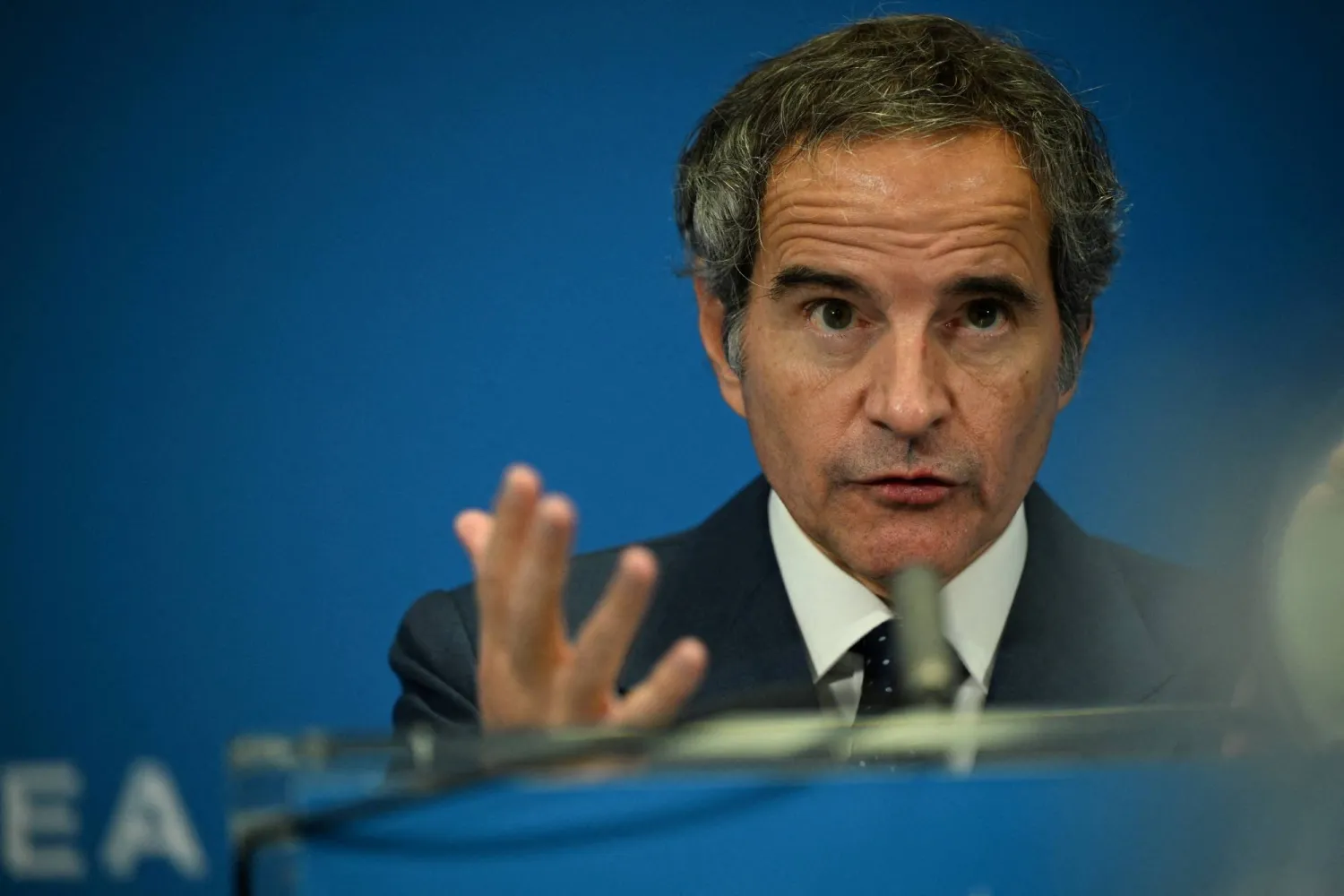
International Atomic Energy Agency (IAEA) Director General Rafael Grossi speaks to the media on the sidelines of a meeting of the IAEA Board of Governors in Vienna, Austria, June 5, 2026. REUTERS/Elisabeth Mandl
TT

Iran: IAEA is Politicizing Oversight of Tehran's Nuclear Program

International Atomic Energy Agency (IAEA) Director General Rafael Grossi speaks to the media on the sidelines of a meeting of the IAEA Board of Governors in Vienna, Austria, June 5, 2026. REUTERS/Elisabeth Mandl

Iran's Deputy Foreign Minister Kazem Gharibabadi said that the UN nuclear watchdog should avoid turning technical reports into "tools of political pressure" if it wanted ⁠to contribute to ⁠a diplomatic solution.

He said that the loss of the agency's ⁠oversight at some facilities resulted from the attacks rather than a lack of cooperation by Iran, adding that the International Atomic Energy Agency was using ⁠the ⁠consequences of US and Israeli strikes on Iranian nuclear sites to create "ambiguity" about Tehran's nuclear program.

The agency reaffirmed in a confidential report on Thursday that a lack of access to verify nuclear material in Iran posed a "proliferation concern,” calling on the country to "engage the agency constructively.”

The IAEA has not had access to some key nuclear facilities in Iran since Israel and the United States launched a 12-day conflict in June 2025 that saw strikes on nuclear sites.

Nuclear sites have also been struck in the war that erupted on February 28. The IAEA has repeatedly urged access.

"While the agency acknowledged that the military attacks on Iran's nuclear facilities and sites have created an unprecedented situation, it is critical for the agency to conduct verification activities in Iran without delay," the IAEA said in the report.

Prior to US strikes in June 2025, the IAEA calculated that Iran possessed approximately 440 kilograms of uranium enriched to 60 percent, which is close to the 90 percent needed to make a bomb and well above the 3.67-percent limit set by a 2015 now-defunct agreement with Iran.

Since June 2025, the fate of this stockpile has remained uncertain, with Tehran refusing access to IAEA inspectors at sites ravaged by US and Israeli strikes.

"The agency's lack of access to verify the previously declared highly enriched uranium and low enriched uranium for nearly a year -- which is long overdue according to standard safeguard practices -- is a matter of proliferation concern," it added.



Putin, Lukashenko Hold Talks on Friday at Tense Point in Ukraine War

Russian President Vladimir Putin makes a video address to participants of the 13th Forum of Regions of Russia and Belarus at the Kremlin in Moscow, Russia June 26, 2026. (Sputnik/Gavriil Grigorov/Pool via Reuters)
TT

Putin, Lukashenko Hold Talks on Friday at Tense Point in Ukraine War

Russian President Vladimir Putin makes a video address to participants of the 13th Forum of Regions of Russia and Belarus at the Kremlin in Moscow, Russia June 26, 2026. (Sputnik/Gavriil Grigorov/Pool via Reuters)

Russian President Vladimir Putin and Belarusian President Alexander Lukashenko held talks on Friday, the Kremlin said, and discussions were expected to focus on the war in Ukraine.

Meeting at Putin's Valdai residence in northwestern Russia, the two leaders addressed trade and economic cooperation, the implementation of joint projects and issues of regional security.

Kremlin spokesman Dmitry Peskov earlier told state news agency ‌TASS that ‌no press statements or document ‌signings ⁠were planned after the ⁠meeting.

The meeting follows mounting tension between Belarus and Ukraine, whose president, Volodymyr Zelenskiy, says he believes Putin is trying to get Lukashenko to step up his support for Russia in the conflict.

Moscow and Minsk deny that, and Belarus says it ⁠is Ukraine and the West that are ‌fueling tensions. Lukashenko said ‌on Thursday he had met representatives of Zelenskiy and ‌warned them not to try to drag his ‌country into war.

Putin and Lukashenko are close allies and meet frequently. The Kremlin has accused Ukraine of threatening the sovereignty of Belarus after Zelenskiy last Friday gave ‌Minsk a week to remove signal relay stations he said were being used ⁠to help guide ⁠Russian attacks.

The Kremlin said on Monday that Putin and Lukashenko were expected to discuss Zelenskiy's remarks "in the foreseeable future".

On Wednesday, Zelenskiy said the relay stations had stopped working, although there was no independent confirmation of this.

While Lukashenko has not sent Belarusian troops to fight alongside Russia, he let Putin use Belarus as a launchpad to attack Ukraine in February 2022 and later agreed to let Russia station tactical nuclear missiles on Belarusian territory.


115 Vessels, 2,500 Seafarers Evacuated from Strait of Hormuz Since Tuesday, Says UN Maritime Head

Vessels at the Strait of Hormuz, as seen from Musandam, Oman, June 24, 2026. (Reuters)
TT

115 Vessels, 2,500 Seafarers Evacuated from Strait of Hormuz Since Tuesday, Says UN Maritime Head

Vessels at the Strait of Hormuz, as seen from Musandam, Oman, June 24, 2026. (Reuters)

A total of about 115 vessels and 2,500 seafarers have been evacuated from the Strait of Hormuz since Tuesday, the head of the UN maritime body said Friday.

International Maritime Organization secretary-general Arsenio Dominguez gave the update after the IMO on Thursday suspended its efforts to evacuate some 600 ships and 11,000 sailors, following an attack on a vessel in the Gulf of Oman.

Dominguez told an online press conference that "115 (vessels) have evacuated in the last three and a half days, representing around 2,500 seafarers that have now safely left the Strait of Hormuz" since the UN began its safe-passage program Tuesday.

Dominguez said that following "consultations with some countries, particularly in the region", he took the decision to pause evacuations of those trapped because of the US-Iran war.

Yet vessels continued to use a non-Iranian-approved passage, tracking platforms showed Friday.

Formal evacuation of crews is being carried out via two routes -- one close to the Omani coast and the other near to the Iranian coast.

Neither is the traditional passage established by the IMO in 1968 as part of the Traffic Separation Scheme aimed at reducing collision risks in the Strait of Hormuz.

This is because of mines located in the usual traffic route.

In the memorandum of understanding signed by Iran and the United States last week aimed at ending the war, Tehran committed to clearing the mines from the area within 30 days.


Trump Says Iran Attacks on Ships a ‘Foolish Violation’ of the Ceasefire

 Vessels at the Strait of Hormuz, as seen from Musandam, Oman, June 26, 2026. (Reuters)
Vessels at the Strait of Hormuz, as seen from Musandam, Oman, June 26, 2026. (Reuters)
TT

Trump Says Iran Attacks on Ships a ‘Foolish Violation’ of the Ceasefire

 Vessels at the Strait of Hormuz, as seen from Musandam, Oman, June 26, 2026. (Reuters)
Vessels at the Strait of Hormuz, as seen from Musandam, Oman, June 26, 2026. (Reuters)

US President Donald Trump on Friday blamed Iran for carrying out a drone strike on a cargo ship in the Strait of Hormuz, calling it a “foolish violation” of the ceasefire agreement with the US. 

Trump said one drone hit the upper deck of the ship and “damage was done,” but the ship was able to proceed. He added that the US shot down three other drones. 

His post on social media did not identify the ship or the time of the strike, but on Thursday the British military said a vessel was hit by a projectile off the coast of Oman. 

It comes during a fragile time for the US and Iran as they work to negotiate a permanent end to the war.