


Armenia Votes in Test of PM’s Pivot Away from Russia

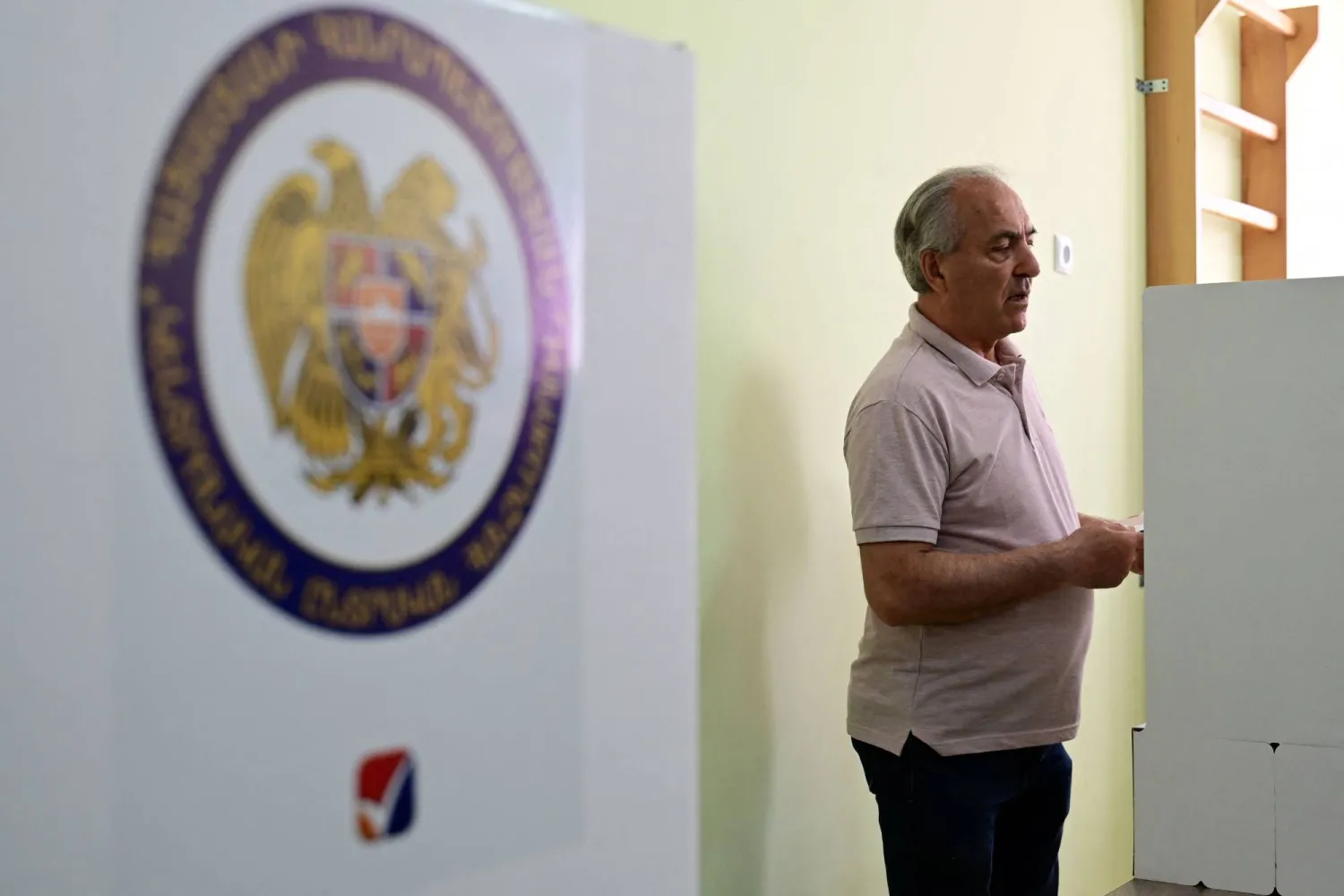
 A man votes in Armenia's parliamentary election at a polling station in Yerevan on June 7, 2026. (AFP)
A man votes in Armenia's parliamentary election at a polling station in Yerevan on June 7, 2026. (AFP)
TT

Armenia Votes in Test of PM’s Pivot Away from Russia

 A man votes in Armenia's parliamentary election at a polling station in Yerevan on June 7, 2026. (AFP)
A man votes in Armenia's parliamentary election at a polling station in Yerevan on June 7, 2026. (AFP)

Armenia voted Sunday in a parliamentary election set to test Prime Minister Nikol Pashinyan's tilt to the West, as the country faces threats and allegations of interference from former imperial ruler Russia.

Armenia and Russia are technically allies, but Moscow has compared the former Soviet republic's EU ambitions to the same path it claims triggered its 2022 invasion of Ukraine.

The election comes after years of upheaval since Pashinyan was propelled to power in a 2018 street revolution.

The small Caucasus country is still reeling from long-time foe Azerbaijan's military takeover of the Karabakh region.

The conflict came to an end in 2023, when the Azerbaijan army seized control of the enclave, and most of the Armenian population fled.

Pashinyan has framed the vote as a choice between a lasting peace with Azerbaijan, or a return to war.

The 51-year-old has also sought to loosen Armenia's dependence on Moscow, after it failed to help during the Karabakh conflict.

He has frozen participation in a Russia-led security bloc while deepening ties with the European Union and United States, and set Armenia on a path toward possible EU membership.

While US President Donald Trump offered his "TOTAL Endorsement for Re-Election" to "great friend and Leader" Pashinyan, Moscow has bristled at the possible loss of yet another ally in its backyard.

"We will accept any choice made by the people" in the election, Pashinyan told journalists at a polling station in Yerevan after casting his ballot.

He said Armenia would pursue a balanced foreign policy after the vote, insisting "there is no question of choosing" between Russia and the West.

In a pointed remark, Russian President Vladimir Putin said in May: "We all see what is happening with Ukraine now... How did it all begin? With Ukraine's attempt to join the EU."

The Kremlin has been accused of seeking to sway the vote.

Analysts have noted misinformation on the web, hacker activity and Kremlin-friendly narratives portraying Western cooperation as dangerous.

In the weeks before the vote, Russia banned the import of several products from Armenia -- seen as a move to heap economic pressure on the country.

And Armenian officials have warned "enemies of freedom" are funding propaganda efforts.

- 'Reckless rush' -

Pashinyan has insisted he does not want a rupture with Moscow.

But the campaign is a battle over Armenia's geopolitical future.

Pashinyan and his chief opponents have all accused each other of risking a fresh conflict.

Pashinyan told voters Armenia could face a "catastrophic war" with Azerbaijan within months if his Civil Contract party -- leading in opinion polls -- fails to secure a strong majority.

His opponents say that rhetoric is fearmongering.

Samvel Karapetyan, a billionaire Russian-Armenian businessman whose Strong Armenia party is polling second, has rejected claims he would drag Armenia back into Russia's orbit, but warned against Pashinyan's "reckless rush" to the West.

"Russia has been and will remain our strategic partner and principal economic partner," he said.

Karapetyan has been under house arrest since last year on charges of plotting a coup -- allegations he rejects as politically motivated.

Europe has made little secret of who it wants to win.

In a high-profile visit in May, French President Emmanuel Macron threw his support behind Pashinyan, embracing the Armenian leader as a dear friend.

At an evening reception, Macron took to the microphone and Pashinyan to the drums for a rendition of "La Boheme", the 1965 classic by the late Charles Aznavour, a singer beloved in both countries.

- 'Voted for peace' -

It remains unclear whether Pashinyan's party can secure the two-thirds parliamentary majority needed to pass constitutional amendments, demanded by Azerbaijan as a condition for a final peace treaty.

Pashinyan's democratic record is also on the ballot paper.

Eight years after he swept to power on a promise to dismantle Armenia's oligarchic system, he faces increasing accusations of democratic backsliding.

Still for many Armenians, the opposition remains associated with Russian influence and oligarchs.

"I voted for peace. Only Pashinyan can bring peace," one voter, 63-year-old craftsman Hakob Hakobyan, told AFP.

Another voter, Khachatur Movsisyan, a 59-year-old mechanical engineer, said he had backed an opposition party "because the country, and all of us, need change -- in foreign policy, domestic policy and in negotiations with Azerbaijan."



Egypt Tries to Revive US-Iran Negotiations

 Vessels near the Strait of Hormuz, as seen from Musandam, Oman, August 17, 2026. (Reuters)
Vessels near the Strait of Hormuz, as seen from Musandam, Oman, August 17, 2026. (Reuters)
TT

Egypt Tries to Revive US-Iran Negotiations

 Vessels near the Strait of Hormuz, as seen from Musandam, Oman, August 17, 2026. (Reuters)
Vessels near the Strait of Hormuz, as seen from Musandam, Oman, August 17, 2026. (Reuters)

The top diplomats for Egypt and Iran discussed efforts to bring Tehran and Washington back to the negotiating table to settle the war, Egypt's foreign ministry said on Saturday.

Iranian Foreign Minister Abbas Araghchi and Egyptian counterpart Badr Abdelatty also discussed the Iranian-Omani talks on the management of the Strait of Hormuz, the ministry said.

Araghchi briefed Egypt's foreign minister about “Iran’s view of ongoing developments, the course of negotiations and their challenges,” the ministry said, without elaborating.

There was no immediate statement from Araghchi.


Putin Says Ukraine Opened ‘Pandora’s Box’ with Strikes on Economic Targets

 Russian President Vladimir Putin gives an interview to journalist Pavel Zarubin in Moscow, Russia, August 22, 2026. (Sputnik/Mikhail Metzel/Pool via Reuters)
Russian President Vladimir Putin gives an interview to journalist Pavel Zarubin in Moscow, Russia, August 22, 2026. (Sputnik/Mikhail Metzel/Pool via Reuters)
TT

Putin Says Ukraine Opened ‘Pandora’s Box’ with Strikes on Economic Targets

 Russian President Vladimir Putin gives an interview to journalist Pavel Zarubin in Moscow, Russia, August 22, 2026. (Sputnik/Mikhail Metzel/Pool via Reuters)
Russian President Vladimir Putin gives an interview to journalist Pavel Zarubin in Moscow, Russia, August 22, 2026. (Sputnik/Mikhail Metzel/Pool via Reuters)

Russian President Vladimir Putin said in comments published on Saturday that Kyiv had opened "Pandora's box" with its strikes on Russian economic targets, saying that Russia would hit back at Ukraine's "most sensitive economic sectors".

Ukraine has this summer escalated a campaign of drone strikes targeting Russian economic infrastructure, including oil refineries and online retailers' warehouses, seeking to ‌destroy infrastructure it ‌says is central to Russia's ‌war ⁠effort.

Russia has responded ⁠with strikes against Ukrainian economic infrastructure, including Ukrainian grain exports via the Black Sea.

"The Kyiv regime set out to damage our economy. What did it do? It opened this Pandora’s box itself. Well then, expect a response targeting your ⁠most sensitive economic sectors," Putin said ‌in comments to ‌a Russian state television journalist.

He said that the strikes, ‌which have jeopardized Ukraine's agricultural exports, would ‌not cause global food shortages, because Russia would be able to replace Ukrainian exports, even as Kyiv has targeted Russian grain export infrastructure.

"We do face ‌challenges regarding the shipment of our goods, but we will resolve these issues. ⁠Consequently, ⁠there will be no shortage on the global market," Putin said.

Russia and Ukraine had previously adhered to a Turkish-brokered deal to protect grain exports on the Black Sea. But Russia exited the deal in 2023.

The Russian leader also restated his position that Moscow is open to peace talks, but only on the basis of "realities on the ground", rather than what he called "exotic" proposals that he said had been made by Ukraine via intermediaries.


Iran Condemns US Plans to Announce New Sanctions

Iranian people walk past an anti-US mural in Tehran, Iran, 17 August 2026. (EPA)
TT

Iran Condemns US Plans to Announce New Sanctions

Iranian people walk past an anti-US mural in Tehran, Iran, 17 August 2026. (EPA)

Iran on Saturday denounced US plans to announce new sanctions that could put further strain on the country’s economy and have an impact on its most important trading partners including China.

After nearly six months of war since the US and Israel launched airstrikes against Iran on February 28, the sides are not firing at each other but also showing no sign of pursuing peace talks.

Oil shipments are at a virtual standstill in the Strait of Hormuz, with Tehran threatening to strike any unauthorized oil tankers that try to transit the vital waterway, and Iran's economy is already under immense pressure from sanctions.

US Treasury Secretary Scott Bessent is due to hold a press conference at 2 p.m. EDT (1800 GMT) on Monday after threatening "the toughest sanctions in history" on Iran.

Bessent has also urged cooperation with Washington by China, which buys more than 80% of Iran's shipped oil, according to 2025 data from ‌analytics firm Kpler. ‌Beijing has urged diplomacy.

Iran's Foreign Ministry spokesperson, Esmaeil Baghaei, said on Saturday the imminent US announcement of ‌new ⁠economic sanctions was an "assertion ⁠of extraterritorial sovereignty over every independent member state of the United Nations."

"Such secondary sanctions find no foundation in international law," he said in a post on X.

The chief of staff of Iran's armed forces, Major General Ali Abdollahi, promised on Friday that Iran would respond to enemy threats militarily with "crushing, punishing and devastating responses.”

US President Donald Trump, who has warned of economic consequences against any country that provides "any type of lifeline to Iran," said on Friday that Washington was observing "what happens" in the conflict.

"They would love to make a deal, but they're not ready to make the right deal, in my opinion," Trump said of Iran.

HORMUZ TRAFFIC HALTED

While the US has effectively blockaded Iranian vessels in their ports, the Strait of ⁠Hormuz remained bottled up with thousands of seafarers stranded on hundreds of vessels.

Only four commodity ships ‌sailed along the strait on Thursday, none of them large crude carriers or liquefied ‌natural gas tankers, ship-tracking data showed.

However, Iran has granted permission for a number of Iraqi oil tankers to pass through the Strait following repeated requests from ‌Baghdad, Iran’s state news agency IRNA reported on Saturday.

IRNA said obtaining special permission for Iraqi tankers was one of Baghdad’s main requests ‌during a visit to Iraq by Parliament Speaker Mohammad Baqer Qalibaf.

US Energy Secretary Chris Wright said the US military helped move a seven-day average of 8 million barrels a day of oil through the strait. That's down from more than 20 million per day before the war or about one of every five barrels consumed worldwide.

US attacks have severely diminished Iran's economy and devastated its navy and air force, but Tehran maintains enough missile and drone capability ‌to impede oil tanker traffic and attack regional rivals.

Abdollahi, the armed forces chief of staff, sought to underline Iran's missile capabilities during a visit to an underground plant manufacturing ballistic missiles that was reported ⁠by state television on Saturday.

"This ⁠plant has been able, much better than in the past, to produce equipment superior both in capacities and quality and in quantity," he said.

Trump, meanwhile, has yet to achieve objectives he set at the start of the war such as dismantling Iran's nuclear program - the state of which remains uncertain given that UN inspectors have been shut out since 2025 - and creating conditions for Iranians to overthrow their clerical rulers.

Thousands have been killed, mainly in Iran, where 168 Iranian school children were killed on the first day of the war. The US has reported more than 750 military personnel wounded and 18 killed.

While Iran remains defiant, President Masoud Pezeshkian has also called for a diplomatic solution.

"It would be better to end the war today, when we are powerful and have dignity, and the whole world acknowledges our victory and emphasizes that America, contrary to all regulations, attacked our schools, hospitals, and infrastructure and is hated in the world," the ISNA news agency quoted him as saying on Friday.