
Millions of Chinese Students Sit for Grueling 'Gaokao'

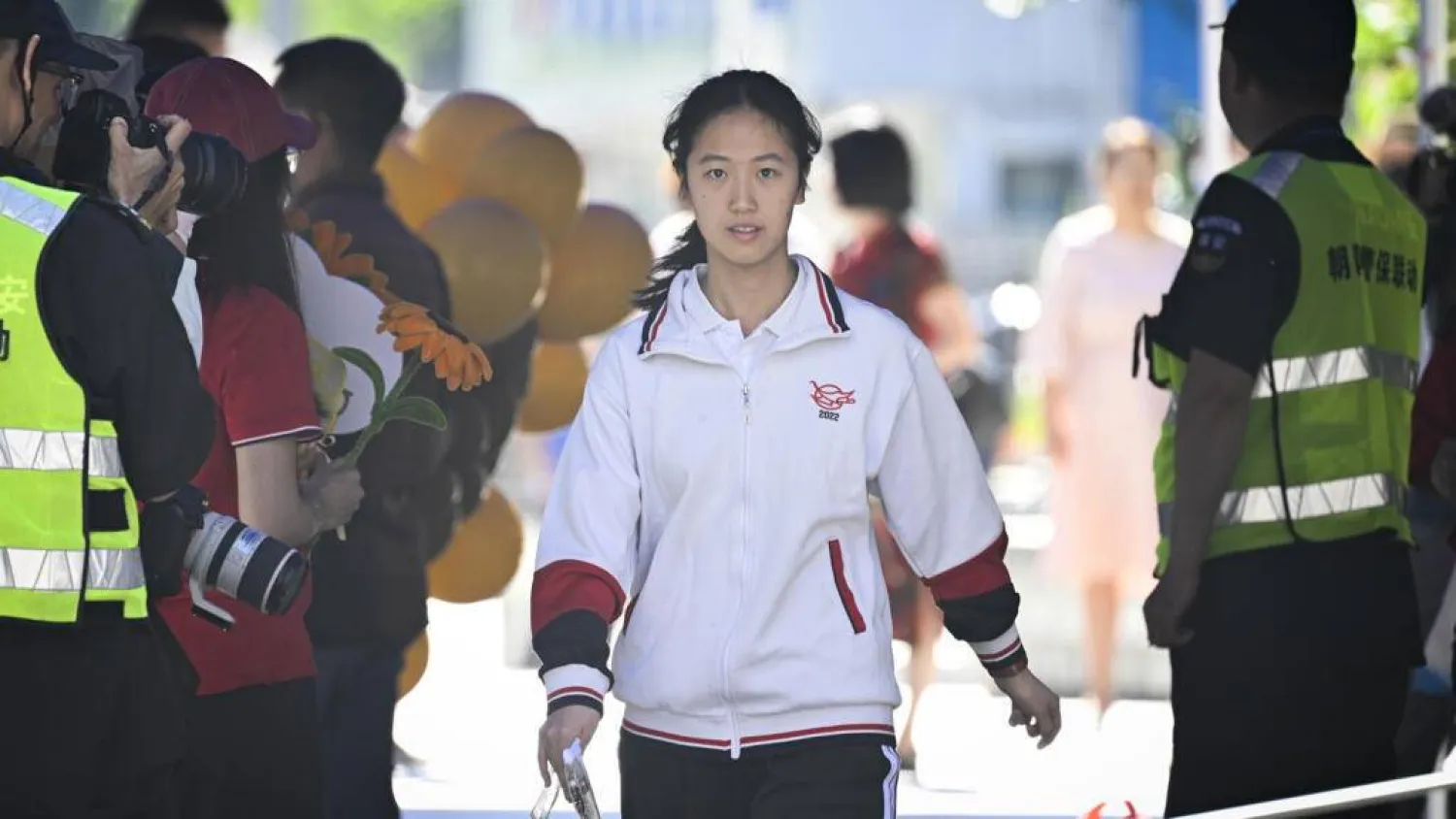
A student enters a school on the first day of China's National College Entrance Examination, known as "gaokao". WANG Zhao / AFP
TT

Millions of Chinese Students Sit for Grueling 'Gaokao'

A student enters a school on the first day of China's National College Entrance Examination, known as "gaokao". WANG Zhao / AFP

Hundreds of young Chinese students clutching pens and their IDs shuffled into a testing center in blue-skied Beijing on Sunday, swarmed by parents, joining millions sitting for the national high-stakes university entrance exam.

Around 12.9 million students nationwide registered for this year's "gaokao", according to the Ministry of Education, which for most is the sole determining factor in admission to a Chinese university.

The multi-day exam, which began Sunday, drills test-takers on subjects including Chinese, mathematics, English, science and the humanities -- with the tallied scores to be released later this month, said AFP.

"It's my first time, so I'm a bit anxious," said student Zhang Xinnan moments before entering the exam hall.

The spectacled Beijinger admitted he was nervous for the essay portion of the Chinese test, as he said he thought the prompts had become harder to respond to.

But, wearing his school uniform, the 18-year-old told AFP that despite the jitters he thought he would do well, having spent the last year drilling practice questions.

"The things we needed to master have been mastered," said Zhang, who hopes to work with new energy vehicles.

"Just go in with self-confidence; you'll be solid."

Some mothers and fathers clustered outside the exam halls dressed in red, a symbol of good fortune in Chinese culture.

Dozens of police and security guards milled about as parents stood beside the line of students waiting to enter the exam hall, hoping to film their children walking inside.

- Shifting attitudes -

High-level education has expanded rapidly in China in recent decades as an economic boom pushed up living standards -- as well as parental expectations for their children's careers.

Yet the job market that fresh graduates enter is no longer as rosy as it once was, with high youth unemployment a significant concern.

Roughly one in six Chinese between the ages of 16 and 24, excluding students, are jobless, according to official data.

Attitudes toward the test are changing, with students and parents more and more unwilling to trade physical and mental health for high test scores.

"I'm pretty free range," said mother Deng Ju, standing across from the exam hall holding a stack of practice books for her daughter, revising last minute with her friend nearby.

"Just perform normally; that's enough," said Deng, 53. "I care more about physical health; the test is just a formality."

For Deng, whose daughter isn't aiming for a "name school" such as the elite Tsinghua or Peking University in the capital, doing away with the gaokao would be ideal.

"No more gaokao. Let's not gaokao anymore," she told AFP. "But that's impossible," she said, smiling.

For many Beijing students, the gaokao was still a step toward achieving their dream.

"I hope I can go to my ideal university," said student Zhang.

His friends also cared about the exam, he said.

"But if we can calm down, we should be able to get to a stable mentality," said Zhang.

"Mentality is the most important when it comes to the gaokao."


King Salman bin Abdulaziz Royal Reserve Highlights Two Distinctive Native Shrubs

The King Salman Bin Abdulaziz Royal Natural Reserve (SPA).
TT

King Salman bin Abdulaziz Royal Reserve Highlights Two Distinctive Native Shrubs

The King Salman Bin Abdulaziz Royal Natural Reserve (SPA).

King Salman bin Abdulaziz Royal Reserve is distinguished by its unique natural plant diversity and its captivating natural features, highlighted by distinctive plants that add exceptional beauty to its various environments. Among the most prominent plant features found across most areas of the reserve are Al-Rmath (Haloxylon salicornicum) and Al-Qaisum (white wormwood).

Al-Rmath is a perennial shrub in the family Amaranthaceae and is widespread throughout most of the reserve.

According to SPA, it can reach a height of 120 centimeters and is characterized by bluish-green stems that turn gray with age, as well as scale-like leaves and tiny yellow flowers.

Al-Qaisum is also a perennial aromatic shrub belonging to the Asteraceae family. It grows in clay flats, valleys, ravines, and most areas of the reserve.

It can reach a height of 60 centimeters and is distinguished by its white stems, oval to oblong leaves with serrated edges, and small yellow flowers.


Lebanon Arrests ‘Doctor Food’ over Drug-laced Treats

Georges Dib, known on TikTok as "Doctor Food." Photo: Social media
TT

Lebanon Arrests ‘Doctor Food’ over Drug-laced Treats

Georges Dib, known on TikTok as "Doctor Food." Photo: Social media

Lebanon on Sunday arrested an online influencer known for his videos about food who had been handed a life sentence in absentia for drug trafficking, a judicial source told AFP.

Georges Dib, known on TikTok as "Doctor Food" and followed by more than eight million accounts, was apprehended at his home in the far north governorate of Akkar, the source said, speaking on condition of anonymity.

Dib, who also owns a confectionery business, would be taken to a detention center in Mount Lebanon, where he would face a new trial on further drug trafficking charges, the source added.

Two years ago, the Lebanese judiciary issued a warrant for Dib, accusing him of "manufacturing narcotics, trafficking and smuggling them abroad,” according to Lebanon's state-run National News Agency (NNA).

The NNA said at the time that authorities had seized confectionery and other food products at Beirut's international airport that contained narcotics and were manufactured in factories owned by Dib.

The products were to be shipped to a Gulf country, the news agency reported.

Despite an arrest warrant and conviction against him, Dib continued to post videos on TikTok.

Last month, after news of his conviction was made public, he denied the accusations in one of his videos, urging followers not to listen to what was being said about him.

Dib rose to prominence on social media posting content about cooking and daily life with his ex-wife, known as Shorouk, a Canadian of Palestinian origin who has more than 15 million followers.

They separated after she accused him of abuse. On Saturday night, she held a "divorce party" at a seaside resort in Lebanon attended by thousands of her followers.


Mahatma Gandhi’s 688 Handwritten Messages to Grieving Friend Sell for Millions

Gandhi’s peti charkha, a portable box spinning wheel, along with two letters about the spiritual discipline of spinning, sold for Rs 10.2m (Saffronart)
TT

Mahatma Gandhi’s 688 Handwritten Messages to Grieving Friend Sell for Millions

Gandhi’s peti charkha, a portable box spinning wheel, along with two letters about the spiritual discipline of spinning, sold for Rs 10.2m (Saffronart)

A collection of 688 handwritten reflections by Mahatma Gandhi has sold for £1.2 million at an auction in India, setting a record for an Indian historical document sold at auction, according to The Independent.

The handwritten messages were addressed to Anand T Hingorani, a close associate of Gandhi and a fellow participant in India’s independence movement.

They were written over almost two years, from 20 November 1944 to 10 October 1946, and were later compiled into a book called A Thought for the Day, according to auction house Saffronart.

The circumstances in which they were written were deeply personal; Hingorani’s wife Vidya had died, and he shared his loneliness and grief with Gandhi while undergoing nature-cure treatment for deafness, according to the Hingorani family.

Gandhi responded by writing him a thought each day, turning a private act of consolation into one of the most extensive surviving records of their relationship.

“Gandhi responded by setting aside time each day to write a personal thought. What began as a personal exchange soon evolved into a collaborative project,” Minal Vazirani, co-founder and president of Saffronart, told The Indian Express.

“While Gandhi authored each reflection, Hingorani became the recipient, organizer and transcriber, ultimately preparing the writings for publication,” she said.

FILED - 30 November 2002, An undated photo shows Mahatma Gandhi sitting behind his spinning wheel and reading letters. Photo: Margaret Bourke White/dpa

The 688 entries cover many of the subjects that occupied Gandhi throughout his life, including truth, ahimsa or non-violence, brahmacharya (self-control), non-possession, fearlessness, religious equality, prayer, service, labor, duty, silence, conscience and self-realization.

A group of nine letters from 1930 and 1931 concerns Anand and Vidya Hingorani’s marriage, including parental opposition, financial independence, reconciliation within the family and Gandhi’s views on self-restraint and domestic obligations.

The wider collection was preserved by the Hingorani family across generations and was offered as an 86-lot sale by Saffronart under the title Gandhi: From the Collection of Anand T Hingorani.